
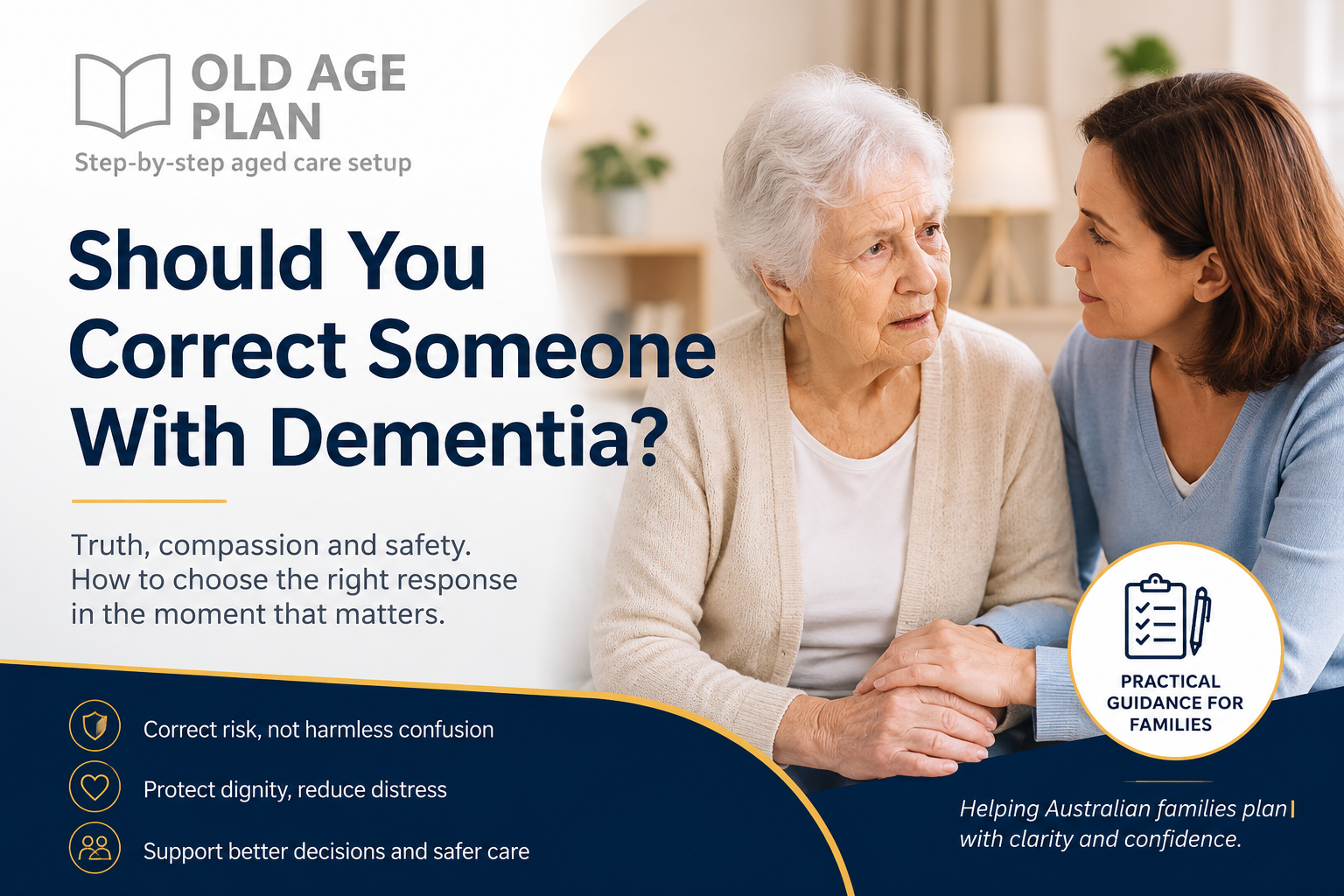

Should You Correct Someone With Dementia?
Should you correct someone with dementia when they say something that is clearly wrong? Sometimes yes, but not every time. The harder question is not whether the person is factually correct. The harder question is whether correcting them will improve safety, reduce confusion, support a real decision, or simply create another painful argument.
This is where families often get stuck. One person says, “You can’t just let them believe something that isn’t true.” Another says, “Every time we correct them, they get upset.” Both concerns can be valid. Dementia communication is not about choosing truth or comfort forever. It is about working out what matters in this moment.
Short Answer
You usually should not correct someone with dementia just to prove they are wrong. If the mistake is harmless, reassurance, validation or redirection may be kinder and more useful. But if the misunderstanding affects safety, medication, money, driving, care decisions or urgent risk, gentle correction may still be needed.
Key Takeaway
The goal is not to win the facts. The goal is to protect dignity, reduce distress and keep important decisions safe. Correction is useful when it helps the person stay safe or understand something that matters. Correction is harmful when it only repeats distress without changing the outcome.
Why Correction Becomes So Difficult In Dementia
Correcting someone with dementia can feel like the honest thing to do. If they say their mother is coming to visit, or they need to go to work, or someone stole their wallet, your instinct may be to bring them back to reality.
But dementia can affect memory, reasoning, language, recognition and emotional regulation. The person may not be choosing to ignore the truth. Their brain may be filling gaps with old memories, partial information or feelings that seem real to them.
That means correction can fail in two ways.
First, the person may not retain what you say. You correct them, they become upset, and ten minutes later the same question returns.
Second, they may experience the correction as criticism, humiliation or threat. What sounds like a simple factual correction to you may feel like being told, again and again, that they are wrong, confused or losing control.
This is why dementia communication needs judgment, not automatic rules.
When You Should Not Rush To Correct Them
If the mistake is not dangerous, correction may not be worth the distress it causes.
For example, if someone says they need to pick up children from school, but those children are now adults, bluntly saying, “No, your children are grown up,” may not help. The person may not be asking for a calendar update. They may be feeling responsible, anxious or unsettled.
A more useful response may be:
“You’re worried about them. They’re safe. Let’s sit down for a minute.”
This does not turn the conversation into a battle over facts. It responds to the feeling underneath the statement.
Correction is often less useful when:
- the mistake is harmless
- the person is already distressed
- the same correction has failed many times before
- the person cannot retain the corrected information
- the correction mainly satisfies someone else’s need for accuracy
This is not the same as pretending dementia does not matter. It is recognising that factual accuracy is not always the highest priority in a dementia conversation.
When Correction May Be Necessary
There are times when avoiding correction can create risk. Dementia does not remove the need for boundaries, safety or clear information.
Gentle correction may be necessary when the misunderstanding affects:
- medication
- food, hydration or health care
- driving or leaving home unsafely
- money, banking or scams
- legal documents or consent
- appointments or care arrangements
- accusations that may harm relationships or safety
For example, if someone believes they have not taken their medication and wants to take it again, reassurance alone may not be enough. A better response may be:
“Let’s check the medication chart together before we do anything.”
This corrects the situation without turning it into a confrontation.
If someone insists they are still safe to drive despite repeated incidents, the family may need to move beyond gentle conversation and seek medical or licensing guidance. In that situation, avoiding correction because it is uncomfortable may allow risk to grow.
For more on that decision, see Can Someone With Dementia Still Drive?.
The Difference Between Correcting Facts And Correcting Risk
This distinction matters.
Not every false statement needs correction. But some false beliefs create real-world risk.
If someone says, “I have to go to work,” while sitting safely at home, the issue may be emotional reassurance.
If they say, “I have to go to work,” then try to leave the house alone at night, the issue has changed. You are no longer correcting a memory error. You are managing safety.
Old Age Plan separates these situations because they require different responses.
A harmless memory error may call for reassurance.
A repeated unsafe action may call for escalation.
A legal, financial or medical misunderstanding may call for professional advice.
That is why the right question is not simply:
Are they wrong?
The better question is:
Does this misunderstanding create a decision, safety or care risk?
Why Repeated Correction Can Become Cruel Without Meaning To
Families rarely intend to be cruel. Most correction comes from care, fear or habit.
But repeated correction can become painful when the person keeps experiencing the same loss as if it is new.
For example, if someone repeatedly asks where their deceased spouse is, telling them “He died years ago” may be factually true. But if they cannot retain that information, they may experience fresh grief every time.
In that situation, the correction may be true but not useful.
A gentler response might be:
“You’re missing him today.”
Or:
“You loved him very much. Tell me about him.”
This protects emotional reality without repeatedly forcing the person through the same shock.
This is one of the hardest parts of dementia communication: sometimes the most truthful response is not the most factual sentence. Sometimes the deeper truth is the emotion underneath.
When Reassurance Becomes Deception
Reassurance can be compassionate. It can also become a way for families to take control without admitting that control is being taken.
This is the uncomfortable part.
Families may say:
- “It keeps them calm.”
- “They don’t need to know.”
- “It is easier this way.”
- “There is no point upsetting them.”
Sometimes those statements are true. Sometimes reassurance prevents repeated distress and protects the person from pain they can no longer process.
But sometimes reassurance becomes something else.
It becomes convenience.
It becomes avoidance.
It becomes manipulation dressed up as kindness.
The brutal question is:
Who benefits most from this reassurance?
Are you calming them because they cannot hold the truth safely?
Or are you avoiding a hard conversation because it is uncomfortable for you?
Are you protecting their dignity?
Or bypassing their right to participate in reality while they still can?
This matters because dementia does not remove autonomy all at once. A person may still understand some issues, express preferences, recognise unfairness, or participate in decisions even when their memory is unreliable.
If reassurance is used too early, it can silence the person under the language of care.
A useful test is:
Does this reassurance preserve dignity, or does it bypass consent?
If the answer is unclear, slow down. The issue may no longer be simple communication. It may be a decision-reliability question, a family-boundary question, or an authority question.
For related decision support, see Can Someone With Dementia Make Legal Decisions?, Can Someone With Dementia Make Medical Decisions? and When Does Someone With Dementia Lose Capacity?.
What To Do Instead Of Correcting Every Time
When correction is not necessary, the aim is not to dodge the person. The aim is to respond to the need underneath the words.
If the person is frightened, start with safety.
“You’re safe. I’m here with you.”
If they are grieving or missing someone, start with the feeling.
“You miss them today.”
If they are worried about a responsibility, acknowledge the concern before shifting the moment.
“You want to make sure everything is okay. We have it sorted for today.”
If the conversation is circling, move gently toward something familiar or calming.
“Let’s sit down for a cup of tea while we work it out.”
The point is not to use tricks. The point is to avoid turning every memory error into a courtroom.
Some statements are inaccurate but emotionally meaningful. “I need to go home” may mean fear. “Someone stole my purse” may mean panic. “I have to go to work” may mean purpose, routine or responsibility.
The sentence may be wrong. The need may still be real.
For related support, see How Do You Calm Someone With Dementia? and How Do You Support Someone With Dementia?.
What If They Accuse Someone Of Something That Is Not True?
This is where correction becomes more delicate.
If someone with dementia says, “You stole my purse,” it can feel deeply unfair. The natural response is to defend yourself. But direct argument often escalates the situation.
Instead of saying, “I did not steal it. You always do this,” a calmer response may be:
“That must feel upsetting. Let’s look for it together.”
This does not admit guilt. It responds to the distress and moves toward a practical action.
However, repeated accusations should not be ignored if they are damaging relationships, creating fear or placing someone at risk. If accusations become frequent, intense or unsafe, it may be time to speak with a GP, dementia care professional or support service.
Correction alone may not solve a pattern that is being driven by paranoia, confusion, medication effects, infection, pain, sleep disruption or environmental stress.
For sudden changes in confusion or behaviour, see Can Dementia Progress Suddenly? and Can Delirium Be Mistaken For Dementia?.
What If The Family Disagrees About Whether To Correct Them?
Families often split over this issue.
One person believes correction is respectful because it preserves truth. Another believes correction is harmful because it causes distress. A third avoids the conversation because they do not know what to say.
This disagreement is not just about communication style. It is often about deeper values:
- truth vs protection
- dignity vs distress
- safety vs independence
- comfort vs control
If family members respond differently every time, the person with dementia may become more confused. One person corrects. Another reassures. Another argues. Another changes the subject. The result can be more tension for everyone.
A better approach is to agree on patterns.
- Do not argue over harmless memory errors.
- Use reassurance first when the person is distressed.
- Correct gently when medication, money, driving or safety is involved.
- Escalate repeated unsafe patterns to a GP or care professional.
This creates consistency without pretending every situation is the same.
What You May Really Be Trying To Decide
If you are asking whether to correct someone with dementia, you may really be asking:
- Am I lying if I do not correct them?
- Am I being disrespectful if I let the mistake pass?
- Am I making their distress worse?
- When does reassurance become unsafe?
- When does comfort become control?
- When does a communication issue become a care issue?
This is the real decision tension.
You are not choosing between honesty and dishonesty in a simple way. You are trying to decide which response best protects the person in front of you.
Sometimes that means telling the truth clearly.
Sometimes it means not forcing a painful fact into a moment where it cannot be held.
Sometimes it means stepping back and asking whether the repeated confusion is a sign that more support is needed.
Decision Support: A Practical Correction Test
Before correcting someone with dementia, pause and ask five questions.
1. Is there immediate risk?
If the misunderstanding could lead to harm, correction or intervention may be needed. Examples include medication mistakes, unsafe driving, wandering, scams, missed medical care or unsafe use of appliances.
2. Is this about an important decision?
If the person is making a legal, financial, medical or care decision, accuracy matters more. But capacity and understanding may also need careful assessment.
For related articles, see Can Someone With Dementia Make Legal Decisions?, Can Someone With Dementia Make Medical Decisions? and When Does Someone With Dementia Lose Capacity?.
3. Can they retain the correction?
If they cannot hold the corrected information, repeating it may only repeat distress.
4. What emotion is underneath?
If the statement is driven by fear, grief, embarrassment or confusion, emotional reassurance may matter more than factual accuracy.
5. What happens after you correct them?
If correction reliably leads to anger, distress or escalation, and there is no safety benefit, the approach may need to change.
A simple OAP rule:
Correct risk. Do not automatically correct harmless confusion.
This does not mean ignoring dementia. It means choosing the response that best fits the decision, the risk and the person’s emotional state.
When To Get Extra Help
You may need extra support if correction, reassurance and redirection are no longer enough.
Consider speaking with a GP, dementia care professional or support service if:
- confusion suddenly worsens
- the person becomes aggressive or fearful
- accusations become frequent
- they repeatedly try to leave home unsafely
- medication or money mistakes are increasing
- family conflict is escalating
- you are no longer sure what is safe
Communication problems can sometimes be worsened by pain, infection, dehydration, poor sleep, medication side effects, delirium or environmental stress. A sudden change should not automatically be dismissed as “just dementia”.
Related articles include Can Infection Make Dementia Worse?, Can Dehydration Make Dementia Worse?, Can Medication Make Dementia Worse? and Can Poor Sleep Make Dementia Worse?.
Related Old Age Plan Articles
- Should You Tell Someone They Have Dementia?
- Who Should You Tell After A Dementia Diagnosis?
- How Do You Calm Someone With Dementia?
- How Do You Support Someone With Dementia?
- Can Dementia Behaviour Be Managed Without Medication?
- Can Someone With Dementia Still Drive?
- Can Someone With Dementia Refuse Care?
- When Can Family Override Decisions?
Next Steps With Old Age Plan
If correction is becoming a daily source of conflict, the next step is usually not another argument. It is to work out what pattern is forming.
Start by noticing:
- what topics trigger repeated correction
- whether the issue is harmless, distressing or unsafe
- which responses calm the situation
- which responses make it worse
- whether the pattern is becoming more frequent
Old Age Plan is designed to help families move from reactive moments to clearer decision support. A communication tracker, behaviour notes, appointment planner or family discussion resource can help you prepare for conversations with a GP, dementia support service or aged care professional.
The aim is not to script every sentence. The aim is to reduce avoidable distress, recognise when safety is changing and make sure family responses are not working against each other.
Sources
Disclaimer
This article is general information only and is not medical, legal or financial advice.
Dementia affects people differently. Communication strategies that help one person may not suit another person, especially where there are safety concerns, sudden changes, aggression, distress, medication issues or legal decision-making questions.
Laws, policies, services and clinical guidance may change, and personal circumstances vary. You should seek advice from a qualified health professional, legal professional, aged care professional or relevant support service for your situation.
For current dementia information and support in Australia, consider speaking with your GP and referring to Dementia Australia, Healthdirect, My Aged Care and Carer Gateway.
Summary
You do not need to correct someone with dementia every time they say something inaccurate. If the mistake is harmless, constant correction may increase distress without improving understanding. If the misunderstanding affects safety, medication, money, care, driving or important decisions, gentle correction or professional support may be necessary. The better question is not “Are they wrong?” but “Does correcting this help protect their dignity, safety or decision-making right now?”