
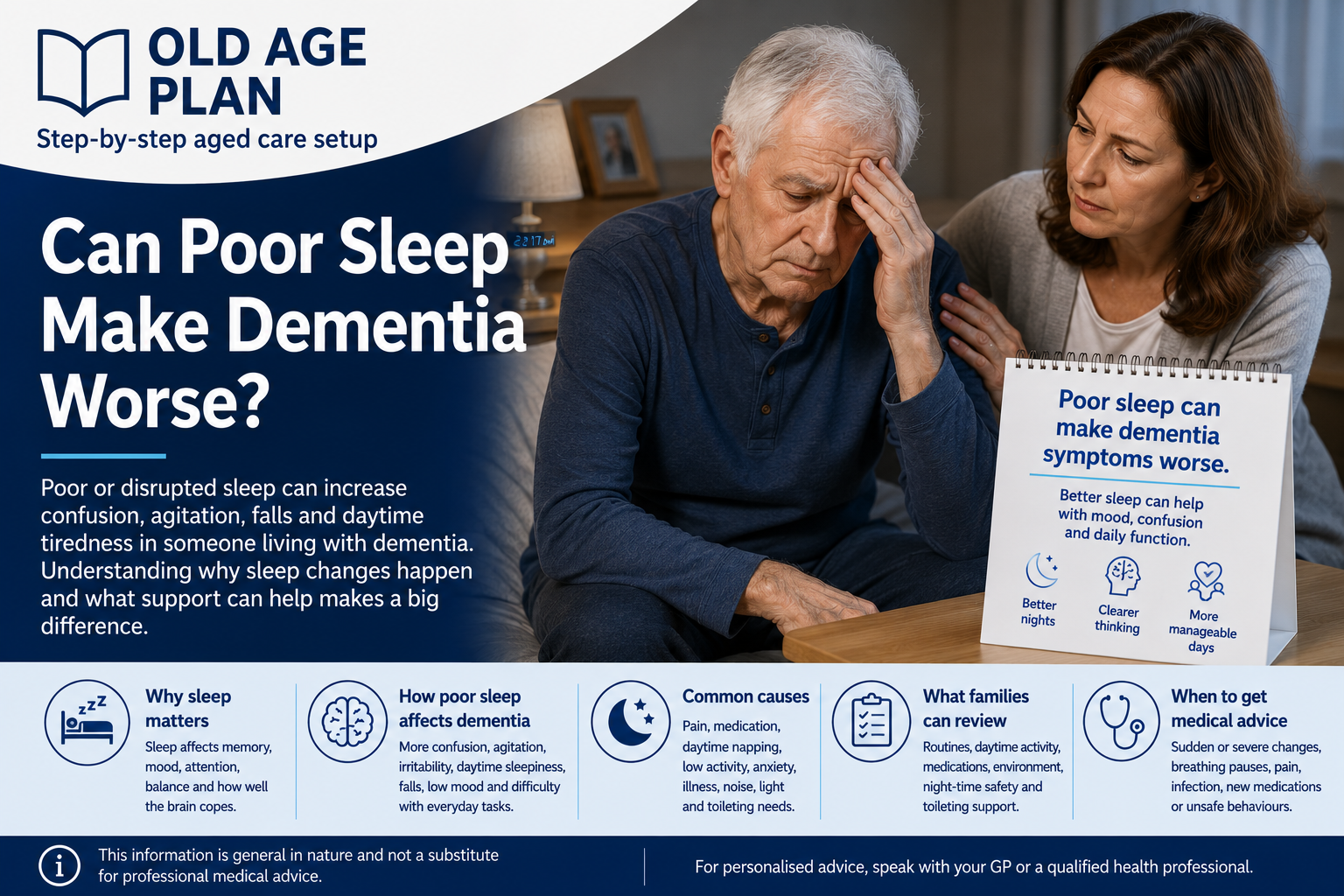

Can Poor Sleep Make Dementia Worse?
A person with dementia may seem much more confused after a bad night.
They may be more irritable, restless, sleepy during the day, unsettled in the evening, or less able to manage familiar routines.
After a better night, they may seem calmer or clearer.
If you are asking can poor sleep make dementia worse, you may also be trying to work out whether the dementia is progressing, whether tiredness is making symptoms harder, or whether sleep problems need medical advice.
Short Answer
Yes, poor sleep can make dementia symptoms worse.
Lack of sleep, disrupted sleep, night waking or changes in the sleep-wake cycle can increase confusion, agitation, daytime sleepiness, falls, low mood and difficulty coping with daily routines.
This does not mean poor sleep causes dementia to suddenly progress.
It means poor sleep can reduce the person’s ability to cope, communicate and function day to day.
Key takeaway: Poor sleep can make dementia symptoms look worse, but it is not always dementia progression. The practical question is whether sleep disruption is temporary, medically related, or a sign that routines and support need to change.
Why Sleep Problems Can Be Missed
Sleep problems are not always obvious from the outside.
A person may be awake during the night but not remember it clearly.
They may nap during the day, wander at night, become restless in the evening, or wake others without understanding why.
Families may notice the daytime effect first.
The person may seem more confused, withdrawn, emotional, irritable or unsteady.
The question is not only:
Did they sleep?
It may be:
Is poor sleep making daily life less safe or less manageable?
How Poor Sleep May Affect Dementia Symptoms
Sleep affects attention, memory, mood, balance and energy.
When sleep is poor, dementia symptoms may become harder to manage.
Possible changes may include:
- more confusion during the day
- more agitation or restlessness
- greater difficulty following conversations
- more trouble completing familiar tasks
- increased daytime sleeping
- lower mood or withdrawal
- more falls or unsteadiness
- more evening confusion or unsettled behaviour
- greater reliance on family support
These changes may not mean dementia has permanently worsened.
They may show that tiredness is reducing the person’s ability to cope.
Why Sleep Can Become Harder With Dementia
Dementia can affect the brain systems involved in routine, body clock, awareness and daily activity.
This can make sleep less predictable.
Sleep may also be affected by other issues, including:
- pain
- anxiety or low mood
- medication effects
- needing the toilet overnight
- daytime napping
- low activity during the day
- noise or light
- sleep apnoea
- infection or illness
- hospital stays or changes in routine
That matters because sleep disruption may have more than one cause.
Before assuming dementia has progressed, families may need to ask what is disrupting sleep and whether that issue can be addressed.
Sleep Problems Or Dementia Progression?
This can be hard to separate.
Poor sleep can make dementia symptoms look worse.
Dementia progression can also make sleep harder over time.
The decision question is:
Did the person’s symptoms worsen after sleep changed, or did sleep change because their dementia needs have increased?
Both may be true.
That is why it helps to look at patterns rather than one night.
If confusion, agitation or falls are consistently worse after poor sleep, sleep may be a major support issue.
If sleep problems are new, sudden, severe or linked with illness, medical review may be needed.
Evening Confusion And Night-Time Restlessness
Some people with dementia become more confused or unsettled later in the day.
Families may notice restlessness, pacing, repeated questions, suspicion, agitation or difficulty settling at night.
This can affect both the person with dementia and the people caring for them.
The practical issue is not only whether the behaviour has a name.
It is whether the night-time routine is still safe and manageable.
If one person is awake much of the night supervising, redirecting or calming the person, the support arrangement may no longer be sustainable.
When To Seek Medical Advice
Medical advice may be needed if sleep problems are new, severe, unsafe or linked with sudden changes in behaviour or alertness.
Seek advice if there is:
- sudden confusion or major behaviour change
- new hallucinations or severe agitation
- frequent night wandering or falls
- breathing pauses, choking or loud snoring during sleep
- pain, fever or signs of infection
- new medication or medication changes
- severe daytime sleepiness
- carers unable to safely manage night-time needs
This is not about treating every bad night as an emergency.
It is about recognising when sleep disruption may point to a medical issue or a care arrangement that needs review.
What Families May Need To Review
If poor sleep keeps affecting daily life, the support arrangement may need to become clearer.
Families may need to consider:
- whether pain or illness is disrupting sleep
- whether medication timing should be reviewed
- whether daytime naps are affecting night sleep
- whether the person is active enough during the day
- whether toileting support is needed overnight
- whether the home is safe if the person wakes at night
- whether carers can continue managing night-time supervision
This does not mean every family needs formal care immediately.
It means sleep may have shifted from a personal routine into a care and safety issue.
Can Better Sleep Improve Dementia Symptoms?
Sometimes, better sleep may help the person seem calmer, clearer or steadier.
It may reduce agitation, daytime tiredness or confusion.
However, this does not mean dementia has been reversed.
It may mean the person’s brain and body are coping better when sleep improves.
This distinction matters.
The useful question becomes:
What helped sleep improve, and can that support be made reliable?
Why This Matters For Care Decisions
Poor sleep can turn daytime support into a 24-hour issue.
A family arrangement that works during the day may become unsafe or unrealistic if nights are disrupted.
This is where families may need to separate three decisions:
- Does the sleep problem need medical review?
- Can routine, environment or support be adjusted?
- Is night-time supervision becoming a formal care need?
These are different decisions.
Mixing them together can lead to either delay or overreaction.
The OAP approach is to identify what is actually needed now, what can be tried safely, and what can no longer wait.
What You May Really Be Trying To Decide
If you are searching for whether poor sleep can make dementia worse, the real question may be:
Is this dementia getting worse, or is poor sleep making everything harder?
That is the right distinction.
If poor sleep is occasional, the next step may be monitoring and routine adjustments.
If sleep problems are sudden, severe or unsafe, medical advice may be needed.
If night-time support is becoming constant, the family may need to review whether the current care arrangement is still sustainable.
The goal is not to blame sleep for everything.
The goal is to understand what the sleep problem is revealing about health, safety and support.
Related Old Age Plan Articles
- What Is Dementia?
- Can Stress Make Dementia Worse?
- Can Dehydration Make Dementia Worse?
- Can Infection Make Dementia Worse?
- Can Dementia Symptoms Come And Go?
- Can Dementia Improve?
Sources
- Dementia Australia – Sleep
- Healthdirect Australia – Dementia
- Healthdirect Australia – Sleep
- My Aged Care – Living with memory loss, dementia or depression
Disclaimer
This article provides general information only. It is not legal, medical or financial advice.
Dementia symptoms, sleep guidance, medical advice, aged care services and government policies may change over time and individual circumstances can vary.
Always seek advice from qualified healthcare professionals and refer to official Australian Government, My Aged Care and Dementia Australia resources for current information.
Summary
Poor sleep can make dementia symptoms worse.
It may increase confusion, agitation, daytime sleepiness, falls, low mood and difficulty managing daily routines.
This does not always mean dementia has suddenly progressed.
Families should look at sleep patterns, seek medical advice for sudden or unsafe changes, and review whether night-time support has become a care need.