
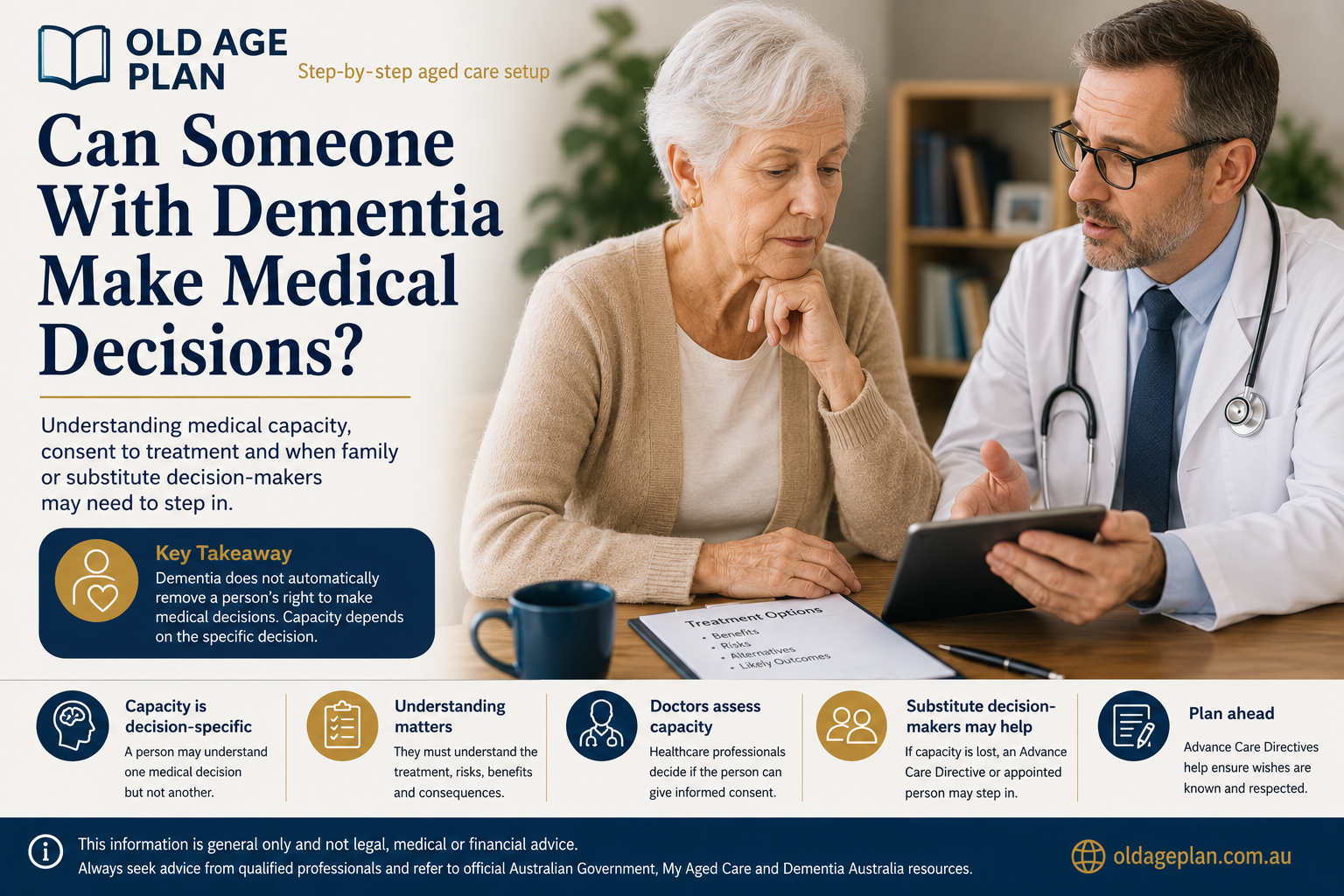

Can Someone With Dementia Make Medical Decisions?
Medical decisions can become difficult when someone has dementia or noticeable cognitive changes.
Families may be asked for input during appointments, hospital stays or treatment discussions.
This often leads to an important question: can someone with dementia make medical decisions?
The answer depends on whether the person can still understand the specific medical decision being made.
Short Answer
Yes, someone with dementia may be able to make medical decisions if they still have capacity for that specific healthcare decision.
A dementia diagnosis does not automatically remove a person’s right to consent to or refuse treatment.
The key question is whether they can understand the treatment options, risks, benefits and likely consequences.
Some people may make simple healthcare choices but need help or substitute decision-making for more complex medical decisions.
Key Takeaway: Dementia does not automatically stop someone from making medical decisions. The real question is whether they can reliably understand the treatment decision, the risks involved and what may happen next.
Medical Capacity Is Decision-Specific
Medical capacity is not all-or-nothing.
A person may understand one healthcare decision but not another.
For example, someone may understand taking a routine medication but not fully understand the risks of surgery, anaesthetic, hospital transfer or refusing treatment.
This is why capacity should be considered in relation to the actual medical decision being made.
The more serious or complex the decision, the more carefully capacity may need to be assessed.
What Medical Decision-Making Capacity Looks Like
In practical terms, the person usually needs to understand what decision is being asked of them.
They should be able to understand the basic nature of the condition, the proposed treatment, possible risks, likely benefits and alternatives.
They should also be able to communicate a choice.
That choice does not need to be the choice family members prefer.
The issue is whether the person understands the decision well enough to make it.
Decision Reliability Matters
With dementia, the concern is not always whether someone can say yes or no.
The deeper question is whether their decision-making is reliable enough for the medical decision in front of them.
A person may need more time, simpler explanations or a quieter setting and still be able to decide.
That is different from a person who cannot remember the discussion, misunderstands the risk or changes their answer depending on who is speaking.
A useful OAP question is:
Can they reliably understand the treatment choices, risks and consequences?
Simple Medical Choices And Complex Medical Decisions
Some medical decisions are relatively simple.
Others carry serious risks or long-term consequences.
Examples of simpler decisions may include:
- agreeing to a routine check-up
- choosing between familiar comfort options
- discussing everyday symptoms
- accepting a minor test that has been clearly explained
More complex decisions may include:
- consenting to surgery
- refusing life-sustaining treatment
- changing major medication plans
- deciding about hospital discharge arrangements
- choosing residential aged care after a health event
The more serious the consequence, the more important clear understanding becomes.
Can Someone With Dementia Refuse Medical Treatment?
A person with dementia may be able to refuse medical treatment if they have capacity for that decision.
Capacity does not depend on whether others agree with the choice.
A person may make a decision that family members find difficult or unwise and still have capacity.
However, if the refusal is based on confusion, misunderstanding or inability to understand the consequences, further assessment may be needed.
Who Assesses Medical Capacity?
Medical capacity is usually assessed by the treating healthcare professional involved in the decision.
This may be a GP, hospital doctor, specialist, surgeon, geriatrician or other clinician.
If the decision is complex, more than one professional may be involved.
In some situations, a specialist assessment may be needed, especially if there is disagreement or uncertainty.
What Happens If The Person Cannot Make The Medical Decision?
If the person does not have capacity for a specific medical decision, doctors may need to involve an authorised substitute decision-maker.
This may be someone appointed under an Advance Care Directive, Enduring Guardianship arrangement or relevant state or territory law.
The exact process can differ across Australia.
Health professionals may also consider the person’s known wishes, values and previous decisions where possible.
Why Advance Care Directives Matter
An Advance Care Directive can help record healthcare wishes before capacity becomes uncertain.
It may guide future decisions if the person cannot make or communicate their wishes later.
This can be especially important for decisions about serious illness, hospital care, treatment limits or end-of-life preferences.
Earlier planning can reduce uncertainty for families and health professionals.
What If Family Members Disagree?
Family disagreement can make medical decisions harder.
One person may believe the person still understands the decision.
Another may believe they are confused or easily influenced.
In these situations, the focus should return to the person’s capacity for the specific decision.
Can they explain the choice in their own words?
Do they understand the likely consequences?
Are they making the decision freely?
Is the decision consistent enough to be reliable?
If disagreement continues, medical, legal or tribunal guidance may be needed.
What You May Really Be Trying To Decide
If you are asking whether someone with dementia can make medical decisions, you may not only be asking about consent.
You may be trying to work out who should speak for them during hospital care, treatment discussions or future planning.
You may be wondering whether:
- Mum can still consent to surgery
- Dad can refuse treatment
- doctors need to involve family
- an Advance Care Directive applies
- an Enduring Guardian or substitute decision-maker is needed
The practical question is this:
Is the person’s understanding reliable enough for this healthcare decision?
How Families Can Approach This Carefully
Families should avoid assuming that dementia automatically removes medical decision-making rights.
That can take away independence too early.
At the same time, families should not ignore signs that the person no longer understands serious risks or consequences.
That can leave important decisions unsupported.
A careful approach is to ask what decision is being made, how serious it is, whether the person understands it and who should be involved if capacity is unclear.
Related Old Age Plan Articles
- Can Someone With Dementia Make Legal Decisions?
- When Does Someone With Dementia Lose Capacity?
- Who Decides If Someone Has Lost Capacity?
- Can Capacity Be Partial?
- What Is An Advance Care Directive?
- What Is Enduring Guardianship?
- Hospital And Advance Care Directives
Sources
- Dementia Australia — Planning Ahead
- NSW Government — Capacity Toolkit
- Australian Government Department of Health — Advance Care Planning
- My Aged Care — Appointed Decision-Makers
- OPAN — Supported Decision-Making
Disclaimer
This article provides general information only. It is not legal, medical or financial advice.
Dementia symptoms, medication guidance, medical advice, aged care services and government policies may change over time and individual circumstances can vary.
Always seek advice from qualified healthcare professionals and refer to official Australian Government, My Aged Care and Dementia Australia resources for current information.
Summary
Someone with dementia may still be able to make medical decisions if they have capacity for the specific healthcare decision.
The diagnosis alone does not decide the issue.
The key question is whether the person can understand the treatment options, risks and consequences well enough to decide.
If medical capacity is unclear, healthcare professionals, substitute decision-makers and relevant planning documents may need to be involved.