
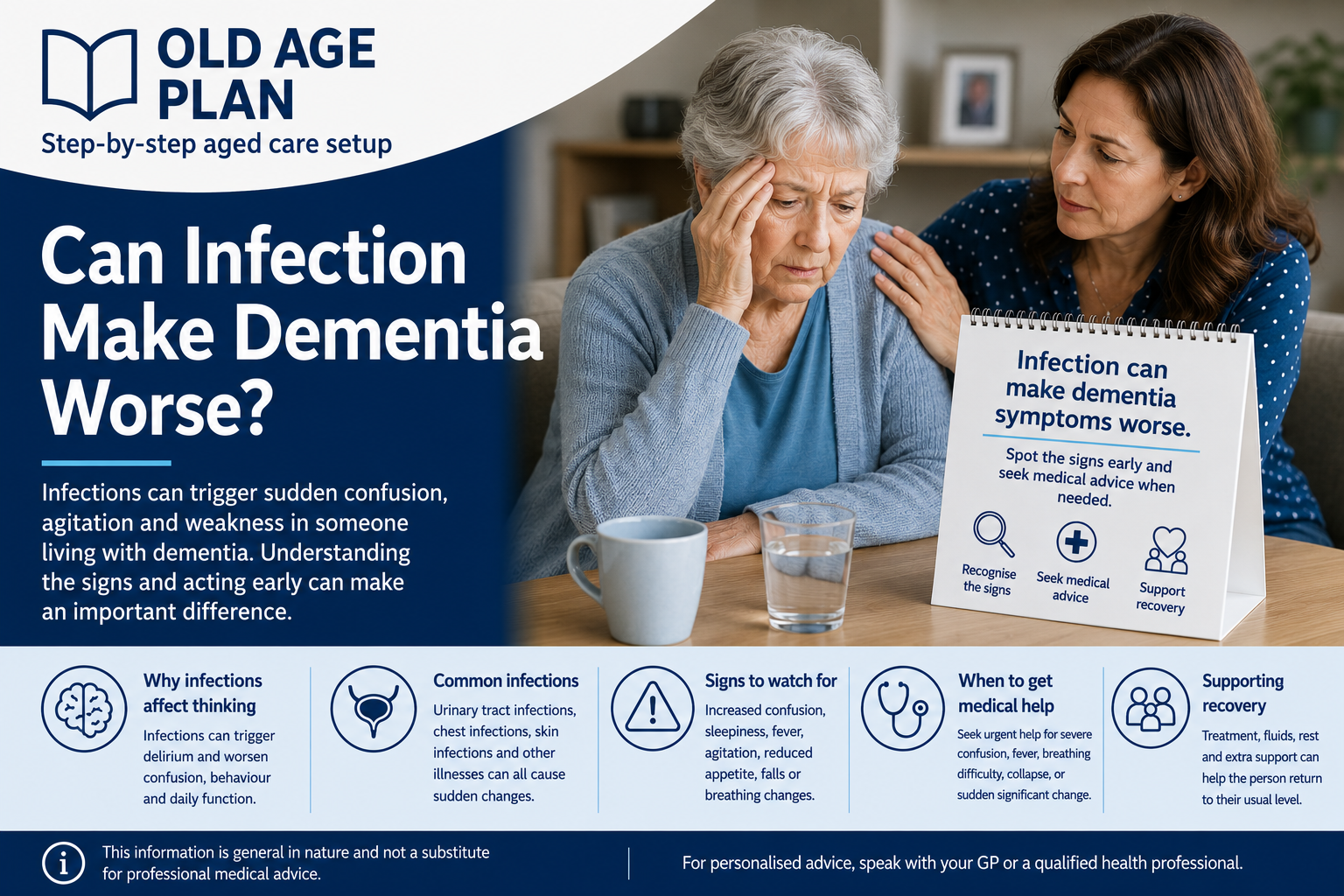

Can Infection Make Dementia Worse?
A person with dementia may suddenly seem more confused, sleepy, agitated, unsteady or withdrawn.
They may stop eating properly, become harder to communicate with, fall more often, or seem unable to manage familiar routines.
It can be easy to assume the dementia has suddenly progressed.
If you are asking can infection make dementia worse, you may also be trying to work out whether this is dementia progression, illness, delirium, or something that needs medical advice now.
Short Answer
Yes, infection can make dementia symptoms worse.
Infections such as urinary tract infections, chest infections, skin infections or other illnesses may increase confusion, weakness, sleepiness, agitation, falls or behaviour changes.
An infection may also contribute to delirium, which is a sudden change in thinking, alertness or behaviour.
This means sudden worsening should not automatically be treated as dementia progression. It may be a medical issue that needs review.
Key takeaway: Infection can make dementia symptoms appear suddenly worse. The practical decision is whether this is gradual dementia progression, a treatable illness, or an urgent change that needs medical attention.
Why Infection Can Be Missed In Someone With Dementia
Infection is not always obvious.
A person may not clearly describe pain, burning, fever, shortness of breath or feeling unwell.
Instead, the first sign may be a change in behaviour or function.
They may seem more confused, refuse food, become unusually sleepy, fall, or act in a way that feels out of character.
This creates a common decision problem for families.
The question is not only:
Does the person have infection symptoms?
It may be:
Has the person changed suddenly in a way that could point to illness?
What Infection-Related Change May Look Like
Infection-related change can look different from person to person.
Possible signs may include:
- sudden increase in confusion
- new sleepiness or reduced alertness
- new agitation, aggression or distress
- more falls or unsteadiness
- reduced eating or drinking
- fever, chills or sweating
- new cough or breathing changes
- pain or signs of discomfort
- new continence changes
- withdrawal or unusual quietness
These signs do not prove an infection is present.
But they are enough to take the change seriously, especially if it appears over hours or days.
Infection, Delirium And Dementia
Infection can trigger delirium, especially in older people and people living with dementia.
Delirium is different from ordinary dementia progression because it often comes on quickly.
Healthdirect describes delirium as a sudden change in thinking and behaviour that can be caused by health changes such as infection or medicine changes.
Dementia Australia also explains that delirium often occurs in people living with dementia and can make the person seem more confused than usual.
This distinction matters.
Dementia progression usually raises care planning questions.
Delirium or infection raises medical review questions.
Families may need both, but they should not be treated as the same issue.
Common Infections That May Affect Dementia Symptoms
Different infections may affect thinking, behaviour and function.
Examples may include:
- urinary tract infections
- chest infections
- skin infections
- wound infections
- viral illnesses
- sepsis or serious systemic infection
Some infections may have obvious symptoms.
Others may first show up as confusion, weakness, falls or reduced daily function.
This is why sudden change should be checked rather than guessed at.
When To Seek Medical Advice
Medical advice may be needed if a person with dementia suddenly becomes more confused, weak, sleepy, agitated or physically unwell.
Seek urgent medical advice if there is:
- sudden severe confusion
- fever or signs of infection
- new breathing difficulty
- collapse, fainting or repeated falls
- new inability to stay awake or respond normally
- severe pain or signs of distress
- very reduced eating or drinking
- new hallucinations or unsafe behaviour
This is not about assuming the worst.
It is about not missing a treatable or serious medical issue.
Why Infection Can Change Care Needs Temporarily
Even if the infection is treatable, support may need to increase for a period of time.
The person may need help with fluids, meals, medication, toileting, walking, rest, appointments or monitoring.
Family members may also need to watch whether the person returns to their usual level after treatment.
The practical question becomes:
Is this a short-term increase in support, or has the person’s baseline changed?
That distinction can prevent rushed long-term decisions.
It can also prevent families from ignoring a real care change if the person does not return to their previous level.
Can Infection Cause Lasting Decline?
Sometimes, a person may not fully return to how they were before an infection.
Other times, they may improve once the infection, dehydration, pain, delirium or other issue is treated.
This uncertainty is one reason infection-related changes are difficult.
The safest approach is to avoid deciding too early that the dementia has permanently worsened.
First, seek medical review.
Then review whether daily support needs have changed after the illness settles.
Why This Matters For Family Decisions
Infection can make families feel that care decisions have suddenly become urgent.
That may be true in the short term.
But the type of decision matters.
There may be an immediate medical decision.
There may be a temporary support decision.
There may later be a longer-term care decision.
Those should not be blended into one rushed conclusion.
The OAP approach is:
Check the health issue first. Then review what support is actually needed now.
What You May Really Be Trying To Decide
If you are searching for whether infection can make dementia worse, the real question may be:
Is this sudden change something we need to act on today?
If the change is sudden, severe or unusual, medical advice may be needed.
If infection is confirmed, the next question may be what support is needed during recovery.
If the person does not return to their previous level, the family may then need to review care needs more broadly.
The key is not to assume every sudden change is permanent dementia progression.
It is to identify what changed, what may be treatable, and what support now needs to be more reliable.
Related Old Age Plan Articles
- What Is Dementia?
- Can Dementia Progress Suddenly?
- Can Dehydration Make Dementia Worse?
- Can Dementia Improve?
- Can Dementia Symptoms Come And Go?
- Does Dementia Always Get Worse?
Sources
- Healthdirect Australia – Delirium
- Healthdirect Australia – Confusion
- Dementia Australia – Delirium
- Australian Commission on Safety and Quality in Health Care – Delirium Clinical Care Standard
Disclaimer
This article provides general information only. It is not legal, medical or financial advice.
Dementia symptoms, infection risks, delirium guidance, aged care services and government policies may change over time and individual circumstances can vary.
Always seek advice from qualified healthcare professionals and refer to official Australian Government, My Aged Care and Dementia Australia resources for current information.
Summary
Infection can make dementia symptoms worse.
It may cause sudden confusion, sleepiness, agitation, falls, weakness, reduced eating or changes in behaviour.
This may be linked with delirium and should not automatically be treated as dementia progression.
Families should seek medical advice for sudden or severe changes, then review whether the person needs temporary or longer-term support after the illness settles.