
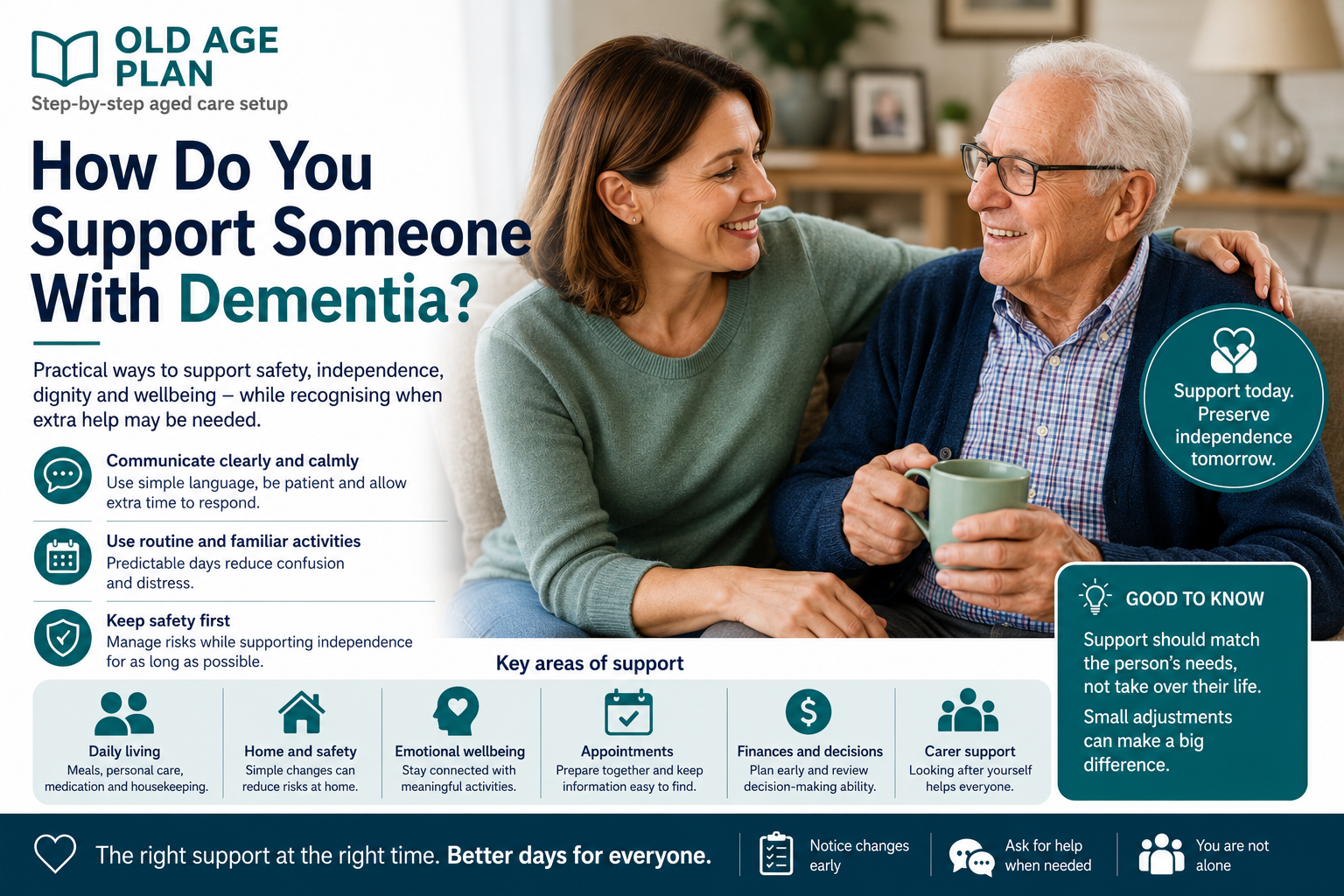

How Do You Support Someone With Dementia?
Supporting someone with dementia is not only about helping with tasks.
It is about working out how to protect safety, preserve dignity, support independence and respond to change without taking over too early or waiting until things become unsafe.
That balance can be difficult. The right support often changes over time.
Short Answer
You support someone with dementia by helping them stay safe, understood, involved and as independent as possible for as long as possible.
This may include clear communication, familiar routines, practical home adjustments, medication support, meaningful activities, appointment preparation, carer support and professional help when needs increase.
Key Takeaway
Good dementia support is not about doing everything for the person. It is about giving the right level of help at the right time, while recognising when family support alone may no longer be enough.
Start With The Person, Not The Diagnosis
A dementia diagnosis matters, but it does not tell you everything about the person.
Someone may still have strong preferences, habits, relationships, skills and routines. They may still be able to make many daily decisions, even if memory or planning has changed.
Support should begin with what the person can still do.
This helps avoid two common mistakes:
- taking over too early
- leaving the person unsupported for too long
The better question is:
What does this person need help with now, and what can they still do safely with support?
Support Communication
Communication often needs to become simpler and calmer.
Helpful approaches may include:
- using short sentences
- speaking slowly
- offering one idea at a time
- allowing extra time to respond
- reducing background noise
- avoiding unnecessary correction
- using reassurance when confusion increases
This does not mean talking down to the person. It means reducing the effort needed to understand the conversation.
Use Routine Without Removing Choice
Routine can reduce confusion and make daily life easier to follow.
A familiar routine may help with meals, medication, sleep, personal care, appointments and activities.
But routine should not become control.
The aim is to create predictable support while still allowing choice where possible. A person may need help with the structure of the day, but still be able to choose clothing, food, music, activities or how they spend quiet time.
Support Daily Tasks Gradually
Dementia support often increases in stages.
At first, the person may only need reminders or light prompts. Later, they may need help setting up tasks. Eventually, some tasks may need direct assistance.
Support may be needed with:
- meals
- shopping
- medication
- personal care
- transport
- appointments
- cleaning
- finances
- home safety
The important issue is not whether help is needed. It is whether the level of help still matches the person’s actual ability and risk.
Protect Safety Without Taking Over Everything
Safety can become more important as dementia progresses.
Common safety concerns include:
- missed medication
- falls
- leaving appliances on
- getting lost
- unsafe driving
- financial mistakes
- scams or pressure from others
- poor nutrition
- wandering or leaving home unexpectedly
Not every concern means full control should transfer immediately.
Sometimes practical changes, reminders, supervision, professional advice or home support can preserve independence while reducing risk.
Watch For Changes In Decision-Making
Supporting someone with dementia also means noticing when decisions become less reliable.
This does not mean every slow or repeated decision is a capacity problem.
Some people need more time, simpler explanations or less pressure. Their decisions may still be stable and meaningful.
Concern increases when decisions become repeatedly inconsistent, poorly understood, easily influenced or disconnected from consequences.
This matters for financial, legal, medical and care decisions.
Support Emotional And Social Connection
Dementia can affect confidence and social participation.
Support may include:
- regular visits
- familiar activities
- music
- gentle exercise
- photo albums
- short outings
- time with pets
- family routines
- community or day programs
Connection does not need to be complicated. A calm, familiar activity may be more useful than a long conversation or busy outing.
Know When Behaviour May Be Communicating A Need
Behaviour changes are not always “just dementia.”
Distress, agitation, withdrawal, aggression, sleep disruption or refusal may be linked to something else.
Possible causes include:
- pain
- infection
- delirium
- constipation
- dehydration
- medication side effects
- fear
- confusion
- too much noise
- unmet needs
- changes in routine
If behaviour changes suddenly, becomes unsafe or causes serious concern, professional advice should be sought.
Support The Carer Too
Dementia support is not only about the person with dementia.
The person helping them also needs support, information and breaks.
Useful support may include:
- Dementia Australia
- Carer Gateway
- My Aged Care
- Dementia Support Australia
- GP support
- respite care
- family meetings
- home care services
- support groups
If one family member is carrying most of the responsibility, the support arrangement may become fragile. That can affect both the carer and the person living with dementia.
When Family Support May No Longer Be Enough
Family support may need to increase or change when risks become harder to manage.
Warning signs may include:
- repeated falls
- missed meals or medication
- unsafe wandering
- frequent distress or agitation
- unsafe driving concerns
- financial vulnerability
- carer exhaustion
- repeated hospital visits
- home support no longer covering the need
- conflict about decisions or care
This does not automatically mean residential care is required.
It may mean the next layer of support needs to be considered before choices narrow.
What You May Really Be Trying To Decide
If you are asking how to support someone with dementia, you may be trying to decide whether the current support is still enough.
You may be noticing more confusion, more risk, more repeated questions, more distress or more pressure on family members.
The deeper question may be:
What support can preserve the person’s independence, and what support now needs to increase because risk is changing?
Decision Support
A practical way to think about dementia support is to separate daily preferences from higher-risk decisions.
The person may still be able to make many daily choices, such as what to wear, what music to listen to or how they prefer their routine.
But other areas may need closer support, such as medication, finances, driving, legal documents, safety, care arrangements or medical decisions.
Ask:
- What can the person still do safely?
- What tasks now need prompting or supervision?
- What decisions are becoming inconsistent?
- Where is risk increasing?
- What support would preserve independence rather than remove it?
- What professional advice is needed?
- What will become harder if action is delayed?
The goal is not to transfer control too early.
The goal is to notice when support needs to change, while keeping the person involved wherever possible.
Related Old Age Plan Articles
- Can Routine Help Someone With Dementia?
- What Non-Drug Treatments Help Dementia?
- Can Music Help Dementia?
- Can Someone With Dementia Make Legal Decisions?
Next Steps With Old Age Plan
If supporting someone with dementia is becoming more difficult, it may help to organise what is changing before speaking with a GP, My Aged Care, Dementia Australia or another support service.
Old Age Plan’s Free OAP Tools can help families record observations, prepare questions and identify which areas of support may need attention next.
The goal is not to solve every care decision at once. The goal is to move from scattered concerns to clearer support decisions.
Sources
- Dementia Australia — For Family, Friends And Carers
- Healthdirect Australia — Supporting Carers Of People With Dementia
- Healthdirect Australia — Dementia Overview
- My Aged Care — Caring For Someone Living With Dementia
- Healthdirect Australia — Dementia Support Australia
- NICE — Dementia Assessment, Management And Support Recommendations
Disclaimer
This article provides general information only and is not medical, legal or financial advice.
Dementia support needs vary depending on the person’s diagnosis, symptoms, health conditions, decision-making ability, home environment, risks and available support. Services, policies and clinical guidance may change over time.
Always seek advice from qualified health professionals, legal professionals or aged care services where appropriate. For current information and support, refer to Dementia Australia, Healthdirect, My Aged Care, Dementia Support Australia, Carer Gateway and relevant Australian health professionals.
Summary
Supporting someone with dementia means helping them stay safe, understood, involved and as independent as possible.
Good support may include communication changes, routine, home adjustments, meaningful activities, safety planning, carer support and professional help when needs increase.
The key is to match support to the person’s current needs, preserve choice where possible and recognise when extra help is needed before options become too limited.