
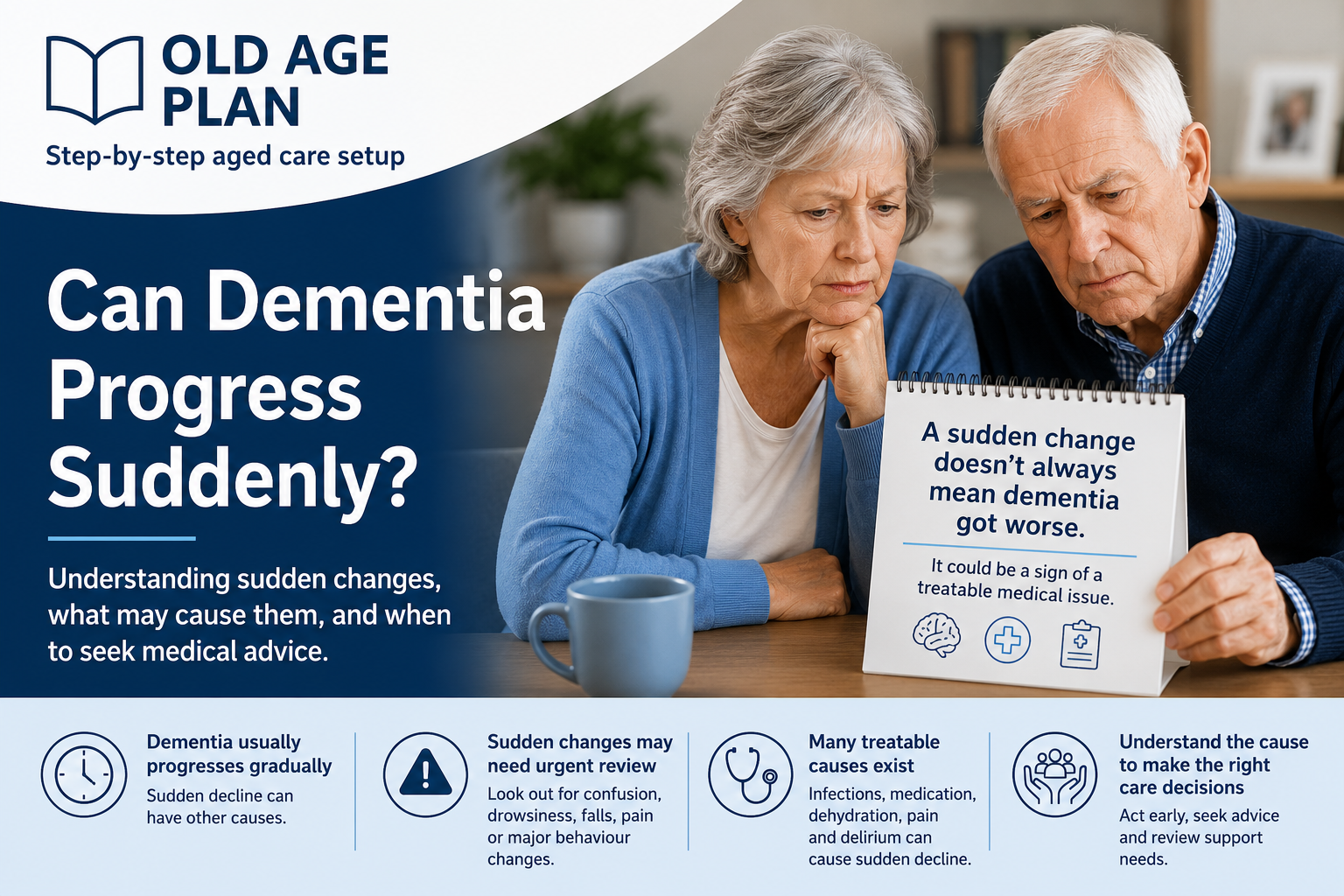

Can Dementia Progress Suddenly?
A sudden change in dementia can feel like everything has shifted overnight.
Yesterday, the person may have been walking, talking, eating or managing familiar routines.
Today, they may seem much more confused, sleepy, agitated, withdrawn, unsteady or unable to do things they could do recently.
If you are asking can dementia progress suddenly, you may also be trying to work out whether this is the dementia getting worse, whether something else is happening, or whether urgent medical advice is needed.
Short Answer
Dementia usually progresses gradually, but symptoms can sometimes appear to worsen suddenly.
A sudden change is not always dementia progression.
It may be caused by delirium, infection, dehydration, pain, constipation, medication changes, poor sleep, a fall, hospitalisation or another health issue.
Sudden or major changes should not be dismissed as “just dementia”. Medical advice may be needed, especially if the change is new, severe or unusual.
Key takeaway: Dementia usually changes over time, but sudden worsening can be a warning sign. The practical decision is whether this is gradual progression, a temporary health issue, or a situation that needs medical review now.
What Sudden Change May Look Like
Sudden change may not look the same for every person.
For one person, it may be sudden confusion.
For another, it may be sleepiness, falls, aggression, hallucinations, refusal to eat, or not recognising familiar people.
Changes that may need attention include:
- sudden confusion or disorientation
- new drowsiness or reduced alertness
- new agitation, aggression or distress
- new hallucinations or paranoia
- sudden trouble walking or more falls
- new continence changes
- reduced eating or drinking
- new pain or signs of discomfort
- sudden change in speech or communication
- major change after a hospital stay or medication change
The important point is the speed of the change.
If the person seems noticeably different over hours or days, it should be taken seriously.
Why Sudden Worsening May Not Be Dementia Progression
Families can lose time when every change is treated as dementia.
Dementia may be part of the picture, but a sudden change can be caused by something else.
Healthdirect explains that delirium is a sudden change in thinking and behaviour and is often caused by health changes such as infection or medicine changes.
Dementia Australia also notes that delirium can be brought on by illness, constipation, dehydration, infection, pain or drug effects.
This matters because delirium can look like dementia suddenly becoming much worse.
But the decision pathway is different.
Dementia progression may require care planning.
Delirium or another sudden health issue may require medical review.
When To Seek Medical Advice
Sudden changes should usually be discussed with a GP, nurse, urgent care service or emergency service, depending on severity.
Seek medical advice urgently if the person has:
- sudden severe confusion
- new weakness, collapse or repeated falls
- chest pain, breathing difficulty or severe pain
- signs of infection such as fever or sudden decline
- new inability to stay awake or respond normally
- new hallucinations, severe agitation or unsafe behaviour
- new trouble eating, drinking or swallowing
- a sudden change after medication changes
This is not about overreacting.
It is about not missing a treatable or urgent health issue.
What Families Often Need To Separate
When dementia seems to change suddenly, families may be facing three different questions at once.
- Is this dementia progression?
- Is this a medical problem that needs review?
- Does the current support arrangement still work?
These questions are connected, but they are not the same.
If they are mixed together, families may either delay medical care or rush into long-term care decisions before understanding the cause of the change.
The clearer approach is:
Check the sudden change first. Then review whether support needs have changed.
Can A Sudden Change Lead To Lasting Decline?
Sometimes, yes.
A person may not fully return to their previous level after illness, hospitalisation, delirium, a fall or another major event.
Other times, some function may improve once the cause is treated and routines are restored.
This uncertainty is one reason sudden changes are so difficult for families.
The important decision is not to guess too early.
Medical review, observation and support planning may all be needed before deciding what has permanently changed.
Why Hospital Stays Can Change The Picture
Some families notice a major change after hospital admission.
The person may return home weaker, more confused, less confident or needing more help.
This may relate to illness, reduced mobility, disrupted sleep, unfamiliar surroundings, delirium, medication changes or loss of routine.
That does not always mean dementia itself suddenly advanced.
But it may still mean support needs have changed.
The practical question becomes:
What can no longer be safely managed the same way as before?
Why This Matters For Care Decisions
A sudden change can push families into fast decisions.
Home may suddenly feel unsafe.
One family member may no longer be able to manage care alone.
Medication, meals, hygiene, walking or supervision may now need more structure.
But before making major decisions, it helps to separate urgent health needs from longer-term care needs.
For example, the first step may be medical review.
The next step may be temporary extra support.
Then the family can assess whether the person has returned to baseline or whether care needs have genuinely changed.
What You May Really Be Trying To Decide
If you are searching for whether dementia can progress suddenly, the real question may be:
Do we need to act now, or should we wait and see?
With sudden changes, waiting too long can be risky.
The safest approach is usually to treat sudden changes as something that needs attention, not as something to explain away.
That does not mean every sudden change leads to residential care or major permanent decisions.
It means the first decision is often medical:
What changed, when did it change, and could something treatable be causing it?
After that, the care decision becomes clearer.
Related Old Age Plan Articles
- What Is Dementia?
- Can Dementia Symptoms Come And Go?
- Does Dementia Always Get Worse?
- How Fast Does Dementia Progress?
- What Happens In The Middle Stages Of Dementia?
- What Happens After A Dementia Diagnosis?
Sources
- Dementia Australia – Delirium
- Healthdirect Australia – Delirium
- Healthdirect Australia – Confusion
- My Aged Care – Living with memory loss, dementia or depression
Disclaimer
This article provides general information only. It is not legal, medical or financial advice.
Dementia symptoms, delirium, medical guidance, aged care services and government policies may change over time and individual circumstances can vary.
Always seek advice from qualified healthcare professionals and refer to official Australian Government, My Aged Care and Dementia Australia resources for current information.
Summary
Dementia usually progresses gradually, but symptoms may sometimes appear to worsen suddenly.
A sudden change should not automatically be treated as dementia progression.
It may be caused by delirium, infection, dehydration, pain, constipation, medication changes, hospitalisation or another health issue.
Families should seek medical advice for sudden or major changes, then review whether care needs or support arrangements have changed.