
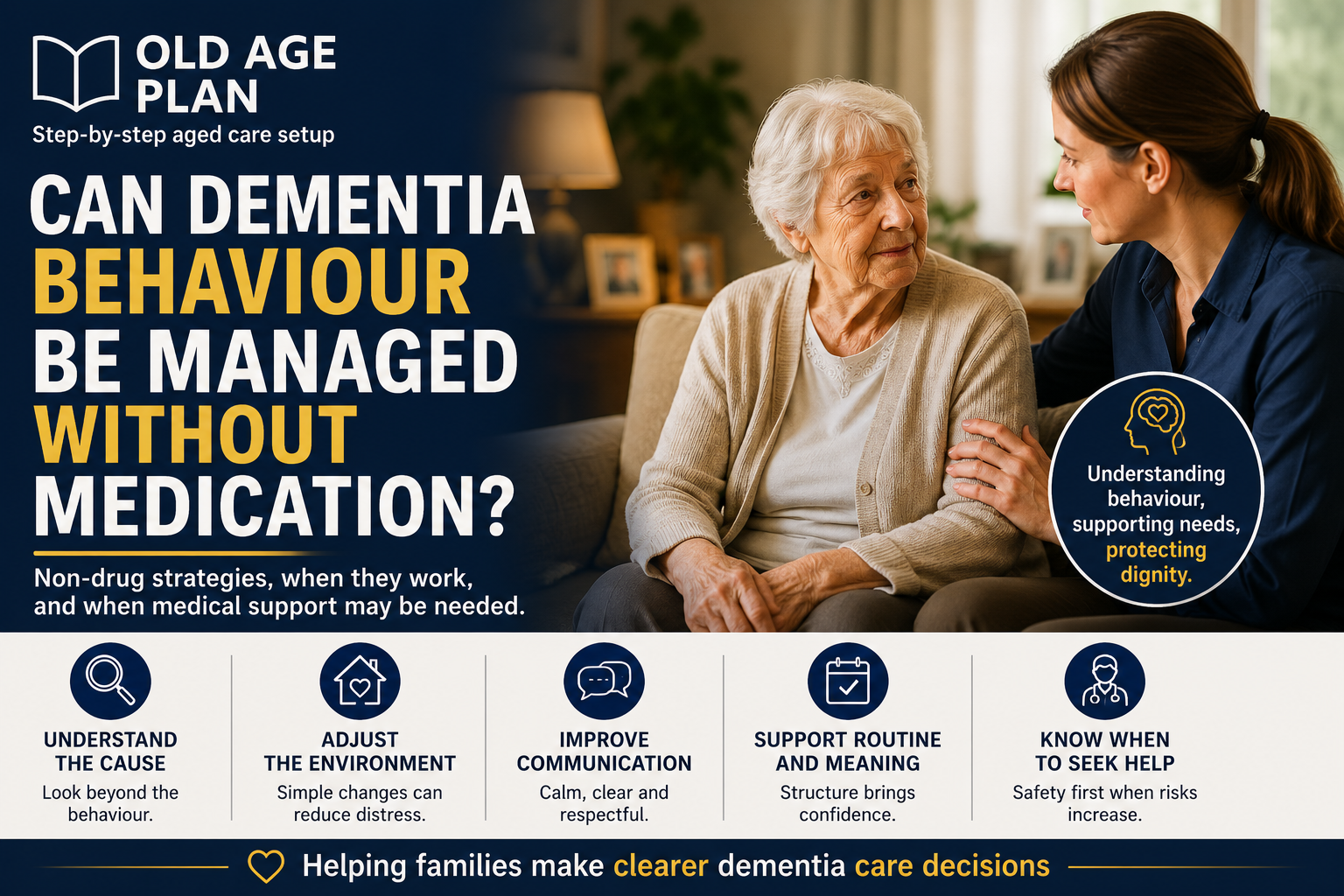

Can Dementia Behaviour Be Managed Without Medication?
Families often ask whether dementia behaviour can be managed without medication.
But the real question is usually more difficult than that.
Are we trying to understand distress, or are we trying to stop behaviour because care is becoming too hard?
Are medications becoming necessary, or are we reaching for them because the situation feels unmanageable?
Can this still be supported safely at home?
Dementia behaviour can sometimes be managed without medication, especially when behaviour is linked to pain, fear, confusion, environment, fatigue, communication problems or unmet needs.
But non-medication approaches do not mean ignoring risk.
The real decision is whether the behaviour is still understandable, manageable and safe enough with support, or whether medical review and higher-level care are now needed.
Short Answer
Yes, some dementia behaviour can be managed without medication.
Non-drug approaches may include adjusting the environment, improving communication, reducing triggers, supporting routine, checking for pain or illness, simplifying tasks and providing better supervision.
Medication may still be considered in some situations, especially where there is serious distress, risk of harm, severe agitation, psychosis or behaviour that cannot be safely managed in other ways.
The safest approach is usually to understand what may be driving the behaviour before assuming medication is the only answer.
Key Takeaway
Dementia behaviour is often a signal, not just a problem to suppress.
The behaviour may be communicating pain, fear, confusion, overload, boredom, hunger, tiredness, loss of control or an environment that no longer makes sense.
The most important question is not simply:
How do we stop this behaviour?
The better question is:
What is this behaviour telling us about the person’s needs, safety and care limits?
What Counts As Dementia Behaviour?
Dementia behaviour can include many changes that are difficult for families to manage.
These may include:
- agitation
- restlessness
- wandering
- calling out
- refusing care
- resisting showering or dressing
- suspicion or paranoia
- repetitive questions
- sleep disruption
- anger or aggression
- emotional distress
- pacing
- shadowing a carer
- accusing others of stealing
- trying to leave the home
These behaviours can feel personal.
They can also exhaust families quickly.
But in dementia care, behaviour often has meaning even when the person can no longer explain it clearly.
Why Behaviour May Happen In Dementia
Dementia can affect memory, reasoning, language, judgement, perception, emotional regulation and the ability to understand what is happening.
That can make ordinary situations feel frightening or confusing.
Behaviour may be triggered by:
- pain
- infection or sudden illness
- dehydration
- hunger
- constipation
- tiredness
- poor sleep
- medication side effects
- too much noise
- too many choices
- unfamiliar people or places
- changes in routine
- fear during personal care
- loss of privacy or control
- not understanding what someone is asking
This is why behaviour should not automatically be treated as “bad behaviour.”
It may be the person’s way of saying something is wrong.
Behaviour Management Starts With Meaning, Not Control
One of the biggest mistakes families and services can make is jumping straight to control.
Control asks:
How do we make them stop?
Support asks:
What are they experiencing, and what needs to change?
That difference matters.
If the behaviour is caused by pain, fear, confusion or overstimulation, medication alone may miss the real cause.
If the behaviour creates immediate danger, safety must come first.
Good dementia behaviour support holds both truths at once.
Try to understand the behaviour, but do not ignore risk.
The Real Tension: Comfort Versus Sedation
This article sits inside a difficult care tension.
Families may be told to avoid unnecessary medication.
But they may also be dealing with behaviour that is frightening, exhausting or unsafe.
That creates a real question:
Are we improving comfort, or are we sedating distress because care has become too hard?
Medication is not automatically wrong.
There are situations where clinical treatment may be appropriate.
But medication should not become a shortcut for unmet needs, poor support, unsafe environments or carer exhaustion that has gone unrecognised.
The aim is not “no medication at any cost.”
The aim is the right support, at the right time, for the right reason.
Can Behaviour Be Managed Without Medication?
Sometimes, yes.
Behaviour may improve when the cause is better understood and the environment is adjusted.
Non-medication approaches may help when behaviour is linked to:
- confusion
- overstimulation
- boredom
- fear
- poor routine
- pain or discomfort
- communication breakdown
- personal care distress
- unsafe or confusing surroundings
For example, a person who resists showering may not be “refusing care” in a simple sense.
They may be cold, embarrassed, afraid of falling, confused by the bathroom or unable to understand why someone is asking them to undress.
That behaviour may need a different shower routine, warmer room, better explanation, more privacy, a different time of day or occupational therapy input.
For practical home and task support, see Can Occupational Therapy Help Dementia?.
When Non-Drug Approaches Are Most Useful
Non-drug approaches may be most useful when behaviour has an identifiable pattern.
For example:
- agitation happens after too much noise
- distress happens during showering
- wandering happens late in the day
- anger increases when the person feels rushed
- restlessness increases when the person is bored
- calling out increases when the person is alone
- confusion worsens when the routine changes
A pattern gives families something to work with.
It does not mean the behaviour is easy.
It means the response can be more targeted than simply hoping it stops.
When Behaviour May Need Medical Review
Some behaviour changes need medical review.
This is especially important when behaviour is sudden, severe or very different from the person’s usual pattern.
Seek medical advice if there is:
- sudden confusion
- new aggression
- new hallucinations or delusions
- fever or signs of infection
- new pain
- falls or head injury
- dehydration concerns
- major sleep disruption
- recent medication changes
- behaviour that creates immediate danger
Delirium, infection, pain, medication effects, constipation, dehydration or other health issues can make dementia symptoms worse.
If the behaviour changes quickly, do not assume it is just dementia progression.
For related reading, see Can Delirium Be Mistaken For Dementia?, Can Infection Make Dementia Worse? and Can Medication Make Dementia Worse?.
Behaviour Reliability Matters
Families often judge behaviour by the best moments.
They may say:
“They were fine this morning.”
“They were calm when the nurse visited.”
“They only become aggressive sometimes.”
Those details matter, but they are not enough.
The more useful question is:
Is the behaviour reliably manageable across normal daily conditions?
Can the person remain safe when tired?
Can they accept essential care most days?
Can the carer redirect them without fear?
Can they be left alone safely?
Can evening behaviour still be managed?
If behaviour is only manageable under perfect conditions, the care plan may be more fragile than it appears.
Common Non-Medication Strategies
Non-medication strategies should match the person and the behaviour.
Common approaches may include:
- keeping routines predictable
- reducing noise and overstimulation
- using calm, simple communication
- checking pain, hunger, thirst and toileting
- offering reassurance rather than correction
- changing the timing of difficult tasks
- simplifying choices
- using familiar music or objects
- supporting gentle activity during the day
- improving lighting and reducing shadows
- making the home easier to navigate
- avoiding rushed care
- giving the person more privacy and dignity during personal care
These strategies are not a complete behaviour management system.
They are starting points for understanding what may reduce distress and risk.
For broader support strategies, see How Do You Support Someone With Dementia?.
Communication Can Change The Behaviour
Some dementia behaviour worsens because communication becomes too complex, rushed or corrective.
Families may try to explain, argue or reason.
That can backfire when the person cannot process the explanation.
Helpful communication may include:
- using short sentences
- giving one instruction at a time
- allowing more time
- using a calm tone
- avoiding arguments about facts
- reassuring before redirecting
- not correcting every mistake
- approaching from the front
- explaining before touching or assisting
The aim is not to win the conversation.
The aim is to reduce fear, confusion and escalation.
If the immediate issue is distress or agitation, see How Do You Calm Someone With Dementia?.
Routine Can Reduce Behaviour Pressure
Routine does not remove dementia.
But it can reduce the number of decisions the person has to process.
Predictable routines may help with:
- meals
- personal care
- medication timing
- rest periods
- sleep preparation
- daily movement
- calm evening transitions
Routine is especially useful when behaviour worsens with uncertainty.
But routines should remain humane.
A routine that becomes rigid, rushed or controlling may create more distress.
For more on this, see Can Routine Help Someone With Dementia?.
Behaviour At Night Can Change The Decision
Behaviour that is manageable during the day may become much harder at night.
This matters because night-time behaviour can quickly exhaust carers.
Examples include:
- wandering
- calling out
- trying to leave
- fear after dark
- resisting bedtime
- waking repeatedly
- becoming agitated in the evening
When behaviour worsens in the late afternoon or evening, sundowning may be part of the picture.
For that specific pattern, see What Is Sundowning And How Is It Managed?.
When Medication May Still Be Considered
Medication may be considered when symptoms are severe, distressing or unsafe, especially if non-drug approaches are not enough or the person is at risk of harm.
This decision should involve a qualified health professional.
Medication decisions may need to consider:
- the type of behaviour
- risk of harm
- possible causes
- side effects
- other health conditions
- current medications
- the person’s comfort and dignity
- whether non-drug supports have been tried where appropriate
The important point is not to treat medication as either always wrong or always inevitable.
The better question is whether medication is being used for the right reason, after the real issue has been properly considered.
For medication context, see What Medications Are Used For Dementia? and Can Dementia Medication Slow Progression?.
What You May Really Be Trying To Decide
The surface question is whether dementia behaviour can be managed without medication.
The deeper decision may be about safety, dignity, carer limits and care escalation.
You may really be trying to decide:
- Is this behaviour distress or danger?
- Are we missing pain, infection or medication side effects?
- Can the behaviour still be managed with routine and support?
- Are we trying to preserve comfort or simply stop disruption?
- Is medication being considered too early?
- Is medication being avoided for too long?
- Is the carer becoming unsafe or exhausted?
- Can home care still work if this behaviour continues?
These are serious decisions.
They deserve more than a simple “try non-drug strategies first” answer.
Decision Support
Before deciding whether behaviour can be managed without medication, separate the issue into three questions.
1. What Is The Behaviour Communicating?
Ask what may be underneath the behaviour.
Is the person in pain?
Are they frightened?
Are they overwhelmed?
Are they tired, hungry, thirsty or needing the toilet?
Are they reacting to a task, person, place or time of day?
If the cause can be identified, support can be more targeted.
2. Is The Behaviour Still Safely Manageable?
Some behaviour is distressing but manageable.
Some behaviour becomes unsafe.
Risk increases when behaviour involves:
- physical aggression
- leaving the home
- unsafe kitchen use
- falls risk
- refusal of essential care
- severe fear or distress
- carer injury risk
- sleep loss that makes care unsustainable
If behaviour is unsafe, families should not feel they must manage alone to prove they avoided medication.
3. Is The Carer Still Able To Provide Support?
Behavioural changes can transfer the burden of decision-making very quickly.
A family may manage memory loss.
They may even manage personal care.
But aggression, paranoia, refusal of care, wandering or severe night disruption can change the whole care arrangement.
When carers are frightened, exhausted or unable to safely redirect the person, the decision may need to move toward professional support.
That is not failure.
It means the behaviour has changed the care task.
How Behaviour Management Decisions Usually Escalate
Behaviour management decisions often escalate through stages.
- Observe the pattern — identify when, where and how the behaviour happens.
- Check basic causes — pain, infection, dehydration, hunger, toileting, sleep and medication changes.
- Adjust communication — reduce correction, simplify language and use reassurance.
- Adjust the environment — reduce noise, clutter, shadows, confusion and overstimulation.
- Strengthen routine and support — make difficult parts of the day more predictable.
- Seek clinical review — especially if behaviour is sudden, severe, risky or distressing.
- Review care needs — if behaviour can no longer be safely managed at home.
This ladder matters because families often jump from “we are coping” to “we are in crisis.”
Earlier recognition can create more options before exhaustion or risk forces the decision.
Behaviour Changes And Professional Care
Behavioural changes are one of the clearest signs that care needs may be escalating.
This is especially true when behaviour affects:
- personal care
- sleep
- wandering
- medication routines
- eating and drinking
- safety at home
- carer mental health
- family conflict
Professional care may become relevant when support needs are no longer occasional or predictable.
For broader care escalation guidance, see When Should Professional Care Be Considered For Dementia?.
Non-Drug Support Is Not The Same As Doing Nothing
Managing behaviour without medication does not mean simply tolerating distress.
It also does not mean leaving families unsupported.
Non-drug support may still involve:
- GP review
- dementia support services
- occupational therapy
- respite care
- home care support
- carer education
- environmental changes
- formal aged care assessment
That is an important distinction.
A non-medication approach can still be structured, serious and professionally supported.
Related Old Age Plan Articles
- How Do You Calm Someone With Dementia?
- What Is Sundowning And How Is It Managed?
- Can Routine Help Someone With Dementia?
- How Do You Support Someone With Dementia?
- What Non-Drug Treatments Help Dementia?
- What Medications Are Used For Dementia?
- Can Dementia Medication Slow Progression?
- Can Occupational Therapy Help Dementia?
- When Should Professional Care Be Considered For Dementia?
- Can Delirium Be Mistaken For Dementia?
- Can Infection Make Dementia Worse?
- Can Medication Make Dementia Worse?
Next Steps With Old Age Plan
If dementia behaviour is becoming harder to manage, start by looking for the pattern before deciding medication is inevitable.
When does the behaviour happen?
What seems to trigger it?
Is the person distressed, unsafe or both?
Is the carer still able to respond calmly and safely?
If the behaviour is mostly agitation or distress, compare this article with How Do You Calm Someone With Dementia?.
If behaviour becomes worse in the evening or overnight, read What Is Sundowning And How Is It Managed?.
If behaviour is now affecting safety, sleep, wandering or carer capacity, read When Should Professional Care Be Considered For Dementia?.
Old Age Plan resources can help families move from scattered behaviour concerns to clearer planning. A behaviour pattern tracker, medication discussion planner or care escalation worksheet may help you record what is changing before speaking with a GP, dementia support service or aged care assessor.
The aim is not to avoid medication at all costs.
The aim is to understand whether behaviour can still be supported safely, or whether medical review, formal support or a wider care decision is now needed.
Sources
- Dementia Australia — Mood And Behaviour Changes
- Dementia Australia — Changed Behaviours
- Dementia Australia — Aggression
- Healthdirect — Dementia Behaviour Changes
- NICE — Dementia: Assessment, Management And Support Recommendations
- RACGP — Behavioural And Psychological Symptoms Of Dementia
- National Institute On Aging — Managing Behaviour Changes In Alzheimer’s
Disclaimer
This article provides general information only. It is not medical, legal or financial advice.
Dementia symptoms, behaviour changes, medication decisions, safety risks and care pathways vary between individuals. Laws, policies, services and clinical guidance may also change over time.
You should seek advice from a qualified health professional, legal professional or aged care professional about your own circumstances.
For current dementia, behaviour, medication and aged care support information in Australia, you may wish to refer to Dementia Australia, My Aged Care, your GP, dementia support services, state health services and other relevant official resources.
Summary
Some dementia behaviour can be managed without medication, especially when behaviour is linked to pain, fear, confusion, environment, communication problems, routine changes or unmet needs.
But non-medication support does not mean ignoring risk.
The key question is whether behaviour is still understandable, manageable and safe enough with support.
The real tension is comfort versus sedation, and support versus control.
If behaviour becomes sudden, severe, unsafe or exhausting for carers, medical review or formal support may be needed.
The goal is not to avoid medication at all costs.
The goal is to understand what the behaviour is communicating and choose support that protects safety, dignity and care sustainability.