
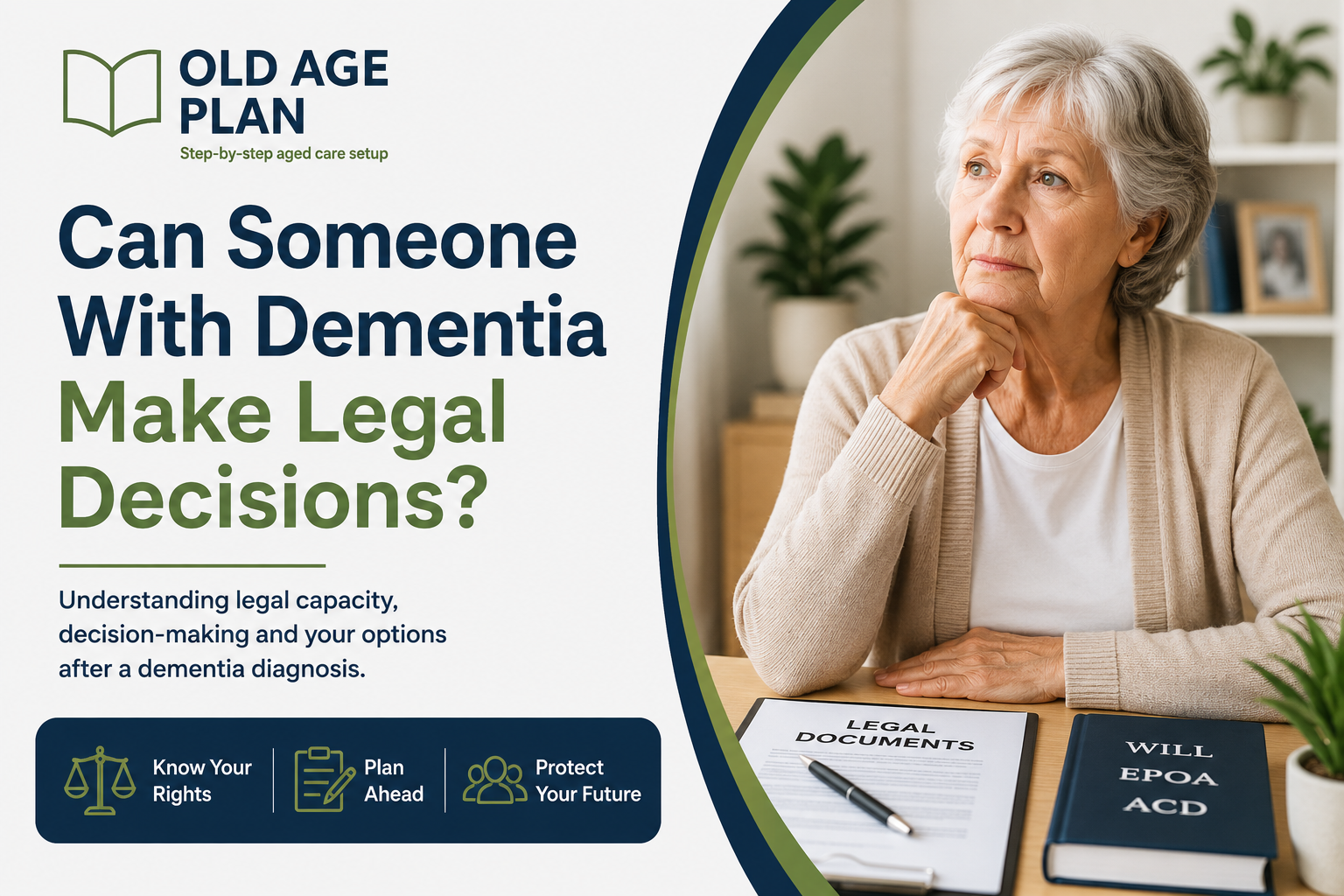

Can Someone With Dementia Make Legal Decisions?
When someone is diagnosed with dementia, families often start wondering what decisions the person can still make.
You may be trying to work out whether they can sign legal documents, update a will, appoint someone to help, or make choices about care and money.
If you are asking can someone with dementia make legal decisions, the answer is sometimes yes.
A dementia diagnosis does not automatically mean a person has lost legal capacity.
Capacity depends on the decision being made, the person’s understanding at the time, and the legal requirements that apply.
Short Answer
Someone with dementia may still be able to make legal decisions if they have decision-making capacity for that specific decision at that time.
Capacity is usually decision-specific.
This means a person may be able to make some decisions but not others.
If there is doubt, families should seek legal or medical advice before relying on important documents or decisions.
Key Takeaway
Dementia does not automatically remove a person’s ability to make legal decisions.
The key question is whether the person has capacity for the specific decision being made at the time.
If legal documents, money, care decisions or family disagreements are involved, getting proper advice early can help avoid serious problems later.
Why This Matters
Legal decisions made after a dementia diagnosis can affect care, finances, property, healthcare wishes and family responsibilities.
This is why capacity matters.
A person may still be able to make decisions if they understand the decision, understand the choices, weigh the consequences and communicate their decision.
Justice Connect explains that capacity involves understanding facts, choices and consequences, and being able to communicate a decision.
However, capacity can become more difficult to assess when dementia symptoms progress.
When Families Usually Start Asking Questions
Families often start asking capacity questions after a diagnosis or when decisions need to be made quickly.
This may happen when:
- legal documents have not been completed
- an Enduring Power Of Attorney is needed
- an Advance Care Directive needs review
- a will needs updating
- family members disagree about what should happen
- banks, lawyers or doctors raise capacity concerns
- care decisions need to be made
- the person is becoming more confused
The real question is often not just whether the person has dementia.
It is whether they can still understand and make a specific decision safely and legally.
Dementia Does Not Automatically Mean No Capacity
A diagnosis of dementia does not automatically mean a person cannot make legal decisions.
Some people with early dementia may still understand information, weigh up choices and communicate decisions clearly.
ELDAC notes that capacity is decision-specific and that a person with dementia may still have capacity to make all or some decisions, especially in early dementia.
This is important because people should not be excluded from decision-making simply because they have a diagnosis.
What Is Decision-Making Capacity?
Decision-making capacity usually means the person can understand the decision and its consequences.
In general, a person may need to be able to:
- understand the information relevant to the decision
- understand the main choices available
- weigh up the likely consequences
- communicate their decision in some way
The exact legal test may depend on the type of decision and the state or territory involved.
This is why important legal decisions should be handled carefully.
Capacity Is Decision-Specific
Capacity is not always all or nothing.
A person may have capacity for one decision but not another.
For example, someone may still be able to decide what they want for lunch or who they want visiting them.
However, they may struggle to understand a complex legal document, property sale or financial arrangement.
The more complex the decision, the more carefully capacity may need to be considered.
Capacity Can Change Over Time
Capacity can also change over time.
A person may be clearer at one time of day than another.
They may also be affected by illness, infection, medication, tiredness, pain, sleep problems or unfamiliar surroundings.
This means timing and environment can matter.
For important decisions, families may need to choose a calm time and seek professional support.
Can Someone With Dementia Sign Legal Documents?
Someone with dementia may be able to sign legal documents if they have capacity for that document at the time of signing.
However, this should not be guessed.
Important documents may include:
- a will
- an Enduring Power Of Attorney
- an Enduring Guardianship document
- an Advance Care Directive
- property or financial documents
- aged care agreements
If there is doubt, legal advice should be sought before the document is signed.
Can Someone With Dementia Make A Will?
Someone with dementia may be able to make or change a will if they have testamentary capacity at the time.
This is a specific type of legal capacity.
It usually involves understanding what a will does, understanding the nature of the estate, and understanding who may reasonably expect to benefit.
Because wills can later be challenged, capacity concerns should be handled carefully with legal advice.
Can Someone With Dementia Create An Enduring Power Of Attorney?
Someone with dementia may be able to create an Enduring Power Of Attorney if they still have the required capacity at the time.
However, once capacity is lost, it may be too late to appoint an attorney.
Legal Aid NSW explains that an Enduring Power Of Attorney is used when a person wants the power to continue after they lose mental capacity.
This is why early planning matters.
Can Someone With Dementia Create An Advance Care Directive?
Someone with dementia may be able to create or update an Advance Care Directive if they have decision-making capacity at the time.
Capacity requirements and forms vary between Australian states and territories.
Dementia Australia explains that planning ahead may include legal documents that formalise decisions and allow people to act on your behalf, with some variation between states and territories.
If dementia has already been diagnosed, it is sensible to get advice before delaying important planning documents.
Who Decides If Someone Has Capacity?
Capacity may be considered by different professionals depending on the situation.
This may include doctors, lawyers, specialists, health professionals or tribunals.
For medical decisions, health professionals may assess capacity for consent to treatment.
For legal documents, lawyers may need to consider whether the person appears to have the required capacity.
In serious disputes, a tribunal or court may become involved.
What Happens If Capacity Is Lost?
If someone loses capacity and legal documents are already in place, appointed decision-makers may be able to act within the authority given to them.
If no documents are in place, family members may need to seek advice about substitute decision-making options.
This may involve state or territory guardianship, administration or tribunal processes.
The exact pathway depends on the decision needed and where the person lives.
Why Early Planning Helps
Early planning gives the person with dementia more opportunity to be involved in decisions.
It may also reduce uncertainty for family members later.
Planning may include reviewing:
- Enduring Power Of Attorney
- Enduring Guardianship
- Advance Care Directive
- will
- superannuation nominations
- banking and account access
- healthcare wishes
- family communication arrangements
These decisions should not be rushed or forced.
However, delaying too long can make choices harder if capacity declines.
Decision Support
If you are trying to work out whether someone with dementia can make a legal decision, consider:
- What specific decision needs to be made?
- Does the person understand the decision?
- Can they explain the main choices?
- Can they understand the possible consequences?
- Can they communicate a clear decision?
- Is the decision simple or complex?
- Could illness, medication, tiredness or confusion affect capacity today?
- Should a lawyer, doctor or specialist be involved?
The goal is not to take decisions away from the person too early.
The goal is to support valid, informed decisions while protecting the person from avoidable risk.
What Could Happen Next?
If the person appears to have capacity, the next step may be to complete or review important legal documents with proper advice.
If capacity is uncertain, a lawyer or doctor may recommend further assessment.
If capacity has already been lost, families may need advice about who can legally make decisions and what formal steps may be required.
What You May Really Be Trying To Decide
If you are searching for whether someone with dementia can make legal decisions, you may not only be looking for a legal definition.
You may also be trying to decide:
- whether it is too late to complete legal documents
- whether a will, EPOA or Advance Care Directive can still be changed
- whether family members should step in
- whether professional capacity advice is needed
- who can make decisions if capacity is lost
- what needs to happen before the situation becomes harder
These are important decisions.
If legal documents, money, healthcare or family disagreement are involved, getting proper advice early can help prevent bigger problems later.
Related Old Age Plan Articles
- What Is Dementia?
- What Happens After A Dementia Diagnosis?
- What Is Mild Cognitive Impairment?
- What Is An Enduring Power Of Attorney?
- What Is Enduring Guardianship?
- What Is An Advance Care Directive?
- What Is A Will?
Sources
- Dementia Australia — Planning Ahead After Diagnosis
- Dementia Australia — Planning Ahead, Decision-Making Capacity And The Law
- Legal Aid NSW — Powers Of Attorney
- Legal Aid NSW — Who Will Decide For You If You Cannot Decide?
- ELDAC — Capacity And Consent To Medical Treatment
- Justice Connect — Powers Of Attorney In NSW
Summary
Someone with dementia may still be able to make legal decisions if they have capacity for the specific decision at the time.
Dementia does not automatically remove legal capacity.
However, capacity can change over time and may depend on the complexity of the decision.
If important legal documents, money, healthcare decisions or family disagreements are involved, families should seek appropriate legal or medical advice before relying on the decision.