
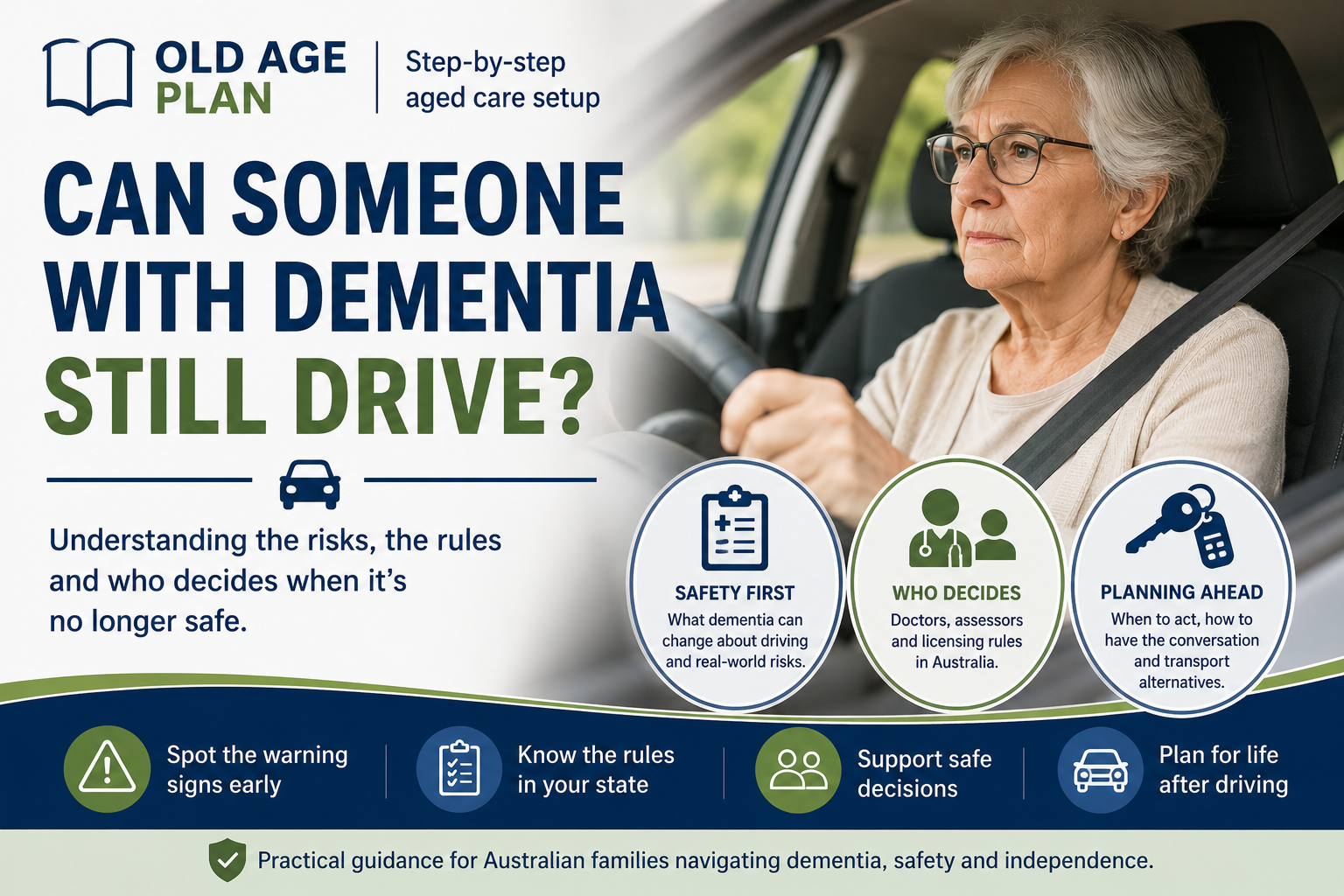

Can Someone With Dementia Still Drive?
Driving can be one of the hardest dementia decisions for families.
It is not only about transport.
It can affect independence, identity, safety and confidence.
So families often ask: can someone with dementia still drive?
The answer depends on the person’s condition, driving safety, medical assessment and the rules of the relevant state or territory licensing authority.
Short Answer
Someone with dementia may be able to keep driving for a time, especially in the early stages, but they should not assume they can continue without assessment.
In Australia, drivers with dementia generally need to follow medical fitness-to-drive requirements and notify the relevant licensing authority.
A medical assessment, conditional licence or practical driving assessment may be required.
The key question is not whether the person can physically operate a car. It is whether they can still drive safely, reliably and legally.
Key Takeaway: A dementia diagnosis does not always mean someone must stop driving immediately, but it does mean driving safety should be assessed. The real issue is whether the person can still notice hazards, make safe decisions and respond quickly enough under real driving conditions.
Why Dementia Can Affect Driving
Driving requires more than memory.
It depends on attention, judgement, reaction time, visual processing, planning and the ability to respond to unexpected situations.
Dementia can affect these abilities over time.
This means a person may still manage familiar routines at home but struggle with traffic, intersections, route changes, pedestrians or sudden hazards.
That is why driving can become risky before a person fully recognises the change.
Diagnosis Alone Is Not The Whole Answer
A dementia diagnosis does not automatically answer whether someone can drive safely today.
Some people in the early stages may still be able to drive for a period with assessment and restrictions.
Others may become unsafe much sooner.
The practical question is not only whether dementia is present.
The practical question is whether driving ability remains reliable in real traffic.
Functional Safety Threshold
Old Age Plan looks at driving through a safety and decision-support lens.
The deeper question is:
Can the person still reliably recognise hazards, make safe decisions and react fast enough under real driving conditions?
This is the functional safety threshold.
Driving becomes different from many other dementia decisions because risk can affect the person, passengers, pedestrians and other road users.
That does not mean driving should be removed too early.
It does mean safety concerns should be taken seriously when patterns start appearing.
Warning Signs Driving May No Longer Be Safe
Families may notice changes before the person does.
Warning signs may include:
- getting lost on familiar routes
- new dents, scratches or minor accidents
- near misses or unexplained incidents
- confusion at intersections or roundabouts
- slower reactions in traffic
- driving too slowly or too fast for conditions
- difficulty staying in the correct lane
- missing signs, exits or traffic lights
- becoming upset, confused or defensive after driving
- family members feeling unsafe as passengers
One incident may not prove someone must stop driving.
A pattern of risk should not be ignored.
Decision Reliability Matters Behind The Wheel
Driving is a real-time decision activity.
The person needs to notice changes, interpret risk and respond quickly.
This is different from a slower conversation at home, where someone may have time to think through a decision.
A person may seem mostly capable during daily conversation but still be unsafe in traffic.
A useful OAP question is:
Is their driving still reliable when the situation changes quickly?
Who Decides When Someone With Dementia Should Stop Driving?
Family members may raise concerns, but they usually do not make the formal licensing decision alone.
Doctors, specialists, occupational therapy driving assessors and state or territory licensing authorities may become involved.
In Australia, licensing rules vary by state and territory.
Dementia Australia advises people to follow the instructions of their local licensing authority, which may include a formal assessment.
Austroads provides national medical fitness-to-drive standards used by health professionals and licensing authorities.
Can A Doctor Report Driving Concerns?
A doctor may assess whether a medical condition affects driving safety.
Depending on the state or territory, reporting requirements can differ.
Some situations may involve the doctor advising the person to notify the licensing authority.
In other situations, the doctor may have reporting obligations or may contact the authority if there is serious safety concern.
This is why local licensing rules matter.
What Is A Conditional Licence?
Some people with dementia may be considered for a conditional licence if they are assessed as safe under certain limits.
Conditions may vary depending on the licensing authority.
Examples may include driving only in familiar areas, during daylight, within a limited distance or with regular medical review.
Healthdirect notes that people living with dementia who want to keep driving may need medical assessment, and a conditional or restricted licence may be possible if they are safe to drive.
Can Family Take The Keys?
This is one of the hardest practical questions.
If there is immediate danger, families may feel they need to act quickly.
However, simply taking keys can create conflict, distress and legal uncertainty if the person still has capacity and a valid licence.
If there is serious risk, it is usually better to involve a GP, specialist, licensing authority or other appropriate professional as soon as possible.
The aim is not to win an argument.
The aim is to reduce risk using the right authority and support.
What If The Person Refuses To Stop Driving?
Refusal is common because driving often represents independence.
The person may not recognise the risk.
They may believe family members are overreacting.
They may fear losing access to appointments, shops, friends or familiar routines.
In these situations, the conversation often works better when it focuses on safety, alternatives and assessment rather than blame.
If risk is increasing, professional advice should not be delayed.
Planning For Life After Driving
Stopping driving can create practical problems.
It can affect appointments, shopping, social contact and independence.
Families may need to consider alternatives such as:
- family transport arrangements
- community transport
- taxi or rideshare support
- home delivery services
- My Aged Care support services
- local council or community programs
- medical appointment transport options
The earlier these options are explored, the less sudden the transition may feel.
What You May Really Be Trying To Decide
If you are asking whether someone with dementia can still drive, you may not only be asking about road rules.
You may be trying to work out whether the person is still safe, whether you are overreacting, or whether action is already overdue.
You may be wondering whether:
- Mum is still safe driving locally
- Dad should tell the licensing authority
- a doctor needs to assess driving ability
- family can stop the person driving
- transport alternatives should be arranged now
The practical question is this:
Has driving crossed from independence into safety risk?
How Families Can Approach This Carefully
Families should avoid two common mistakes.
The first mistake is removing driving too early without evidence or assessment.
That can cause unnecessary loss of independence.
The second mistake is waiting too long when warning signs are already appearing.
That can put the person and others at risk.
A careful approach is to note specific examples, arrange medical review, follow licensing authority requirements and plan transport alternatives before a crisis occurs.
Related Old Age Plan Articles
- Can Someone With Dementia Make Legal Decisions?
- When Can Family Override Decisions?
- Can Someone With Dementia Refuse Care?
- Can Someone With Dementia Make Medical Decisions?
- When Does Someone With Dementia Lose Capacity?
- Who Decides If Someone Has Lost Capacity?
- What Happens After A Dementia Diagnosis?
Sources
- Austroads — Assessing Fitness To Drive: Dementia
- Dementia Australia — Driving And Dementia
- healthdirect — Dementia And Driving
- My Aged Care — Caring For Someone Living With Dementia
Disclaimer
This article provides general information only. It is not legal, medical or financial advice.
Dementia symptoms, medication guidance, medical advice, aged care services and government policies may change over time and individual circumstances can vary.
Always seek advice from qualified healthcare professionals and refer to official Australian Government, My Aged Care and Dementia Australia resources for current information.
Summary
Someone with dementia may still drive for a time if they are assessed as safe and meet licensing requirements.
A diagnosis alone does not answer the whole question.
The key issue is whether the person can still recognise hazards, make safe decisions and respond reliably in real driving conditions.
If warning signs appear, families should seek medical advice, follow licensing authority requirements and start planning safe transport alternatives.