
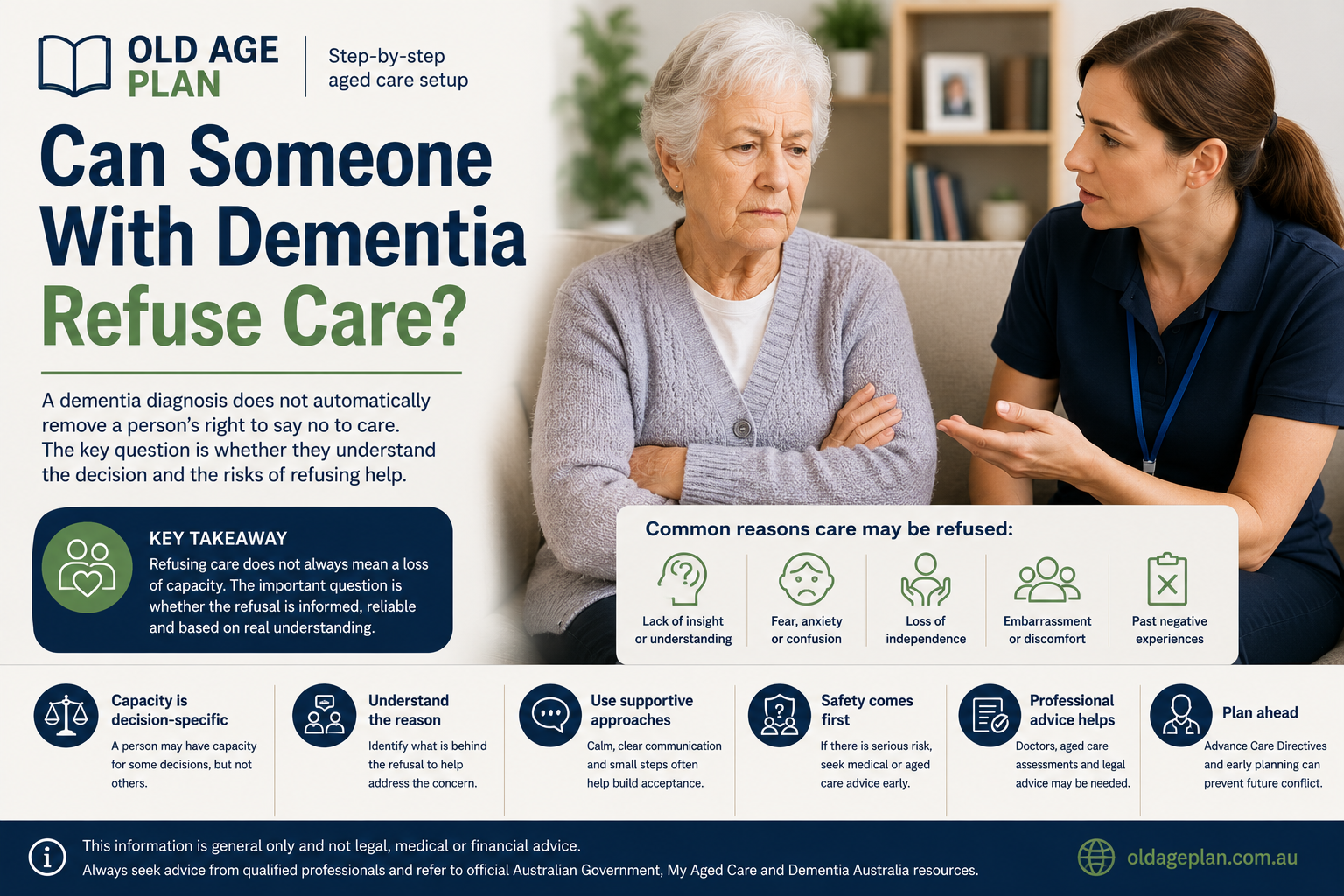

Can Someone With Dementia Refuse Care?
Families often face this question when someone with dementia refuses help that seems important.
Can someone with dementia refuse care?
The answer depends on whether the person still has capacity for that specific care decision.
A refusal should not be ignored. But it also should not automatically be treated as proof that the person cannot decide for themselves.
Short Answer
Yes, someone with dementia may be able to refuse care if they still understand the decision, the risks and the likely consequences.
A dementia diagnosis does not automatically remove the right to say no.
However, if the refusal is based on confusion, impaired insight, fear, misunderstanding or inability to recognise risk, further support or assessment may be needed.
The key question is whether the refusal is a reliable decision or a sign that decision-making has become unsafe for that situation.
Key Takeaway: Refusing care does not automatically mean someone lacks capacity. The important question is whether the person understands what they are refusing and what could happen if support is not accepted.
Refusing Care Is Not Always Loss Of Capacity
People have the right to make decisions others disagree with.
This can include refusing help, treatment, personal care or aged care services.
A person with dementia may still understand the situation and make a clear choice.
That choice may feel difficult for family members, especially when safety is involved.
But disagreement alone does not prove incapacity.
What Type Of Care Is Being Refused?
Not all care refusals carry the same level of risk.
Refusing help with one household task is different from refusing medication, wound care, food, hygiene support or safe accommodation.
Common examples include refusing:
- home care workers
- showering or hygiene support
- medication assistance
- meals or hydration support
- mobility aids
- medical appointments
- hospital care
- residential aged care
The more serious the risk, the more carefully the refusal may need to be considered.
Decision Reliability Matters
The real question is not only whether the person said no.
The deeper question is whether the refusal is reliable.
Can the person explain what they are refusing?
Do they understand what may happen if care is not provided?
Is the refusal consistent, or does it change depending on the time of day or who is speaking?
Are they refusing because they understand the trade-off, or because they do not recognise the risk?
A useful OAP question is:
Is the refusal a reliable decision based on genuine understanding, or a sign of impaired insight, fear or confusion?
Why Someone With Dementia May Refuse Care
Refusal does not always mean stubbornness.
There may be a reason behind it.
A person may refuse care because they:
- do not believe they need help
- feel embarrassed about personal care
- do not recognise the care worker
- feel rushed or pressured
- are tired, unwell or confused
- fear losing independence
- do not understand what the service is for
- have had a poor experience before
Understanding the reason can help families respond more effectively.
Sometimes the problem is not the care itself, but how, when or by whom it is introduced.
When Refusal Becomes More Concerning
Refusal becomes more concerning when safety, health or wellbeing may be affected.
This may include situations where the person is:
- missing essential medication
- not eating or drinking enough
- falling or becoming unsafe at home
- unable to maintain hygiene
- refusing urgent medical care
- leaving appliances on
- wandering or becoming lost
- living in unsafe conditions
These signs do not automatically mean family can force care.
They may mean the situation needs professional assessment and a clearer support plan.
Can Family Force Someone With Dementia To Accept Care?
In most situations, family members cannot simply force care because they believe it is needed.
If the person still has capacity for the decision, their choice generally matters, even if others disagree.
If the person lacks capacity and there is serious risk, an authorised substitute decision-maker, guardian, healthcare professional, tribunal or emergency service may need to become involved.
The exact pathway depends on the type of care, the urgency and the state or territory involved.
What If The Person Says “I’m Fine” But Clearly Is Not?
This is one of the hardest situations for families.
A person may insist they are managing while bills are unpaid, food is spoiling, hygiene is declining or safety risks are increasing.
The issue is not just whether they say they are fine.
The issue is whether they understand the gap between how they believe things are going and what is actually happening.
If insight is affected, the refusal may not be fully reliable.
Supported Decision-Making May Help
Before assuming someone needs decisions made for them, it may help to change the way care is discussed.
Support may include:
- using simple, calm explanations
- introducing one service at a time
- choosing a familiar time of day
- using familiar people where possible
- explaining the benefit in practical terms
- avoiding arguments or pressure
- checking whether discomfort, pain or fear is involved
Sometimes a person refuses “care” but accepts help when it is framed differently.
For example, they may reject “aged care” but accept “someone to help with the garden” or “a regular lift to appointments.”
When Professional Help May Be Needed
Professional help may be needed when refusal creates ongoing safety, health or care risks.
This may involve a GP, dementia specialist, My Aged Care assessment, aged care provider, social worker, hospital team or legal adviser.
If there are serious concerns about capacity, neglect, abuse or unsafe living conditions, specialist advice may be needed urgently.
The aim is not to override the person unnecessarily.
The aim is to understand what support is needed and what legal authority exists.
What You May Really Be Trying To Decide
If you are asking whether someone with dementia can refuse care, you may not only be asking about rights.
You may be trying to work out what to do when someone you care about keeps saying no while the risks keep increasing.
You may be wondering whether:
- Mum can refuse home care workers
- Dad can refuse medication support
- family can insist on help
- My Aged Care should be contacted
- guardianship or substitute decision-making may be needed
The practical question is this:
Is the refusal informed and reliable, or is the person no longer able to understand the risk of refusing care?
How Families Can Approach This Carefully
Families should avoid two common mistakes.
The first mistake is treating every refusal as incapacity.
That can remove independence too early.
The second mistake is accepting every refusal at face value when clear risks are increasing.
That can leave the person unsupported for too long.
A careful approach is to identify what care is being refused, understand why, assess the level of risk and seek professional advice when capacity or safety is unclear.
Related Old Age Plan Articles
- Can Someone With Dementia Make Medical Decisions?
- Can Someone With Dementia Make Legal Decisions?
- When Does Someone With Dementia Lose Capacity?
- Who Decides If Someone Has Lost Capacity?
- Can Capacity Be Partial?
- What Is Enduring Guardianship?
- What Is An Advance Care Directive?
Sources
- Dementia Australia — Planning Ahead
- NSW Government — Capacity Toolkit
- My Aged Care — Caring For Someone Living With Dementia
- My Aged Care — Appointed Decision-Makers
- OPAN — Supported Decision-Making
Disclaimer
This article provides general information only. It is not legal, medical or financial advice.
Dementia symptoms, medication guidance, medical advice, aged care services and government policies may change over time and individual circumstances can vary.
Always seek advice from qualified healthcare professionals and refer to official Australian Government, My Aged Care and Dementia Australia resources for current information.
Summary
Someone with dementia may be able to refuse care if they still have capacity for that specific decision.
The diagnosis alone does not decide the issue.
The key question is whether the person understands what they are refusing and what risks may follow.
If the refusal is unreliable, unsafe or based on confusion, professional guidance may be needed to protect both independence and wellbeing.