
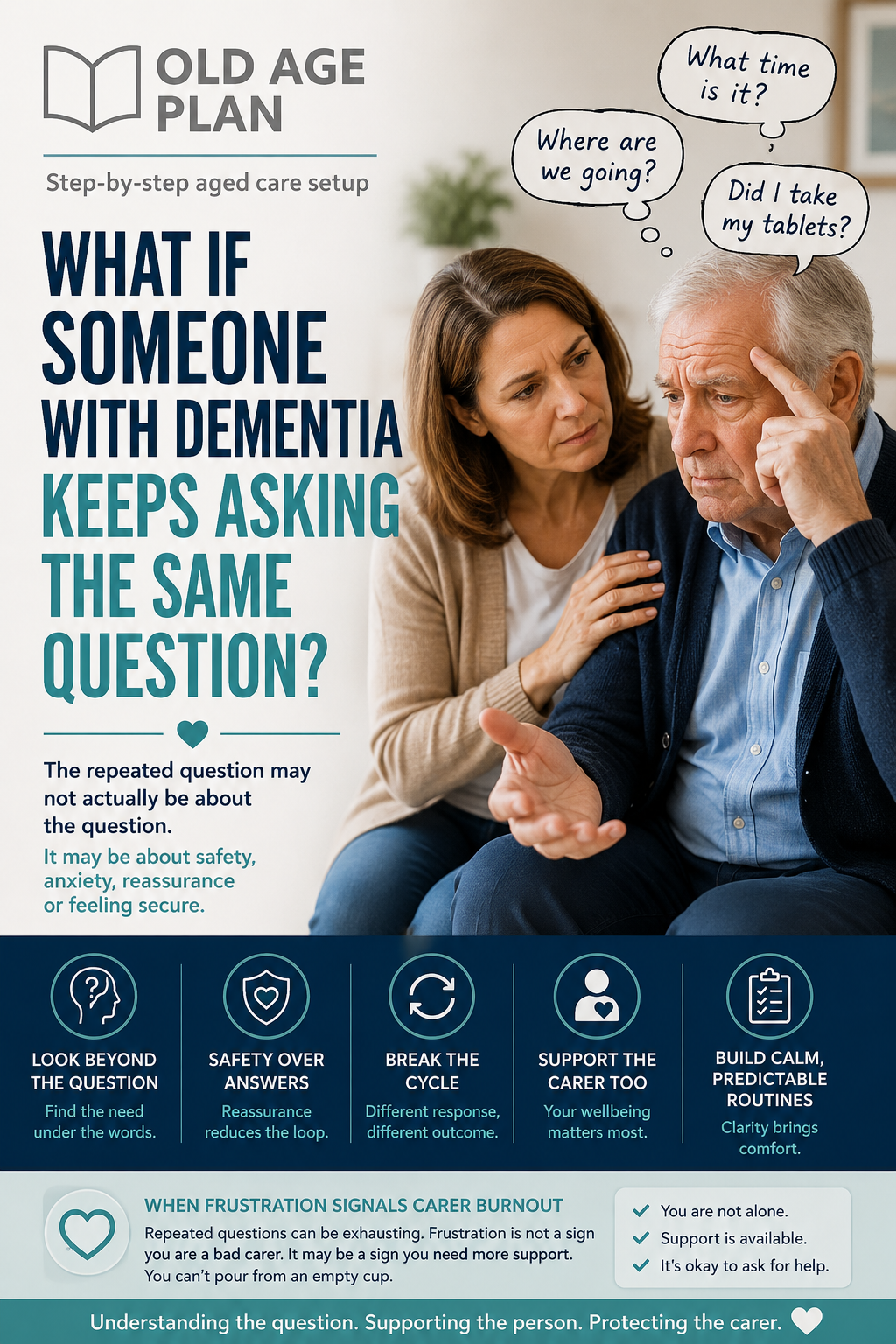

What If Someone With Dementia Keeps Asking The Same Question?
What if someone with dementia keeps asking the same question again and again? It can be exhausting, especially when you have already answered gently, clearly and more than once. You may start calm, then feel your patience slipping. Then comes the guilt.
This is one of the hardest parts of dementia communication because the repeated question may not actually be about the question.
Someone may ask, “What time is the appointment?” ten times. But underneath, they may really be asking, “Am I safe? Have I forgotten something important? Is someone going to help me?”
If you only answer the literal question, the cycle may keep repeating.
Short Answer
If someone with dementia keeps asking the same question, try not to treat it only as a memory problem. Repetition may be linked to anxiety, uncertainty, fear, pain, unmet needs or loss of orientation. A calm answer can help, but repeated reassurance, routine, written cues and checking the emotion underneath the question may work better than giving the same factual answer again and again.
Key Takeaway
The most useful question is not always, “How do I stop them asking?” It is often, “What are they really needing from me each time they ask?”
Why Repeated Questions Are Not Always About Memory
Repeated questions are often explained as memory loss. That may be partly true, but it is not always the whole story.
A person may forget the answer. But they may also be trying to manage uncertainty.
They may ask:
- “What time are we leaving?”
- “Where are we going?”
- “Did I take my tablets?”
- “When are you coming back?”
- “Where is Mum?”
On the surface, these sound like information requests.
Underneath, they may be asking for safety, reassurance, orientation or emotional steadiness.
This distinction matters because facts alone may not settle the person if the real driver is anxiety.
If someone keeps asking when you are leaving, the answer “At 2 pm” may not solve the concern. What they may need is:
“You do not need to worry. I will make sure we are ready.”
That is not dodging the question. It is answering the need under the question.
When The Question Is Really About Safety
Some repeated questions are safety-seeking.
The person may not feel sure about what is happening, who is responsible, or whether something important has been missed.
For example, “Did I take my tablets?” may not only mean they forgot. It may mean they feel unsafe because they no longer trust their own memory.
In that situation, simply saying, “Yes, you did,” may help once. But if the question returns again and again, the person may need a more visible anchor.
That might mean:
- a medication chart
- a simple note on the table
- a whiteboard with today’s plan
- a calm routine after medication
- one trusted person giving the same reassurance
The aim is not to overload the person with systems. The aim is to reduce the need to keep seeking certainty from memory alone.
If the repeated question involves medication, wandering, driving, money or care safety, it may also signal that practical support needs review. For related safety decisions, see Can Someone With Dementia Still Drive? and Can Someone With Dementia Refuse Care?.
When The Question Is Really About Anxiety
Some repeated questions are anxiety loops.
The person is not asking because they want new information. They are asking because the answer does not stay emotionally settled.
For example:
“When are we going home?”
may really mean:
“I do not feel settled here.”
“Where is my husband?”
may really mean:
“I feel alone.”
“What time is the appointment?”
may really mean:
“I am scared I will miss it or get something wrong.”
If anxiety is driving the loop, a factual answer may expire almost immediately.
The person may need emotional reassurance more than information.
Instead of repeating only the answer, try naming the concern gently:
“You seem worried about being late. I will keep track of the time for you.”
Or:
“You want to know what is happening next. I will stay with you and help you through it.”
For related communication support, see How Do You Calm Someone With Dementia?.
Why Repeating The Same Answer Often Fails
Repeating the same answer can feel logical.
They ask. You answer.
They ask again. You answer again.
But after the fifth, tenth or twentieth time, the answer may no longer be the intervention.
The pattern is the intervention point.
If the same question keeps returning, ask what is not being resolved.
Is the person still unsafe?
Still anxious?
Still unsure what happens next?
Still unable to see the cue?
Still looking for a particular person?
Still overstimulated?
Still in pain, thirsty, tired or frightened?
When the answer keeps failing, the question may need a different kind of response.
For example, if someone keeps asking, “When is the doctor coming?” the solution may not be to keep saying “Tomorrow at 10.” It may be to write it clearly, place it where they can see it, and reassure them that someone else is responsible for remembering.
The message becomes:
“You do not have to hold this by yourself.”
When Reassurance Becomes A Loop
Reassurance is usually kind. But it can also become part of the loop.
If every repeated question receives a long explanation, the person may become more dependent on repeated verbal reassurance. The caregiver then becomes the memory system, the anxiety regulator and the emotional container all day long.
That can exhaust both people.
The aim is not to withhold reassurance. It is to make reassurance more stable.
Instead of answering from scratch every time, families can sometimes create a consistent reassurance pattern.
For example:
“The appointment is tomorrow. It is written on the board. I will take you.”
Then gently return to the same anchor:
“Let’s check the board together.”
This helps avoid a fresh emotional conversation every time.
It also prevents the caregiver from having to rebuild the entire answer again and again.
If reassurance is not working at all, look for a cause underneath the loop. Repeated questioning may worsen with poor sleep, infection, dehydration, medication side effects, pain, stress or delirium. For sudden or unusual changes, see Can Delirium Be Mistaken For Dementia?, Can Infection Make Dementia Worse? and Can Medication Make Dementia Worse?.
When Frustration Signals Carer Burnout
Sometimes the repeated question is not the real crisis.
The real crisis is the caregiver’s nervous system.
Repeated questioning can slowly wear down patience, sleep, emotional regulation and empathy. The first answer may be kind. The tenth may be tight. The twentieth may come out sharper than intended.
Then shame arrives.
Many carers think:
- “Why am I getting angry?”
- “Why can’t I just be patient?”
- “A good carer would not feel this way.”
- “Am I becoming cruel?”
That shame can be dangerous because it keeps people silent.
Frustration does not automatically mean someone is a bad carer.
Sometimes frustration is evidence that the carer has been operating beyond capacity for too long.
That does not excuse yelling, mocking, threatening or punishing the person with dementia. But it does mean the situation needs support, not just more guilt.
If repeated questioning is pushing a carer toward anger, withdrawal or resentment, the answer is not simply “try harder.”
The answer may be:
- more respite
- shared family support
- a calmer routine
- professional advice
- carer counselling
- a review of care needs
Caregiver burnout changes decision quality. It can make small problems feel unbearable and serious risks easier to ignore.
For related support, see How Do You Support Someone With Dementia? and When Should Professional Care Be Considered For Dementia?.
What You May Really Be Trying To Decide
If someone with dementia keeps asking the same question, you may not only be trying to answer them.
You may be trying to decide:
- How do I stay patient?
- Is this normal dementia behaviour?
- Am I handling this badly?
- Is the question really anxiety?
- Do we need more support?
- Is this becoming unsafe for them or for me?
This is why repeated questions matter.
They are not just communication moments. They can reveal whether the person feels secure, whether the environment is predictable, and whether the carer is coping.
Decision Support: What Is The Question Under The Question?
Before answering the same question again, pause and ask what the question may really be carrying.
1. Is this an information question?
If they simply need a reminder, a short answer, note, calendar or whiteboard may help.
2. Is this a safety question?
If they are worried about medication, appointments, money, transport or being left alone, the answer may need a practical support system.
3. Is this an anxiety question?
If the person is unsettled, the answer may need reassurance before information.
4. Is this a grief or attachment question?
If they are asking for someone who is absent or has died, repeated factual correction may cause distress. For related guidance, see Should You Correct Someone With Dementia?.
5. Is this a burnout signal?
If the question is triggering anger, dread or shame in the carer, the care arrangement may need more support.
A simple OAP rule:
Do not only answer the repeated question. Identify what the repeated question is trying to stabilise.
When To Get Extra Help
Consider extra support if repeated questions are becoming more intense, more distressing or more unsafe.
Speak with a GP, dementia support service or aged care professional if:
- repetition suddenly worsens
- the person becomes fearful, suspicious or agitated
- questions are linked to medication, wandering, driving or money risks
- the carer is becoming angry, exhausted or overwhelmed
- family members disagree about how to respond
- the person cannot be reassured for long
Repeated questioning may be part of dementia, but sudden changes should not be dismissed without review. Infection, dehydration, pain, medication effects, poor sleep or delirium may worsen confusion and distress.
Related articles include Can Dehydration Make Dementia Worse?, Can Poor Sleep Make Dementia Worse? and Can Dementia Progress Suddenly?.
Related Old Age Plan Articles
- Should You Correct Someone With Dementia?
- How Do You Calm Someone With Dementia?
- How Do You Support Someone With Dementia?
- When Should Professional Care Be Considered For Dementia?
- Can Dementia Behaviour Be Managed Without Medication?
- Can Delirium Be Mistaken For Dementia?
Next Steps With Old Age Plan
If repeated questions are becoming a daily source of stress, the next step is not to keep relying on patience alone. It is to work out what pattern is forming and what support is missing.
Start with the Carer Burnout Warning Signs Checklist, available free on Old Age Plan’s Free Tools page. This can help identify whether repeated questioning is becoming part of a wider carer strain pattern.
If repeated questions are creating family tension or disagreement about how to respond, the Family Discussion Checklist may help family members agree on a calmer, more consistent approach.
If the situation is becoming harder to manage day to day, the Family Meeting Planner can help organise concerns, support needs and next steps before stress turns into crisis.
For broader planning around dementia support, care decisions and future needs, the Aged Care Starter Pack or Complete Aged Care Planning Pack may provide more structured support.
Frequently Asked Questions
Why does someone with dementia keep asking the same question?
Repeated questions may happen because the person forgets the answer, but they may also be seeking reassurance, safety, orientation or emotional comfort.
Should you answer every time someone with dementia repeats a question?
Often you will need to respond, but the response does not always need to be the same factual answer. Sometimes reassurance, a written cue or checking the concern underneath works better.
What should you say when someone with dementia keeps asking the same thing?
Use a calm, simple response. If the question keeps returning, try to identify whether the person is anxious, unsafe, confused, tired or needing reassurance.
Is it wrong to feel frustrated by repeated questions?
No. Frustration can happen when a carer has been under pressure for too long. It does not make someone a bad carer, but it may be a sign that more support is needed.
Can repeated questions be a sign of anxiety?
Yes. Sometimes the person is not seeking information as much as reassurance that they are safe, supported and not responsible for remembering everything alone.
Should you correct someone with dementia when they repeat a wrong question?
Not always. If correction causes distress and does not improve safety, reassurance may be better. See Should You Correct Someone With Dementia?.
When should repeated questions be checked by a doctor?
Seek medical advice if repeated questions suddenly worsen, come with agitation, confusion, fear, medication concerns, falls, infection symptoms or major behaviour changes.
What if repeated questions are exhausting the whole family?
That may be a sign the care arrangement needs more support, clearer routines or a family discussion. See How Do You Support Someone With Dementia? and When Should Professional Care Be Considered For Dementia?.
Sources
Disclaimer
This article is general information only and is not medical, legal or financial advice.
Dementia affects people differently. Repeated questions, distress, agitation, sudden confusion or carer strain may have different causes and may require different support depending on the person’s health, environment, care needs and safety risks.
Laws, policies, services and clinical guidance may change, and personal circumstances vary. You should seek advice from a qualified health professional, legal professional, aged care professional or relevant support service for your situation.
For current dementia information and support in Australia, consider speaking with your GP and referring to Dementia Australia, Healthdirect, My Aged Care and Carer Gateway.
Summary
When someone with dementia keeps asking the same question, the repeated question may not only be about memory. It may be about safety, anxiety, uncertainty or emotional reassurance. The best response is not always repeating the same answer. It is working out what the question is really trying to stabilise, while also recognising when repeated questioning is becoming a sign of carer burnout or growing care needs.