
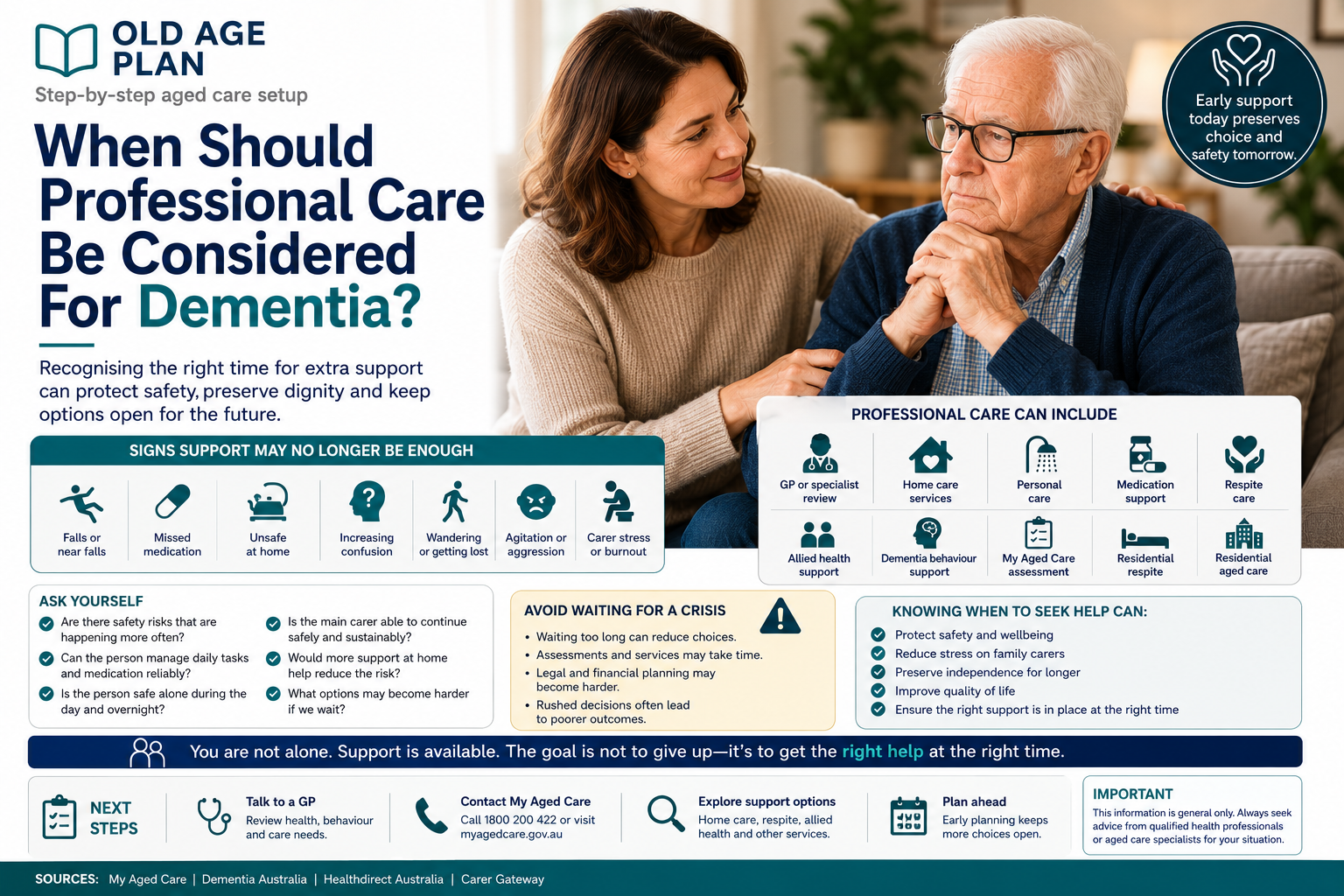

When Should Professional Care Be Considered For Dementia?
Many families try to support someone with dementia at home for as long as possible.
That can be the right goal. Staying at home may preserve familiarity, comfort and independence. But dementia can change over time, and the level of support that worked earlier may eventually stop being enough.
The difficult question is not only whether professional care is needed. It is whether waiting longer is starting to reduce safety, choices and support options.
Short Answer
Professional care should be considered for dementia when safety, daily living, medication, behaviour, mobility, nutrition, hygiene, supervision or carer capacity can no longer be managed reliably with informal family support alone.
This does not always mean residential aged care. It may begin with GP review, My Aged Care assessment, home care services, respite care, allied health support, dementia support services or increased supervision.
Key Takeaway
Professional care should be considered before a crisis forces the decision. The aim is not to move too early or remove independence unnecessarily. The aim is to recognise when extra support is needed while there are still choices available.
Professional Care Does Not Always Mean Residential Care
When families hear “professional care,” they may immediately think of residential aged care.
But professional care can include many levels of support.
Depending on the situation, it may include:
- GP review
- geriatrician or specialist review
- occupational therapy
- home care services
- personal care support
- meal support
- medication assistance
- respite care
- dementia behaviour support
- My Aged Care assessment
- residential respite
- residential aged care
The first step is usually not to choose the final care setting. The first step is to work out what kind of support is now needed.
Signs Family Support May No Longer Be Enough
Family support may need to increase when risks become more frequent, serious or difficult to manage.
Warning signs may include:
- falls or near falls
- missed medication
- poor nutrition or dehydration
- unsafe cooking or appliances left on
- wandering or getting lost
- repeated confusion about time or place
- poor hygiene or changing personal care needs
- unsafe driving concerns
- financial vulnerability
- increased agitation, distress or aggression
- repeated hospital visits
- family members no longer coping safely
One incident may not mean a major care change is required. But repeated patterns should not be ignored.
Safety Is Often The Turning Point
Safety concerns often move dementia care from informal support to professional support.
This may happen when the person is no longer safe alone for long periods, cannot reliably manage medication, leaves the house unexpectedly, forgets appliances or is vulnerable to scams, falls or confusion.
The decision is not simply whether the person can still live at home.
The better question is:
What level of support is needed for home to remain safe enough?
Sometimes home can remain workable with more support. Sometimes the support needed becomes too frequent, unpredictable or complex for family to manage alone.
Behaviour Changes May Need Professional Review
Changes in behaviour may be one of the clearest signs that extra help is needed.
This may include:
- frequent agitation
- distress that is hard to settle
- aggression or unsafe behaviour
- hallucinations or paranoia
- sleep disruption
- wandering
- refusing essential care
- severe anxiety or fear
Behaviour changes are not always “just dementia.” They may be linked to pain, infection, delirium, medication side effects, fear, overstimulation or unmet needs.
If behaviour changes suddenly, becomes unsafe or escalates, professional review should not wait.
Carer Capacity Matters Too
Professional care should not only be considered when the person with dementia is struggling.
It should also be considered when the main carer or family support system is becoming unsafe, exhausted or unable to continue reliably.
Signs may include:
- one person carrying most responsibility
- family conflict about care decisions
- missed work or constant disruption
- sleep loss due to supervision needs
- no backup support
- resentment or constant tension
- care tasks becoming physically unsafe
- the carer avoiding medical appointments or support because there is no time
If the support arrangement depends on one person never becoming sick, tired or unavailable, it may already be fragile.
When Home Care May Be The Next Step
Home care may be worth considering when the person can still live at home, but practical support is needed.
Home care may help with:
- personal care
- cleaning
- meals
- transport
- shopping
- medication prompts
- social support
- respite for carers
- basic home safety support
Home care can sometimes preserve independence for longer. But it needs to match the person’s actual needs. A few short visits may not be enough if supervision is needed throughout the day or night.
When Residential Care May Need To Be Considered
Residential aged care may need to be considered when care needs become too frequent, risky or complex to manage safely at home.
This may be more likely when:
- the person needs regular supervision
- night-time safety is a serious issue
- wandering creates ongoing risk
- falls are repeated
- personal care needs are high
- behaviour changes are unsafe
- family carers cannot continue safely
- home care is no longer enough
- hospital discharge requires a higher level of support
This is often the hardest point for families because it can feel like a personal failure.
It is not.
Residential care is sometimes considered because the support need has changed, not because the family stopped caring.
The Risk Of Waiting Too Long
Waiting can feel kinder because it avoids a difficult decision.
But waiting too long can reduce options.
For example:
- legal planning may become harder if capacity changes
- home care approvals may take time
- respite may not be immediately available
- preferred providers may have wait times
- hospital discharge may force rushed decisions
- family conflict may increase under pressure
- the person may have less ability to participate in decisions
The goal is not to rush into care.
The goal is to avoid waiting until crisis removes better choices.
The Risk Of Acting Too Early
There is also a risk in acting too early.
Moving too quickly into formal care, especially residential care, may reduce independence before it is necessary.
Before major care changes, it is worth asking:
- Have reversible causes been checked?
- Could home care reduce the risk?
- Would respite help the family reset?
- Would occupational therapy improve safety?
- Would medication review help?
- Would routine, communication changes or behaviour support help?
- Is the current concern temporary or repeated?
Good dementia care avoids both extremes: waiting until crisis, and escalating before the support need is clear.
What You May Really Be Trying To Decide
If you are asking when professional care should be considered for dementia, you may already be noticing that something has changed.
You may be asking whether the person can still live safely at home, whether the family is coping, whether home care is enough or whether residential care is becoming unavoidable.
The deeper question may be:
Are we still preserving independence, or are we now relying on luck, exhaustion and last-minute fixes?
Decision Support
A practical way to think about professional care is to look at pattern, risk and support capacity.
Ask:
- What risks are happening repeatedly?
- What support is needed every day?
- What support is needed overnight?
- Can medication, meals and hygiene be managed reliably?
- Is the person safe alone?
- Can the main carer continue safely?
- Have medical causes for sudden changes been checked?
- Would home care, respite or allied health support help?
- What options may become harder if we wait?
If the answer points to rising risk, professional care should be explored early enough to compare options calmly.
Exploring care does not mean committing immediately. It means understanding what support may be needed before the decision is forced.
Related Old Age Plan Articles
- How Do You Support Someone With Dementia?
- How Do You Calm Someone With Dementia?
- Can Routine Help Someone With Dementia?
- What Happens When Someone With Dementia Loses Capacity?
Next Steps With Old Age Plan
If professional care is starting to feel necessary, it may help to organise what is happening before contacting services or making major decisions.
Old Age Plan’s Free OAP Tools can help families record care concerns, prepare questions and identify which support needs are becoming harder to manage.
If care needs are becoming more complex, a structured planning resource may also help families compare support options without rushing into the first available solution.
The aim is not to force a move into care. The aim is to understand what level of support is now needed while there is still time to plan well.
Sources
- My Aged Care — Caring For Someone Living With Dementia
- My Aged Care — Living With Memory Loss, Dementia Or Depression
- Dementia Australia — Family, Friends And Carers
- Dementia Australia — Changed Behaviours And Dementia
- Healthdirect Australia — Support For Carers Of People With Dementia
- Carer Gateway
Disclaimer
This article provides general information only and is not medical, legal or financial advice.
Dementia care needs vary depending on the person’s diagnosis, symptoms, health conditions, decision-making ability, home environment, safety risks, funding options and available support. Aged care services, eligibility rules and clinical guidance may change over time.
Always seek advice from qualified health professionals, aged care assessors, legal professionals or relevant support services where appropriate. For current information, refer to My Aged Care, Dementia Australia, Healthdirect, Carer Gateway and relevant Australian health and aged care professionals.
Summary
Professional care should be considered for dementia when informal support is no longer enough to manage safety, daily living, behaviour, medication, hygiene, supervision or carer capacity reliably.
This does not always mean residential care. Professional care may begin with GP review, home care, respite, allied health, dementia behaviour support or My Aged Care assessment.
The safest approach is to explore support before crisis forces the decision, while still preserving independence and choice wherever possible.