
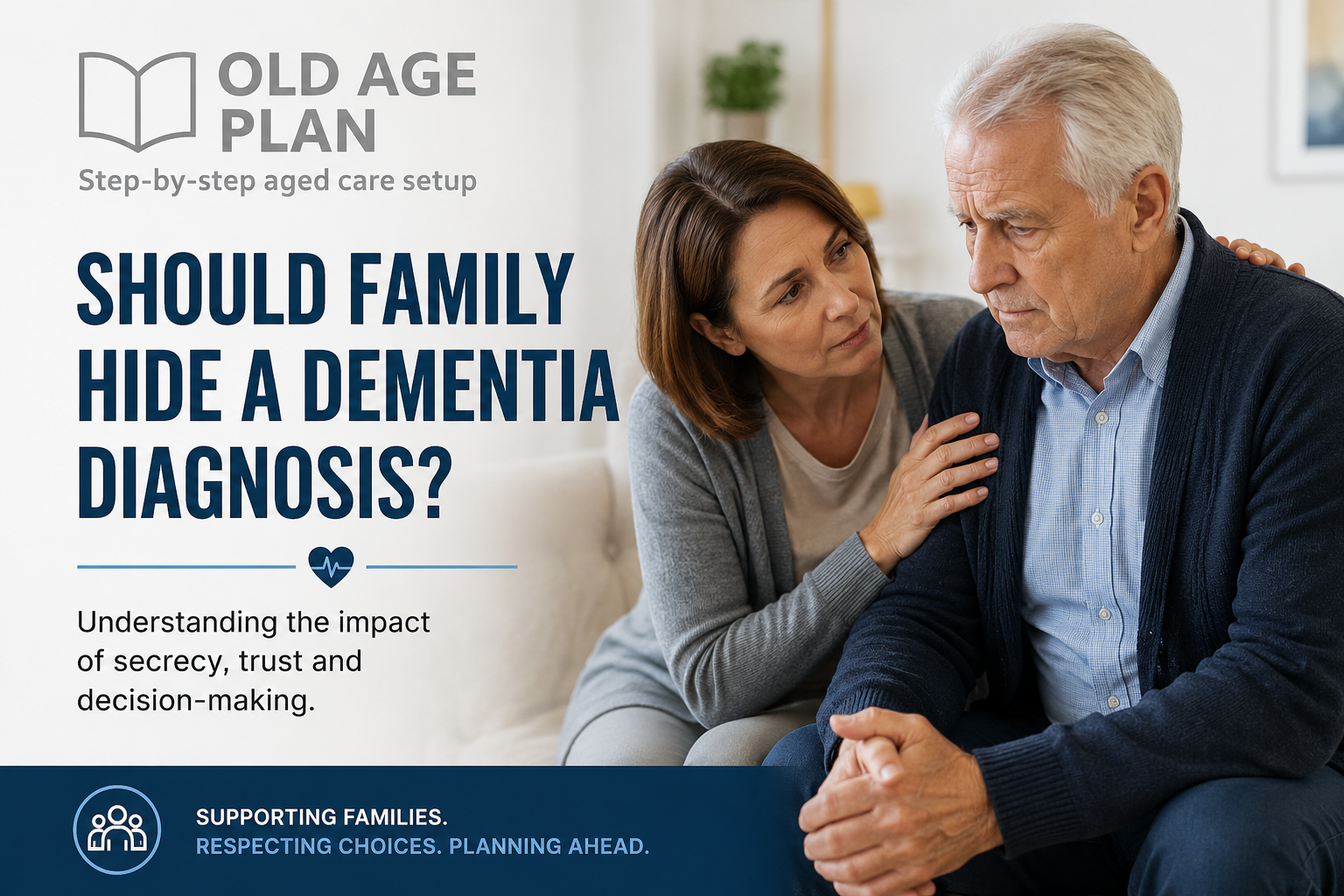

Should Family Hide A Dementia Diagnosis?
Should family hide a dementia diagnosis from the person who has been diagnosed? It can feel protective. You may worry that telling them will cause fear, shame, anger or distress. You may also worry they will not understand, will deny it, or will keep asking the same painful questions.
But hiding a dementia diagnosis is not a small communication choice. It can affect autonomy, trust, planning, consent and family decision-making. The real question is not only whether the truth will upset them. It is whether withholding the truth protects them, or quietly removes their right to take part in decisions while they still can.
Short Answer
Family should not automatically hide a dementia diagnosis. In most cases, the person has a right to understand what is happening to them in a way they can reasonably process. However, disclosure may need to be gentle, staged and supported, especially if the person is distressed, has limited insight or cannot retain the information.
There may be rare situations where repeating the diagnosis causes harm without benefit. But secrecy should not become the default just because the conversation is difficult.
Key Takeaway
Hiding a dementia diagnosis may feel compassionate, but it can also become paternalistic. The better approach is usually supported disclosure: tell the truth in a way that protects dignity, reduces distress and allows the person to participate in decisions for as long as they can.
Why Families Consider Hiding A Dementia Diagnosis
Families rarely hide a dementia diagnosis because they are careless. Most do it because they are frightened.
Common reasons include:
- fear the person will panic or become depressed
- fear they will deny the diagnosis
- fear they will become angry at the family
- belief that “they would not understand anyway”
- belief that knowing will make dementia worse
- desire to avoid repeated painful conversations
- family shame, cultural pressure or embarrassment
These fears can be real. A dementia diagnosis can be deeply confronting. It may affect identity, independence, relationships, work, driving, legal planning and future care decisions.
But difficulty is not the same as justification for secrecy.
Old Age Plan treats this as a decision-support issue, not a simple yes-or-no communication rule. The question is not, “Will this be upsetting?” The question is, “What decision rights, planning opportunities or trust risks are created if the diagnosis is hidden?”
The Difference Between Gentle Disclosure And Secrecy
Families sometimes confuse careful timing with hiding.
There is a major difference between:
- choosing the right time and support to explain the diagnosis
- using simple language because the person is overwhelmed
- repeating information gently over time
- avoiding harsh or frightening detail all at once
and:
- pretending nothing has changed
- telling others but not the person diagnosed
- making decisions around them without involving them
- using the diagnosis privately to justify control
- blocking conversations with doctors, friends or relatives
The first approach is supported disclosure.
The second approach is secrecy.
Supported disclosure protects the person while still respecting their place in the decision.
Secrecy can remove them from their own life.
For the broader disclosure question, see Should You Tell Someone They Have Dementia?.
Why Hiding The Diagnosis Can Cause Harm
Hiding a dementia diagnosis may reduce immediate distress, but it can create larger problems later.
The person may still notice something is wrong. They may feel confused, frightened or excluded without understanding why everyone else is acting differently.
They may wonder why:
- family members are suddenly managing appointments
- people are whispering around them
- driving, money or medication is being questioned
- others are making plans without them
- their concerns are being brushed aside
That can damage trust.
It can also delay important planning. A person in the early stages of dementia may still be able to express preferences, update documents, discuss care wishes, choose who they trust, and say what matters to them.
If the family hides the diagnosis until capacity has declined further, some choices may become harder, more contested or no longer available.
Related planning articles include Can Someone With Dementia Make Legal Decisions? and When Does Someone With Dementia Lose Capacity?.
When Protection Becomes Control
This is the uncomfortable part.
Families often describe hiding a diagnosis as protection.
They may say:
- “We do not want to upset them.”
- “They cannot handle it.”
- “There is no point telling them.”
- “It is easier if we manage things quietly.”
Sometimes those concerns are sincere and reasonable.
But protection can become control when the diagnosis is used to exclude the person from decisions they may still be able to understand.
The brutal question is:
Are you protecting them from harm, or protecting the family from a difficult conversation?
Another question matters just as much:
Who gains power when the diagnosis is hidden?
If hiding the diagnosis allows family members to make decisions faster, avoid disagreement, control money, control care arrangements or manage appearances, the ethical risk rises sharply.
This does not mean every family has bad intentions. It means dementia creates a power shift. Once one person knows the truth and the diagnosed person does not, the information balance changes.
That imbalance can be compassionate.
It can also become paternalism.
A useful test is:
Does withholding this diagnosis preserve dignity, or does it remove participation?
If the answer is uncomfortable, the family may need support from a GP, specialist, counsellor, dementia support service or legal professional before deciding how to proceed.
What If The Person Cannot Understand The Diagnosis?
Some people with dementia may not fully understand or retain the diagnosis. That does not automatically mean the family should hide it.
Understanding is not all-or-nothing.
A person may not remember the word “dementia,” but they may understand:
- their memory is changing
- they need support with some tasks
- certain decisions are becoming harder
- they want to stay at home as long as possible
- they trust one person more than another
That partial understanding still matters.
The goal may not be to force full clinical insight. The goal may be to help them understand enough to participate in the next decision.
For example, instead of saying:
“You have dementia and you need to accept it.”
A more useful approach may be:
“The doctor found changes with memory and thinking. We want to make sure you have the right support and that your wishes are understood.”
This gives truthful information without turning the conversation into a confrontation.
For related communication support, see Should You Correct Someone With Dementia?.
What If Telling Them Causes Distress?
A dementia diagnosis can cause grief, fear, anger or denial. That does not automatically mean disclosure was wrong.
Some truths are painful because they matter.
The question is whether the distress can be supported, not whether all distress can be avoided.
Families can reduce harm by:
- choosing a calm time
- using simple language
- having a trusted person present
- allowing silence and emotion
- avoiding too much information at once
- linking the diagnosis to practical support, not doom
Disclosure should not feel like dropping a verdict and walking away.
It should feel like opening a supported conversation.
If the person becomes very distressed, repeated blunt discussion may not help. The family may need to slow down, use gentler language, involve the GP, or focus on immediate support rather than repeating the label.
For calming strategies, see How Do You Calm Someone With Dementia?.
When Repeating The Diagnosis May Not Help
There is a difference between telling someone once in a supported way and repeatedly forcing the same diagnosis into every conversation.
If the person cannot retain the diagnosis, repeating it harshly may cause fresh shock each time.
For example, if someone asks, “Why do I need help?” the answer does not always need to be:
“Because you have dementia. We already told you.”
A gentler response may be:
“Your memory has been making things harder lately, so we are putting support around you.”
This stays truthful without weaponising the diagnosis.
That distinction matters.
Do not hide the diagnosis to avoid all discomfort.
But do not use the diagnosis as a blunt instrument every time the person is confused.
Good dementia communication protects both truth and dignity.
What If Family Members Disagree About Telling Them?
Family disagreement is common.
One person may say, “They deserve to know.” Another may say, “It will destroy them.” Someone else may say, “Let the doctor handle it.”
This disagreement should not be dismissed as drama. It can shape the person’s future care, legal planning and trust in the family.
Families should ask:
- What has the person previously said about wanting to know health information?
- Can they currently understand part of what is happening?
- What decisions still need their input?
- Who benefits if they are not told?
- What risks increase if disclosure is delayed?
If disagreement continues, it may help to involve the diagnosing doctor, a dementia support professional, a counsellor or a legal adviser where planning decisions are affected.
For related family decision issues, see Who Should You Tell After A Dementia Diagnosis? and When Can Family Override Decisions?.
What You May Really Be Trying To Decide
If you are asking whether family should hide a dementia diagnosis, you may really be asking:
- Will telling them cause unnecessary harm?
- Are we allowed to decide what they can handle?
- Are they still able to take part in planning?
- Are we protecting them, or excluding them?
- What happens if we wait too long?
This is the real decision tension.
Hiding the diagnosis may reduce distress today, but it may also remove tomorrow’s choices.
Telling the diagnosis may cause distress today, but it may also allow honesty, planning, trust and supported autonomy.
Old Age Plan does not treat disclosure as a slogan. The right approach depends on the person’s understanding, emotional state, decision reliability, safety risks and the decisions that still need to be made.
Decision Support: A Disclosure Test For Families
Before deciding to hide or disclose a dementia diagnosis, ask five questions.
1. Can the person understand some part of what is happening?
They may not understand everything. But if they can understand enough to express preferences, that matters.
2. Are important decisions still open?
If legal, financial, medical, driving, home care or future care decisions are still being made, the person should be included as much as possible.
Related articles include Can Someone With Dementia Make Medical Decisions? and Can Someone With Dementia Refuse Care?.
3. Is withholding the diagnosis temporary or indefinite?
Delaying disclosure until the right support is present may be reasonable. Avoiding it indefinitely is a different decision.
4. Who benefits from secrecy?
If secrecy mainly protects the family from discomfort, conflict or inconvenience, the decision needs review.
5. What is the least harmful truthful approach?
The choice is not usually blunt truth versus total silence. Often the best path is gentle, staged, supported truth.
A simple OAP rule:
Do not use protection as a reason to remove participation before it is necessary.
When To Get Extra Help
Consider extra support if:
- the person becomes highly distressed after disclosure
- family members strongly disagree about telling them
- the person denies the diagnosis but risks are increasing
- legal or financial decisions are urgent
- driving, medication or home safety is becoming unsafe
- family members are making decisions without clear authority
- you are unsure whether the person still has decision-making capacity
A GP, specialist, dementia support service, counsellor or legal professional may help the family choose a safer communication and planning pathway.
If confusion or behaviour changes suddenly, do not assume it is only dementia progression. Infection, dehydration, medication effects, delirium, pain and poor sleep can worsen confusion and may need medical review.
Related articles include Can Delirium Be Mistaken For Dementia?, Can Infection Make Dementia Worse?, Can Medication Make Dementia Worse? and Can Poor Sleep Make Dementia Worse?.
Related Old Age Plan Articles
- Should You Tell Someone They Have Dementia?
- Should You Correct Someone With Dementia?
- Who Should You Tell After A Dementia Diagnosis?
- How Do You Calm Someone With Dementia?
- How Do You Support Someone With Dementia?
- Can Someone With Dementia Make Legal Decisions?
- When Does Someone With Dementia Lose Capacity?
- When Can Family Override Decisions?
Next Steps With Old Age Plan
If your family is struggling with whether to disclose a dementia diagnosis, the next step is usually not forcing the conversation or avoiding it completely. It is preparing for the discussion properly.
Start with a structured conversation using the Family Discussion Checklist, available free on Old Age Plan’s Free Tools page. This can help families identify what the person already understands, what decisions still need their input, and where conflict is forming.
If the conversation is complex or family members disagree, the Family Meeting Planner can help organise concerns, priorities and next-step decisions before tensions escalate.
For broader planning around legal, medical and future care decisions, the Aged Care Starter Pack or Complete Aged Care Planning Pack may provide more structured support.
Frequently Asked Questions
Should you tell someone they have dementia?
In most cases, yes. The person should usually be told in a way they can understand and with the right support around them. For the broader disclosure issue, see Should You Tell Someone They Have Dementia?.
Is it ever okay not to repeat a dementia diagnosis?
Yes. If the person cannot retain the diagnosis and repeating it causes fresh distress each time, it may be better to use gentler wording while still staying truthful about support needs.
What if family members disagree about telling them?
Family disagreement should be handled carefully because secrecy can affect trust, planning and decision-making. A structured family discussion may help before conflict escalates. See Who Should You Tell After A Dementia Diagnosis?.
Can someone with dementia still make decisions after diagnosis?
Yes, depending on the decision and their level of understanding. Capacity is decision-specific and may change over time. See Can Someone With Dementia Make Legal Decisions? and Can Someone With Dementia Make Medical Decisions?.
When does hiding the diagnosis become a problem?
It becomes a problem when secrecy removes the person from decisions they could still participate in, delays planning, or gives family members control without proper authority.
What if the person becomes distressed after being told?
Distress does not automatically mean disclosure was wrong. The conversation may need to be slowed down, supported by a GP or dementia professional, and followed with reassurance. See How Do You Calm Someone With Dementia?.
What if the person denies the diagnosis?
Denial is common. Avoid turning every conversation into an argument. Focus on support, safety and the next practical decision. For related communication issues, see Should You Correct Someone With Dementia?.
When should families get professional help?
Get help if legal, financial, medical, driving, care or safety decisions are affected, or if family members are making decisions without clear authority. See When Does Someone With Dementia Lose Capacity? and When Can Family Override Decisions?. aim is to preserve trust, dignity and participation for as long as possible.
Sources
Disclaimer
This article is general information only and is not medical, legal or financial advice.
Dementia affects people differently. Decisions about disclosure, capacity, care, legal planning and safety should take account of the person’s condition, understanding, emotional wellbeing, risks and support network.
Laws, policies, services and clinical guidance may change, and personal circumstances vary. You should seek advice from a qualified health professional, legal professional, aged care professional or relevant support service for your situation.
For current dementia information and support in Australia, consider speaking with your GP and referring to Dementia Australia, Healthdirect, My Aged Care and Carer Gateway.
Summary
Family should not automatically hide a dementia diagnosis. While disclosure may need to be gentle, staged and supported, secrecy can damage trust, reduce autonomy and delay important planning. The better question is not only whether the truth will upset them, but whether withholding it removes their chance to participate in decisions while they still can.