
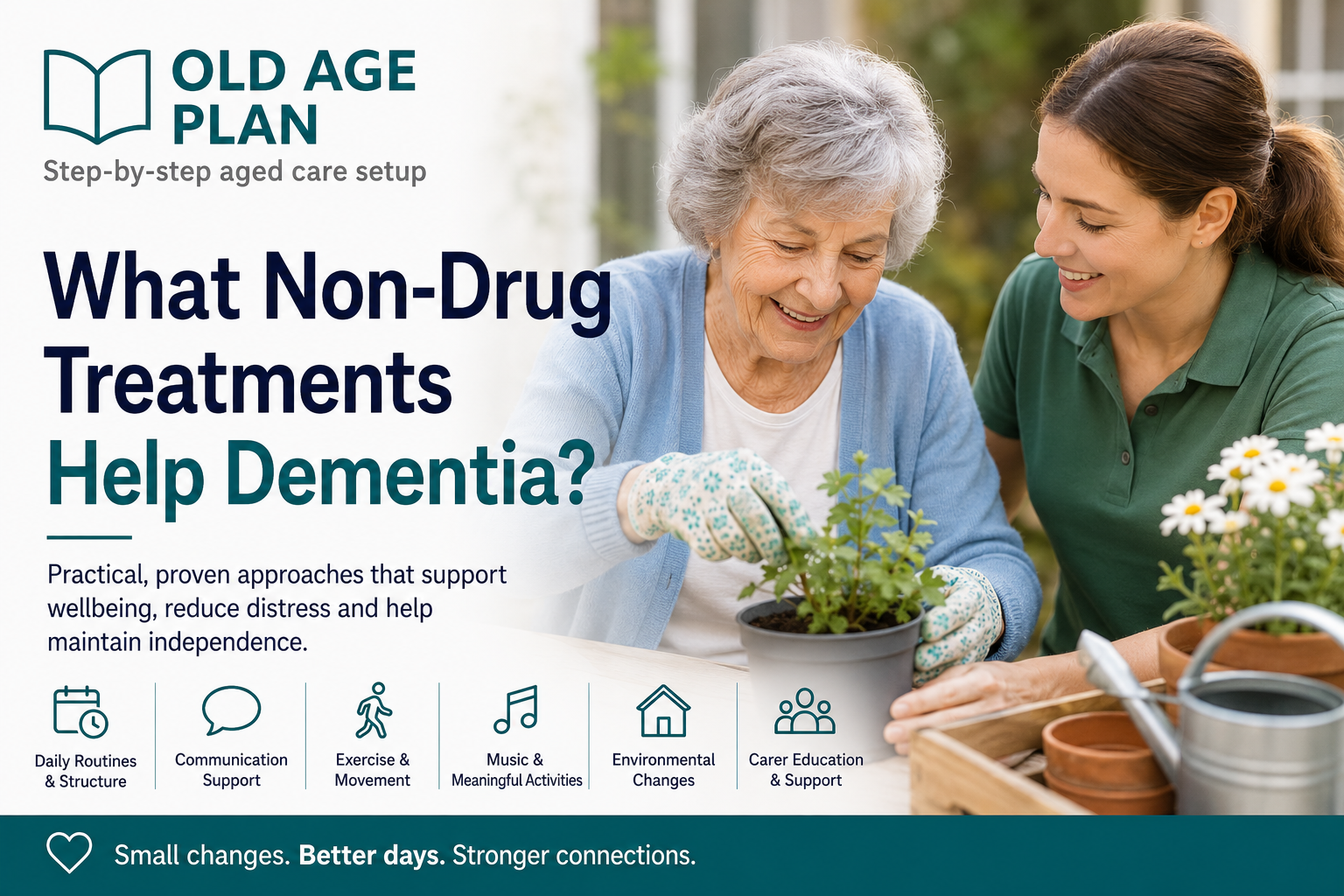

What Non-Drug Treatments Help Dementia?
When someone is living with dementia, medication is only one part of treatment and management.
Families often want to know what else may help. That question matters because daily routines, communication, environment, activities and support can affect how safe, calm and capable a person feels.
Non-drug treatments do not cure dementia. But they may help people live better with dementia and may reduce some distress, confusion or avoidable decline.
Short Answer
Non-drug treatments that may help dementia include routine, communication support, meaningful activities, exercise, music, occupational therapy, cognitive stimulation, environmental changes and carer education.
The right approach depends on the person, their symptoms, their dementia type, their home environment and what is causing the difficulty.
Key Takeaway
Non-drug treatments work best when they are matched to the person’s needs. The goal is not to force activity or control behaviour. The goal is to support function, reduce distress, preserve independence where possible and make daily life easier to manage.
Why Non-Drug Treatments Matter
Dementia affects more than memory.
It can affect communication, confidence, sleep, mobility, mood, behaviour, safety and daily routines.
Medication may help some symptoms for some people, but it does not replace everyday support. Many dementia challenges happen in real situations: getting dressed, taking medicine, preparing meals, leaving the house, managing appointments or coping with unfamiliar places.
That is where non-drug support can matter.
Routine And Familiarity
A steady routine can help reduce confusion and uncertainty.
This may include:
- regular meal times
- consistent sleep and waking times
- familiar daily activities
- simple visual reminders
- calm transitions between tasks
- fewer sudden changes where possible
Routine should not become rigid control. The aim is to make the day easier to understand, not to remove choice.
Communication Support
Communication often needs to change as dementia progresses.
Helpful approaches may include speaking slowly, using short sentences, offering one idea at a time, allowing extra time and reducing background noise.
It can also help to avoid constant correction. If the person says something that is not accurate, the better response may depend on the situation. Sometimes reassurance is more useful than argument.
The practical question is not “How do we make them understand everything?”
It is often:
How do we communicate in a way that reduces distress and supports the decision or task in front of us?
Meaningful Activities
Activities may help maintain identity, confidence and connection.
Useful activities may include:
- walking
- gardening
- music
- cooking simple familiar meals
- folding laundry
- looking through photos
- craft or art
- simple household tasks
- spending time with pets
The activity does not need to look impressive. It needs to be meaningful, safe and suited to the person’s current ability.
Exercise And Physical Activity
Physical activity may support general health, mood, sleep, mobility and confidence.
This may include walking, gentle exercise, supervised group activity or movement built into daily routines.
The right level depends on the person’s health, balance, falls risk and medical advice. For some people, exercise may be simple and gentle. For others, professional guidance may be needed.
Occupational Therapy
Occupational therapy may help a person continue daily activities more safely and independently.
An occupational therapist may look at:
- home safety
- daily routines
- falls risks
- memory prompts
- bathroom or kitchen setup
- equipment needs
- ways to simplify tasks
This can be especially useful when a person is still living at home but daily tasks are becoming harder.
Cognitive Stimulation And Rehabilitation
Some people may benefit from structured cognitive stimulation or rehabilitation, especially in earlier stages.
This may involve supported activities designed to engage thinking, memory, language or problem-solving in a practical way.
The aim is not to “train dementia away.” The aim is to support remaining abilities, confidence and participation.
Music, Reminiscence And Sensory Approaches
Music can be powerful for some people with dementia, especially when songs are familiar and personally meaningful.
Reminiscence activities, such as photos, familiar objects or life-story conversations, may also support connection.
Some people may respond well to gentle sensory approaches such as hand massage, calming scents, touch, familiar textures or quiet spaces.
These supports should be used respectfully. What is calming for one person may be irritating or confusing for another.
Environmental Changes
The environment can make dementia symptoms easier or harder to manage.
Helpful changes may include:
- reducing clutter
- improving lighting
- removing trip hazards
- using clear signs or labels
- keeping important items in consistent places
- reducing noise and distractions
- making bathrooms and bedrooms easier to navigate
Small changes can sometimes prevent larger problems. A confusing environment can make a person appear more impaired than they are.
Carer Education And Support
Families often focus on the person with dementia and forget that support also needs to include the people helping them.
Carer education may help families understand:
- why behaviour changes happen
- how to respond to distress
- how to simplify communication
- when safety concerns are increasing
- how to prepare for medical appointments
- when extra help may be needed
This can reduce avoidable conflict and make support more consistent.
When Behaviour Changes Need Careful Review
Behaviour changes are not always “just dementia.”
Agitation, aggression, withdrawal, wandering, sleep disruption or distress may be linked to:
- pain
- infection
- constipation
- dehydration
- medication side effects
- delirium
- fear or confusion
- changes in routine
- overstimulation
- unmet needs
Before assuming medication is the answer, it may be important to ask what the behaviour is communicating.
If behaviour creates serious safety risk, professional help should be sought promptly.
What You May Really Be Trying To Decide
If you are asking about non-drug treatments, you may really be trying to decide whether there is still something useful you can do.
The answer is often yes.
But the useful action may not be one big treatment. It may be a combination of smaller supports: clearer routine, better communication, safer environment, more meaningful activity, professional review and carer support.
The deeper question is:
What is making daily life harder right now, and what kind of support is most likely to reduce that difficulty?
Decision Support
A helpful way to think about non-drug dementia support is to start with the problem, not the treatment.
Ask:
- Is the main issue memory, safety, behaviour, communication, routine or daily function?
- Has something changed recently?
- Could pain, infection, medication or delirium be involved?
- Is the environment making things harder?
- Is the person being asked to do too much at once?
- Is the family responding consistently?
- Would GP, occupational therapy, allied health or dementia support services help?
This avoids two common mistakes.
The first mistake is waiting too long because the person is “not bad enough yet.” The second is acting too heavily and removing independence before support has been properly tested.
Good dementia support usually sits between those extremes.
Related Old Age Plan Articles
- Can Dementia Be Treated?
- What Medications Are Used For Dementia?
- Can Dementia Medication Slow Progression?
- What Happens After A Dementia Diagnosis?
Next Steps With Old Age Plan
If daily support is becoming harder, it may help to organise what is changing before speaking with a GP, My Aged Care, Dementia Australia or another support service.
Old Age Plan’s Free OAP Tools can help families record observations, prepare appointment questions and identify which parts of daily life are becoming harder to manage.
The goal is not to build a complete care system overnight. The goal is to move from scattered concerns to clearer next steps.
Sources
- Dementia Australia — Non-Pharmacological Treatments For Dementia
- Dementia Australia — Treatment And Management Of Dementia
- Healthdirect Australia — Dementia Overview
- RACGP — Behavioural And Psychological Symptoms Of Dementia
- NICE — Dementia Assessment, Management And Support Recommendations
- My Aged Care — Living With Memory Loss, Dementia Or Depression
Disclaimer
This article provides general information only and is not medical, legal or financial advice.
Dementia support needs vary depending on the person’s diagnosis, symptoms, health conditions, home environment, risks and available support. Treatment options, services and clinical guidance may change over time.
Always seek advice from qualified health professionals, such as a GP, geriatrician, occupational therapist, pharmacist or dementia support service, before making treatment or care changes. For current information, refer to Dementia Australia, Healthdirect, My Aged Care and relevant Australian health professionals.
Summary
Non-drug treatments that may help dementia include routine, communication support, meaningful activities, exercise, occupational therapy, cognitive stimulation, environmental changes and carer education.
These supports do not cure dementia, but they may improve daily function, reduce distress and help people remain involved in life for longer.
The most useful approach is to identify what is becoming harder, check for treatable causes and match support to the person’s current needs.