
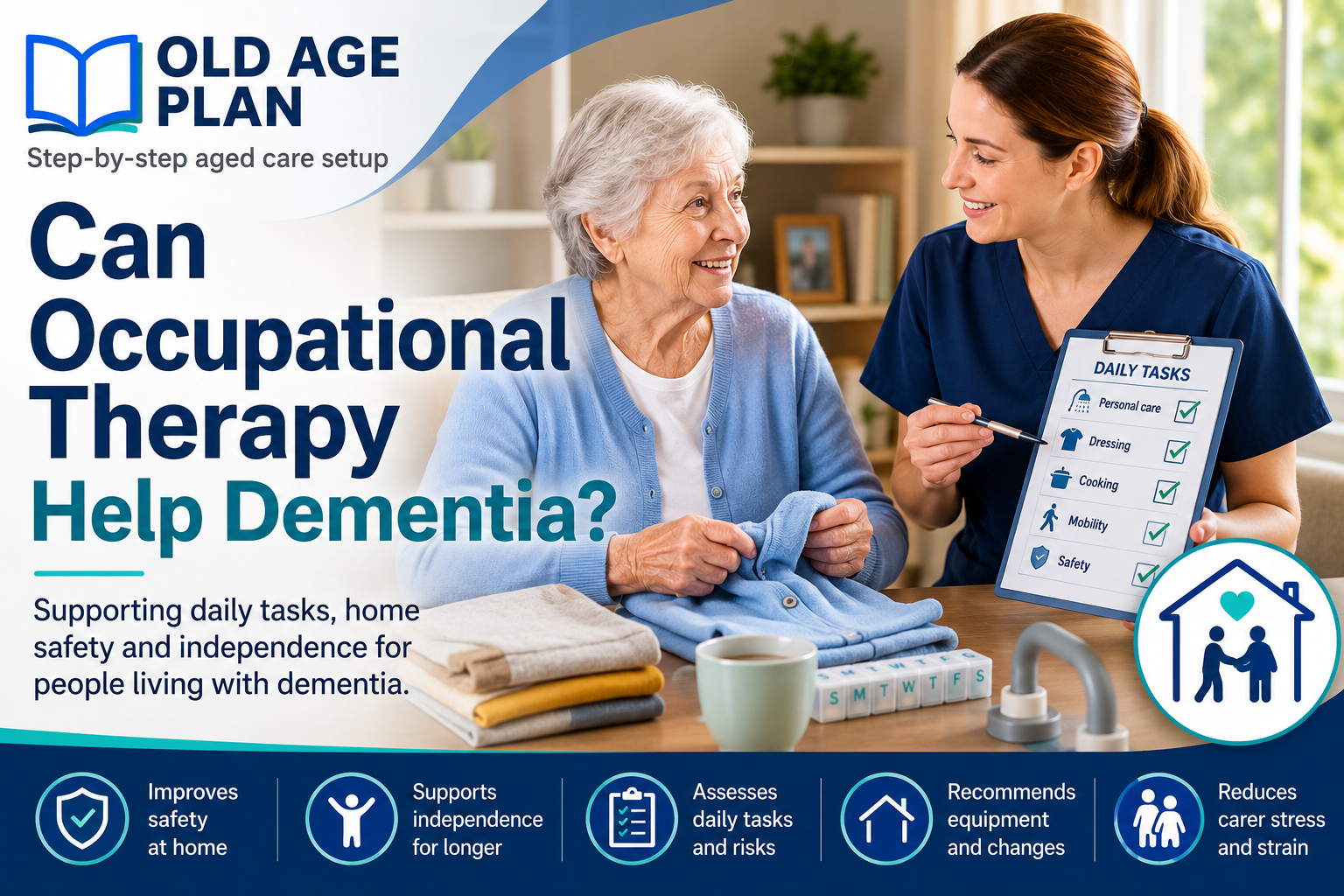

Can Occupational Therapy Help Dementia?
Families often ask whether occupational therapy can help dementia.
But the real concern is usually more practical than the question sounds.
Is everyday life becoming harder or less safe?
Are showering, dressing, cooking, walking around the home or using the bathroom becoming unreliable?
Are family carers quietly doing more because the person can no longer manage tasks the way they used to?
Occupational therapy cannot cure dementia. It cannot reverse memory loss.
But it can help families understand how dementia is affecting daily function, home safety, independence and care needs.
That makes occupational therapy important because dementia decisions are often not triggered by memory alone.
They are often triggered when ordinary daily tasks start becoming unsafe, inconsistent or too difficult to manage without support.
Short Answer
Yes, occupational therapy can help some people with dementia.
An occupational therapist may help assess daily activities, home safety, equipment needs, routines, carer strain and ways to support independence for as long as possible.
Occupational therapy does not treat dementia itself in the way medication might target symptoms.
Its value is practical.
It helps identify what the person can still do, what has become unreliable and what changes may make daily life safer and easier.
Key Takeaway
The main value of occupational therapy in dementia is not simply “more support.”
It is clearer visibility.
Occupational therapy can help reveal where daily function is starting to break down.
That may include showering, dressing, cooking, medication routines, transfers, falls risk, home layout or carer burden.
For families, this can turn vague concern into a clearer decision.
Is the person still safe with minor adjustments?
Do they need supervision?
Does the home need changes?
Or are care needs beginning to move beyond what family can safely manage?
What Does An Occupational Therapist Do?
An occupational therapist, often called an OT, helps people manage everyday activities.
In dementia care, this may involve looking at how the person functions at home, how safe the environment is and what support may help them keep doing meaningful tasks.
An OT may consider:
- personal care tasks
- showering and toileting
- dressing
- meal preparation
- mobility around the home
- falls risks
- home layout
- equipment needs
- memory prompts and visual cues
- carer safety
- routines and task simplification
The goal is not to make the person “normal again.”
The goal is to support function, safety, comfort and dignity within the person’s current abilities.
Why Occupational Therapy Matters In Dementia
Dementia can affect more than memory.
It can affect sequencing, judgement, attention, problem-solving, spatial awareness, communication and the ability to complete familiar tasks.
That means a person may know what they want to do but struggle to complete the task safely.
They may start a shower but forget steps.
They may cook but leave the stove on.
They may dress but choose clothing that does not suit the weather.
They may walk around the home but become unsafe in the bathroom or on stairs.
This is where occupational therapy can be useful.
It looks at daily life as it actually happens, not just memory scores or diagnosis labels.
Occupational Therapy Can Reveal Functional Reliability
One of the most important questions in dementia care is not simply whether someone can complete a task once.
The better question is:
Can they complete that task reliably enough to remain safe?
This matters because dementia often creates inconsistency.
A person may dress independently some days but become confused on others.
They may manage breakfast when the routine is familiar but become unsafe if something changes.
They may shower safely when supervised but not when alone.
They may use the toilet during the day but become unsafe overnight.
Occupational therapy can help identify whether a task is still reliable, partly reliable or no longer safe without support.
That distinction is important.
It helps families avoid two common mistakes:
- removing independence too early
- leaving risk unsupported for too long
The Real Tension: Independence Versus Safety
Occupational therapy often sits inside a difficult family tension.
Families want to preserve independence.
They also want to prevent harm.
Those goals can clash.
If family steps in too early, the person may lose confidence, routine and dignity.
If family waits too long, risks may build quietly around falls, burns, hygiene, medication, nutrition or carer injury.
The goal is not to take over everything.
The goal is to find the least intrusive support that keeps the person safe enough for the task in front of them.
That is where OT can help.
What Occupational Therapy May Help With
Occupational therapy may help with practical areas of daily life.
These may include:
Showering And Personal Care
Bathrooms can become high-risk areas.
There may be slippery surfaces, poor lighting, confusion about taps, difficulty stepping into the shower or uncertainty about sequencing personal care.
An OT may suggest safer routines, equipment, supervision strategies or bathroom modifications.
Dressing
Dressing can become harder when sequencing, judgement or decision-making changes.
The person may put clothes on in the wrong order, wear unsuitable clothing or become distressed by too many choices.
Simplifying clothing options or using visual cues may help.
Cooking And Kitchen Safety
Kitchen tasks involve memory, judgement, timing and hazard awareness.
Risks may include leaving appliances on, forgetting food, burns, sharp objects or unsafe food handling.
An OT may help assess whether kitchen routines are still safe and what changes may reduce risk.
Falls And Mobility Around The Home
Occupational therapy may help identify hazards such as loose mats, poor lighting, clutter, unsafe bathroom access, stairs or furniture layout.
This overlaps with mobility support, but OT focuses strongly on how the home environment affects safety and daily function.
For the movement side of this issue, see Can Exercise Help Dementia?.
Memory Prompts And Visual Cues
Some people benefit from simple prompts, labels, signs, clocks, calendars or visible routines.
The aim is not to overwhelm the home with instructions.
The aim is to reduce confusion at the points where the person regularly gets stuck.
Equipment And Home Modifications
Equipment may include rails, shower chairs, non-slip surfaces, improved lighting, ramps or other supports.
Home modifications should match the person’s actual needs, not just a generic list of aged care equipment.
A poorly chosen aid can create clutter, confusion or false confidence.
Occupational Therapy Is Not Just A Home Safety Checklist
It is easy to reduce OT to rails, shower chairs and trip hazards.
Those things matter.
But good dementia-focused occupational therapy is broader than equipment.
It asks how the person lives, what still matters to them, what the carer is carrying and where the environment is making dementia harder than it needs to be.
A dementia-friendly home is not only a safer home.
It should also support comfort, familiarity, independence and wellbeing.
When Occupational Therapy May Be Most Useful
Occupational therapy may be especially useful when:
- daily tasks are becoming inconsistent
- bathroom safety is becoming a concern
- falls or near falls are increasing
- the person is struggling with dressing or personal care
- kitchen safety is uncertain
- the home feels harder to manage
- family carers are physically or emotionally strained
- the person wants to stay at home but risks are increasing
- equipment or home modifications are being considered
This is where OT becomes more than a service referral.
It becomes a way to clarify whether home life is still working and what needs to change next.
When Occupational Therapy May Not Be Enough
Occupational therapy can help identify risks and support function.
But it may not solve every care problem.
More support may still be needed if:
- the person cannot be left safely alone
- wandering risk is increasing
- falls continue despite changes
- the person resists essential care
- carers can no longer provide safe physical support
- personal care needs exceed family capacity
- behaviour changes create safety risks
- home modifications are not enough to make the home workable
At that point, the decision may shift from “Can we adapt the home?” to “Can care still be safely managed here?”
For related escalation guidance, see When Should Professional Care Be Considered For Dementia?.
What You May Really Be Trying To Decide
The surface question is whether occupational therapy helps dementia.
The deeper decision is often about whether everyday life is still safe, workable and sustainable.
You may really be trying to decide:
- Can they still shower safely?
- Can they still dress appropriately?
- Can they still move around the home without unreasonable risk?
- Can they still use the kitchen safely?
- Is the home helping or making things harder?
- Are carers compensating too much?
- Do we need equipment or home modifications?
- Is staying at home still realistic without more support?
These are not small questions.
They often sit at the point where ordinary family support begins turning into structured care planning.
Decision Support
Before deciding whether OT is needed, consider three practical questions.
1. Which Daily Tasks Are Becoming Unreliable?
Do not only look for complete failure.
Look for inconsistency.
Is showering safe every time, or only when someone is nearby?
Is cooking safe when the person is calm, but unsafe when distracted?
Can they use the toilet safely during the day, but not overnight?
In dementia care, inconsistency is often the warning sign.
2. Is The Environment Increasing The Risk?
Sometimes the person’s ability has changed.
Sometimes the home no longer fits the person’s ability.
Poor lighting, clutter, slippery floors, confusing layouts, stairs, bathrooms and kitchen hazards can turn manageable dementia symptoms into daily risk.
An OT may help identify which risks can be reduced with practical changes.
3. Is The Carer Still Able To Support Tasks Safely?
This is a major decision point.
If family carers are lifting, guiding, supervising showers, managing toileting, preventing falls or constantly compensating for unsafe tasks, the care burden may already have shifted.
When carers can no longer safely support daily activities, the decision may begin transferring toward allied health input, formal care services or a wider care review.
That does not mean family has failed.
It means the care task has changed.
How Occupational Therapy Decisions Usually Escalate
OT-related decisions often escalate in stages.
- Notice difficulty — small changes in daily tasks, confidence or safety.
- Simplify the task — fewer steps, fewer choices, clearer routines.
- Adjust the environment — lighting, layout, labels, reduced hazards.
- Add equipment or prompts — rails, chairs, signs, clocks or assistive technology.
- Seek OT assessment — professional review of function, risks and supports.
- Review care needs — if daily support now exceeds what family can manage safely.
This ladder is important because families often wait for a major incident.
But OT may be most useful before a crisis, when small changes can still preserve function and reduce risk.
Occupational Therapy And Staying At Home
Many families hope to keep a person with dementia at home for as long as possible.
Occupational therapy may support that goal by identifying what would make home life safer and more manageable.
But staying at home should not only mean staying in the same building.
It should mean the person is still reasonably safe, supported and cared for.
If the home environment can be adapted, OT may help preserve independence.
If the person’s needs keep increasing despite changes, the family may need to consider wider care planning.
For stage-related context, see What Happens In The Middle Stages Of Dementia? and What Happens In Late-Stage Dementia?.
Occupational Therapy, Routine And Dementia Support
OT often works best when practical changes are linked to routine.
A new shower chair may help physically, but the person may still need a calm, familiar shower routine.
A sign on a door may help, but only if it matches what the person can understand.
A simplified wardrobe may reduce distress, but only if the person’s preferences are respected.
Equipment alone is rarely the full answer.
Routine, communication and support still matter.
For related reading, see Can Routine Help Someone With Dementia? and How Do You Support Someone With Dementia?.
Occupational Therapy And Behaviour Changes
Sometimes behaviour changes are partly linked to the environment.
A person may resist showering because the bathroom feels cold, confusing or unsafe.
They may become agitated because they cannot find what they need.
They may pace because they are restless, uncomfortable or unsure where to go.
OT does not solve every behaviour change, but it may help identify environmental triggers and practical adjustments.
If distress or agitation is a major issue, see How Do You Calm Someone With Dementia?.
Occupational Therapy Is Different From Exercise Or Cognitive Stimulation
Occupational therapy overlaps with other dementia supports, but it has a different focus.
Exercise often focuses on strength, movement and mobility.
Cognitive stimulation focuses on engagement, thinking and communication.
Occupational therapy focuses on everyday function.
It asks:
Can this person still do the daily task safely, with dignity and with the right level of support?
For related articles, see Can Exercise Help Dementia? and Can Cognitive Stimulation Help Dementia?.
When To Seek More Support
Consider seeking more support if:
- daily tasks are becoming unsafe
- falls or near falls are increasing
- bathroom safety is worrying
- cooking safety is uncertain
- the person is getting stuck during familiar tasks
- the carer is physically strained
- the home feels confusing or unsafe
- equipment or home modifications are being considered
- the person wants to remain at home but support needs are increasing
A GP, occupational therapist, physiotherapist, dementia support service or aged care assessor may help clarify what support is appropriate.
My Aged Care may also be relevant if formal aged care assessment, help at home, assistive technology or home modifications need to be explored.
Related Old Age Plan Articles
- Can Dementia Be Treated?
- What Non-Drug Treatments Help Dementia?
- Can Exercise Help Dementia?
- Can Cognitive Stimulation Help Dementia?
- Can Routine Help Someone With Dementia?
- How Do You Support Someone With Dementia?
- How Do You Calm Someone With Dementia?
- When Should Professional Care Be Considered For Dementia?
- What Happens In The Middle Stages Of Dementia?
- What Happens In Late-Stage Dementia?
Next Steps With Old Age Plan
If you are wondering whether occupational therapy may help, start with the daily tasks that are becoming harder.
Is showering becoming unsafe?
Is dressing becoming confusing?
Is cooking creating risk?
Are falls, near falls or transfers becoming more concerning?
Compare this article with When Should Professional Care Be Considered For Dementia? if you are trying to decide whether functional decline is becoming a care escalation issue.
You may also find Can Routine Help Someone With Dementia? useful if daily tasks are harder when the routine changes.
If the issue is mostly movement and falls, read Can Exercise Help Dementia?.
Old Age Plan resources can help families move from scattered concerns to clearer planning. A home safety worksheet, daily function tracker or care escalation planner may help you record what is changing before speaking with a GP, occupational therapist or aged care assessor.
The aim is not to take independence away too early.
The aim is to notice when ordinary daily tasks are no longer reliable enough without extra support.
Sources
- Dementia Australia — At Home With Dementia
- Dementia Australia — Creating A Dementia-Friendly Home
- Dementia Australia And Occupational Therapy Australia — Joint Position Statement
- Healthdirect — Creating A Dementia-Friendly Environment
- Better Health Channel — Occupational Therapy
- Better Health Channel — Preventing Falls At Home
- My Aged Care — Assistive Technology And Home Modifications
- NICE — Dementia: Assessment, Management And Support
Disclaimer
This article provides general information only. It is not medical, legal or financial advice.
Dementia symptoms, daily function, home safety risks, occupational therapy needs and aged care pathways vary between individuals. Laws, policies, services and clinical guidance may also change over time.
You should seek advice from a qualified health professional, legal professional or aged care professional about your own circumstances.
For current dementia, occupational therapy, home safety and aged care support information in Australia, you may wish to refer to Dementia Australia, My Aged Care, your GP, occupational therapists, state health services and other relevant official resources.
Summary
Occupational therapy can help some people with dementia by supporting daily function, home safety, independence and carer wellbeing.
Its value is practical.
It helps families understand which daily tasks are still reliable, which tasks need adjustment and when support needs may be escalating.
The key tension is independence versus safety.
Good support should not take over too early, but it should also not leave risks unmanaged for too long.
If showering, dressing, cooking, walking around the home or transfers are becoming unsafe, occupational therapy may help clarify what needs to change next.