
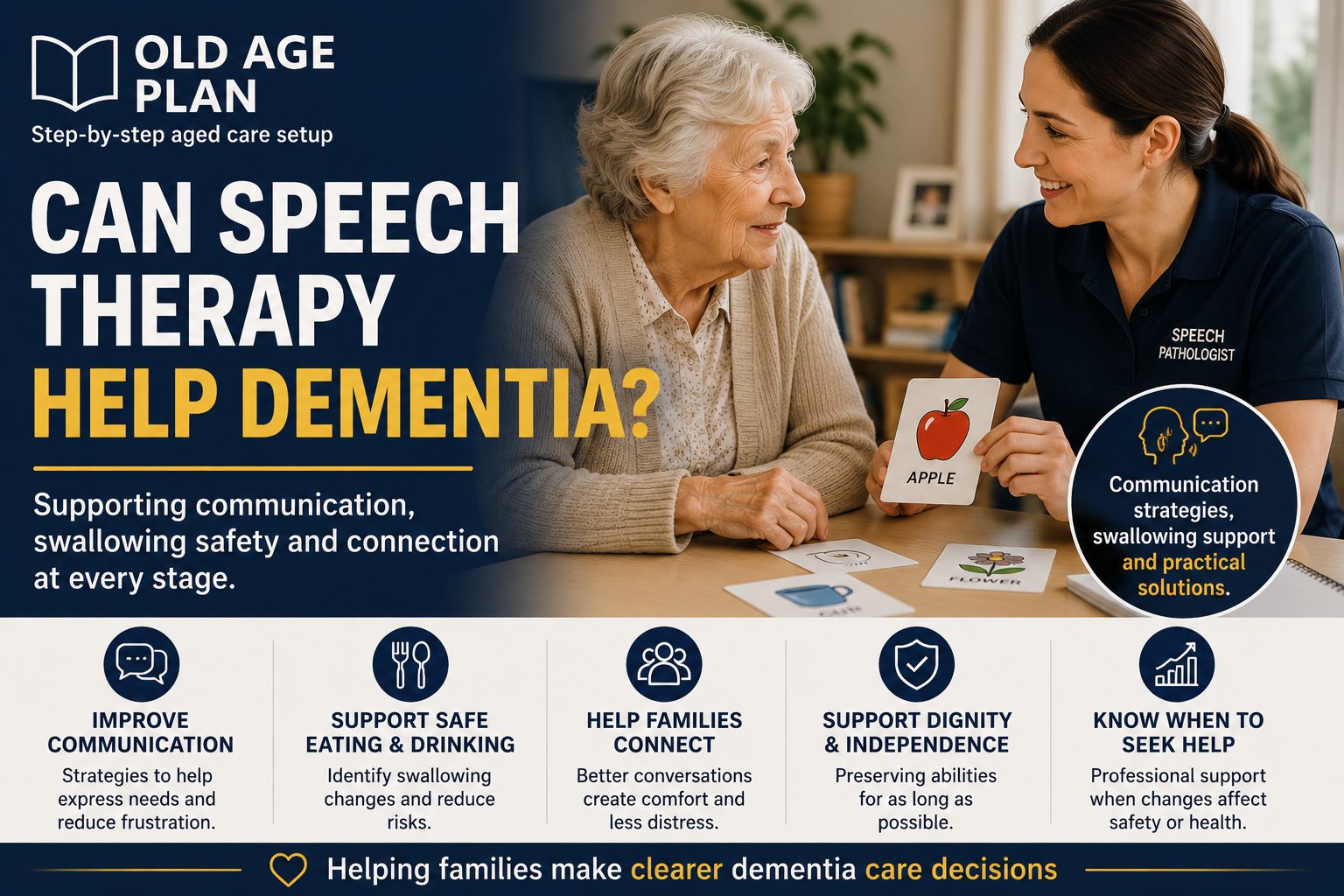

Can Speech Therapy Help Dementia?
Families often ask whether speech therapy can help dementia.
At first, that sounds like a question about talking.
But in dementia care, speech therapy can sit inside a much bigger decision.
Are conversations becoming harder because the person cannot find words?
Is communication breakdown causing distress, frustration or behaviour changes?
Are swallowing problems starting to affect safe eating and drinking?
Speech therapy cannot cure dementia or reverse the condition.
But it may help some people with dementia communicate more clearly, reduce frustration, support family communication and identify swallowing risks before they become more serious.
The important point is this: speech therapy is not only about speech.
In dementia care, it may also become part of safety, nutrition, dignity and care planning.
Short Answer
Yes, speech therapy can help some people with dementia.
A speech pathologist may help with communication strategies, word-finding problems, conversation support, family education and swallowing difficulties.
Speech therapy does not stop dementia progression.
But it may help families understand what is changing, how to communicate more effectively and when eating or swallowing safety needs professional attention.
Key Takeaway
The biggest mistake is assuming speech therapy is only about helping someone talk better.
For dementia, speech therapy may involve two different but connected issues:
- communication decline
- swallowing safety
That matters because a person may lose words, misunderstand instructions, become distressed during conversation or begin coughing during meals.
Those are not minor details.
They can affect dignity, relationships, nutrition, choking risk, aspiration risk and whether care can still be safely managed at home.
What Does A Speech Pathologist Do?
A speech pathologist, sometimes called a speech therapist, works with communication and swallowing difficulties.
In dementia care, they may help assess and support:
- word-finding problems
- understanding spoken language
- expressing needs
- conversation difficulties
- communication between family and carers
- safe eating and drinking
- coughing or choking during meals
- changes in voice, speech or swallowing
- mealtime support strategies
This means speech therapy can be relevant even when the person is still speaking.
The question is not only whether they can talk.
The question is whether communication and swallowing are still reliable enough for daily life and safety.
How Dementia Can Affect Communication
Dementia can affect communication in different ways.
A person may:
- struggle to find words
- repeat questions
- lose track of conversations
- use the wrong word
- misunderstand instructions
- become frustrated when not understood
- withdraw from conversation
- have difficulty following long explanations
- become distressed when corrected
Communication changes can be painful for families.
They may feel like they are losing the person conversation by conversation.
But good support is not only about preserving speech.
It is also about preserving connection.
Speech Therapy Can Help Families Communicate Differently
Speech therapy may help families change how they communicate.
This may include using:
- shorter sentences
- one idea at a time
- slower pacing
- visual cues
- gesture or pointing
- familiar words
- calm tone
- more time for responses
- less correction
- conversation prompts based on familiar topics
This matters because many communication problems become worse when the family tries harder in the wrong way.
More explaining is not always better.
More questions are not always helpful.
Correcting every mistake can increase shame, frustration or withdrawal.
The goal is not to force perfect communication.
The goal is to make communication easier, safer and less distressing.
The Hidden Issue: Communication Reliability
Families often ask whether the person can still communicate.
A better question is:
Can they communicate reliably enough for the situation?
This is important because communication ability is not the same in every context.
A person may manage casual conversation but struggle to explain pain.
They may answer simple questions but not understand medication instructions.
They may say “yes” to care without really understanding what is being asked.
They may appear agreeable but be unable to express fear, discomfort or refusal clearly.
That difference matters.
Communication reliability affects care, consent, safety and dignity.
How Communication Problems Can Create Behaviour Changes
Some behaviour changes are partly communication problems.
A person may become agitated because they cannot explain pain.
They may resist care because they do not understand what is happening.
They may become angry because people keep correcting them.
They may withdraw because conversation has become embarrassing.
They may call out repeatedly because they cannot express what they need.
This is why speech therapy may support more than conversation.
It may reduce frustration by helping carers understand what communication is still possible and how to adapt.
For related behaviour support, see Can Dementia Behaviour Be Managed Without Medication?.
Speech Therapy And Swallowing Problems
Speech pathologists also assess and support swallowing difficulties.
This is a major issue in dementia care.
Swallowing problems may develop as dementia progresses.
They can affect eating, drinking, nutrition, hydration, choking risk and aspiration risk.
Aspiration means food, fluid or saliva may enter the airway or lungs instead of going safely into the stomach.
This can sometimes contribute to chest infections or serious health complications.
That is why swallowing changes should not be treated as a minor inconvenience.
Signs Swallowing May Need Attention
Families may need to seek advice if the person:
- coughs during meals
- chokes or gags when eating or drinking
- has a wet or gurgly voice after swallowing
- holds food in their mouth
- takes much longer to eat
- avoids certain textures
- spits food out
- has unexplained weight loss
- has repeated chest infections
- seems afraid of eating or drinking
- becomes very tired during meals
- forgets how to chew or swallow safely
These signs do not automatically mean the person must stop normal eating.
But they do mean the situation should be taken seriously.
A GP or speech pathologist may help assess what is happening.
The Real Tension: Comfort Eating Versus Swallowing Safety
Swallowing changes create one of the hardest tensions in dementia care.
Food is not only nutrition.
It is comfort, memory, culture, routine, pleasure and identity.
But eating and drinking can also become unsafe.
Families may feel caught between two fears:
- taking away foods the person enjoys
- allowing eating or drinking that may increase choking or aspiration risk
This is not a simple “safe versus unsafe” decision.
It is often a dignity, comfort and risk decision.
The goal is to understand the risk clearly enough to make a careful decision with appropriate professional guidance.
When Speech Therapy May Be Most Useful
Speech therapy may be especially useful when:
- communication breakdown is increasing distress
- the person is withdrawing from conversation
- family members do not know how to communicate anymore
- the person cannot explain needs clearly
- care instructions are being misunderstood
- behaviour changes may be linked to communication difficulty
- swallowing problems are suspected
- mealtimes are becoming slow, stressful or unsafe
- coughing, choking or repeated chest infections are occurring
Speech therapy is often most helpful before the situation becomes a crisis.
Earlier support may help families adapt communication and identify swallowing risks before decisions become more urgent.
When Speech Therapy May Not Be Enough
Speech therapy can help support communication and swallowing.
But it may not solve every problem.
More support may be needed if:
- the person cannot communicate essential needs
- swallowing remains unsafe despite changes
- nutrition or hydration is becoming difficult
- mealtimes require constant supervision
- the person refuses food or fluids
- behaviour makes care unsafe
- family carers cannot manage communication or mealtime risks
- dementia has progressed into more complex care needs
At that point, the issue may shift from speech therapy alone to broader care planning.
For escalation support, see When Should Professional Care Be Considered For Dementia?.
What You May Really Be Trying To Decide
The surface question is whether speech therapy can help dementia.
The deeper decision may be about communication, swallowing, safety and care limits.
You may really be trying to decide:
- Can they still express what they need?
- Are communication problems causing distress or behaviour changes?
- Can family still understand them well enough to provide care?
- Are they saying yes without understanding?
- Are meals becoming unsafe?
- Is coughing or choking becoming a warning sign?
- Do we need a swallowing assessment?
- Are food and drink decisions becoming more serious?
- Can this still be managed safely at home?
These decisions are not only about speech.
They are about whether the person can still be understood, supported and kept safe during ordinary daily care.
Decision Support
Before deciding whether speech therapy may help, separate the issue into three questions.
1. Is The Main Issue Communication, Swallowing Or Both?
Some families only notice word-finding problems.
Others only notice coughing at meals.
Some are dealing with both.
This distinction matters because communication support and swallowing support may involve different strategies, risks and professionals.
2. Is The Problem Occasional Or Reliable Enough To Affect Safety?
Look for patterns.
Does the person only struggle when tired?
Do mealtimes become worse in the evening?
Do they cough with thin fluids but not softer foods?
Do they communicate better with one person than another?
In dementia care, inconsistency is often the warning sign.
If communication or swallowing is unreliable, the care plan needs to account for the worst moments, not only the best ones.
3. Has The Decision Started Moving Beyond Family Support?
Families can often adapt communication for a long time.
But swallowing risk changes the decision.
Once choking, aspiration, weight loss, dehydration or repeated chest infections become concerns, family preference alone is not enough.
The decision needs clinical input.
That does not remove dignity or choice.
It means the risk has become serious enough that professional guidance is needed.
How Speech Therapy Decisions Usually Escalate
Speech therapy decisions often escalate through stages.
- Notice communication changes — word-finding, misunderstanding, withdrawal or frustration.
- Adapt communication — shorter language, visual cues, calm pacing and fewer corrections.
- Support daily care — help carers communicate during personal care, meals and routines.
- Watch mealtimes — coughing, choking, fatigue, food refusal or slow eating.
- Seek speech pathology assessment — especially if swallowing safety is uncertain.
- Review food, fluids and supervision — where professional advice suggests changes are needed.
- Review broader care needs — if communication or swallowing risks exceed what family can safely manage.
This ladder matters because families often wait until communication or meals become frightening.
Earlier recognition may preserve more options.
Speech Therapy, Eating And Family Conflict
Swallowing decisions can create family conflict.
One person may want to keep meals normal.
Another may worry about choking.
Someone else may feel that changing food textures is undignified.
These reactions are understandable.
Food is emotional.
But when swallowing risk increases, the family needs shared clarity about what is happening and why changes may be suggested.
The best decision is usually not made from fear alone or comfort alone.
It is made by understanding the risk, the person’s preferences and the practical care reality.
Speech Therapy And Routine
Communication and swallowing support often work better when linked to routine.
Predictable mealtimes, calm environments and familiar carers may reduce confusion.
Simple communication patterns may help the person understand what is happening.
Rushed meals, noisy rooms or too many instructions may make problems worse.
For related support, see Can Routine Help Someone With Dementia?.
Speech Therapy And Other Dementia Supports
Speech therapy may work alongside other supports.
For example:
- occupational therapy may help with mealtime setup, positioning and daily routines
- physiotherapy may help with posture and physical function
- GP review may identify medical causes of sudden change
- dementia support services may help families adapt communication
- aged care services may help with supervised meals or personal care
For related home and daily task support, see Can Occupational Therapy Help Dementia?.
When To Seek More Support
Consider seeking professional advice if:
- communication decline is causing distress
- the person cannot explain pain or needs
- care instructions are not understood
- family conversations regularly escalate into frustration
- the person coughs or chokes during meals
- mealtimes are becoming slow or unsafe
- there is unexplained weight loss
- there are repeated chest infections
- hydration is becoming difficult
- the person is refusing food or drink
- carers are unsure how to manage eating and drinking safely
A GP, speech pathologist, dementia support service or aged care assessor may help clarify what support is appropriate.
Related Old Age Plan Articles
- Can Dementia Be Treated?
- What Non-Drug Treatments Help Dementia?
- Can Dementia Behaviour Be Managed Without Medication?
- How Do You Support Someone With Dementia?
- How Do You Calm Someone With Dementia?
- Can Routine Help Someone With Dementia?
- Can Occupational Therapy Help Dementia?
- What Is Sundowning And How Is It Managed?
- When Should Professional Care Be Considered For Dementia?
- What Happens In The Middle Stages Of Dementia?
- What Happens In Late-Stage Dementia?
Next Steps With Old Age Plan
If you are wondering whether speech therapy may help, start by separating the issue.
Is the main problem communication?
Is it swallowing?
Or are both starting to change?
If communication breakdown is creating distress or behaviour changes, read Can Dementia Behaviour Be Managed Without Medication?.
If daily routines and care tasks are becoming harder, read Can Occupational Therapy Help Dementia?.
If swallowing, choking, food refusal or mealtime safety is becoming a concern, this may be a point where professional advice should not be delayed.
Old Age Plan resources can help families move from vague concern to clearer preparation. A communication changes tracker, mealtime safety worksheet or care escalation planner may help you record what is changing before speaking with a GP, speech pathologist or aged care assessor.
The aim is not to preserve perfect speech at all costs.
The aim is to protect communication, dignity, comfort and safety as dementia changes what the person can reliably manage.
Sources
- Dementia Australia — Communication And Behaviour Changes
- Dementia Australia — Eating And Drinking
- Speech Pathology Australia
- Healthdirect — Speech Pathologists
- Healthdirect — Dysphagia
- NICE — Dementia: Assessment, Management And Support Recommendations
Disclaimer
This article provides general information only. It is not medical, legal or financial advice.
Dementia symptoms, communication changes, swallowing risks, speech pathology needs and aged care pathways vary between individuals. Laws, policies, services and clinical guidance may also change over time.
You should seek advice from a qualified health professional, legal professional or aged care professional about your own circumstances.
For current dementia, speech pathology, swallowing and aged care support information in Australia, you may wish to refer to Dementia Australia, Speech Pathology Australia, My Aged Care, your GP, speech pathologists, state health services and other relevant official resources.
Summary
Speech therapy can help some people with dementia by supporting communication, family understanding and swallowing safety.
Its value is not limited to talking.
Speech pathologists may help families adapt communication and identify eating or drinking risks.
The key issue is reliability.
Can the person still communicate needs clearly enough?
Can they swallow safely enough?
When communication or swallowing becomes unreliable, the decision may shift from ordinary support to clinical assessment and wider care planning.