
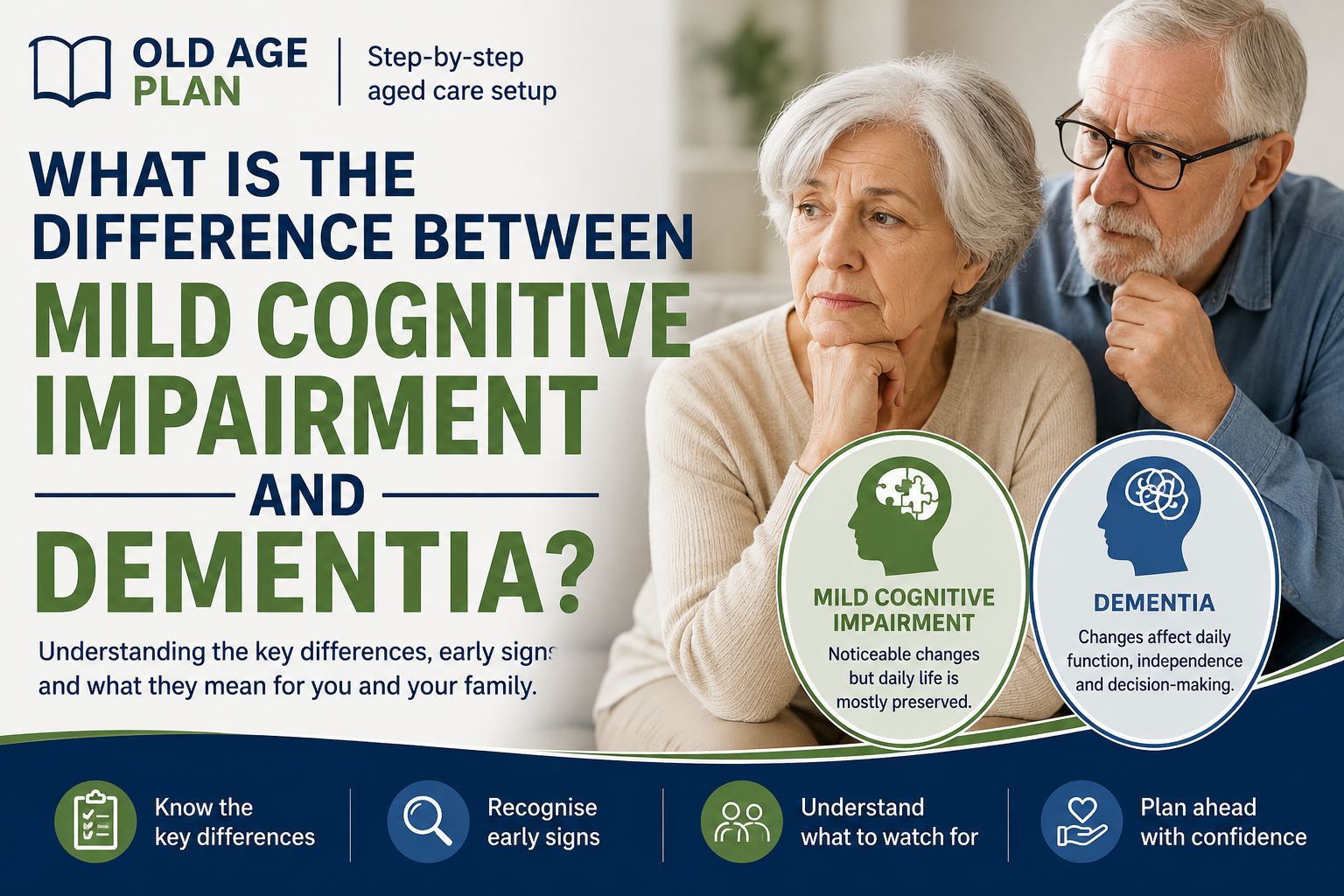

What Is The Difference Between Mild Cognitive Impairment And Dementia?
Memory changes can be difficult to judge from the outside.
Someone may forget names, repeat questions or lose track of appointments, but still manage daily life.
This often leads to an important question: what is the difference between mild cognitive impairment and dementia?
The main difference is usually how much the changes affect everyday independence, function and decision reliability.
Short Answer
Mild cognitive impairment, often called MCI, involves noticeable changes in memory or thinking that are greater than expected with normal ageing.
However, the person can usually still manage most daily activities independently.
Dementia involves more significant cognitive decline that begins to affect everyday life, independence, decision-making or ability to manage usual responsibilities.
The key question is not only whether memory has changed. It is whether thinking changes are now affecting real-world function.
Key Takeaway: Mild cognitive impairment may affect memory or thinking, but daily independence is usually mostly preserved. Dementia is more likely when cognitive changes begin affecting everyday function, safety, care needs or decision reliability.
Why The Difference Matters
The difference between mild cognitive impairment and dementia matters because the next decisions may be very different.
MCI may require monitoring, medical review and lifestyle support.
Dementia may require broader planning around care, legal documents, safety, support services and future decision-making.
Families often want to know whether they are seeing early warning signs or whether the situation has already moved into something more serious.
That is why this question should not be treated as a label-only issue.
It is really a planning question.
What Mild Cognitive Impairment Can Look Like
Mild cognitive impairment may involve changes that are noticeable to the person, family members or a doctor.
This may include:
- forgetting recent conversations
- misplacing items more often
- taking longer to find words
- needing more reminders
- finding complex tasks harder than before
- feeling less mentally sharp
However, the person can usually still manage everyday life.
They may still pay bills, attend appointments, shop, cook, drive, socialise and make decisions with little or no support.
What Dementia Can Look Like
Dementia usually involves cognitive changes that begin interfering with daily life.
This may include problems with memory, language, judgement, reasoning, planning, behaviour or orientation.
The person may begin to need support with tasks they previously managed alone.
Examples may include:
- getting lost in familiar places
- missing important bills or appointments
- struggling to manage medication
- making unsafe financial decisions
- having difficulty following conversations
- becoming confused about time or place
- needing more help with daily routines
The shift is often not one single event.
It is usually a pattern of change that starts affecting independence.
The Threshold Crossing Question
Old Age Plan looks at this through a practical decision-support lens.
The useful question is not only: “Is this MCI or dementia?”
The deeper question is:
Has the problem remained mostly isolated memory change, or has it started affecting daily function and decision reliability?
This is the threshold families are often trying to understand.
Memory changes alone may be concerning.
But when those changes start affecting safety, judgement, finances, appointments, medication, care decisions or independence, the planning conversation usually becomes more urgent.
Decision Reliability Matters
Mild cognitive impairment may slow thinking or make memory less dependable.
But dementia is more likely to affect the reliability of everyday decisions over time.
A person may still give clear answers but become less consistent.
They may agree to something, forget the discussion and later deny it happened.
They may underestimate risks or make choices that no longer match their usual judgement.
This does not automatically mean capacity has been lost.
It does mean decision reliability should be watched carefully.
Does Mild Cognitive Impairment Always Become Dementia?
No.
Mild cognitive impairment does not always progress to dementia.
Some people remain stable for years.
Some improve, especially if symptoms are linked to treatable factors such as sleep problems, depression, medication effects, alcohol use, vitamin deficiencies or other health conditions.
Others may gradually progress to dementia.
This is why medical review matters.
Assuming the worst too early can cause unnecessary fear.
Ignoring changes for too long can delay useful planning.
Can Dementia Be Mistaken For Mild Cognitive Impairment?
Sometimes the difference is not clear at first.
A person may appear mostly independent during short appointments but struggle more at home.
Families may notice problems that are not obvious during a brief conversation.
On the other hand, temporary health problems can make cognition look worse than it really is.
That is why doctors may consider symptoms, daily function, medical history, medication, mood, sleep and assessment results before making a diagnosis.
When Should Memory Changes Be Checked?
Memory changes should be checked when they are new, worsening, repeated or affecting daily life.
It is especially important to seek medical advice if the person is:
- getting lost
- missing medication
- struggling with money
- repeating the same questions often
- forgetting important appointments
- showing personality or behaviour changes
- having difficulty managing familiar tasks
Early assessment does not mean assuming dementia.
It means identifying what may be causing the change and what decisions may need attention.
What You May Really Be Trying To Decide
If you are asking about the difference between mild cognitive impairment and dementia, you may not only be looking for definitions.
You may be trying to work out whether memory changes have crossed into something that needs more serious planning.
You may be wondering whether:
- this is normal ageing
- a doctor appointment is needed
- legal planning should be reviewed
- home support may soon be needed
- family should start monitoring safety more closely
The practical question is this:
Are the changes still mostly memory-based, or are they now affecting daily function, independence and decision reliability?
How Families Can Approach This Carefully
Families should avoid two common mistakes.
The first mistake is dismissing repeated cognitive changes as normal ageing when daily life is clearly being affected.
The second mistake is assuming every memory change means dementia.
A careful approach is to notice patterns, write down examples, arrange a medical review and consider whether legal, care or safety planning should be reviewed.
This helps families respond early without overreacting.
Related Old Age Plan Articles
- What Is Mild Cognitive Impairment?
- What Is Dementia?
- What Are The Early Signs Of Dementia?
- Is Dementia A Normal Part Of Ageing?
- How Is Dementia Diagnosed?
- What Happens After A Dementia Diagnosis?
- Can Someone With Dementia Make Legal Decisions?
Sources
- Dementia Australia — What Is Dementia?
- Dementia Australia — Mild Cognitive Impairment
- healthdirect — Dementia
- My Aged Care — Caring For Someone Living With Dementia
Disclaimer
This article provides general information only. It is not legal, medical or financial advice.
Dementia symptoms, medication guidance, medical advice, aged care services and government policies may change over time and individual circumstances can vary.
Always seek advice from qualified healthcare professionals and refer to official Australian Government, My Aged Care and Dementia Australia resources for current information.
Summary
The difference between mild cognitive impairment and dementia is usually about daily function.
Mild cognitive impairment may cause noticeable memory or thinking changes while independence is mostly preserved.
Dementia is more likely when cognitive changes begin affecting daily life, safety, care needs or decision reliability.
The safest approach is to seek medical advice, watch for patterns and begin planning early if independence or decision-making starts to change.