

Can Blood Tests Detect Dementia?
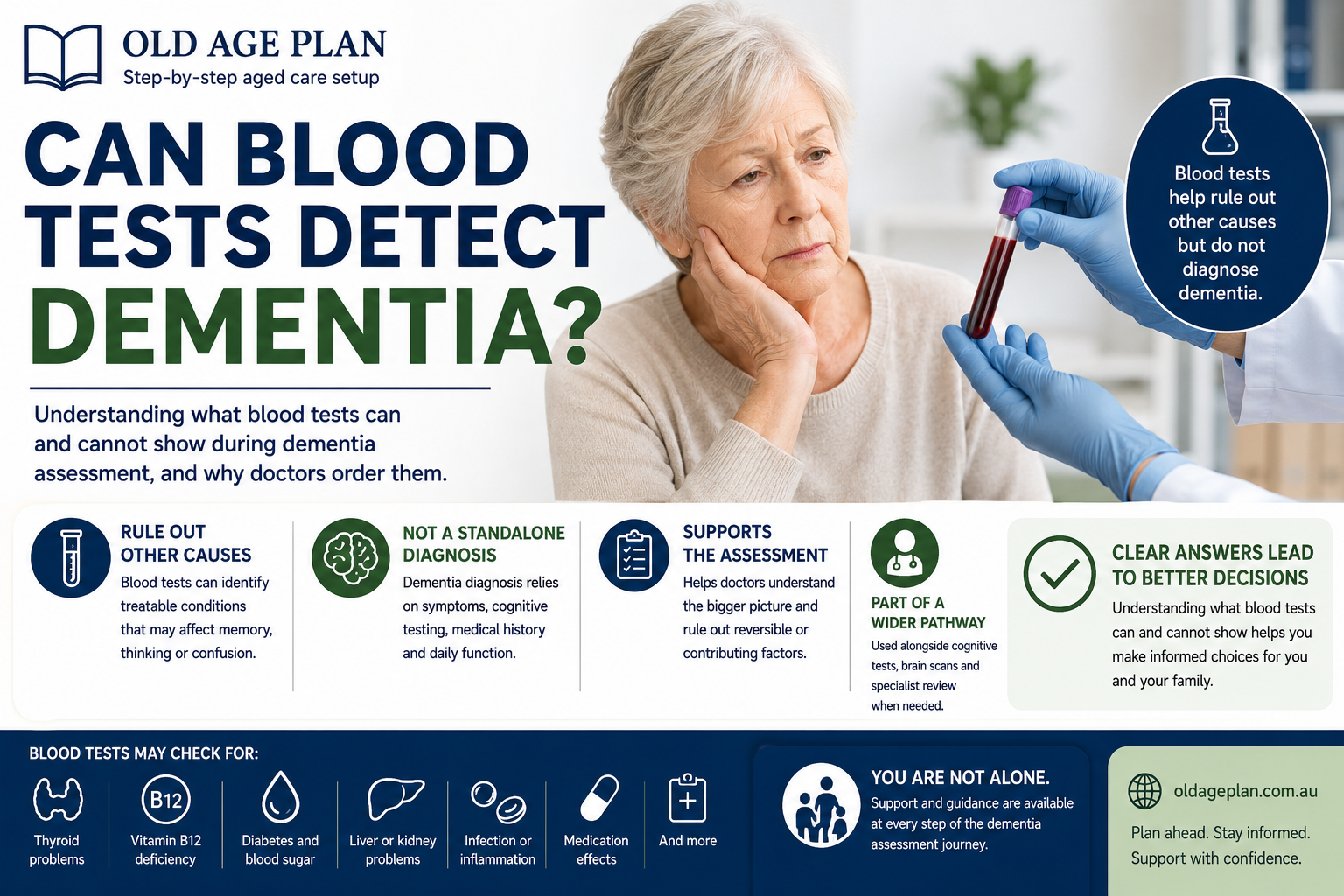
Can blood tests detect dementia? In most cases, standard blood tests do not diagnose dementia by themselves. However, they are often an important part of dementia assessment because they can help rule out other causes of memory, thinking or confusion symptoms.
This matters because not every memory problem is dementia.
Some health issues can cause dementia-like symptoms or make existing cognitive problems worse.
The real question is not only whether blood tests can detect dementia.
It is what blood tests can clarify, what they cannot prove and how the results affect the next decision.
Short Answer
Standard blood tests usually cannot confirm dementia on their own. Doctors often use blood tests to check for other conditions that may affect memory, thinking or confusion, such as infection, thyroid problems, vitamin deficiencies, liver or kidney issues, diabetes or medication-related concerns.
Blood tests may help rule out treatable or reversible causes before dementia is diagnosed.
Key Takeaway
Blood tests are usually used to support the dementia assessment process, not replace it.
They help doctors check whether something else may be causing or worsening symptoms, while diagnosis still depends on medical history, cognitive testing, daily function, scans where needed and clinical judgement.
Why Blood Tests Are Used In Dementia Assessment
Memory and thinking changes can have many possible causes.
Some may be related to dementia.
Others may be linked to health problems that need different treatment.
Blood tests may help doctors check for issues such as:
- thyroid problems
- vitamin B12 or folate deficiency
- infection or inflammation
- kidney problems
- liver problems
- diabetes or blood sugar issues
- anaemia
- electrolyte imbalance
- medication effects
If one of these problems is found, treating it may improve symptoms or reduce confusion.
This is why blood tests can be important even when they do not directly diagnose dementia.
Can A Blood Test Confirm Dementia?
For most people, a routine blood test cannot confirm dementia.
Dementia diagnosis usually depends on the whole picture, including:
- symptoms
- medical history
- daily function
- cognitive assessment
- medicine review
- family or carer observations
- blood test results
- brain scans where needed
- specialist review in some cases
A blood test may support the assessment by showing what else needs attention.
But a normal blood test does not automatically rule out dementia.
Can Blood Tests Rule Out Dementia?
No. Normal blood test results usually cannot rule out dementia.
They may show that certain other causes are less likely, but they do not prove that dementia is not present.
This can be confusing for families.
A person may have normal blood results and still need cognitive testing, monitoring, brain imaging or specialist review if symptoms continue.
The value of blood tests is that they help narrow the question.
They help doctors ask, “Is there another condition contributing to this?”
What Blood Tests Might A Doctor Order?
The exact tests depend on the person’s symptoms, medical history and clinical situation.
A GP or specialist may consider tests that check:
- blood count
- thyroid function
- vitamin B12 and folate levels
- kidney function
- liver function
- blood glucose or diabetes markers
- inflammation or infection markers
- electrolytes
- calcium levels
Not every person needs every test.
The doctor should choose tests based on what needs to be ruled out or clarified.
What If Blood Tests Find A Problem?
If blood tests find an issue, the next step depends on what was found.
For example, a doctor may treat a deficiency, review medicines, check for infection, adjust diabetes care or investigate another health problem.
This does not always mean dementia is ruled out.
Sometimes a person may have dementia and another health issue at the same time.
But treating the other issue may still improve function, reduce confusion or make the assessment clearer.
What If Blood Tests Are Normal?
Normal blood tests can still be useful.
They may help rule out some reversible or treatable contributors.
If symptoms continue, the doctor may consider:
- cognitive testing
- brain imaging
- medicine review
- mental health assessment
- specialist referral
- monitoring over time
The important point is that normal blood tests are not the end of the assessment if memory, thinking or daily function concerns remain.
Are New Blood Tests For Dementia Available?
Research into dementia-related blood tests is developing, especially for conditions such as Alzheimer’s disease.
These tests may help detect biological markers associated with some dementia-related changes.
However, availability, accuracy, interpretation and appropriate use can vary.
For most families, the usual assessment pathway still involves a GP or specialist reviewing symptoms, daily function, cognitive testing and other medical information.
If you hear about a new dementia blood test, it is worth asking a doctor whether it is appropriate, available and useful for the specific situation.
Why A Doctor Might Order Blood Tests First
A doctor may order blood tests early because they are a practical way to check for other causes.
This can be especially important if symptoms appeared suddenly, changed quickly or do not fit a typical pattern.
Blood tests may also help before referral because they give the GP or specialist more information.
They can help answer whether the next step should be treatment of another condition, monitoring, imaging, cognitive testing or specialist review.
Blood Tests And Diagnosis Confidence
Families sometimes feel disappointed when blood tests do not provide a simple yes-or-no answer.
But diagnosis confidence often comes from combining information.
Blood tests help by reducing uncertainty around other causes.
Cognitive testing helps assess memory and thinking.
Scans may help show brain changes or rule out structural issues.
Family observations help show how symptoms affect daily life.
Together, these pieces can support a more reliable diagnosis.
What You May Really Be Trying To Decide
If you are asking whether blood tests can detect dementia, you may really be trying to decide:
- Will a blood test give us a clear answer?
- Why has the GP ordered blood tests?
- Could something else be causing the symptoms?
- What happens if the blood tests are normal?
- Do we still need cognitive testing or scans?
- Should we ask for specialist review?
- Are we waiting too long for answers?
These are practical diagnosis pathway questions.
Blood tests are useful, but they are only one part of the answer.
Decision Support
Before relying on blood test results, ask what decision they are meant to support.
Useful questions for the GP may include:
- What are these blood tests checking for?
- Could any of these issues explain the symptoms?
- What happens if the results are abnormal?
- What happens if the results are normal?
- Do we still need cognitive testing?
- Is a brain scan needed?
- Should we consider specialist referral?
The goal is not to expect one blood test to answer everything.
The goal is to understand whether blood tests reduce uncertainty and help guide the next step.
Related Old Age Plan Articles
- How Is Dementia Diagnosed?
- Can A GP Diagnose Dementia In Australia?
- How Long Does A Dementia Diagnosis Take?
- What Scans Are Used To Diagnose Dementia?
- What Tests Are Used To Check Memory Problems?
- What Is A Cognitive Assessment?
- Can Dementia Be Misdiagnosed?
Next Steps With Old Age Plan
If blood tests have been ordered during dementia assessment, it can help to understand what they are meant to rule out and what should happen after the results.
Old Age Plan’s Free Tools can help you record concerns, prepare questions and keep track of test results or follow-up steps.
You may also find it helpful to read related guides on GP assessment, brain scans and cognitive testing so blood tests fit into the wider diagnosis pathway.
The goal is not to expect one test to provide every answer.
The goal is to understand what each test adds and what decision should follow next.
Sources
- Healthdirect Australia — Dementia
- Healthdirect Australia — Dementia overview
- Dementia Australia — Diagnosis
- RACGP — Dementia
- Healthdirect Australia — Blood tests
- My Aged Care — Living with memory loss, dementia or depression
Disclaimer
This article provides general information only. It is not medical, legal or financial advice.
Dementia symptoms, diagnosis, blood tests and support needs can vary between individuals. Medical assessment and diagnosis should be provided by qualified health professionals.
Laws, services, policies and procedures may change over time. You should seek advice from appropriate professionals and refer to official Australian Government, health and dementia resources for current information.
For dementia-related information and support, you may wish to contact Dementia Australia, Healthdirect, My Aged Care or your GP.
Summary
Standard blood tests usually cannot detect or confirm dementia on their own.
However, they are often an important part of dementia assessment because they can help rule out other causes of memory, thinking or confusion symptoms.
Blood tests should be understood as one part of the wider diagnosis pathway, alongside cognitive testing, medical history, daily function, scans where needed and professional assessment.