

What Is A Cognitive Assessment?
A cognitive assessment can sound formal or intimidating, especially when memory problems are already causing concern.
What is a cognitive assessment?
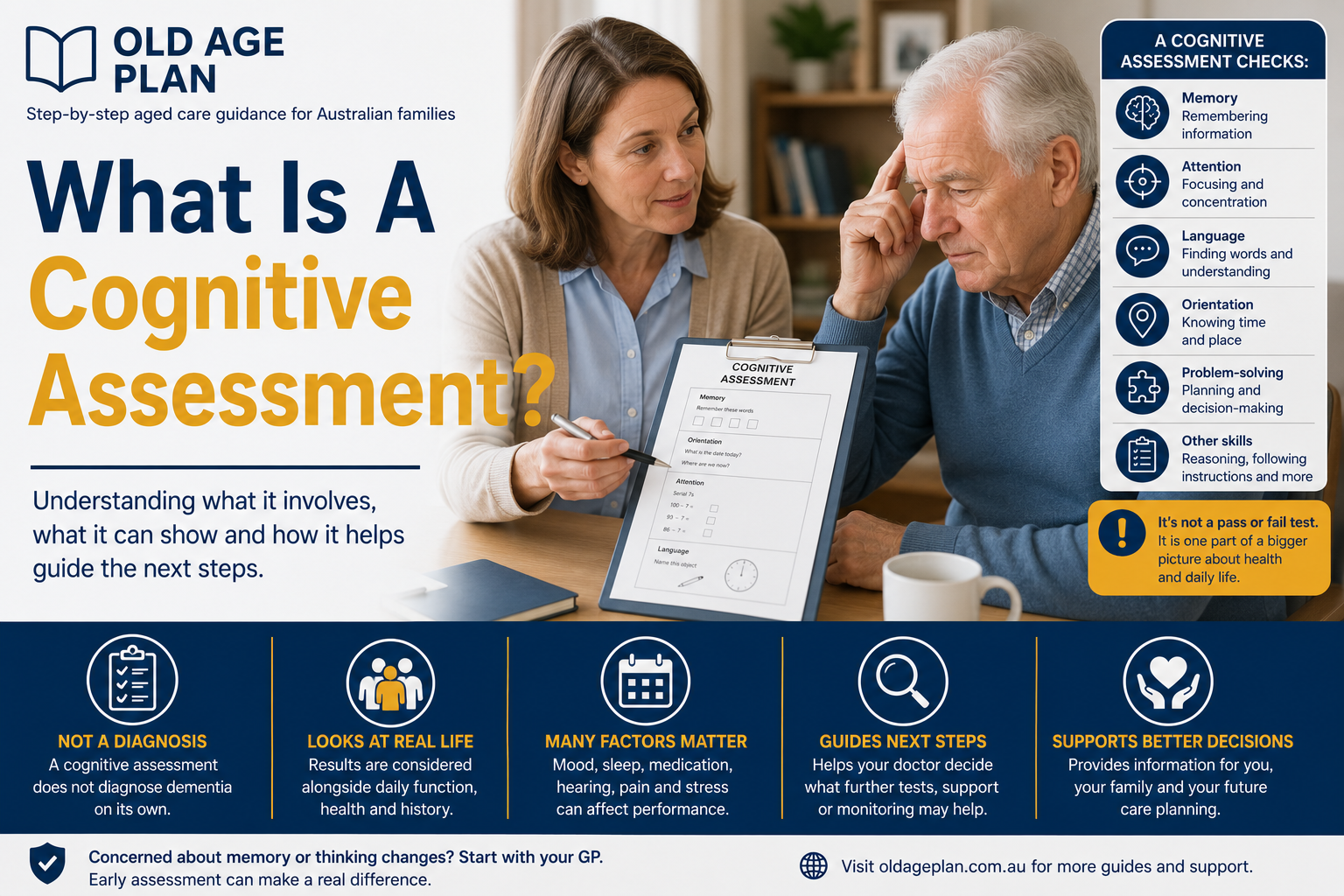
A cognitive assessment is a structured way of checking thinking skills such as memory, attention, language, problem-solving, orientation and reasoning.
It does not automatically diagnose dementia by itself. It is one part of a broader assessment that may include health checks, medication review, blood tests, daily function questions and sometimes specialist referral.
Short Answer
A cognitive assessment checks how well a person is thinking, remembering, concentrating and processing information.
It may include questions, simple tasks, memory exercises, drawing tasks, language checks or problem-solving activities.
The result can help doctors understand whether further assessment is needed, but it should be considered alongside the person’s health, daily function and real-life changes.
Key Takeaway
Key takeaway: A cognitive assessment is not about “passing” or “failing”. It is a structured check of thinking skills that helps guide the next step, not a complete diagnosis on its own.
Why Cognitive Assessments Are Used
Cognitive assessments are used when there are concerns about memory, thinking, communication or daily function.
They help health professionals look for patterns.
For example, someone may have trouble remembering new information but still communicate clearly.
Another person may remember some things well but struggle with planning, attention or problem-solving.
These patterns can help guide further investigation.
The aim is not to label someone too quickly.
The aim is to understand what has changed and whether more support, testing or monitoring may be needed.
What Skills May Be Checked?
A cognitive assessment may check several thinking skills.
These can include:
- short-term memory
- attention and concentration
- language and word-finding
- orientation to time and place
- problem-solving
- planning and organisation
- visual-spatial skills
- ability to follow instructions
Different assessments may focus on different areas.
The exact questions depend on the test being used and why the assessment is being done.
What Happens During A Cognitive Assessment?
The person may be asked to complete simple tasks or answer questions.
They may be asked to remember words, draw a clock, follow instructions, name objects, repeat information or answer questions about the date and location.
Some assessments are short screening tools.
Others are longer and more detailed.
A health professional may also ask about changes in daily life, mood, sleep, medicines and safety.
This matters because thinking scores only make sense when compared with real-life function.
Does A Low Score Mean Dementia?
No. A low score does not automatically mean dementia.
Cognitive scores can be affected by many things, including:
- poor sleep
- anxiety
- depression
- pain
- hearing or vision problems
- language barriers
- education background
- medication effects
- infection or delirium
- stress during the appointment
This is why cognitive assessment should not be treated as a stand-alone verdict.
It is a signal that needs interpretation.
Does A Normal Score Rule Out A Problem?
Not always.
Some people may score within a normal range but still have real-world difficulties.
This may happen if the changes are subtle, early, fluctuating or more noticeable in complex daily tasks.
For example, a person may do reasonably well on a short test but still struggle with bills, appointments, medicines or decision-making at home.
That is why family observations and daily function examples can be important.
Why Daily Function Matters
A cognitive assessment is more useful when it is connected to real life.
Doctors may want to know whether thinking changes affect:
- managing medicines
- paying bills
- attending appointments
- driving safely
- cooking or using appliances
- personal care
- shopping
- legal, financial or care decisions
This helps separate occasional forgetfulness from changes that may affect safety or independence.
Can Someone Prepare For A Cognitive Assessment?
A cognitive assessment is not something to “study for”.
Trying to rehearse answers may make the result less useful.
However, it can help to bring clear information about what has changed.
Useful information may include when symptoms started, examples of memory problems, medication lists, recent illnesses and changes noticed by family or friends.
The goal is not to perform well.
The goal is to help the doctor understand what is really happening.
What Happens After A Cognitive Assessment?
After a cognitive assessment, the doctor may discuss the result and what it may mean.
They may suggest monitoring, further tests, blood tests, medication review, brain imaging or referral to a specialist or memory clinic.
Sometimes the result is clear.
Sometimes the next step is to watch changes over time.
This can feel slow, but it may be necessary when symptoms are mild, mixed or affected by several possible causes.
What You May Really Be Trying To Decide
Many people asking this question are not only asking what a cognitive assessment is.
They are trying to understand what the assessment could mean for independence, planning and future decisions.
The real questions may be:
- Will this prove dementia?
- Will the person lose control if they score poorly?
- Can one test change legal or care decisions?
- Should family attend the appointment?
- What happens if the result is unclear?
- Could this affect driving, care planning or legal documents?
A cognitive assessment can provide useful information, but it should not be treated as the whole decision.
The more important question is how the result fits with daily function, safety, health history and decision-making reliability.
Decision Support Questions
When thinking about a cognitive assessment, it may help to ask:
- What changes have been noticed?
- Are the changes affecting daily life?
- Did the changes happen suddenly or gradually?
- Could mood, sleep, medication or illness be contributing?
- Are safety, money, medicines or driving affected?
- Has the person’s decision-making become less reliable?
- What information would help the doctor understand the full picture?
These questions can help keep the focus on evidence rather than fear.
Related Old Age Plan Articles
- What Tests Are Used To Check Memory Problems?
- When Should Memory Loss Be Checked?
- When Should You See A Doctor About Memory Problems?
- What Is Mild Cognitive Impairment?
- What Is The Difference Between Mild Cognitive Impairment And Dementia?
- How Is Dementia Diagnosed?
Sources
- Dementia Australia — Dementia testing and diagnosis
- healthdirect Australia — Memory loss
- healthdirect Australia — Dementia overview
- Better Health Channel — Dementia
- Dementia Australia — Early warning signs of dementia
Disclaimer
This article provides general information only. It is not medical, legal or financial advice. Cognitive assessments and memory concerns should be interpreted by qualified health professionals in the context of the person’s health, circumstances and daily function. If confusion appears suddenly or safety is at risk, seek urgent medical help.
Summary
A cognitive assessment is a structured check of thinking skills such as memory, attention, language, reasoning and problem-solving.
It may help identify whether further assessment is needed, but it does not diagnose dementia by itself.
The result should be considered alongside health history, medication, daily function, family observations and any changes in safety or decision-making.