
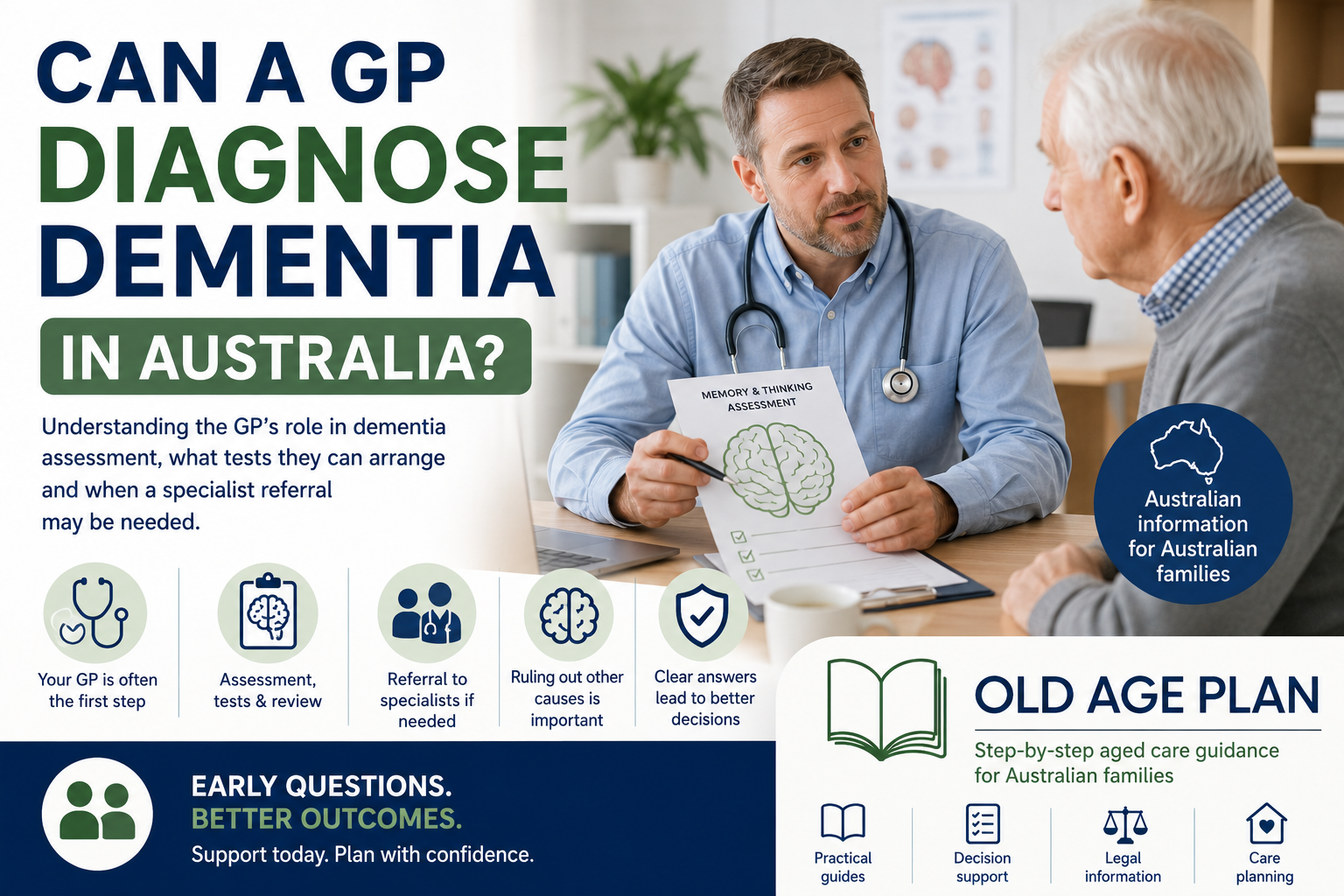

Can A GP Diagnose Dementia In Australia?
Can a GP diagnose dementia in Australia? A GP can often start the dementia assessment process, review symptoms, check for other causes and sometimes make or support a diagnosis. However, some people may need referral to a specialist, memory clinic or other health professional for further assessment.
For many families, the GP is the first practical step.
The question is not only whether a GP can diagnose dementia.
It is whether the GP can assess the situation clearly enough, or whether specialist input is needed before major decisions are made.
Short Answer
Yes, a GP can play a key role in diagnosing dementia in Australia. A GP may assess memory and thinking changes, review medical history, check medicines, arrange cognitive tests and order blood tests or scans to look for other possible causes.
Depending on the symptoms and level of uncertainty, the GP may also refer the person to a geriatrician, neurologist, psychiatrist, memory clinic or other specialist service.
Key Takeaway
A GP is usually a sensible starting point for dementia concerns.
If symptoms are mild, complex, changing suddenly or the diagnosis is uncertain, specialist review may be needed to clarify what is happening and what decisions should follow.
Why The GP Is Often The First Step
Many dementia assessments begin with a GP because they understand the person’s broader health history.
A GP may already know:
- existing medical conditions
- current medicines
- recent infections or hospital visits
- mood or sleep issues
- changes reported by family
- other risk factors that may affect memory or thinking
This matters because not every memory problem is dementia.
Some symptoms may be caused or worsened by other conditions that need to be checked before assuming dementia.
What A GP May Assess
A GP may look at several areas before deciding what should happen next.
This may include:
- memory changes
- thinking and reasoning
- language changes
- daily functioning
- mood and behaviour
- sleep
- medicine effects
- physical health
- family observations
- safety concerns
The GP may ask when symptoms started, whether they are getting worse and whether changes are affecting daily life.
They may also ask whether the person is still managing appointments, bills, medicines, driving, cooking, shopping and household routines.
What Tests Can A GP Arrange?
A GP may arrange or complete several parts of the assessment.
These may include:
- basic memory or cognitive screening
- physical examination
- blood tests
- urine tests
- medicine review
- mental health screening
- referral for imaging if needed
- referral to specialist services
These tests do not always prove dementia by themselves.
They help build a clearer picture and may also identify conditions that can mimic or worsen dementia-like symptoms.
Can A GP Diagnose The Type Of Dementia?
Sometimes a GP may suspect dementia and explain the likely diagnosis.
However, identifying the exact type of dementia may be more complex.
Different types of dementia can have overlapping symptoms, especially early on.
Specialist input may be helpful when:
- symptoms are unusual
- the person is younger
- symptoms changed quickly
- there are movement, hallucination or behaviour changes
- the diagnosis is unclear
- family members disagree about what is happening
- major legal, driving or care decisions depend on the diagnosis
The aim is not to bypass the GP.
The aim is to use the right pathway for the decision that needs to be made.
When A Specialist Referral May Be Needed
A specialist referral may be useful when the situation is complex or uncertain.
This may include referral to a:
- geriatrician
- neurologist
- psychiatrist
- memory clinic
- neuropsychologist
- other relevant specialist service
Specialist review may help clarify diagnosis, dementia type, progression, capacity questions or treatment options.
It may also help when the diagnosis is contested or when family members are unsure whether the GP assessment is enough.
What If The GP Says It Is Just Ageing?
Sometimes families worry that symptoms are being dismissed as normal ageing.
Normal ageing may involve slower recall or occasional forgetfulness.
But repeated confusion, worsening memory, judgement changes or difficulty managing familiar tasks may need further assessment.
If concerns continue, families may want to:
- book a longer appointment
- write down specific examples
- ask what else could explain the changes
- ask whether cognitive screening is appropriate
- ask whether blood tests, medicine review or referral may help
- seek another medical opinion if uncertainty remains
The issue is not proving the GP wrong.
The issue is making sure meaningful changes are not missed.
What Information Should You Bring To The GP?
A GP appointment is more useful when concerns are specific.
It may help to bring:
- examples of memory or thinking changes
- when symptoms began
- whether symptoms are getting worse
- changes in daily tasks
- medicine lists
- recent hospital or health changes
- safety concerns
- family observations
- questions about next steps
This does not need to become a complicated report.
The goal is to help the GP see patterns clearly.
What If The Person Refuses To See The GP?
Some people do not want to discuss memory or thinking changes.
They may feel there is nothing wrong, worry about losing independence or not want family involved.
In that situation, arguing may not help.
It may be better to frame the appointment around a general health review, medication review, sleep issue, mood concern or practical change that the person is willing to discuss.
If safety risks are increasing, families may need advice from a GP, dementia support service or relevant authority about what can be done.
GP Diagnosis And Decision-Making Capacity
A GP may also be involved when there are concerns about decision-making capacity.
A dementia diagnosis does not automatically mean someone cannot make decisions.
The real issue is whether their decisions are still reliable enough for the specific decision being made.
For example, a person may still make everyday choices but struggle with complex decisions about finances, legal documents or medical treatment.
If capacity is disputed, a GP may provide medical input, but legal or formal capacity questions may require additional professional advice.
What You May Really Be Trying To Decide
If you are asking whether a GP can diagnose dementia in Australia, you may really be trying to decide:
- Should we start with the GP?
- Do we need a specialist now?
- Is this normal ageing or something more serious?
- What tests should be done first?
- Was the assessment thorough enough?
- Should we ask for a referral?
- Are we waiting too long?
These are practical pathway questions.
The GP is often the right first door, but not always the final step.
Decision Support
Start with the GP if memory, thinking, judgement or daily function changes are becoming noticeable.
Ask what has been checked, what else could explain the symptoms and whether referral is needed.
If symptoms are mild and the GP can explain a clear assessment pathway, monitoring and follow-up may be appropriate.
If symptoms are unusual, worsening, sudden, disputed or affecting major decisions, specialist input may be more important.
The safest approach is not to delay because the situation feels uncertain.
It is to use the GP appointment to work out whether the next step is monitoring, testing, referral or planning.
Related Old Age Plan Articles
- How Is Dementia Diagnosed?
- Can Dementia Be Diagnosed Early?
- What Tests Are Used To Check Memory Problems?
- What Is A Cognitive Assessment?
- Can Dementia Be Misdiagnosed?
- Should You Get A Second Opinion After A Dementia Diagnosis?
- Can Someone With Dementia Make Legal Decisions?
Next Steps With Old Age Plan
If you are preparing to speak with a GP about memory or thinking changes, it can help to organise examples before the appointment.
Old Age Plan’s Free Tools can help you record concerns, prepare questions and keep track of what needs to be clarified.
You may also find it helpful to read related guides on memory tests, cognitive assessments and dementia diagnosis so the GP conversation is more focused.
The goal is not to arrive with a diagnosis already decided.
The goal is to make the first medical conversation clearer, more useful and less likely to miss important patterns.
Sources
- Healthdirect Australia — Dementia
- Healthdirect Australia — Dementia overview
- Dementia Australia — Diagnosis
- Dementia Australia — Early warning signs of dementia
- RACGP — Dementia
- My Aged Care — Living with memory loss, dementia or depression
Disclaimer
This article provides general information only. It is not medical, legal or financial advice.
Dementia symptoms, diagnosis, capacity and support needs can vary between individuals. Medical assessment and diagnosis should be provided by qualified health professionals, and legal or capacity-related questions should be discussed with qualified professionals.
Laws, services, policies and procedures may change over time. You should seek advice from appropriate professionals and refer to official Australian Government, health, dementia and legal resources for current information.
For dementia-related information and support, you may wish to contact Dementia Australia, Healthdirect, My Aged Care, your GP or Legal Aid.
Summary
A GP can play an important role in dementia diagnosis in Australia. They may assess symptoms, review health history, check medicines, arrange tests and decide whether specialist referral is needed.
For many families, the GP is the right first step.
If symptoms are complex, changing quickly, disputed or affecting major decisions, specialist input may help clarify the diagnosis and the next pathway.