
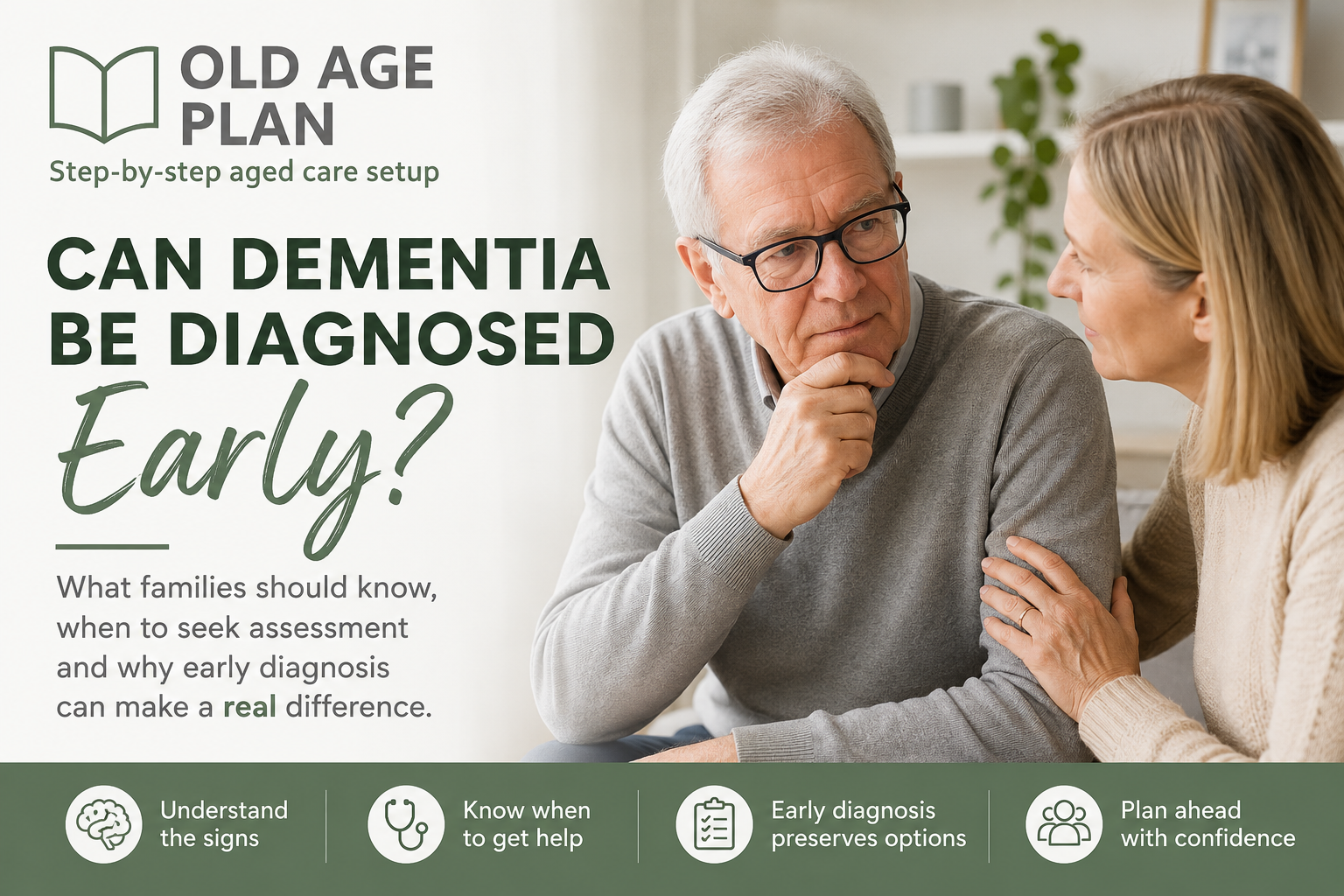

Can Dementia Be Diagnosed Early?
Can dementia be diagnosed early? In some cases, yes. Dementia may be identified in the early stage, especially when memory, thinking, behaviour or daily function changes are noticed, discussed with a GP and assessed properly.
However, early diagnosis is not always simple. Some changes are subtle. Some symptoms may be caused by other conditions. Some families are unsure whether they are seeing dementia, normal ageing, stress, medication effects, depression, delirium or another health issue.
The important question is not only whether dementia can be diagnosed early.
It is whether the changes are significant enough to be checked now, before options narrow.
Short Answer
Yes, dementia can sometimes be diagnosed early, but it usually requires a proper medical assessment. A GP may review symptoms, medical history, medicines, mood, daily function and memory concerns. They may also arrange cognitive tests, blood tests, urine tests or brain imaging, or refer the person to a specialist if needed.
Early diagnosis can help families plan support, review legal documents, consider treatment options, reduce avoidable risks and make decisions while the person may still be able to participate meaningfully.
Key Takeaway
Early diagnosis is not about rushing to label someone. It is about checking meaningful changes early enough to preserve options.
If memory or thinking changes are becoming more frequent, affecting daily life, creating safety concerns or making decisions less reliable, it is usually better to seek medical advice than wait until the situation becomes harder to manage.
What Early Diagnosis Really Means
Early diagnosis does not always mean dementia is found at the very first sign of forgetfulness.
It usually means dementia is identified while symptoms are still mild enough that the person may still manage many daily activities, communicate preferences and take part in planning.
This matters because dementia often affects more than memory. It may affect:
- thinking and reasoning
- language
- planning
- judgement
- mood or behaviour
- daily tasks
- decision-making reliability
In the early stage, the person may still seem mostly independent. This can make families hesitate.
They may think:
“It is probably just ageing.”
“They are still managing most things.”
“We do not want to overreact.”
Those concerns are understandable. But early checking does not mean taking control away. It means getting better information before bigger decisions are forced by crisis.
Why Dementia Can Be Hard To Diagnose Early
Early dementia can be difficult to identify because symptoms may overlap with other issues.
Memory and thinking changes may be linked to:
- depression
- anxiety
- poor sleep
- infection
- delirium
- medication side effects
- thyroid problems
- vitamin deficiencies
- hearing or vision problems
- normal age-related slowing
This is why a proper medical assessment matters.
The goal is not only to ask, “Is this dementia?”
The goal is also to ask, “Could something else be causing or worsening these changes?”
Some causes of confusion or memory problems may be treatable. Others may need ongoing monitoring. Either way, guessing at home is rarely as useful as getting a structured assessment.
When Early Changes Should Be Checked
Occasional forgetfulness does not automatically mean dementia.
However, changes should be checked when they become more frequent, more noticeable or harder to explain.
Examples may include:
- forgetting recent conversations often
- repeating the same questions more than usual
- getting lost in familiar places
- struggling with familiar tasks
- missing bills, appointments or medicines
- finding it harder to follow conversations
- becoming confused about time or place
- making unusual financial or safety decisions
- showing judgement changes that are out of character
The decision point is not whether every sign is severe.
The better question is:
Are the changes starting to affect daily life, safety, judgement or decision reliability?
Early Diagnosis And Decision Reliability
A dementia diagnosis does not automatically mean a person has lost capacity.
Someone may still be able to make many decisions, especially if information is explained clearly and they are given enough time.
The issue families often notice first is not total incapacity. It is decision-making becoming less reliable.
There is a difference between slower decision-making and unreliable decision-making.
Slower decision-making may look like:
- needing more time to process information
- asking for things to be repeated
- becoming tired with complex discussions
- needing simpler explanations
That does not automatically mean the person cannot decide.
Unreliable decision-making is different. It may look like:
- changing major decisions repeatedly without clear reason
- agreeing with whoever spoke most recently
- not understanding the consequences of a decision
- being easily pressured
- making choices that are inconsistent with long-held values
This distinction matters because early diagnosis can help families preserve autonomy while also recognising when more support may be needed.
What Usually Happens During An Early Dementia Assessment?
The assessment process may vary, but it often begins with a GP.
A GP may ask about:
- memory and thinking changes
- when symptoms started
- whether symptoms are getting worse
- daily functioning
- mood and sleep
- medical history
- current medicines
- alcohol use
- family observations
They may also arrange tests to check cognition, mood, physical health and possible reversible causes.
Depending on the situation, the person may be referred to a geriatrician, neurologist, psychiatrist, memory clinic or other specialist service.
Early assessment is not always one appointment. It may take time to gather enough information and rule out other causes.
Why Early Diagnosis Can Help
Early diagnosis can be difficult emotionally and practically, but it may also create more time and more options.
It may help with:
- understanding what is changing
- reviewing medicines and health risks
- planning care and support earlier
- discussing legal documents while capacity may still be present
- making home safety changes before incidents occur
- accessing support services
- reducing family confusion
- allowing the person to express preferences
Waiting too long can compress options.
By the time a family is dealing with wandering, medication errors, unsafe driving, financial mistakes or conflict about authority, decisions may become more urgent and less flexible.
Can Early Diagnosis Be Wrong?
Yes, diagnosis can sometimes be uncertain, especially in the early stages.
Dementia-like symptoms may be caused or worsened by other conditions. Different types of dementia can also be hard to distinguish early.
This does not mean assessment is pointless.
It means families should understand that diagnosis is a process. Sometimes the safest answer is further testing, monitoring, referral or review over time.
If the diagnosis does not seem to match what the family is seeing, or if symptoms change suddenly, it may be reasonable to ask more questions or seek further medical advice.
What You May Really Be Trying To Decide
If you are searching “Can dementia be diagnosed early?”, you may not only want a medical answer.
You may be trying to decide:
- Are we worrying too soon?
- Should we book a GP appointment?
- Is this normal ageing or something more serious?
- Should legal planning happen now?
- Should we start talking about care support?
- Are we waiting too long?
The safest approach is usually not panic and not denial.
It is to notice patterns, document concerns in a simple way, speak with a GP and keep the person involved as much as possible.
Decision Support
Early diagnosis is most useful when it improves decision quality.
Consider seeking medical advice when changes are:
- repeated, not isolated
- new or worsening
- affecting daily tasks
- creating safety concerns
- affecting money, medicines, driving or appointments
- causing family disagreement about what is happening
- making important decisions less consistent or reliable
The goal is not to remove independence too early.
The goal is to avoid waiting until the person has fewer choices, fewer legal options and less ability to explain what they want.
Early assessment can help families slow the situation down and make decisions with better information.
Related Old Age Plan Articles
- How Is Dementia Diagnosed?
- What Happens After A Dementia Diagnosis?
- Can Dementia Be Misdiagnosed?
- When Should Memory Loss Be Checked?
- When Should You See A Doctor About Memory Problems?
- What Tests Are Used To Check Memory Problems?
- What Is A Cognitive Assessment?
- Can Someone With Dementia Make Legal Decisions?
Next Steps With Old Age Plan
If you are noticing memory or thinking changes, the most useful next step may be organising what you are seeing before speaking with a GP.
Patterns are often easier to recognise when concerns are recorded over time rather than relying on memory during appointments.
Old Age Plan’s Free Tools can help you organise observations, record changes and prepare better questions for medical appointments.
You may also find it helpful to continue with related guides covering memory assessments, dementia diagnosis and early warning signs so you can better understand what may need attention next.
The goal is not to rush into care decisions or assume dementia too early.
The goal is to make sure important patterns are recognised while there is still time to preserve options and plan well.
Sources
- Healthdirect Australia — Dementia overview
- Healthdirect Australia — Dementia
- Dementia Australia — Early warning signs of dementia
- My Aged Care — Living with memory loss, dementia or depression
- RACGP — Dementia
Disclaimer
This article provides general information only. It is not medical, legal or financial advice.
Dementia symptoms, diagnosis and support needs can vary between individuals. Medical assessment should be provided by a qualified health professional.
Laws, services, policies and procedures may change over time. You should seek advice from appropriate professionals and refer to official Australian Government, health and dementia support resources for current information.
For dementia-related information and support, you may wish to contact Dementia Australia, Healthdirect, My Aged Care or your GP.
Summary
Dementia can sometimes be diagnosed early, but it usually requires proper medical assessment. Early symptoms can be subtle and may overlap with other health issues, so guessing is not enough.
The main value of early diagnosis is not the label itself. It is the opportunity to understand what is changing, check for other causes, preserve decision-making involvement and plan before options become narrower.
If memory, thinking, judgement or daily function changes are becoming more noticeable, early medical advice can help families make clearer decisions.