
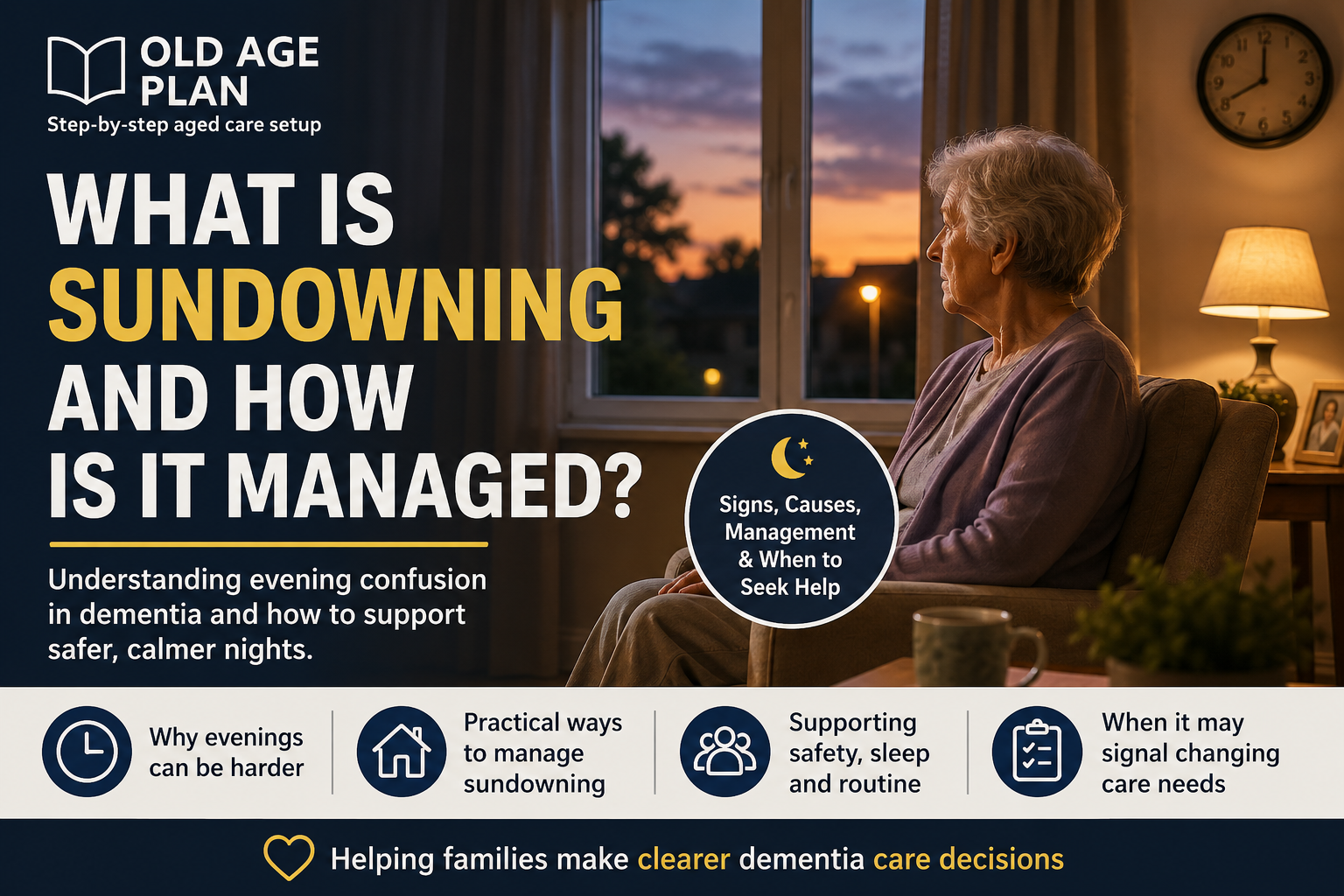

What Is Sundowning And How Is It Managed?
Families often search for sundowning because evenings suddenly feel different.
The person may seem calmer during the day, then become confused, restless, suspicious, anxious or harder to reassure in the late afternoon or evening.
That can leave families asking one obvious question:
What is sundowning and how is it managed?
But underneath that question is usually something more urgent.
Why are evenings becoming unsafe?
Are we doing something wrong?
Can we still manage nights at home?
Sundowning is not a separate disease. It is a pattern of increased confusion, restlessness or distress that can happen later in the day in some people living with dementia.
The most important point is this: sundowning can reveal that care needs are not the same across the whole day.
A person may seem reasonably settled in the morning but become much less reliable by evening. That difference matters for safety, supervision and care planning.
Short Answer
Sundowning is a pattern where a person with dementia becomes more confused, restless, anxious, agitated or distressed in the late afternoon, evening or night.
It may involve pacing, wanting to “go home”, suspicion, calling out, sleep disruption, wandering, resistance to care or increased emotional distress.
Sundowning is usually managed by looking for triggers, keeping routines predictable, reducing late-day overstimulation, improving lighting, checking for pain or illness, supporting sleep and seeking professional advice if risks increase.
It should not be dismissed as “just dementia”, especially if symptoms appear suddenly, become severe or create safety risks.
Key Takeaway
Sundowning is often treated as an evening behaviour problem.
Old Age Plan sees it as something broader.
It can be a reliability signal.
The key question is not only:
Why are they unsettled at night?
The better question is:
Can they still remain safe and supported across the whole day, including the hours when their symptoms are worse?
Morning ability does not always prove evening safety.
That distinction is where many families get caught.
What Does Sundowning Mean?
Sundowning usually refers to increased confusion, anxiety, agitation or restlessness that happens later in the day.
It may begin in the late afternoon, evening or night.
Some people become more suspicious.
Some become more demanding or distressed.
Some pace, call out, resist care, try to leave, or repeatedly say they need to go home.
Others may become frightened, withdrawn, tearful or unable to settle.
The pattern can be hard for families because the person may appear quite different earlier in the day.
That can make sundowning feel sudden, confusing and unfair.
What Sundowning Can Look Like
Sundowning may look different from person to person.
Common signs may include:
- increased confusion late in the day
- restlessness or pacing
- anxiety or fear
- irritability or agitation
- suspicion or paranoia
- wanting to leave or “go home”
- calling out repeatedly
- difficulty settling for bed
- waking during the night
- wandering
- resistance to showering, changing clothes or medication
- seeing, hearing or believing things that are not real
- becoming more impulsive
These changes can feel like a behavioural problem.
But the more useful question is often: what is this behaviour telling us about unmet needs, fatigue, discomfort, environment or changing dementia support needs?
Why Sundowning May Happen
There is usually no single cause.
Sundowning may be linked to several factors happening together.
Possible contributors include:
- tiredness late in the day
- changes to the body clock
- reduced light and shadows in the evening
- too much noise or activity during the day
- pain, hunger, thirst or needing the toilet
- infection or sudden illness
- medication side effects
- poor sleep
- change in routine
- unfamiliar environments
- vision or hearing problems
- carer fatigue affecting the evening atmosphere
This is why management should not jump straight to control.
First, families need to ask what may be driving the late-day change.
Sundowning Is Not The Same As Being Difficult
This distinction matters.
A person who is sundowning is not usually choosing to make evenings hard.
They may be frightened, tired, overwhelmed, uncomfortable or unable to understand where they are.
If the family treats sundowning as deliberate behaviour, the response can become too forceful.
That can increase distress and make the evening worse.
A better approach is to ask:
What is making this time of day harder for them?
That question keeps the focus on support, not blame.
The Hidden OAP Issue: Morning Competence Does Not Prove Evening Safety
This is one of the most important parts of sundowning.
Families may judge the person’s needs based on their best part of the day.
They may think:
“They were fine this morning.”
“They had a good conversation after breakfast.”
“They seemed settled when the doctor saw them.”
That may all be true.
But dementia care decisions cannot rely only on best-hour functioning.
If the person becomes unsafe, distressed or unreliable every evening, then the evening pattern is part of the real care picture.
The decision question becomes:
Are they reliable enough across the whole day, not just during their best hours?
This matters for supervision, medication routines, meal preparation, bathing, wandering risk, carer rest and whether home care is still manageable.
The Real Tension: Comfort Versus Control
Sundowning creates a difficult care tension.
Families want the evening to be calm.
They also want the person to be safe.
Sometimes those goals pull in different directions.
Too little structure can leave the person overwhelmed, restless or unsafe.
Too much control can make them feel trapped, corrected or frightened.
The goal is not to overpower the behaviour.
The goal is to reduce distress while preserving as much dignity, comfort and safety as possible.
That is why good sundowning management is usually gentle, structured and observant.
How Sundowning Is Usually Managed
Sundowning is usually managed by reducing triggers and supporting the person through the most difficult part of the day.
Helpful strategies may include:
- keeping a consistent daily routine
- reducing late-day noise, visitors and stimulation
- using soft lighting before shadows become confusing
- encouraging daylight exposure earlier in the day
- supporting gentle movement during the day
- limiting long late-afternoon naps if they worsen night sleep
- checking hunger, thirst, pain, toileting and temperature
- keeping evenings calm and predictable
- using familiar music, objects or reassurance
- making the bedroom comfortable and easy to navigate
- using night lights if the person wakes or needs the bathroom
These strategies are not a guaranteed fix.
They are ways to reduce friction around the time of day when the person is most vulnerable.
For broader routine support, see Can Routine Help Someone With Dementia?.
Start By Looking For Patterns
Before changing everything, look for the pattern.
Ask:
- What time does it usually start?
- What happened in the hour before it began?
- Was the person tired, hungry, overstimulated or in pain?
- Was there a change in routine?
- Was the environment noisy or dim?
- Did the person nap late in the day?
- Did the evening care routine feel rushed?
- Is it worse after appointments, visitors or outings?
Patterns matter because sundowning management is rarely about one magic solution.
It is usually about finding the repeatable pressure points and reducing them.
When Sundowning May Be A Medical Warning Sign
Not every late-day change should be assumed to be dementia progression.
Sudden or severe confusion may need medical review.
Seek professional advice promptly if there is:
- sudden worsening confusion
- new hallucinations or delusions
- fever or signs of infection
- new pain
- dehydration concerns
- recent medication changes
- falls or head injury
- major sleep disruption
- sudden aggression or unsafe behaviour
Delirium, infection, pain, medication effects or other medical issues can worsen confusion and behaviour.
If the change is sudden, treat it as something worth checking, not simply “normal dementia.”
For related reading, see Can Delirium Be Mistaken For Dementia? and Can Infection Make Dementia Worse?.
What You May Really Be Trying To Decide
The surface question is what sundowning is and how to manage it.
The deeper decision is usually about whether evenings and nights are still safe.
You may really be trying to decide:
- Is this normal dementia progression?
- Are we missing pain, infection or medication problems?
- Can we manage evenings with routine and environmental changes?
- Does the person need more supervision after dark?
- Is wandering or exit risk becoming serious?
- Is the carer getting enough sleep to keep providing care?
- Do we need professional support?
- Is night-time care becoming the real breaking point?
That is why sundowning is not just a behaviour topic.
It can become a care sustainability topic.
Decision Support
Before deciding what to do next, separate the problem into three levels.
1. Is This A Pattern Or A Sudden Change?
If sundowning has gradually developed and follows a repeated evening pattern, routine and environmental changes may help.
If confusion or agitation is sudden, severe or very different from usual, medical review becomes more important.
This distinction protects families from missing treatable causes.
2. Is The Person Safe During Their Worst Hours?
Do not only assess safety during the day.
Ask whether they are safe during the hours when symptoms are strongest.
Can they safely use the bathroom at night?
Can they be left alone in the evening?
Are they trying to leave the house?
Are they becoming frightened, aggressive or unable to settle?
If the answer changes after dark, the care plan needs to account for that.
3. Is The Carer Still Able To Cope With Nights?
Sundowning often shifts pressure onto carers.
A family may manage daytime care but become exhausted by evening agitation, night waking, wandering or constant reassurance.
When carers cannot sleep, recover or safely supervise, the care arrangement may begin to break down.
That is not failure.
It is a signal that the decision has changed.
How Sundowning Decisions Usually Escalate
Sundowning decisions often escalate in stages.
- Notice the pattern — identify when evening changes occur and what may trigger them.
- Reduce pressure points — adjust lighting, noise, hunger, toileting, pain, fatigue and routine.
- Structure the evening — use calm, familiar, predictable wind-down routines.
- Increase supervision — especially if wandering, falls, fear or unsafe behaviour increases.
- Seek medical review — especially if changes are sudden, severe or linked with pain, infection, sleep disruption or medication changes.
- Review care needs — if nights are no longer safe or carers cannot recover enough to keep providing care.
This ladder matters because many families wait until night-time becomes a crisis.
Earlier recognition can help families adjust care before exhaustion or injury forces the decision.
Sundowning And Wandering Risk
One of the highest-risk sundowning patterns is trying to leave.
The person may believe they need to go home, find someone, go to work or complete an old responsibility.
Arguing usually does not help.
If the person believes they are in the wrong place, their fear may feel real to them.
The safer approach is usually reassurance, redirection, comfort and risk reduction.
But if the person is repeatedly trying to leave, especially at night, that becomes a supervision and safety issue.
At that point, families should not treat it as a minor behaviour problem.
Sundowning And Carer Burnout
Sundowning can exhaust carers because it often appears at the exact time carers are already tired.
By evening, the carer may have already managed meals, medication, appointments, personal care, housework and emotional support.
Then the hardest part of the day begins.
This is why sundowning often becomes the hidden breaking point for home care.
The person may still seem manageable to outsiders during the day.
But the family knows that nights are becoming unmanageable.
That reality needs to be taken seriously.
For broader escalation context, see When Should Professional Care Be Considered For Dementia?.
Sundowning, Routine And The Home Environment
Routine and environment can make sundowning better or worse.
A noisy television, dim hallway, cluttered bathroom, late meal, rushed shower or confusing bedroom can all increase distress.
Small changes may help.
These might include:
- turning lights on before the home becomes shadowy
- keeping dinner and bedtime routines predictable
- reducing background noise
- keeping familiar objects nearby
- making the bathroom easier to find at night
- using calm music or familiar reassurance
- avoiding rushed or confrontational evening care
For home safety and practical task support, see Can Occupational Therapy Help Dementia?.
Sundowning And Medication Questions
Families sometimes ask whether medication is needed for sundowning.
Medication decisions should be handled carefully with a qualified health professional.
Sometimes medication, pain, infection, sleep problems or other health issues may be contributing to late-day confusion.
Sometimes non-drug changes should be tried first where safe and appropriate.
The key point is not to treat sedation as the only pathway.
The better starting point is to understand the pattern, check for causes and match support to the actual risk.
For related articles, see What Medications Are Used For Dementia? and What Non-Drug Treatments Help Dementia?.
How Sundowning Differs From General Agitation
Sundowning is closely related to agitation, restlessness and confusion, but the timing pattern matters.
If symptoms consistently worsen in the late afternoon or evening, the care plan should respond to that time pattern.
That may mean moving difficult tasks earlier in the day.
It may mean reducing evening demands.
It may mean changing lighting, meals, visitors, bathing times or bedtime routines.
If the main issue is distress or agitation at any time of day, see How Do You Calm Someone With Dementia?.
When Sundowning May Mean Care Needs Are Changing
Sundowning may signal changing care needs when it creates repeated safety or supervision problems.
This may include:
- night wandering
- attempts to leave the home
- falls or unsafe bathroom use at night
- severe agitation or fear
- carer sleep deprivation
- increased resistance to essential care
- unsafe cooking, doors, appliances or stairs in the evening
- needing constant supervision after dark
At this point, the issue is no longer simply “how do we calm evenings?”
The bigger question may be:
Is this care arrangement still safe across the full day and night?
For stage-related context, see What Happens In The Middle Stages Of Dementia? and What Happens In Late-Stage Dementia?.
Related Old Age Plan Articles
- Can Routine Help Someone With Dementia?
- How Do You Calm Someone With Dementia?
- What Non-Drug Treatments Help Dementia?
- What Medications Are Used For Dementia?
- Can Occupational Therapy Help Dementia?
- Can Exercise Help Dementia?
- When Should Professional Care Be Considered For Dementia?
- Can Delirium Be Mistaken For Dementia?
- Can Infection Make Dementia Worse?
- What Happens In The Middle Stages Of Dementia?
- What Happens In Late-Stage Dementia?
Next Steps With Old Age Plan
If sundowning is becoming a problem, start by looking at the time pattern.
When does it begin?
What seems to make it worse?
Is the person unsafe, or mainly unsettled?
Is the carer losing sleep?
Compare this article with Can Routine Help Someone With Dementia? if evenings are worse when the day becomes unpredictable.
If distress, agitation or fear is the main issue, read How Do You Calm Someone With Dementia?.
If evenings are becoming unsafe or carers can no longer recover overnight, read When Should Professional Care Be Considered For Dementia?.
Old Age Plan resources can help families move from vague concern to clearer planning. A sundowning pattern tracker, night-time safety worksheet or care escalation planner may help you record what is changing before speaking with a GP, dementia support service or aged care assessor.
The aim is not to control every evening perfectly.
The aim is to recognise whether sundowning can still be managed with support, or whether night-time care is becoming the decision that needs attention.
Sources
- Dementia Australia — Restlessness And Sundowning
- Dementia Australia — Sleep And Dementia
- Dementia Australia — Mood And Behaviour Changes
- Healthdirect — Dementia Overview
- NICE — Dementia: Assessment, Management And Support Recommendations
- Alzheimer’s Society — Sundowning And Dementia
- Alzheimer’s Association — Sleep Issues And Sundowning
- National Institute On Aging — Coping With Agitation, Aggression And Sundowning
Disclaimer
This article provides general information only. It is not medical, legal or financial advice.
Dementia symptoms, sundowning patterns, medication issues, sleep problems, safety risks and care pathways vary between individuals. Laws, policies, services and clinical guidance may also change over time.
You should seek advice from a qualified health professional, legal professional or aged care professional about your own circumstances.
For current dementia, behaviour, sleep and aged care support information in Australia, you may wish to refer to Dementia Australia, My Aged Care, your GP, dementia support services, state health services and other relevant official resources.
Summary
Sundowning is a pattern where confusion, restlessness, anxiety or agitation becomes worse later in the day or at night.
It is not a separate disease, but it can be a serious care signal.
The key issue is reliability across the whole day.
A person may seem settled in the morning but become unsafe or distressed by evening.
Management usually starts with identifying patterns, reducing triggers, supporting routine, improving the environment and checking for medical causes when symptoms change suddenly.
If sundowning creates wandering risk, carer exhaustion, unsafe nights or constant supervision needs, the decision may no longer be about behaviour alone.
It may be time to review whether the current care arrangement is still safe and sustainable.