
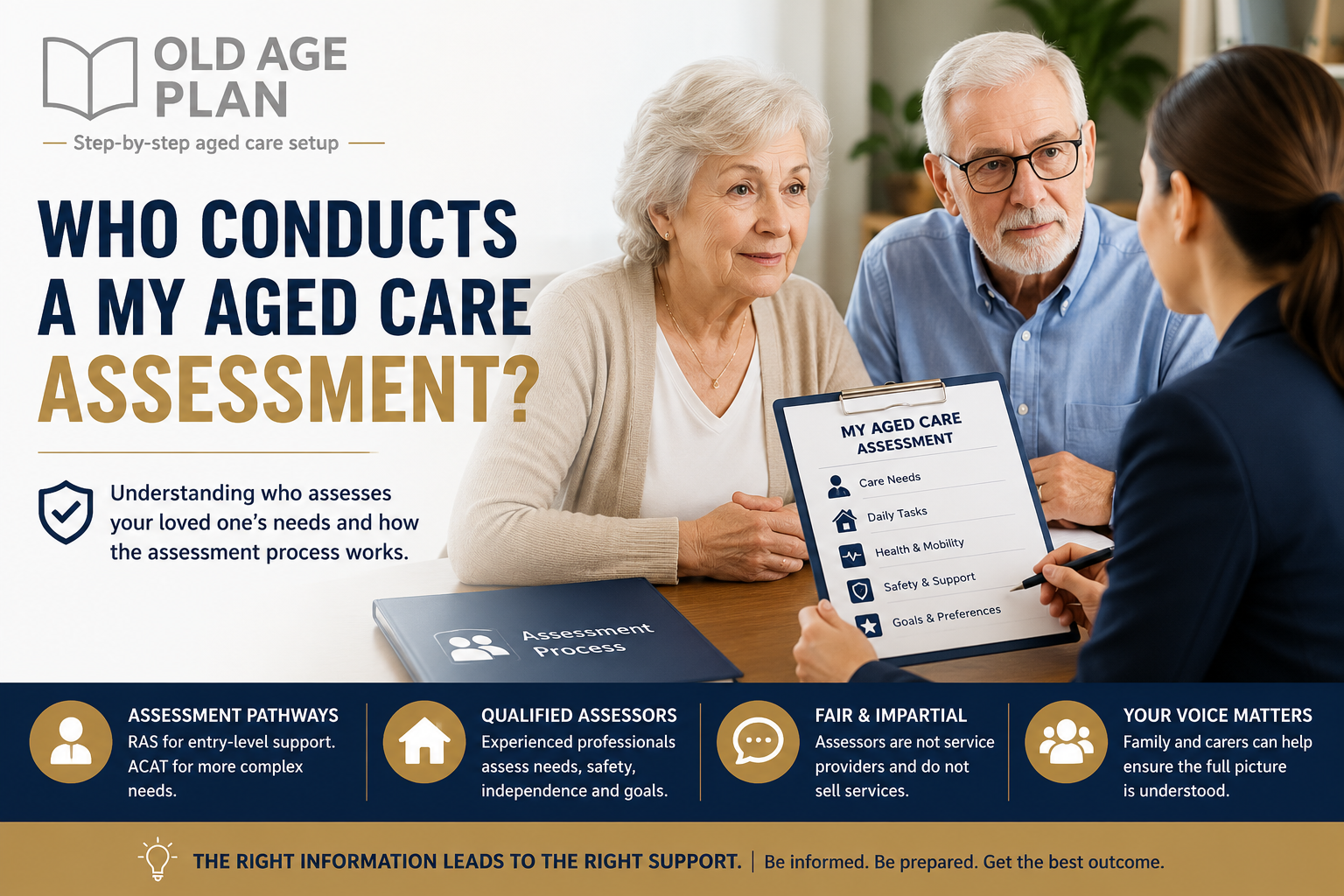

Who Conducts A My Aged Care Assessment?
If a My Aged Care assessment has been arranged, it is normal to wonder who will actually conduct it.
Families may picture a government official, a nurse, a social worker, a local assessor or someone from an aged care provider. That uncertainty can make the assessment feel more intimidating than it needs to be.
The important thing to understand is that the assessor is there to understand the older person’s care needs, daily situation, safety risks, current support and goals. They are not there to sell services or force a decision.
Short Answer
A My Aged Care assessment is conducted by an aged care assessor. Depending on the person’s needs, this may be a Regional Assessment Service assessor for entry-level support or an Aged Care Assessment Team assessor for more complex needs, including Home Care Packages, respite or residential aged care eligibility.
Key Takeaway
The assessor’s role is to understand the person’s support needs and recommend suitable aged care pathways. The more complex the person’s care needs are, the more likely the assessment will involve an Aged Care Assessment Team rather than a simpler entry-level assessment pathway.
Why The Type Of Assessor Matters
Not every aged care assessment is the same.
Some people need basic help at home. Others need more complex support because of personal care needs, dementia, mobility decline, carer pressure, safety risks, hospital discharge or possible residential aged care.
The type of assessor matters because different assessment pathways can lead to different types of support.
OAP Reality Check: The real question is not only “who is conducting the assessment?” It is “will this assessment pathway properly recognise the level of care needed?”
The Two Main Assessment Pathways
My Aged Care may refer a person to different assessment pathways depending on their situation.
Regional Assessment Service
This pathway is generally used for people who need entry-level support at home, such as basic help with daily tasks or low-level services.
Aged Care Assessment Team
This pathway is generally used for people with more complex care needs, including Home Care Packages, respite, transition care or residential aged care eligibility.
Assessment Matching
My Aged Care uses information from the first contact or screening process to help decide which assessment pathway may be suitable.
Changing Needs
If the person’s needs are more complex than first described, the assessment pathway may need to be reviewed or escalated.
What Is A Regional Assessment Service Assessor?
A Regional Assessment Service assessor usually assesses people who may need entry-level aged care support at home.
This may include help with tasks such as cleaning, transport, meals, social support, shopping, minor home modifications or other lower-level supports designed to help the person remain independent at home.
This assessment is still important. Entry-level support can prevent small problems from becoming larger ones, especially where daily tasks are starting to become harder.
What Is An Aged Care Assessment Team Assessor?
An Aged Care Assessment Team assessor is involved where care needs are more complex.
This may include assessing eligibility for Home Care Packages, residential aged care, respite care, transition care or more structured aged care support.
These assessments may involve health professionals such as nurses, social workers, occupational therapists or other trained aged care assessors depending on the assessment service and the person’s needs.
Personal Care Needs
If help is needed with showering, dressing, toileting or mobility, the assessment may need to capture this clearly.
Cognitive Changes
Memory problems, confusion, poor judgement or dementia-related changes may require more careful assessment.
Safety Risks
Falls, wandering, unsafe cooking, medication errors or inability to respond in an emergency should be explained clearly.
Carer Pressure
If family support is heavy or unsustainable, the assessor needs to understand that support load.
Is The Assessor From My Aged Care?
The assessor works within the My Aged Care assessment system, but they may be part of an assessment organisation rather than someone from a service provider.
Their role is to assess needs and recommend appropriate support pathways. They should not be confused with a provider trying to sell services.
This distinction matters because families may be more open and honest when they understand that the assessor is not there to market a particular provider.
Is The Assessor A Doctor?
Not necessarily.
A My Aged Care assessor is not the same as a GP or specialist doctor. The assessment is about aged care support needs, not diagnosing a medical condition.
However, health conditions, medications, mobility, pain, memory, hospital history and safety concerns may all be discussed because they affect support needs.
If medical assessment, diagnosis or treatment advice is needed, the person should speak with their GP or relevant health professional.
Will The Assessor Understand Dementia?
Assessors should consider cognitive and behavioural changes where they affect daily life, safety and care needs.
However, families should not assume that dementia-related needs will automatically be obvious during one assessment conversation.
If the person has memory loss, confusion, poor judgement, wandering, medication problems, agitation, repeated questions or decision-making difficulty, those examples should be explained clearly.
What The Assessor Sees
A calm conversation during a short assessment.
What Family Sees
Confusion, unsafe decisions, repeated problems or changing behaviour across the week.
What Can Be Missed
Bad days, night-time issues, carer exhaustion, supervision needs or hidden safety risks.
What Helps
Specific examples, notes, family input and clear explanation of current support.
Can The Assessor Decide If Someone Goes Into Residential Aged Care?
An assessor does not force someone into residential aged care.
The assessment may determine whether the person is eligible for residential aged care, but eligibility is not the same as being forced to enter a facility.
Residential aged care decisions usually involve the older person, family, health professionals, availability of suitable homes, finances, preferences and whether home support remains safe or sustainable.
What Will The Assessor Ask About?
The assessor will usually ask about the person’s daily life, care needs, health, safety, mobility, home environment, current support, goals and whether carers are coping.
Daily Tasks
Showering, dressing, meals, cleaning, shopping, transport, laundry and household management.
Health And Mobility
Medical conditions, recent hospital stays, falls, mobility aids, pain and physical function.
Memory And Safety
Confusion, medication mistakes, wandering, unsafe cooking, decision-making changes or emergency response.
Support Network
Who currently helps, how often they help, and whether that support is still sustainable.
Can A Family Member Speak With The Assessor?
A family member, carer, friend or registered supporter may be involved if the older person agrees.
This can be helpful where the older person forgets details, minimises problems, has communication difficulty or does not realise how much support is already being provided.
The support person should help clarify the situation without taking over the assessment or silencing the older person’s own wishes.
What If The Wrong Type Of Assessment Happens?
Sometimes families worry that the assessment pathway does not match the person’s real level of need.
For example, a person may have been treated as needing only basic support when family can see that personal care, safety, dementia-related supervision or carer breakdown are becoming serious issues.
If this happens, contact My Aged Care and explain what has been missed or what has changed. A support plan review, reassessment or different assessment pathway may be needed depending on the situation.
Needs Were Understated
The person may have said they were coping when family knows they are not.
Family Support Was Hidden
The person may appear independent only because family is doing frequent unpaid support.
Safety Risk Was Missed
Falls, confusion, unsafe cooking, medication mistakes or wandering may not have been fully explained.
Needs Have Changed
The assessment may have been suitable at the time, but the person’s condition may now be different.
What You May Really Be Trying To Decide
The surface question is:
Who conducts a My Aged Care assessment?
But the deeper concern is often:
Will the person doing the assessment understand the real level of need?
That is the real trust question. Families want to know whether the assessor will recognise what is happening, especially when the older person presents well, minimises problems or has needs that are not obvious in a single conversation.
Decision Support: How To Work With The Assessor
The best way to approach the assessment is to treat the assessor as someone who needs accurate information to understand the situation properly.
Be Specific
Use examples of recent falls, missed meals, medication issues, confusion, personal care needs or carer pressure.
Explain Bad Days
Do not only describe the person’s best day. Explain the pattern across the week.
Make Support Visible
Tell the assessor what family, friends or carers already do to keep the person safe and supported.
Ask About Next Steps
Before the assessment ends, ask what happens next, who will contact you and what to do if needs change.
Related Old Age Plan Articles
Next Steps With Old Age Plan
FAQ
Who conducts a My Aged Care assessment?
A My Aged Care assessment is conducted by an aged care assessor. Depending on the person’s needs, this may be through the Regional Assessment Service or an Aged Care Assessment Team.
Is the assessor a doctor?
Not necessarily. The assessor is there to assess aged care support needs, not to diagnose medical conditions. Medical concerns should be discussed with a GP or health professional.
What is the difference between RAS and ACAT?
The Regional Assessment Service generally assesses entry-level support needs. An Aged Care Assessment Team generally assesses more complex needs such as Home Care Packages, respite or residential aged care eligibility.
Can family speak to the assessor?
Family, carers or supporters may usually be involved if the older person agrees. This can help explain hidden support needs or risks that may not be obvious.
What if the assessment does not match the real need?
Contact My Aged Care and explain what was missed or what has changed. A review, support plan review or reassessment may be appropriate depending on the situation.
Summary
A My Aged Care assessment is conducted by an aged care assessor. Some people are assessed through the Regional Assessment Service for entry-level support, while others are assessed by an Aged Care Assessment Team for more complex aged care needs.
The most important thing is that the assessor understands the real situation. Families should explain daily support needs, safety risks, hidden care, carer pressure and any changes that may not be obvious during one assessment conversation.
Sources
Disclaimer
This article provides general information only and is not medical, legal, financial or aged care advice.
Aged care assessment roles, service pathways and eligibility processes may change. Your situation may also depend on health needs, urgency, location, provider availability, family support and eligibility.
For current information, contact My Aged Care or speak with a qualified aged care, health, legal or financial professional where needed.