
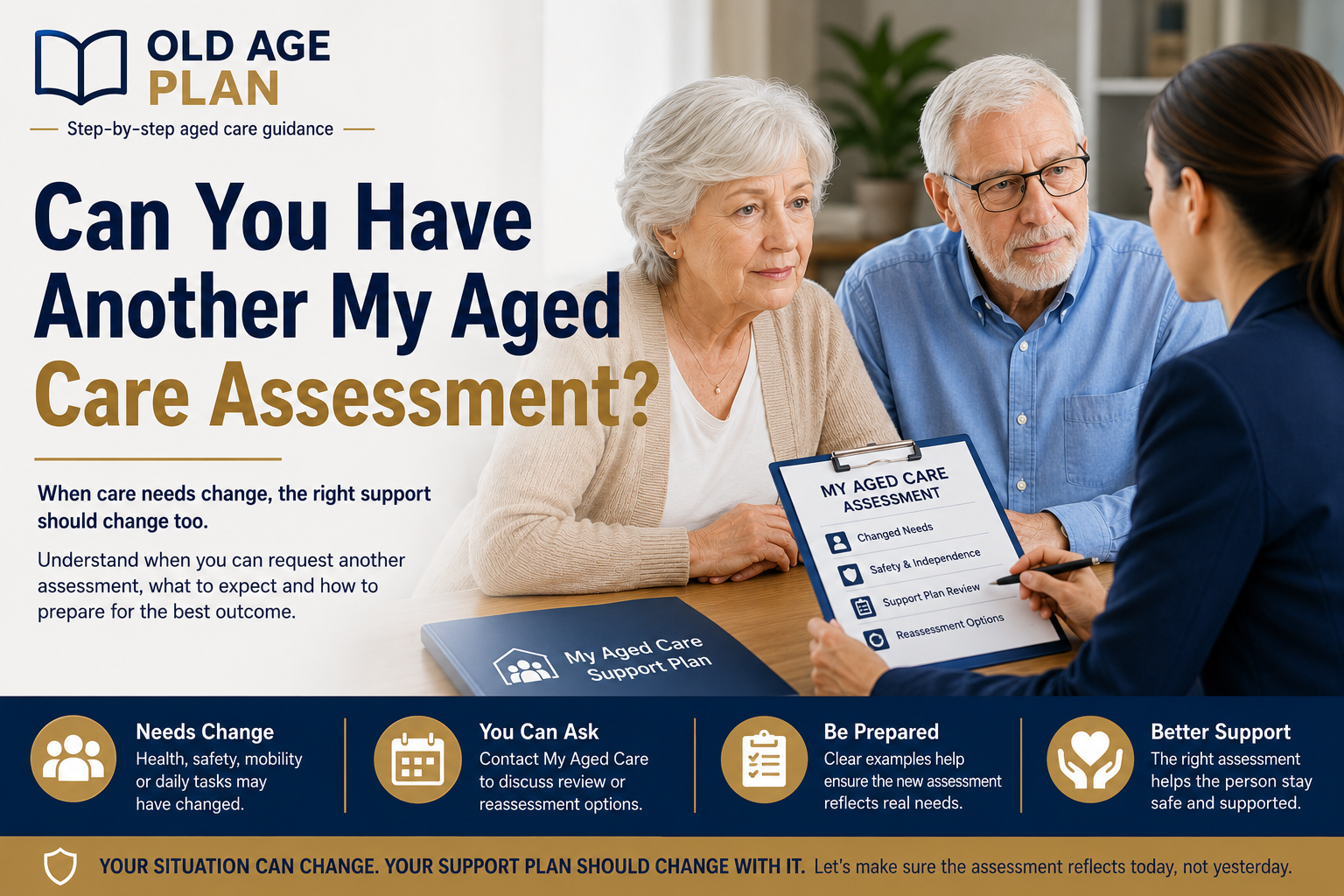

Can You Have Another My Aged Care Assessment?
If an older person has already had a My Aged Care assessment, families sometimes assume that decision is fixed.
But care needs can change. Someone who was managing reasonably well six months ago may now be struggling with showering, meals, falls, memory, mobility, medication, continence, carer pressure or safety at home.
In that situation, the real question is not only whether another assessment is allowed. The real question is whether the current support still matches the person’s actual needs.
Short Answer
Yes. You can contact My Aged Care if care needs have changed after a previous assessment. Depending on the situation, this may lead to a support plan review, reassessment or further discussion about services. Another assessment may be needed if the older person’s health, safety, independence, carer support or living situation has changed.
Key Takeaway
A previous My Aged Care assessment does not mean the person’s needs are locked in forever. If the situation has changed, the support plan may need to be reviewed or the person may need another assessment so their current needs are properly understood.
When Another Assessment May Be Needed
Another assessment may be needed when the person’s current support no longer matches daily life.
This can happen gradually or suddenly. Sometimes families only notice the gap when they realise they are doing more and more in the background to keep the person safe.
Health Has Declined
The person may have worsening mobility, new pain, increased fatigue, reduced strength or more difficulty managing daily activities.
There Has Been A Fall Or Hospital Stay
A fall, injury, illness or hospital discharge can change the level of support needed at home.
Memory Or Confusion Has Increased
New or worsening memory problems may affect medication, meals, safety, appointments, finances or decision-making.
Family Support Is No Longer Enough
If family members are exhausted, unavailable or doing more than before, the previous assessment may no longer reflect the real situation.
Review, Reassessment Or Appeal?
Families often use these words interchangeably, but they are not the same thing.
An appeal or internal review usually relates to a decision you believe was wrong at the time it was made. A reassessment or support plan review usually relates to needs that have changed since the earlier assessment.
Internal Review
Use this when you disagree with a decision in a Notice of Decision and believe the original outcome was wrong or incomplete.
Support Plan Review
Use this when the current services, goals or support arrangements may need updating.
Reassessment
Use this when the person’s needs have changed enough that a new assessment may be required.
Urgent Escalation
Use this when the situation has become unsafe, unstable or beyond what family can manage while waiting.
What Changes Should You Tell My Aged Care About?
When contacting My Aged Care, be specific about what has changed.
Do not only say, “Mum needs more help.” Explain what has become harder, what risks have increased and what family members are now doing that they were not doing before.
Personal Care
Help may now be needed with showering, dressing, toileting, grooming, continence or getting in and out of bed.
Home Tasks
Cleaning, laundry, shopping, meals or household safety may have become difficult or unsafe.
Safety Risks
Falls, wandering, medication mistakes, unsafe cooking, confusion or inability to call for help may now be present.
Carer Load
Family may now be providing more supervision, transport, meals, appointment support or emergency response.
Why Families Often Wait Too Long
Many families delay contacting My Aged Care because they are not sure whether the change is “serious enough.”
They may also worry about making a fuss, upsetting the older person, or admitting that the current arrangement is no longer working.
OAP Reality Check: Waiting until the situation collapses does not protect independence. It often removes options that could have helped earlier.
If The Older Person Says They Are Fine
It is common for an older person to say they are fine even when family members can see that support needs have changed.
This may come from pride, fear of losing independence, embarrassment, memory problems or not realising how much family support is already being provided.
The goal is not to override the person unnecessarily. The goal is to make sure decisions are based on the real situation, not only on the most optimistic version of it.
How To Prepare For Another Assessment
If another assessment or review is likely, preparation helps.
The assessor needs to understand what has changed since the previous assessment and why the current support may no longer be enough.
Compare Then And Now
Write down what the person could do at the last assessment and what they struggle with now.
Use Real Examples
Include recent falls, missed meals, medication mistakes, hygiene concerns, confusion or safety incidents.
Explain Family Support
List what family members are doing each week to keep the person safe, organised or cared for.
Describe Bad Days
Do not only describe the person’s best days. Explain the harder pattern across the week.
What If Needs Have Changed Suddenly?
If needs have changed suddenly, contact My Aged Care and explain the urgency.
This may happen after a hospital discharge, fall, infection, delirium, sudden confusion, carer illness, rapid mobility decline or a new safety risk at home.
If there is immediate danger, a medical emergency or the person is unsafe, do not rely only on the aged care assessment process. Seek urgent health or emergency support where needed.
What If The Current Services Are Not Enough?
Sometimes the person is already receiving services, but those services no longer match their needs.
For example, cleaning support may have helped at first, but now the person may also need personal care, meal support, transport, medication supervision or more structured home support.
This is where a support plan review or reassessment may be needed. The issue is not that the original decision was necessarily wrong. The issue is that the situation has moved on.
What You May Really Be Trying To Decide
The surface question is:
Can you have another My Aged Care assessment?
But the deeper decision is often:
Has the person changed enough that the current support pathway is no longer safe or suitable?
That is the real pressure point. Families are not just asking about eligibility for another appointment. They are trying to work out whether the care plan still fits reality.
Decision Support: When To Ask For Another Assessment
Use the question of change as the starting point.
If Needs Are Mostly Stable
Monitor the situation, keep notes and check whether current services are still meeting the person’s goals.
If Needs Are Increasing
Contact My Aged Care and explain what has changed since the previous assessment.
If Family Is Compensating
Make hidden support visible. The person may appear stable only because family is filling the gaps.
If Safety Is Declining
Do not wait for a routine review if risk is increasing. Ask what reassessment or urgent support options apply.
Related Old Age Plan Articles
Next Steps With Old Age Plan
FAQ
Can you have another My Aged Care assessment?
Yes. If the older person’s needs have changed, you can contact My Aged Care and ask what review or reassessment options are available.
Is another assessment the same as an appeal?
No. An appeal or internal review usually challenges a decision you believe was wrong. Another assessment or reassessment is usually about changed needs.
When should you ask for another assessment?
You should consider contacting My Aged Care if health, mobility, memory, safety, personal care needs, carer pressure or living arrangements have changed.
What information should you provide?
Provide clear examples of what has changed, including daily care needs, safety risks, family support, recent incidents and why current services are no longer enough.
What if the situation becomes urgent?
Contact My Aged Care and explain the urgency. If there is immediate danger, medical risk or the person is unsafe, seek urgent health or emergency support where appropriate.
Summary
You can contact My Aged Care if an older person’s needs have changed after a previous assessment. Depending on the situation, this may lead to a support plan review, reassessment or further discussion about services.
The key is to explain what has changed clearly. Compare the previous situation with the current reality, make hidden family support visible and describe any new safety risks, personal care needs or carer pressure.
Sources
Disclaimer
This article provides general information only and is not medical, legal, financial or aged care advice.
Aged care assessment processes, support plan review pathways, reassessment rules and service availability may change. Your situation may also depend on health needs, urgency, location, provider availability, family support and eligibility.
For current information, contact My Aged Care or speak with a qualified aged care, health, legal or financial professional where needed.