
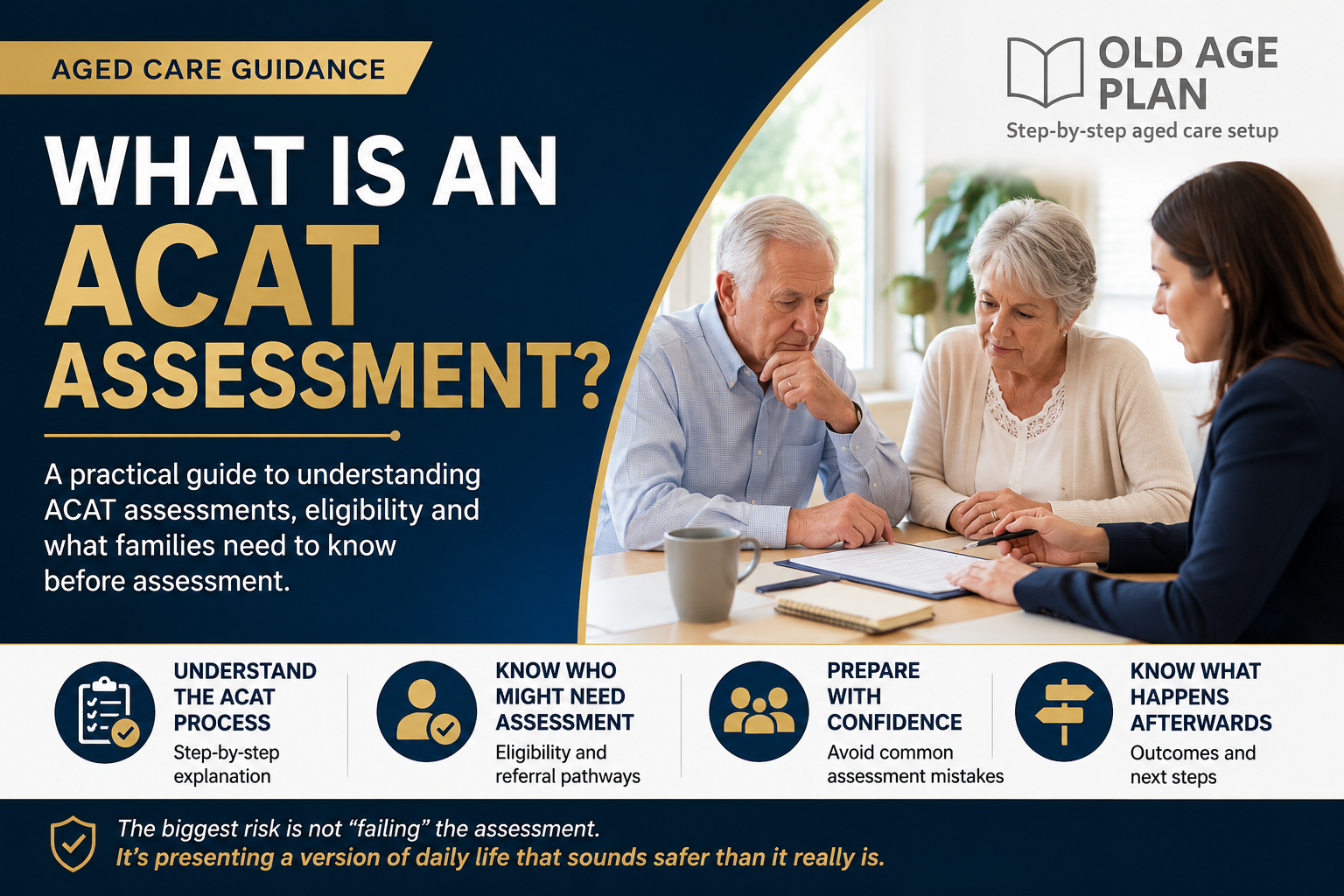

What Is An ACAT Assessment?
Families usually hear the words ACAT assessment when the care situation has already become more serious.
Someone may no longer be safe at home without more support. A hospital discharge may be coming. A carer may be exhausted. Dementia, falls, medication problems or daily living difficulties may be increasing. Suddenly, the question is no longer just “Can we get some help?”
The question becomes:
What level of aged care support is this person actually eligible for, and how do we make sure the assessment reflects what is really happening?
Short Answer
An ACAT assessment is a comprehensive aged care assessment used to decide whether an older person is eligible for higher-level government-subsidised aged care support in Australia.
This may include support at home, short-term care or residential aged care, depending on the person’s needs and assessment outcome.
Key Takeaway
An ACAT assessment is not just a formality. It can shape what support pathways become available next.
The biggest risk is not usually “failing” the assessment. It is presenting a version of daily life that sounds safer, easier or less pressured than it really is.
What An ACAT Assessment Actually Is
ACAT stands for Aged Care Assessment Team. In some places, you may also hear the term ACAS, which stands for Aged Care Assessment Service.
The role of the assessment is to understand the person’s care needs and decide which government-subsidised aged care services they may be eligible for.
An ACAT assessment is usually more comprehensive than a basic aged care screening conversation. It is used when a person may need more than simple entry-level help.
Support At Home
More coordinated or ongoing support may be considered when basic assistance is no longer enough.
Short-Term Care
Short-term restorative or transition care may be considered when recovery, rehabilitation or temporary support is needed.
Respite Care
Respite may be considered when the older person or family carer needs temporary support.
Residential Aged Care
Eligibility may be considered when living at home is no longer safe or sustainable.
OAP Reality Check: An ACAT assessment does not mean the person must enter residential aged care. It means their needs are being assessed so the appropriate support pathways can be considered.
Who May Need An ACAT Assessment?
A person may need an ACAT assessment when their support needs are more complex, ongoing or difficult to manage with basic help alone.
Personal Care Is Becoming Difficult
Help may be needed with showering, dressing, toileting, continence or moving safely.
Falls Or Mobility Problems Are Increasing
The person may be unsteady, unable to transfer safely or becoming frightened to move around alone.
Memory Is Affecting Safety
Medication, meals, appointments, finances or daily routines may be becoming unreliable.
A Family Carer Is No Longer Coping
The current arrangement may depend on a carer who is exhausted, unwell or unable to continue at the same level.
Hospital Discharge Requires Planning
The person may need more support than was required before the hospital stay.
Residential Care May Need To Be Considered
The family may be questioning whether care at home remains safe or sustainable.
Eligibility is not decided by family concern alone. The assessment looks at the person’s needs, situation and level of support required.
How An ACAT Assessment Fits With My Aged Care
My Aged Care is the entry point into government-subsidised aged care services.
The ACAT assessment is one of the assessment pathways that may follow when a person’s needs require a more comprehensive review.
My Aged Care
The front door into the Australian aged care system.
Initial Screening
Information is gathered to understand the person’s situation and determine what type of assessment may be needed.
ACAT Assessment
A more comprehensive assessment used when higher-level or more complex support may be required.
Assessment Outcome
The outcome may open pathways into support at home, respite, short-term care or residential aged care.
You usually do not need to understand every aged care program before starting.
But you do need to understand that the assessment can influence what options become available next.
Before The Assessment, Organise The Facts
If you are still at the early stage, begin writing down what has changed, what support is already being provided and what concerns need to be raised.
The aim is not to create a dramatic version of the situation. It is to prevent important details from disappearing during a short and polite conversation.
What ACAT Assessors Look At
An ACAT assessor will usually ask about the person’s health, daily routines, safety, mobility, memory, support network and current care arrangements.
Personal Care
Whether the person can shower, dress, toilet, groom and move safely without help.
Meals And Nutrition
Whether meals are being prepared, eaten safely and managed consistently.
Medication
Whether medicines are being taken correctly and whether reminders or supervision are required.
Mobility And Falls
How the person moves around, transfers, uses mobility aids and manages falls risk.
Memory And Safety
Whether confusion, wandering, repeated mistakes or poor judgement are affecting daily life.
Family And Carer Support
How much help is already being provided and whether the arrangement is sustainable.
Home Environment
Whether the home remains safe enough for the person’s current needs.
Current Services
What formal support is already in place and whether it is still enough.
OAP Reality Check: The assessment should not become a performance. The goal is not to sound independent. The goal is to explain the real situation clearly.
The Biggest ACAT Mistake Families Make
The biggest ACAT mistake is not being disorganised.
It is understatement.
Families often walk into an assessment with a version of the situation that sounds calmer than reality.
The older person may say they are fine because they want to protect their independence. A spouse may leave out how much help they provide because it has become normal. Adult children may forget to mention the near misses, the night-time calls, the missed meals, the medication confusion or the fall that “was not too bad.”
Then the assessment conversation captures the surface version.
Not the full pressure underneath.
One Fall
May sound minor when described by itself.
Repeated Near Falls
Show an ongoing pattern of mobility and safety risk.
One Missed Tablet
May sound like an isolated mistake.
Regular Medication Confusion
Shows that medication management may no longer be reliable.
One Tired Carer
May sound like ordinary family pressure.
An Unsustainable Carer Role
May involve constant supervision, interrupted sleep and declining carer health.
OAP Reality Check: If the assessment hears the polite version of daily life, the outcome may not reflect the real level of support needed.
When Independence Becomes Misleading
Independence is important. The aim of aged care support should never be to take over decisions unnecessarily.
But independence can become misleading when it only exists because other people are quietly holding everything together.
Shopping
The person appears to manage at home because someone else buys and delivers the groceries.
Appointments
The person appears organised because someone else books, reminds and transports them.
Medication
The person appears medically independent because someone else checks every dose.
Cleaning
The home appears manageable because another person is doing the household work.
Meals
The person appears to eat independently because someone else prepares food and reminds them to eat.
Bills And Paperwork
The person appears administratively capable because someone else manages forms, accounts and correspondence.
Supervision
The person appears safe because another person is always nearby when something goes wrong.
Emergency Response
The arrangement appears stable because family remains constantly available to respond.
That does not mean the person has no independence.
It means the assessment needs to understand how much hidden support is already required.
Decision Reliability During An ACAT Assessment
The key question is not whether the person can still make some decisions.
The real question is whether their decisions remain reliable enough for this specific decision.
During an ACAT assessment, confidence alone is not the same as reliability. A person may confidently say they are managing while forgetting falls, medication problems, meal issues, hygiene decline or carer strain.
Consistency
Does the person give a reasonably consistent account of what is happening?
Understanding
Do they understand the care issues and the decisions being discussed?
Consequences
Can they understand what may happen if support is not accepted or increased?
Stability Over Time
Does the decision remain stable, or does it change with confusion, pressure or memory?
Coherence
Does the person’s explanation connect logically with the known facts?
Vulnerability To Pressure
Is the person easily influenced by fear, family conflict or a desire to end the conversation?
This is why family input can matter, especially when memory, insight or safety awareness is changing.
OAP Reality Check: Supporting decision-making is not the same as taking control. The aim is to help the assessment see whether the person’s decisions remain reliable enough for the care decisions now being made.
How An ACAT Assessment Usually Works
The exact process can vary, but the broad pathway usually follows these steps.
Step 1: The Assessment Is Requested
An assessment may be arranged through My Aged Care after the person applies online, by phone or in person. A family member, friend, carer or health professional may help with the process where appropriate.
Step 2: The Assessor Reviews The Situation
The assessor talks with the person about their current needs, goals, support, risks and living situation. The assessment may occur at home, in hospital or another suitable setting depending on the circumstances.
Step 3: Support Needs Are Considered
The assessor considers what the person can do, what they cannot do safely, what support already exists and whether that support is sustainable.
Step 4: An Outcome Is Issued
After assessment, the person receives a Notice of Decision. This explains whether they are eligible for government-subsidised services and may include a support plan.
Where The Process Can Go Wrong
Problems Are Minimized
The person may present well, forget details or avoid discussing embarrassing difficulties.
Family Support Becomes Invisible
The assessor may not see how often family members intervene or what would fail without them.
The Assessment Captures A Good Day
A calm conversation may not reflect the harder pattern across the week.
Approval Is Mistaken For Service Setup
Families may not realise that provider selection, referrals and practical setup still need to happen.
What Happens After An ACAT Assessment?
After the assessment, the outcome determines which pathway may open next.
Support At Home
The person may be approved for more structured help while continuing to live at home.
Short-Term Care
Short-term restorative, transition or other temporary support may be considered.
Respite Care
Temporary support may help the older person and reduce pressure on family carers.
Residential Aged Care Approval
Eligibility may be approved if residential care becomes necessary or appropriate.
The person may receive a support plan and referral information.
If services are approved, families may still need to compare providers, understand fees, ask questions and make practical decisions about care.
OAP Reality Check: An approval is not the same as care being fully organised. The assessment may open the pathway, but families often still need to choose providers, use referral codes and manage the setup process.
What You May Really Be Trying To Decide
If you are searching for ACAT assessments, you may not only be asking what ACAT means.
You may be trying to decide:
Is This Assessment Serious?
You may be wondering whether the situation has moved beyond basic support.
What Should We Say?
You may be worried that important needs will be forgotten or understated.
Will Independence Be Lost?
You may be concerned that asking for support will take decisions away from the older person.
Are We Asking For Enough Support?
You may be unsure whether the current care arrangement is being described accurately.
Should Family Be Present?
You may be deciding whether someone needs to help explain hidden support or safety risks.
What If The Person Refuses Help?
You may be trying to balance autonomy, safety and decision reliability.
What If The Outcome Is Wrong?
You may be concerned that the assessment will not match daily reality.
Are We Closer To Residential Care?
You may be questioning whether care at home remains sustainable.
Those questions matter because an ACAT assessment is not just administrative.
It often sits at the point where informal family support is no longer enough.
Decision Support
The safest way to approach an ACAT assessment is to be honest, specific and realistic.
Do not exaggerate.
Do not minimise.
Before the assessment, families should think carefully about what has changed, what support is already being provided and what would happen if that support stopped.
What Can The Person Do Safely Without Help?
Separate genuine independence from tasks that only look independent.
What Only Works Because Someone Else Steps In?
Identify the hidden support holding the current arrangement together.
What Risks Are Happening Repeatedly?
Look for patterns rather than treating each incident as isolated.
What Has Changed Recently?
Compare the current situation with three to six months ago.
Is The Current Arrangement Sustainable?
Consider the older person, the carer and the wider family support system.
Are Their Decisions Reliable Enough?
Assess reliability for the specific care decisions now being made.
This does not mean taking control away from the older person.
It means making sure the assessment sees the real support picture.
Related Old Age Plan Guides
Next Steps With Old Age Plan
FAQ
What does ACAT stand for?
ACAT stands for Aged Care Assessment Team. In Victoria, similar assessments have historically been referred to as ACAS, which stands for Aged Care Assessment Service.
Is an ACAT assessment the same as My Aged Care?
No. My Aged Care is the entry point into the aged care system. An ACAT assessment is one assessment pathway used when a person may need higher-level or more complex support.
Does an ACAT assessment mean residential aged care?
No. An ACAT assessment does not automatically mean the person must enter residential aged care. It may assess eligibility for several types of support depending on the person’s needs.
Can family be present during an ACAT assessment?
A trusted family member, friend or carer can often help with the process and be involved where appropriate. This can matter when the person forgets details, minimises problems or needs help explaining their situation.
What happens if someone refuses an ACAT assessment?
Refusal can be difficult, especially if safety or care needs are increasing. Families may need to speak with a GP, hospital team, aged care professional or advocate if the person refuses help and risk is escalating.
How long does an ACAT outcome take?
Timeframes can vary. The assessment organisation reviews the information after the assessment, and the outcome may take time depending on the person’s needs and circumstances.
Can an ACAT assessment be wrong?
An assessment outcome depends on the information available and the needs identified. If important risks or support needs were missed, families may need to follow up through My Aged Care or ask about review options.
What should you not do during an ACAT assessment?
Do not minimise serious risks to protect pride or avoid discomfort. The assessor needs a realistic picture of daily life, including falls, memory problems, carer strain, missed medication, hygiene issues and support already being provided.
Summary
An ACAT assessment is a comprehensive aged care assessment used when an older person may need higher-level or more complex government-subsidised support.
The assessment may influence eligibility for support at home, short-term care, respite or residential aged care.
The most important preparation is not learning the “right” answers. It is making sure the assessment sees the real pattern of daily life, including hidden family support, repeated risks, caregiver pressure and changes that may not be obvious during one conversation.
Sources
Disclaimer
This article provides general information only. It is not legal, medical, financial or aged care advice.
Aged care laws, policies, procedures, eligibility rules, fees and service availability may change. Individual circumstances can vary significantly.
You should seek qualified professional advice where appropriate and refer to official Australian Government resources, including My Aged Care, for current information about aged care assessments, eligibility and service pathways.