
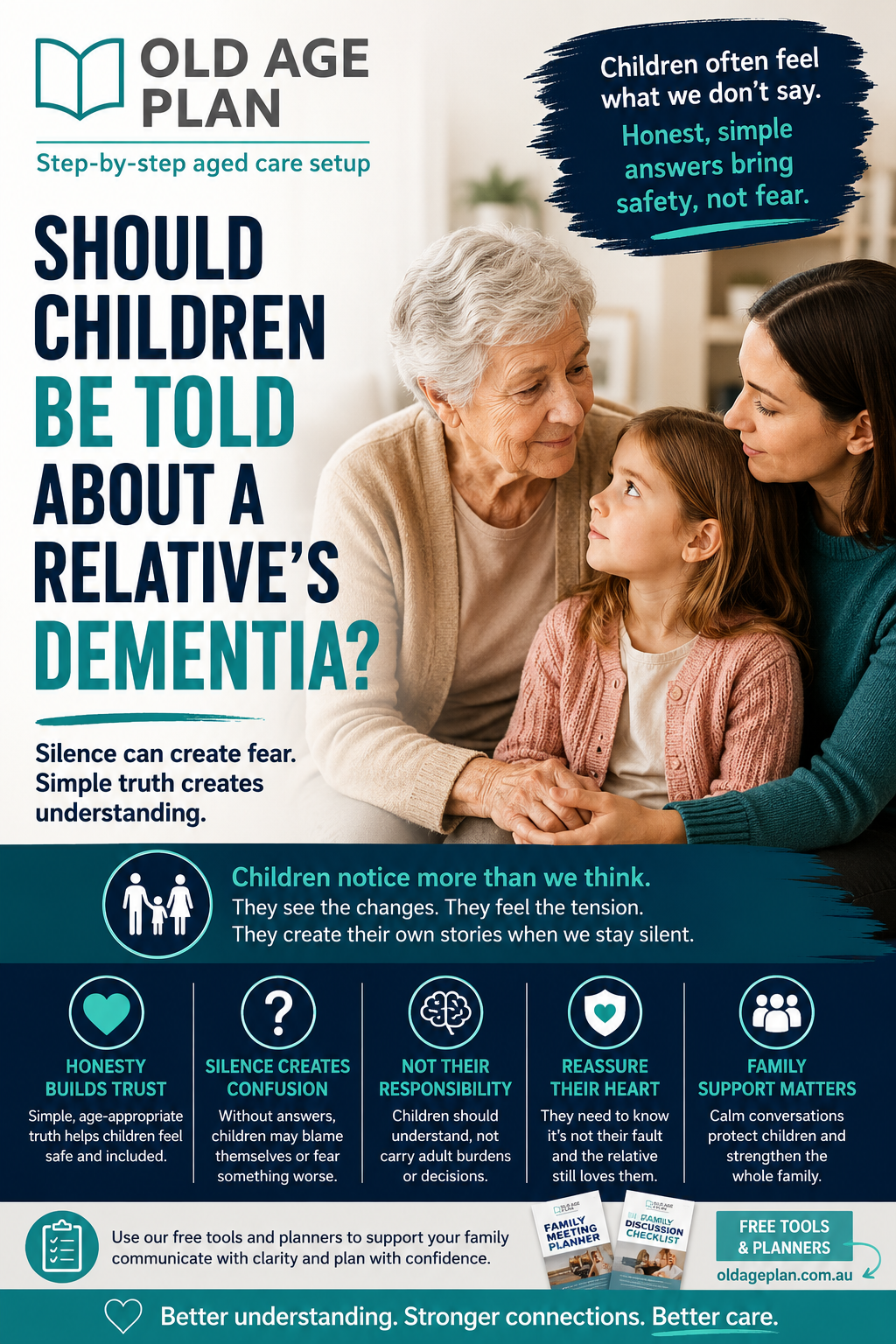

Should Children Be Told About A Relative’s Dementia?
Should children be told about a relative’s dementia? Many families want to protect children from fear, sadness or confusion. That instinct is understandable. But children often notice more than adults think.
They may see the repeated questions. The changed behaviour. The forgotten names. The tension between adults. The whispered conversations after visits. When no one explains what is happening, children may create their own explanation — and sometimes that explanation is more frightening than the truth.
The real question is not only whether children should be told. It is what they may believe if no one tells them anything.
Short Answer
Yes, children should usually be told about a relative’s dementia in a calm, simple and age-appropriate way. The conversation does not need to include every medical detail. But silence can leave children confused, anxious or wrongly blaming themselves. The goal is to help them understand enough to feel safe, included and supported.
Key Takeaway
Protecting children does not always mean hiding dementia from them. Often, it means giving them enough truthful information to understand what they are seeing without making them carry adult fear.
Children Often Notice More Than Adults Think
Adults sometimes assume children are too young to notice dementia changes. That is often wrong.
Children may notice when a grandparent:
- asks the same question again and again
- forgets their name
- becomes angry or distressed
- acts differently during visits
- needs more help than before
- stops doing familiar activities
They may also notice the adults around them changing.
They may hear arguments. See tears. Feel tension. Notice that certain topics are avoided.
Even if children do not understand dementia, they often understand that something is wrong.
If adults say nothing, children may not feel protected. They may feel excluded from a family truth that everyone else seems to know.
What Silence Can Make Children Believe
Silence does not create clarity. It creates space for children to guess.
A child may wonder:
- Did I upset Grandma?
- Why does Grandpa not remember me?
- Is everyone angry?
- Is this my fault?
- Will this happen to Mum or Dad?
- Are adults hiding something worse?
This is where silence can become more harmful than a simple explanation.
Children do not need adult-level detail. But they do need enough truth to stop blaming themselves or imagining something worse.
A simple explanation may sound like:
“Grandma has an illness called dementia. It affects her memory and how she understands things. She still loves you, but sometimes her brain has trouble remembering or staying calm.”
That kind of explanation gives the child a safer frame for what they are seeing.
When Protecting Children Becomes Exclusion
Families often say they are not telling children because they want to protect them.
Sometimes that is reasonable. Children should not be overwhelmed with frightening details, adult conflict or unresolved family stress.
But protection can become exclusion when children are left alone with confusion.
The hard question is:
Are you protecting the child from harm, or protecting the adults from an uncomfortable conversation?
That distinction matters.
If adults avoid the topic because they do not know what to say, children may still carry the emotional weight. They may just carry it without language.
Children are often less frightened by difficult truth than by unexplained emotional tension.
The aim is not to make children responsible for dementia. The aim is to help them understand that the changes they are seeing have a reason.
How Much Should You Tell Them?
Children do not need every detail at once.
The amount you say should match what they are seeing, asking and able to understand.
A helpful approach is to keep the explanation:
- simple
- truthful
- calm
- reassuring
- open to questions
You might say:
“Dementia can make it harder for Grandpa to remember things. If he asks the same question again, it is not because he is ignoring you. His brain is having trouble holding the answer.”
Or:
“Sometimes Nana may get upset or confused. That is not your fault. An adult will help her.”
The child should not leave the conversation feeling responsible for managing the relative’s behaviour.
They should leave with three messages:
- this is not their fault
- the relative still matters
- adults are handling the care decisions
When Children Ask Difficult Questions
Children may ask blunt questions because they are trying to understand.
They may ask:
- Will they get better?
- Will they die?
- Why are they angry?
- Why do they not know who I am?
- Can I catch dementia?
These questions can be painful for adults, but avoiding them may create more fear.
Answers should be honest without being overwhelming.
For example:
“Dementia usually does not go away, but there are ways to help them feel safer and supported.”
Or:
“You cannot catch dementia like a cold.”
Or:
“If they forget your name, it does not mean they stopped loving you.”
Children often need emotional reassurance more than medical detail.
When A Child Feels Rejected
One of the hardest moments is when a child feels personally rejected.
A relative with dementia may forget their name, ignore them, become irritated or say something hurtful.
A child may not understand that dementia is affecting communication. They may think:
They do not like me anymore.
I did something wrong.
I am not important.
This is where adults need to step in gently.
You might say:
“That would have felt hurtful. Grandma’s brain is having trouble today. It is not because you did anything wrong.”
This does not excuse every behaviour or ask the child to ignore their feelings. It helps them understand the behaviour without absorbing blame.
For related communication support, see What Should You Not Say To Someone With Dementia?.
When Family Conflict Reaches Children
Sometimes the hardest thing for children is not dementia itself.
It is the adult tension around dementia.
Children may hear arguments about care, money, visits, diagnosis, driving, home safety or residential care. They may see adults become impatient, secretive or emotionally unavailable.
That can be frightening.
Children are often less frightened by difficult truth than by unexplained emotional tension.
If adults are arguing but no one explains what is happening, children may think the family is breaking apart and no one will tell them why.
This does not mean children should be included in adult disputes.
They should not be asked to take sides, keep secrets or carry adult responsibilities.
But they may need a simple explanation such as:
“The adults are trying to work out the best way to help Grandpa. Sometimes we disagree because we care and because the decisions are hard. This is not your fault, and you do not have to fix it.”
That sentence can remove a burden the child should never have been carrying.
If family disagreement is escalating, see When Can Family Override Decisions? and Who Should You Tell After A Dementia Diagnosis?.
Should Children Visit Someone With Dementia?
Often, yes — if the visit is safe, supported and realistic.
Children may benefit from continued connection, especially when adults prepare them for what may happen.
Before a visit, explain:
- the relative may repeat questions
- they may forget names
- they may get tired quickly
- the visit may need to be short
- an adult will help if things become upsetting
After the visit, check in with the child.
Ask:
“How did that feel for you?”
Do not assume silence means they are fine.
Children may need time to process what they saw.
What You May Really Be Trying To Decide
If you are asking whether children should be told about a relative’s dementia, you may really be asking:
- Will this frighten them?
- Are they too young to understand?
- How much truth is too much?
- Should we shield them from distress?
- What damage does silence create?
This is the real decision tension.
Adults are often trying to protect children from pain. But children may already be living near the pain. They may just not have words for it yet.
The goal is not full disclosure of every adult concern.
The goal is enough truth to prevent confusion, blame and fear.
Decision Support: What Are You Protecting Them From?
Before deciding not to tell a child, ask five questions.
1. What has the child already noticed?
If they have noticed changes, silence may make those changes more confusing.
2. What might they believe if no one explains it?
Children may blame themselves or imagine something worse.
3. Can we explain this without making them responsible?
The child should understand, but not carry the care burden.
4. What emotional reassurance do they need?
They may need to hear that the relative still loves them, that dementia is not their fault, and that adults are managing care.
5. Are adults avoiding the topic because of the child’s needs or their own discomfort?
This is the hard question. Sometimes adults call it protection when it is actually avoidance.
A simple OAP rule:
Do not give children adult burdens, but do not leave them alone with unexplained fear.
When To Get Extra Help
Consider extra support if a child becomes anxious, withdrawn, angry, fearful or distressed after dementia changes in the family.
Extra support may also help if:
- family conflict is happening around the child
- the child is being asked to keep secrets
- the child feels rejected by the relative
- visits are becoming upsetting
- adults disagree about what to tell the child
- the child is taking on too much responsibility
A GP, counsellor, school wellbeing staff member, dementia support service or family support professional may help the child process what is happening safely.
For related family support, see How Do You Support Someone With Dementia? and Should Family Hide A Dementia Diagnosis?.
Related Old Age Plan Articles
- Should You Tell Someone They Have Dementia?
- Should Family Hide A Dementia Diagnosis?
- Who Should You Tell After A Dementia Diagnosis?
- What If Someone With Dementia Keeps Asking The Same Question?
- What Should You Not Say To Someone With Dementia?
- How Do You Calm Someone With Dementia?
Next Steps With Old Age Plan
If your family is unsure how to talk to children about dementia, the next step is not to hide the conversation or overload them with adult detail. It is to prepare a calm, simple explanation that protects the child without excluding them from reality.
Start with the Family Discussion Checklist, available through Old Age Plan’s Free Tools page. This can help families clarify who needs to be told, what needs to be explained and where communication is becoming difficult.
If adults disagree about what children should know, the Family Meeting Planner can help organise the discussion before children are exposed to adult conflict.
For broader planning around dementia support, family roles and future care decisions, the Aged Care Starter Pack or Complete Aged Care Planning Pack may provide more structured support.
Frequently Asked Questions
Should children be told about dementia?
Yes, children should usually be told in a simple, calm and age-appropriate way. They do not need every medical detail, but they often need enough truth to understand what they are seeing.
Can hiding dementia from children make things worse?
Yes. If children notice changes but no one explains them, they may become confused, anxious or wrongly blame themselves.
How do you explain dementia to a child?
You can explain that dementia is an illness that affects memory, thinking and behaviour. Reassure the child that it is not their fault and that adults are managing the care decisions.
What if a child is scared of the person with dementia?
Take the fear seriously. Explain the behaviour calmly, avoid forcing contact, and make sure visits are safe and supported.
Should children visit someone with dementia?
Often yes, if the visit is safe and the child is prepared. Keep visits realistic, supported and appropriate to the child’s comfort level.
What if the person with dementia forgets the child’s name?
Explain that memory changes are part of the illness and that forgetting a name does not mean the relative stopped caring about them.
Should children be told about family conflict over dementia care?
Children should not be pulled into adult disputes, but they may need a simple explanation that adults are working through difficult decisions and that the conflict is not their fault.
When should families get extra help for a child?
Get extra help if the child becomes anxious, withdrawn, angry, frightened, overly responsible or distressed by dementia changes or family tension.
Sources
Disclaimer
This article is general information only and is not medical, legal or financial advice.
Dementia affects families differently. Decisions about what children should be told may depend on the child’s age, emotional wellbeing, relationship with the person, family circumstances, care arrangements and safety concerns.
Laws, policies, services and clinical guidance may change, and personal circumstances vary. You should seek advice from a qualified health professional, legal professional, aged care professional, counsellor or relevant support service for your situation.
For current dementia information and family support in Australia, consider speaking with your GP and referring to Dementia Australia, Healthdirect, My Aged Care and Carer Gateway.
Summary
Children should usually be told about a relative’s dementia in a calm, simple and supported way. Silence may feel protective, but children often notice more than adults realise. The goal is not to give children adult burdens. It is to give them enough truth to reduce confusion, protect trust and help them understand that the changes they are seeing are not their fault.