
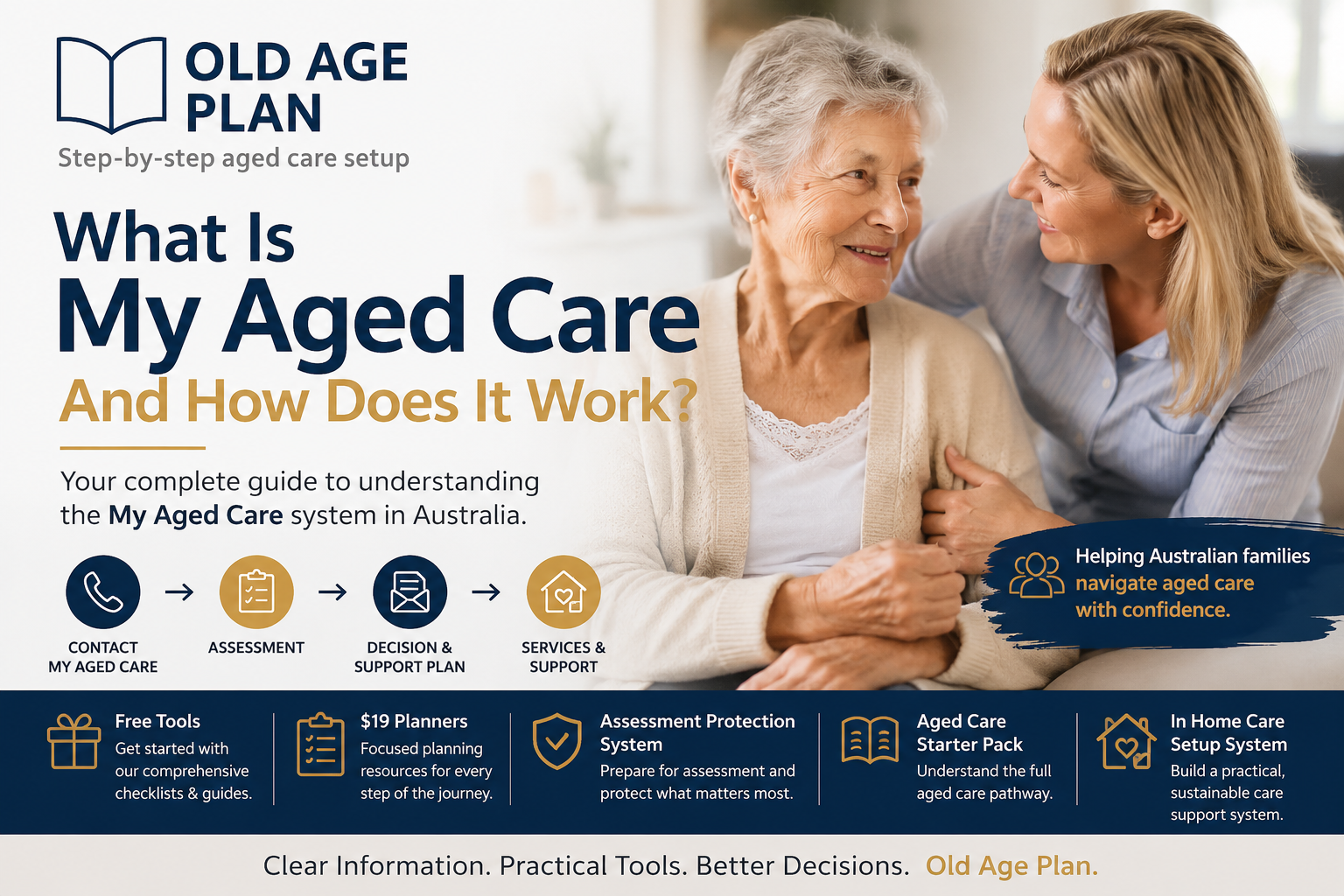

What Is My Aged Care And How Does It Work?
Most families do not start searching for My Aged Care because they are curious about government programs. They start searching because something is already becoming harder.
Mum may be falling more often. Dad may be missing medication. A hospital discharge may be approaching. A carer may be exhausted. Or everyone may know help is needed, but no one is sure what to do first.
That is where My Aged Care becomes important. But the difficult part is not only finding the website or making the call. The difficult part is understanding how the system works before small delays, quiet understatements or family hesitation turn into bigger problems.
Short Answer
My Aged Care is the Australian Government entry point for accessing government-subsidised aged care services. It helps older Australians apply for an assessment, understand what support they may be eligible for and connect with approved services after an assessment outcome.
My Aged Care does not provide every service directly. It is the gateway into assessments, support programs, service referrals and provider choices.
Key Takeaway
My Aged Care is not the whole aged care system. It is the front door. The earlier you understand how that front door works, the easier it becomes to prepare, explain support needs clearly and avoid getting stuck when care needs increase.
What My Aged Care Actually Is
My Aged Care is the main national pathway for older Australians who may need government-subsidised aged care support.
Through My Aged Care, a person may be able to:
- apply for an aged care assessment
- check whether they may meet age and needs requirements
- talk through their current situation
- receive an assessment outcome
- receive a support plan if eligible
- get referral codes for approved services
- find and contact aged care providers
- manage information through a My Aged Care Online Account
That sounds simple on paper. In real life, families are often trying to understand the system while also managing safety concerns, family disagreement, hospital pressure, memory changes or carer burnout.
Old Age Plan note: My Aged Care is usually not confusing because there is no information. It is confusing because families are trying to make care decisions while the situation is still changing.
Who My Aged Care Is For
My Aged Care is generally for older Australians who may need help because of ageing, illness, reduced mobility, memory changes, a recent fall, hospital admission or changes in family care arrangements.
The My Aged Care requirements checker refers to people aged 65 years or older, or 50 years or older for Aboriginal or Torres Strait Islander people, who have noticed changes in what they can do or remember, have reduced mobility, have had a recent fall or hospital admission, or have experienced a change in family care arrangements.
That does not mean every person will be approved for the same type of support. The assessment process is used to understand the person’s needs and decide which services or programs may be appropriate.
How My Aged Care Works
The My Aged Care pathway usually follows a broad sequence.
My Aged Care pathway:
Notice support problems → Contact or apply through My Aged Care → Assessment → Notice of Decision → Support plan and referral codes → Choose provider → Services begin or waiting continues
1. You notice support may be needed
This may begin with small signs: trouble showering safely, missed medication, falls, poor nutrition, increasing confusion, loneliness, carer stress or difficulty managing daily routines.
The first decision is often not “Do we need aged care?”
It is:
Has enough changed that we should find out what support may be available?
2. You apply for an assessment
My Aged Care allows people to apply for an assessment online, by phone or in person. The online application can be completed for yourself or on behalf of someone else. My Aged Care says the online application generally takes about 10 to 15 minutes, and you should have the person’s Medicare card available.
Applying for an assessment does not mean you are accepting a service immediately. It begins the process of working out what support the person may be eligible for.
Before you apply
If you are unsure what to say, start by organising the situation clearly. The Old Age Plan Free Tools can help you write down what has changed, what support is already being provided and what concerns need to be raised.
3. An assessment is arranged
An assessor will talk with the person about their needs, wishes, preferences and current situation. My Aged Care says the assessor will have a copy of the information already provided in the phone, in-person or online application.
Risk point: Assessment can be weakened when hidden support needs are not clearly explained.
This is one of the most important points in the process. If the information provided is too mild, incomplete or optimistic, the assessment may not fully reflect the real support pressure.
The key question is not whether the person can still make some decisions. The real question is whether their decisions remain reliable enough for this specific decision.
During assessment, reliability matters more than confidence. Some people answer confidently while overlooking falls, medication errors, missed meals, night-time risks or increasing dependence on others.
Preparing for assessment?
The My Aged Care Assessment Protection System is designed to help families identify hidden risks, support dependency and caregiver load before an assessment, so important needs are not quietly understated.
4. You receive a Notice of Decision
After the assessment, My Aged Care says the person will receive a Notice of Decision letter. This explains the assessment outcome and whether the person is eligible for government-subsidised aged care services. If eligible, it may also include a support plan.
Risk point: Approval can be mistaken for immediate support. It is usually a pathway forward, not the end of the process.
This letter matters because it shapes the next step. It may confirm approval for entry-level support, more comprehensive support, respite, transition care or residential aged care pathways.
5. You use referral codes and choose providers
If services are approved, the person may receive referral codes. My Aged Care explains that referral codes allow a chosen provider to view the client record and support plan, accept the referral and start organising services.
Risk point: Families can still get stuck after approval if they do not compare providers, follow up referrals or understand what services will actually start.
This is where families often discover that approval is not the same as completion. You may still need to choose providers, ask questions, compare availability, understand fees and follow up if services do not begin quickly.
Why Families Struggle With My Aged Care
My Aged Care can be difficult because families are usually entering the system during uncertainty, not calm planning.
Common pressure points include:
- the older person says they are fine, but family evidence suggests otherwise
- family members disagree about how serious the situation is
- the carer is doing more than anyone realises
- the person minimises falls, confusion or daily risks
- hospital discharge creates urgency
- approval does not immediately solve service access
- families confuse assessment, approval, funding and provider selection
This is the gap Old Age Plan focuses on. Government information explains the system. Families still need help understanding what the system means for their situation.
When “Managing Fine” Becomes Dangerous
One of the biggest My Aged Care traps is not obvious crisis.
It is quiet adaptation.
Families often do not realise how much the situation has changed because change rarely happens all at once. Instead, support gradually expands.
A daughter starts shopping twice a week. A son begins handling bills. A spouse quietly manages medication. Someone starts checking in every morning. Appointments are booked for them. Meals are prepared. Falls are explained away. Confusion gets blamed on tiredness.
Over time, extraordinary support starts to feel normal.
That is dangerous.
Not because the family is failing. Because the system may look stable while becoming increasingly fragile.
The real question is often not:
Are they managing?
It is:
Would they still be managing without the invisible support already holding everything together?
Many families contact My Aged Care only after that invisible support breaks.
That may happen when:
- a carer burns out
- a spouse becomes unwell
- a hospital admission changes everything
- cognitive decline accelerates
- one key family member can no longer cope
Old Age Plan warning: If things only work because one exhausted person is carrying the entire system, you may already be closer to a care transition than you think.
Where Families Get Stuck In My Aged Care
1. Waiting until the situation becomes urgent
Many families delay because they do not want to upset the older person, admit support is needed or start a process they do not understand.
Waiting can feel respectful. But if needs are already changing, waiting may reduce preparation time and increase pressure later.
2. Understating support needs
This is one of the biggest risks.
An older person may say they are managing because they want to remain independent. A carer may understate how much they are doing because it has become normal. Family members may forget to mention near misses, night-time risks, meal problems or medication concerns.
If the assessment picture is too clean, the support pathway may not reflect the real situation.
3. Confusing approval with services starting
An approval letter is important, but it does not always mean support starts immediately. Families may still need to contact providers, use referral codes, compare availability and follow up.
4. Not preparing for the provider stage
After assessment, the decision shifts. The question becomes less “Are we eligible?” and more “Who should provide support, what will they actually do, and how do we know this is enough?”
Setting up care at home?
If the next problem is organising care at home, the In Home Care Setup System helps families move from approval and provider contact into a clearer in-home support setup.
What You May Really Be Trying To Decide
If you are searching for My Aged Care, you may not only be asking what it is.
You may be trying to decide:
- Is it too early to apply?
- Are we waiting too long?
- What support might actually help?
- Will applying make Mum or Dad feel like independence is being taken away?
- What happens if the person refuses help?
- Are we explaining the situation clearly enough?
- Do we need home support, respite or residential aged care?
- What should we prepare before assessment?
Those are decision questions, not just information questions.
Decision Support
A useful way to approach My Aged Care is to separate the first step from the final decision.
Applying for an assessment does not mean every care decision has already been made. It means the situation is serious enough to understand options, eligibility and next steps.
Consider starting the My Aged Care process when:
- daily tasks are becoming harder
- falls, medication issues or nutrition concerns are emerging
- memory changes are affecting safety or routines
- family support is becoming stretched
- a carer is exhausted
- hospital discharge or health decline has changed the situation
- you are unsure what support is appropriate
Be cautious about delaying when:
- everyone is relying on one unpaid carer
- the older person is minimising serious problems
- family members are arguing instead of planning
- support is only working because someone is constantly stepping in
- you are hoping things settle, but the pattern is getting worse
The goal is not to rush someone into services they do not need. The goal is to avoid entering the system late, unprepared or unclear about what support is really required.
Old Age Plan Pathway
Different families need different levels of support depending on where they are in the My Aged Care journey.
- Starting point: Use Free Tools to organise what has changed and what questions need to be asked.
- Single planning issue: Browse the $19 Planners if you need a focused planning resource for one part of the process.
- Assessment preparation: Use the My Aged Care Assessment Protection System if you are preparing for assessment and want to avoid understating support needs.
- System overview: Use the Aged Care Starter Pack if you need to understand the broader aged care pathway before making decisions.
- Home care setup: Use the In Home Care Setup System if the challenge has moved from understanding the system to organising support at home.
Frequently Asked Questions
Is My Aged Care free?
There is no cost to contact My Aged Care or apply for an assessment. However, some aged care services may involve fees or contributions depending on the service type, provider and personal circumstances.
Who is eligible for My Aged Care?
Eligibility depends on age, needs and circumstances. My Aged Care refers to people aged 65 years or older, or 50 years or older for Aboriginal or Torres Strait Islander people, who have noticed changes in what they can do or remember, have reduced mobility, have had a fall or hospital admission, or have experienced changes in family care arrangements.
Can family apply for My Aged Care on someone else’s behalf?
Yes. My Aged Care says the online application can be completed for yourself or on behalf of someone else. It is usually best to involve the older person where possible and appropriate.
How long does My Aged Care take?
Timeframes can vary depending on the person’s situation, the type of assessment needed and local availability. My Aged Care says people can check progress through their Online Account, contact the assessment organisation or call My Aged Care.
What happens after a My Aged Care assessment?
After assessment, the person receives a Notice of Decision letter. This explains whether they are eligible for government-subsidised services and may include a support plan and referral codes.
What is a referral code?
A referral code is a unique code used to connect an approved service referral with a chosen provider. The provider can use the code to view the client record and support plan and begin organising services if the person accepts that provider.
Do you need My Aged Care for a Home Care Package?
Government-subsidised aged care services generally require an assessment through the My Aged Care pathway. If a person may need more coordinated support at home, assessment is usually the step that determines eligibility and the appropriate pathway.
Can someone refuse My Aged Care?
A person may refuse help, and this can be difficult for families. If safety, memory, carer burnout or decision reliability is changing, families may need to seek advice from a GP, aged care professional or appropriate authority pathway before the situation escalates.
Related Old Age Plan Articles
- How To Apply For My Aged Care
- What Happens During A My Aged Care Assessment?
- What Is An ACAT Assessment?
- Home Care Packages Explained
- When Should An Older Person Get Help At Home?
- Residential Aged Care Explained
Next Steps With Old Age Plan
If you are just starting, begin with the Old Age Plan Free Tools and write down what has changed before you contact My Aged Care.
If an assessment is coming, the strongest next step is the My Aged Care Assessment Protection System. It is designed to help families prepare evidence, recognise hidden care load and avoid presenting the situation as safer or easier than it really is.
If you need broader system orientation, the Aged Care Starter Pack can help you understand the bigger pathway. If you are already moving into home support setup, the In Home Care Setup System may be the more practical next step.
Sources
- My Aged Care — Australian Government
- My Aged Care — Requirements Checker
- My Aged Care — How To Get Assessed
- My Aged Care — How To Apply For An Assessment
- My Aged Care — Preparing For Your Assessment
- My Aged Care — What Happens After An Assessment
- My Aged Care — Assessment Outcome: Commonwealth Home Support Program
- My Aged Care — Assessment Outcome: Support At Home
Disclaimer
This article provides general information only. It is not legal, medical, financial or aged care advice.
Aged care laws, policies, procedures, eligibility rules, fees and service availability may change. Individual circumstances can vary significantly.
You should seek qualified professional advice where appropriate and refer to official Australian Government resources, including My Aged Care, for current information about aged care assessments, eligibility and service pathways.