
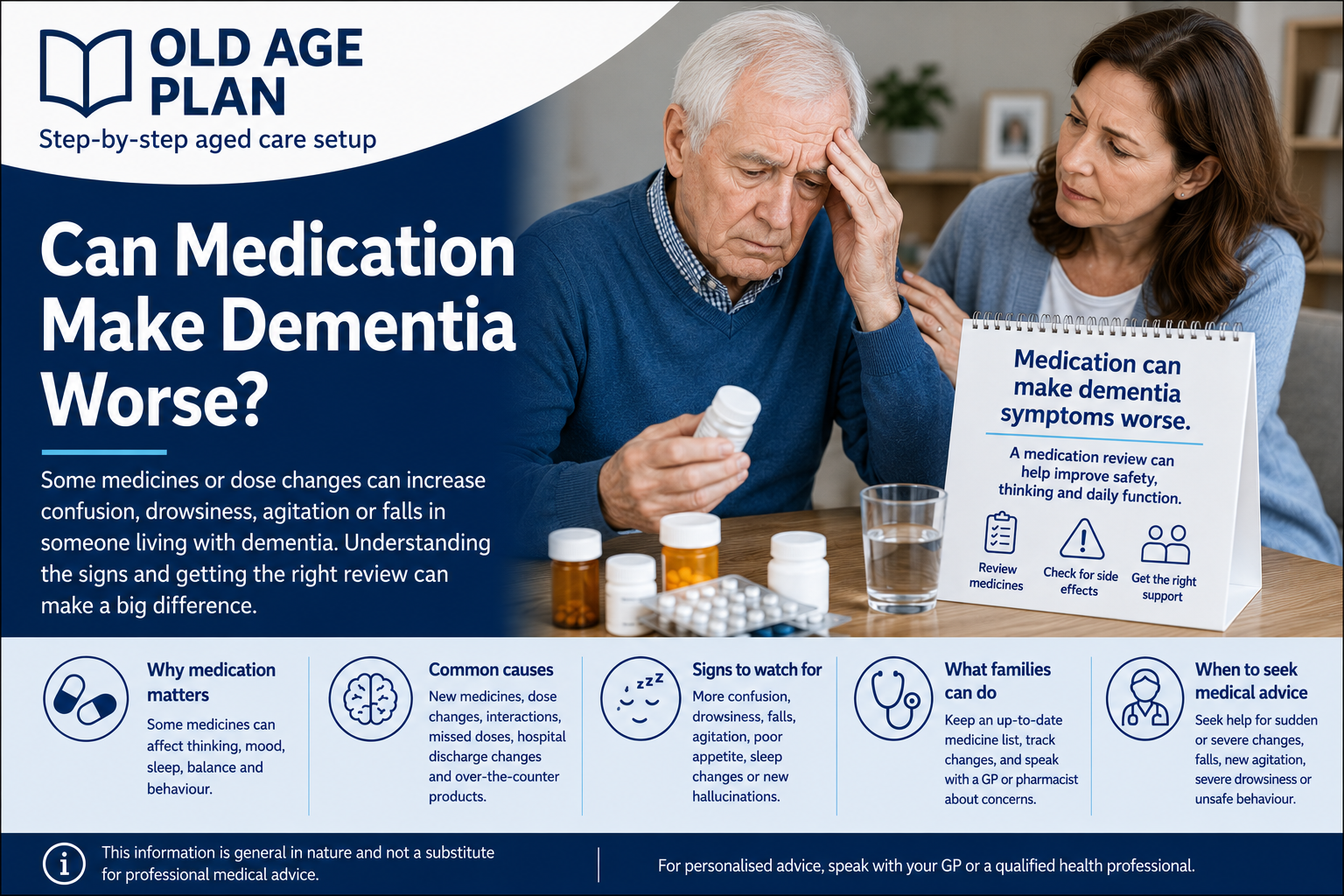

Can Medication Make Dementia Worse?
A person with dementia may suddenly seem more confused, sleepy, unsteady, agitated or withdrawn after starting a new medicine.
They may fall more often, sleep through meals, become harder to communicate with, or seem unable to manage familiar routines.
It can be easy to assume the dementia has suddenly progressed.
If you are asking can medication make dementia worse, you may also be trying to work out whether this is dementia progression, a side effect, a medicine interaction, or something that needs medical review.
Short Answer
Yes, some medications can make dementia symptoms worse or make a person with dementia seem worse than usual.
This may happen because of side effects, medication interactions, incorrect doses, new medicines, missed medicines, or changes after hospital discharge.
Medication-related changes may affect memory, alertness, balance, sleep, mood, behaviour, appetite, continence or communication.
A sudden change should not automatically be treated as dementia progression. It may need a medication review by a GP, pharmacist or other qualified health professional.
Key takeaway: Medication can sometimes make dementia symptoms look worse. The practical decision is whether the change is dementia progression, a medication side effect, an interaction, or a health issue that needs review.
Why Medication Problems Can Be Missed
Medication changes can be hard to track.
A new tablet may be added after a hospital stay.
A dose may change after a GP appointment.
A medicine may be taken at the wrong time, missed entirely, doubled by mistake, or mixed with over-the-counter products.
For someone with dementia, these small changes can have larger effects.
The person may not be able to clearly explain dizziness, drowsiness, confusion, dry mouth, pain, nausea or feeling “not right”.
So the first sign may be a change in behaviour or daily function.
The question is not only:
Has the dementia changed?
It may be:
Has anything changed with medication, dose, timing or health?
What Medication-Related Worsening May Look Like
Medication-related changes can look like dementia getting worse.
Possible signs may include:
- increased confusion
- new drowsiness or sleepiness
- more falls or unsteadiness
- new agitation, restlessness or distress
- worse memory or concentration
- changes in appetite
- new continence changes
- changes in sleep
- new hallucinations or unusual behaviour
- less ability to manage usual routines
These signs do not prove medication is the cause.
But they are enough to ask whether medication should be reviewed, especially if the change started after a new medicine or dose change.
Why Older People With Dementia May Be More Vulnerable
Older people may be more sensitive to medication effects.
Dementia can add another layer of risk because changes in thinking, memory and communication may make side effects harder to notice early.
There may also be more than one medicine involved.
When several medicines are taken together, the chance of side effects or interactions may increase.
This is why medication should not be treated as background noise.
It can be part of the decision picture.
Medication Changes After Hospital Can Matter
Medication lists often change during or after a hospital stay.
Some medicines may be stopped.
Others may be added.
Doses may change.
The person may return home with a new routine that family members do not fully understand.
If confusion, sleepiness, falls or behaviour changes appear after hospital discharge, medication should be one of the things reviewed.
The question is not only whether the person is “worse after hospital”.
It is whether illness, reduced mobility, disrupted routine, delirium, medication changes or support gaps are contributing.
Over-The-Counter Medicines And Supplements Also Matter
Medication review should not only include prescriptions.
Over-the-counter medicines, herbal products, sleeping aids, pain relief, antihistamines and supplements may also affect alertness, balance, thinking or interactions.
This matters because families may not always think of these products as “medicine”.
But for a person with dementia, they may still affect daily function.
When speaking with a GP or pharmacist, it may help to mention everything being taken, including non-prescription products.
Missed Or Incorrect Medication Can Also Cause Problems
The issue is not always a new medicine.
Sometimes the problem is that regular medicine is being missed, doubled, taken at the wrong time or stopped without advice.
Dementia can make medication routines harder because the person may forget whether they have taken tablets.
They may resist help, misunderstand instructions or mix up packets.
This can turn medication from a private routine into a support need.
The OAP question is:
Is medication still being managed reliably, or is it now relying on memory that may no longer be dependable?
When To Seek Medical Advice
Seek medical advice if a person with dementia becomes suddenly more confused, sleepy, unsteady, agitated or different after medication changes.
Medical advice may also be needed if there are:
- new or repeated falls
- new hallucinations or unsafe behaviour
- severe drowsiness or reduced alertness
- new breathing problems
- new rash, swelling or allergic-type symptoms
- vomiting, diarrhoea or dehydration concerns
- new difficulty taking medication safely
- uncertainty about what medicines should be taken
Do not stop prescribed medication suddenly without advice unless emergency services or a qualified health professional tells you to do so.
The safer step is to seek review and explain exactly what changed and when.
What A Medication Review May Help Clarify
A medication review may help identify whether symptoms could be linked to medicine effects, interactions, timing, dose or adherence.
It may also help clarify whether support is needed to manage medicines safely.
Useful information to bring may include:
- when the change started
- what medication changed recently
- whether any doses were missed or doubled
- whether over-the-counter products are being used
- whether the person has been unwell
- whether falls, sleepiness or confusion have increased
This is not about blaming the medication.
It is about making sure medication is not being overlooked as a possible cause or contributor.
Why This Matters For Care Decisions
Medication problems can create false signals.
A person may look as though dementia has suddenly progressed when medication, illness or delirium is contributing.
That can lead to rushed care decisions.
On the other hand, repeated medication mistakes may show that more support is now needed.
Both can be true.
The key is to separate:
- whether medication is causing or worsening symptoms
- whether a medical review is needed
- whether medication management now needs practical support
This helps families avoid both delay and overreaction.
What You May Really Be Trying To Decide
If you are searching for whether medication can make dementia worse, the real question may be:
Is this decline real progression, or could medication be part of the problem?
That is the right question to ask.
If symptoms changed after a new medicine, dose change, hospital stay or missed medication, professional review may be important.
If medication is no longer being managed reliably, support may need to become more structured.
The goal is not to decide this alone.
The goal is to notice the pattern, seek the right review, and then decide what support is actually needed.
Related Old Age Plan Articles
- What Is Dementia?
- Can Dementia Progress Suddenly?
- Can Dementia Improve?
- Can Infection Make Dementia Worse?
- Can Dehydration Make Dementia Worse?
- Can Poor Sleep Make Dementia Worse?
Sources
- Healthdirect Australia – Medicines
- Healthdirect Australia – Medicine safety
- Dementia Australia – Medicines and dementia
- My Aged Care – Living with memory loss, dementia or depression
Disclaimer
This article provides general information only. It is not legal, medical or financial advice.
Dementia symptoms, medication guidance, medical advice, aged care services and government policies may change over time and individual circumstances can vary.
Always seek advice from qualified healthcare professionals and refer to official Australian Government, My Aged Care and Dementia Australia resources for current information.
Summary
Medication can sometimes make dementia symptoms look worse.
Side effects, interactions, dose changes, missed medicines, hospital discharge changes or incorrect use may affect confusion, sleepiness, balance, mood, behaviour and daily function.
A sudden change should not automatically be treated as dementia progression.
Families should seek professional review when medication may be involved and consider whether medication management now needs more reliable support.