

What Is Mild Cognitive Impairment?
Memory and thinking changes can be hard to understand when they are noticeable but not clearly dementia.
You may be wondering whether changes are part of normal ageing, whether they should be assessed, or whether they could be an early warning sign of something more serious.
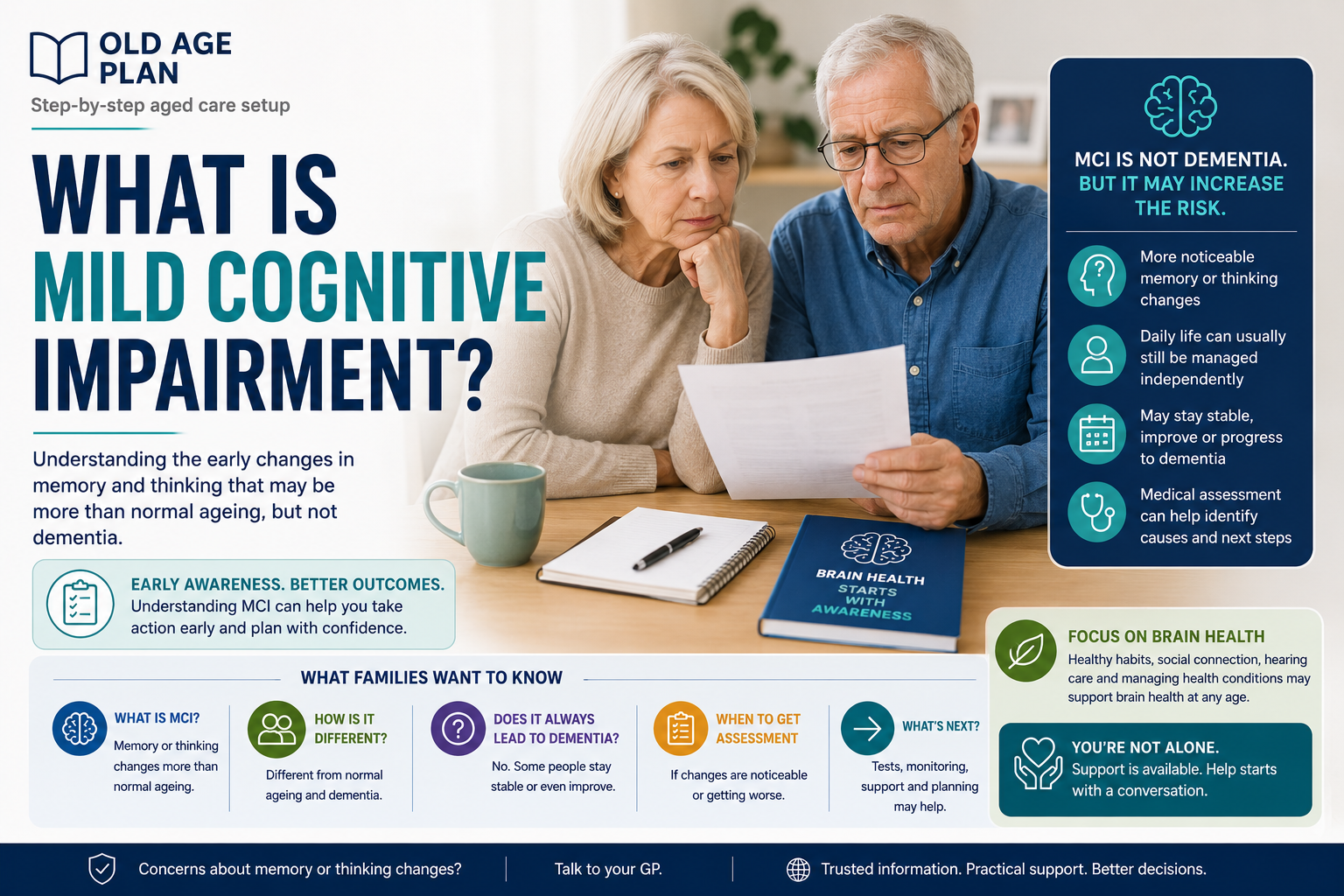
If you are asking what is mild cognitive impairment, it usually means a person has memory or thinking changes that are greater than expected for their age, but they can still manage everyday life independently.
Mild cognitive impairment is often shortened to MCI.
It does not always mean dementia.
However, it may increase the risk of dementia, so medical assessment and monitoring can be important.
Short Answer
Mild cognitive impairment is a condition where memory or thinking changes are more noticeable than normal ageing, but not severe enough to be diagnosed as dementia.
People with mild cognitive impairment can usually still manage daily activities independently.
MCI may stay stable, improve, or progress to dementia depending on the person and the underlying cause.
Key Takeaway
Mild cognitive impairment is not the same as dementia.
It means memory or thinking changes are noticeable, but daily independence is mostly preserved.
If changes are becoming more frequent or concerning, a medical assessment can help identify possible causes and guide next steps.
Why Mild Cognitive Impairment Matters
Mild cognitive impairment matters because it sits between normal ageing and more serious cognitive decline.
It can be difficult to know whether changes are harmless, temporary, or worth investigating.
The Australian Institute of Health and Welfare explains that mild cognitive impairment can be difficult to diagnose because it is not always clear how much memory change is more than normal for that person.
This is why family observations and medical assessment can be useful.
When Families Usually Start Asking Questions
Families may start asking about mild cognitive impairment when someone is still managing life, but small changes keep appearing.
This may include:
- forgetting recent conversations more often
- needing more reminders than before
- losing track of appointments
- finding complex tasks harder
- taking longer to follow instructions
- becoming less confident with planning or organisation
- family members noticing changes before the person does
The question may not be “Is this dementia?”
It may be:
Is this still normal ageing, or should we get this checked?
How Is Mild Cognitive Impairment Different From Normal Ageing?
Normal ageing can involve occasional forgetfulness.
For example, someone may forget a name, misplace an item, or take longer to remember something.
Mild cognitive impairment is more noticeable than this.
The changes may happen more often or be easier for family members to observe.
However, the person can usually still manage everyday activities independently.
How Is Mild Cognitive Impairment Different From Dementia?
The main difference is daily function.
Dementia affects a person’s ability to manage everyday life.
Mild cognitive impairment may affect memory or thinking, but the person usually remains independent in daily activities.
The Australian Institute of Health and Welfare glossary describes people with mild cognitive impairment as still able to function independently, although MCI increases the risk of Alzheimer’s disease.
Does Mild Cognitive Impairment Always Become Dementia?
No.
Mild cognitive impairment does not always become dementia.
Some people with MCI may later develop dementia.
Others may remain stable for years.
Some may improve, especially if symptoms are linked to treatable issues such as sleep problems, medicines, depression, vitamin deficiencies or other health concerns.
This is why it is important not to assume the worst, but also not to ignore repeated changes.
What Can Cause Mild Cognitive Impairment?
Mild cognitive impairment can have different causes.
Possible contributing factors may include:
- early brain changes linked with dementia
- medication side effects
- poor sleep
- depression or mood changes
- thyroid problems
- vitamin deficiencies
- hearing or vision problems
- alcohol use
- stroke or vascular risk factors
- other medical conditions
A doctor can help investigate possible causes.
How Is Mild Cognitive Impairment Assessed?
Mild cognitive impairment is usually assessed through a medical review.
This may include:
- discussion of symptoms
- family observations
- medical history
- medicine review
- memory and thinking tests
- blood tests
- physical examination
- brain imaging in some cases
- specialist referral if needed
The assessment may be similar to the process used when investigating possible dementia.
The goal is to understand what is causing the changes and whether monitoring or further support is needed.
Can Mild Cognitive Impairment Improve?
Sometimes, yes.
Mild cognitive impairment may improve if symptoms are linked to a treatable or manageable cause.
For example, some people may improve when sleep, medicines, depression, hearing, vision or other health issues are addressed.
However, this depends on the person and the cause of the symptoms.
Medical advice is important.
Should Families Be Worried?
Families do not need to panic.
However, repeated memory or thinking changes should be taken seriously.
Mild cognitive impairment may be an early sign that something needs attention.
It may also provide an opportunity to review health, lifestyle, safety, legal documents and future planning before a crisis develops.
What Should You Ask A Doctor?
If mild cognitive impairment is suspected, families may want to ask:
- Could these changes be normal ageing?
- Could another health issue be causing the symptoms?
- Are memory or thinking tests needed?
- Should medicines be reviewed?
- Are blood tests or scans needed?
- Should symptoms be monitored over time?
- What changes should we watch for?
- Should legal or care planning be reviewed early?
Writing down examples before the appointment may help the doctor understand what has changed.
Decision Support
If you are trying to decide whether to act now, consider:
- Are changes happening more often?
- Are family members noticing the same concerns?
- Is the person still managing daily life independently?
- Are appointments, bills, medicines or routines becoming harder?
- Could sleep, mood, medicines, hearing or vision be affecting things?
- Would a GP appointment help clarify what is happening?
- Would early planning reduce confusion later?
The goal is not to label someone too quickly.
The goal is to understand what is changing and whether support or monitoring may help.
What Could Happen Next?
After assessment, the doctor may suggest monitoring symptoms, reviewing medicines, treating other health issues, completing cognitive tests, arranging scans or referring to a specialist.
If mild cognitive impairment is confirmed, families may be advised to watch for changes over time.
They may also be encouraged to support brain health, review safety and consider future planning conversations.
What You May Really Be Trying To Decide
If you are searching for mild cognitive impairment, you may not only be looking for a definition.
You may also be trying to decide:
- whether the changes are serious enough to discuss with a GP
- whether this could be early dementia
- whether daily independence is still safe
- what signs should be monitored
- whether family members should start planning ahead
- what questions to ask before the next appointment
These are sensible questions.
A calm medical review can help separate normal ageing, mild cognitive impairment, dementia and other possible causes.
Related Old Age Plan Articles
- What Is Dementia?
- What Are The Early Signs Of Dementia?
- Is Dementia A Normal Part Of Ageing?
- How Is Dementia Diagnosed?
- Can Dementia Be Prevented?
- What Happens After A Dementia Diagnosis?
Sources
- Australian Institute Of Health And Welfare — Timeliness Of Dementia Diagnosis
- Australian Institute Of Health And Welfare — Dementia Glossary
- Australian Institute Of Health And Welfare — Incidence Of Dementia
- Dementia Australia — Dementia Testing And Diagnosis
- Healthdirect Australia — Tests Used In Diagnosing Dementia
Summary
Mild cognitive impairment means memory or thinking changes are more noticeable than normal ageing, but not severe enough to be diagnosed as dementia.
People with mild cognitive impairment can usually still manage daily activities independently.
MCI does not always become dementia, but it may increase risk.
If changes are becoming more frequent or concerning, speaking with a GP can help families understand what may be happening and what steps may come next.