
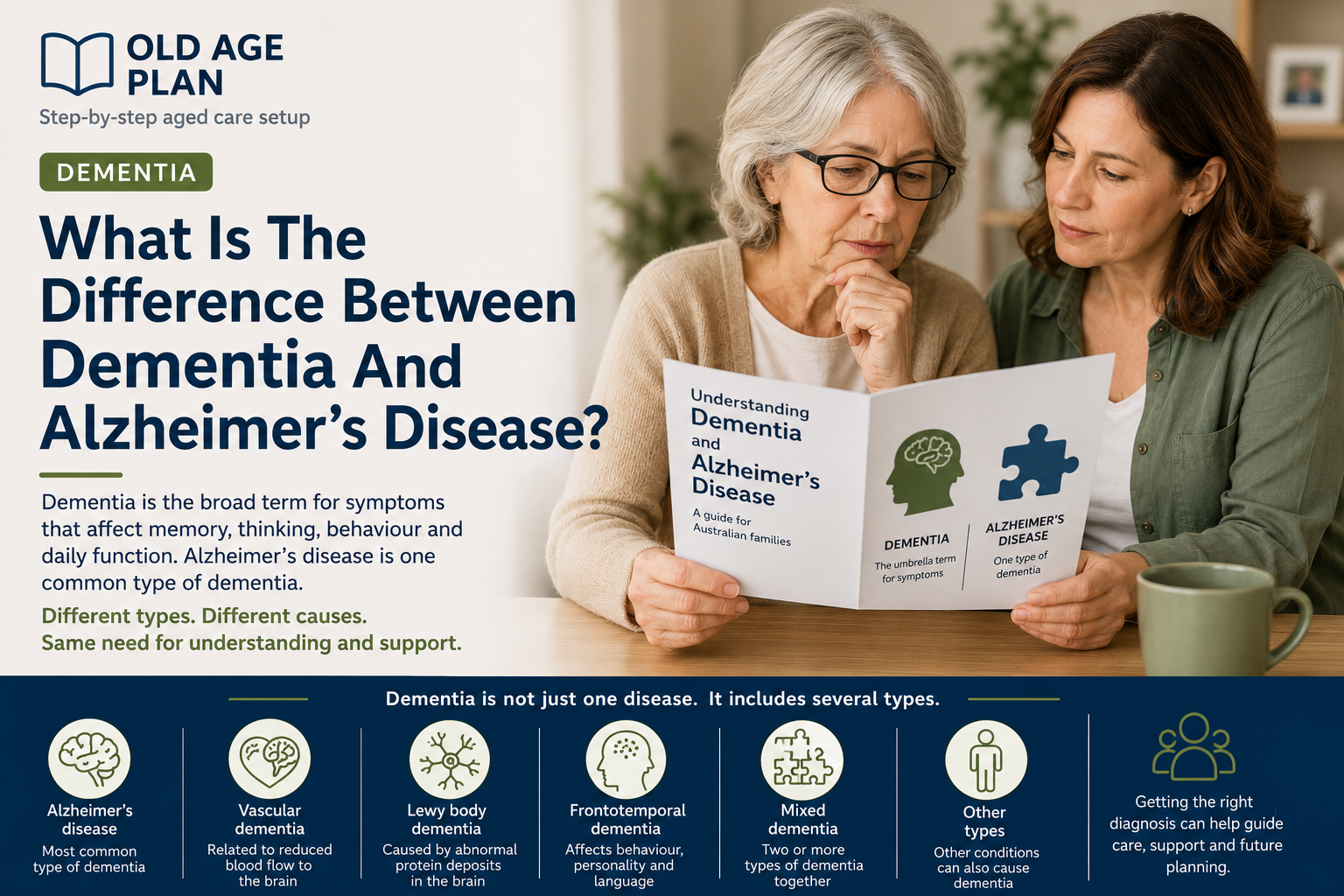

What is the difference between dementia and Alzheimer’s disease? Dementia is the broad term for symptoms that affect memory, thinking, communication, behaviour and everyday function. Alzheimer’s disease is a specific brain disease and the most common form of dementia.
People often use the words dementia and Alzheimer’s disease as though they mean exactly the same thing.
They are closely connected, but they are not interchangeable.
Understanding the distinction can help families make better sense of a diagnosis, ask clearer questions and understand what may need to happen next.
What Is The Difference Between Dementia And Alzheimer’s Disease?
Dementia is an umbrella term. It describes a collection of symptoms caused by diseases or changes affecting the brain.
Alzheimer’s disease is one specific disease that causes dementia.
Not everyone with dementia has Alzheimer’s disease. However, a person with Alzheimer’s disease has a form of dementia once the condition affects their thinking and everyday function.

Key Takeaway
Dementia describes the symptoms and their effect on everyday life. Alzheimer’s disease describes one possible cause of those symptoms.
This distinction matters because dementia can have several different causes. The likely cause may influence the symptoms a person experiences, the investigations a doctor recommends and the support that may be useful.
What Does Dementia Mean?
Dementia is not one single disease.
It is a broad term used to describe a collection of symptoms caused by changes or damage in the brain. These symptoms become significant enough to interfere with a person’s everyday life.
Dementia may affect a person’s:
The exact pattern is different for each person.
Some people experience memory problems first. Others may initially show changes in language, behaviour, movement, alertness, judgement or their ability to organise everyday tasks.
This is one reason the word dementia does not, by itself, provide a complete diagnosis.
What Does Alzheimer’s Disease Mean?
Alzheimer’s disease is a specific progressive brain disease.
It damages brain cells and gradually affects the person’s ability to remember, think, communicate and manage daily activities.
For many people, difficulty remembering recent information is one of the earliest noticeable changes. However, Alzheimer’s disease can also affect:
- language and communication
- planning and problem-solving
- judgement and decision-making
- orientation to time and place
- mood and behaviour
- the ability to complete familiar tasks
Symptoms usually develop gradually and become more significant over time.
Dementia And Alzheimer’s Disease Compared
The umbrella term
Dementia describes a collection of symptoms that interfere with thinking and everyday life.
It can result from several different diseases or combinations of diseases.
One specific cause
Alzheimer’s disease is a particular brain disease and the most common form of dementia.
It is one condition within the broader dementia category.
The distinction may take time
A person may initially be told they have dementia before the likely disease or combination of diseases is confirmed.
Both can affect daily life
Whatever the underlying type, families may need to consider safety, healthcare, legal planning, support and future care needs.
Are Dementia And Alzheimer’s Disease The Same Thing?
No.
Dementia and Alzheimer’s disease are related, but they do not mean the same thing.
Alzheimer’s disease causes dementia symptoms. However, other diseases and conditions can also cause dementia.
A useful way to understand the relationship is:
Dementia is the category. Alzheimer’s disease is one condition within that category.
Another comparison is that a person might be told they have a breathing problem, but further assessment is needed to identify what is causing it. In a similar way, the term dementia describes the functional problem, while the type of dementia describes the likely underlying disease.
What Other Types Of Dementia Are There?
Alzheimer’s disease is common, but it is not the only form of dementia.
Other recognised types and causes include:
- Vascular dementia, associated with reduced blood flow or damage to blood vessels in the brain.
- Lewy body dementia, which may affect thinking, movement, sleep and alertness.
- Frontotemporal dementia, which may initially cause changes in behaviour, personality or language.
- Dementia associated with Parkinson’s disease, which can develop in some people living with Parkinson’s disease.
- Alcohol-related brain damage, which may result from prolonged heavy alcohol use and nutritional deficiency.
- Mixed dementia, where more than one disease process contributes to the person’s symptoms.
Different forms of dementia can produce different early signs, patterns of progression and support needs.
Can Someone Have More Than One Type Of Dementia?
Yes.
A person can have changes associated with more than one type of dementia. This is commonly called mixed dementia.
For example, someone may have changes associated with both Alzheimer’s disease and vascular dementia.
Mixed dementia can make the person’s symptoms more complex. It may also mean that one diagnostic label does not explain every change the family is observing.
Why Does The Difference Matter For Families?
The distinction is not merely about medical terminology.
Knowing the suspected type of dementia may help a family understand:
- which symptoms are likely to appear first
- why the person is behaving or communicating differently
- which investigations or specialist referrals may be considered
- which health conditions may need attention
- what treatment or symptom-management options may be available
- what practical changes may be needed at home
- what questions should be raised at future appointments
For example, memory difficulties may be prominent early in Alzheimer’s disease. Frontotemporal dementia may initially be more noticeable through changes in behaviour or language. Lewy body dementia may involve changes in alertness, movement or visual perception.
These patterns are not identical for every person, but they can help families understand why identifying the likely type may be useful.
How Is The Type Of Dementia Diagnosed?
There is not always one test that immediately confirms the exact type of dementia.
A doctor may consider the person’s symptoms, medical history, medication use, physical health and changes in daily function.
Assessment may include:
- discussion with the person and, where appropriate, someone who knows them well
- memory and thinking assessments
- physical and neurological examinations
- blood tests to investigate other possible causes
- review of medications and existing health conditions
- brain imaging where clinically appropriate
- referral to a geriatrician, neurologist, psychiatrist or memory clinic
The diagnosis may become clearer as test results are reviewed and the pattern of symptoms is observed over time.
Families should not assume that an unclear diagnosis means nothing is being done. Sometimes the careful exclusion of other causes is an important part of reaching a reliable conclusion.
What You May Really Be Trying To Understand
Families asking about the difference between dementia and Alzheimer’s disease are often trying to answer a more immediate question:
What exactly has our family member been diagnosed with, and does it change what we need to do?
There are three common situations.
They Have Been Told They Have Dementia, But No Type Was Named
This may mean assessment is still underway, the cause is uncertain or the clinician is using the broader term because more than one condition may be contributing.
They Have Been Diagnosed With Alzheimer’s Disease
This means the clinician believes Alzheimer’s disease is the underlying brain disease causing the person’s dementia symptoms.
The Family Is Seeing Changes But There Is No Diagnosis
Do not try to decide the type from symptoms alone.
Memory loss, confusion or behaviour changes can have several causes. Some causes may be temporary or treatable, including medication effects, infection, delirium, depression, sleep problems or other health conditions.
A GP assessment is the appropriate next step when changes are persistent, worsening or affecting everyday life.
Does The Exact Label Change The Need For Planning?
The diagnosis can influence treatment and support, but families should not wait for perfect diagnostic certainty before addressing practical risks.
Planning may become important when the person is having difficulty with:
- managing medication safely
- attending appointments or following medical advice
- paying bills or understanding financial decisions
- driving or navigating familiar places
- preparing food or maintaining the home
- recognising hazards
- communicating healthcare or future care wishes
Early planning gives the person the greatest opportunity to participate in decisions while they can still understand the issues, express their preferences and explain what matters to them.
Planning should support the person’s involvement rather than automatically transferring decisions away from them.
Common Misunderstandings
Dementia Always Means Alzheimer’s Disease
This is incorrect. Alzheimer’s disease is one form of dementia, but dementia can have several other causes.
Alzheimer’s Disease Is Only Memory Loss
Memory problems are common, but Alzheimer’s disease can also affect language, judgement, orientation, mood, behaviour and daily function.
The Type Does Not Matter
The likely type may influence investigations, treatment, symptom expectations and practical support.
A Family Can Identify The Type At Home
Symptoms can overlap. A clinical assessment is needed because other medical conditions may resemble or worsen dementia symptoms.
Dementia Is A Normal Part Of Ageing
Dementia is more common with age, but it is caused by disease or damage affecting the brain. It is not an inevitable part of growing older.
Planning Must Wait For A Precise Label
Families can begin discussing safety, support and future wishes while medical assessment continues.
What Questions Should Families Ask The Doctor?
If dementia or Alzheimer’s disease has been mentioned, useful questions may include:
- Is dementia confirmed, or is assessment still continuing?
- What type of dementia is suspected?
- What evidence supports that conclusion?
- Could more than one condition be contributing?
- Have other causes of the symptoms been investigated?
- Are further tests or specialist appointments recommended?
- What changes should the family monitor?
- What treatment, support or planning should begin now?
Families do not need to understand every medical term at the first appointment. It is reasonable to ask the clinician to explain what is known, what remains uncertain and what will happen next.
Frequently Asked Questions
Is Alzheimer’s disease a form of dementia?
Yes. Alzheimer’s disease is a specific brain disease and the most common form of dementia.
Can a person have dementia without Alzheimer’s disease?
Yes. Dementia may be caused by vascular dementia, Lewy body dementia, frontotemporal dementia, Parkinson’s disease-related dementia and other conditions.
Does dementia describe a disease or symptoms?
Dementia is an umbrella term describing symptoms that affect thinking and daily function. Those symptoms are caused by an underlying disease or condition affecting the brain.
Can someone have Alzheimer’s disease and vascular dementia?
Yes. More than one disease process can contribute to dementia. This is commonly described as mixed dementia.
Can memory loss confirm Alzheimer’s disease?
No. Memory loss can have several causes. A medical assessment is needed to investigate the pattern of symptoms and rule out other possible explanations.
Should families begin planning before the exact type is confirmed?
Families can begin discussing immediate safety, support needs, healthcare wishes and future planning while assessment continues. They should avoid assuming the diagnosis or removing the person’s involvement without appropriate clinical or legal guidance.
Related Old Age Plan Articles
Next Steps With Old Age Plan
Sources
Disclaimer
Summary
Dementia and Alzheimer’s disease are closely connected, but they are not the same thing.
Dementia is the broad term for symptoms that interfere with memory, thinking, communication, behaviour and daily function. Alzheimer’s disease is one specific brain disease and the most common form of dementia.
A person can have dementia without having Alzheimer’s disease, and some people have more than one type of dementia at the same time.
Understanding the likely type can help families interpret symptoms and ask better questions. However, families do not need to wait for perfect diagnostic certainty before discussing immediate safety, support needs and future wishes.
Where symptoms are persistent, worsening or affecting everyday life, the safest next step is a medical assessment rather than trying to identify the cause at home.