
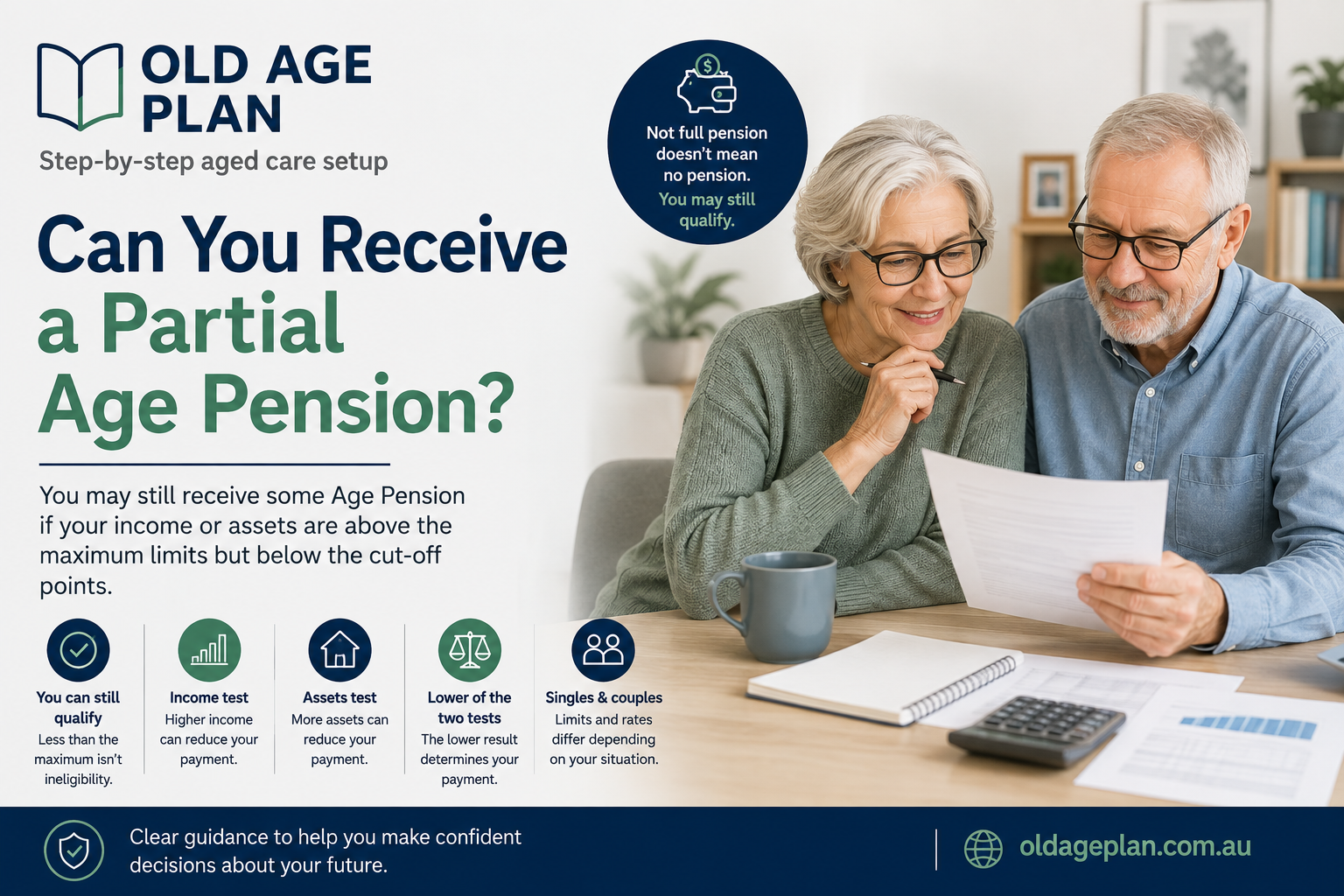

You do not need to qualify for the maximum Age Pension rate to receive an Age Pension payment.
Many people receive a partial Age Pension because their income or assets are above the amounts allowed
for the maximum rate but remain below the relevant cut-off points.
The important question is therefore not simply whether you qualify for a “full pension”.
Centrelink applies both the income test and the assets test to work out whether you can receive the
Age Pension and how much is payable.
Can you get part of the Age Pension?
Yes. You may receive a partial Age Pension if you meet the basic Age Pension qualification rules but
your assessable income or assets reduce your payment below the maximum rate.
Centrelink calculates your payment under both the income test and the assets test. The test producing
the lower payment generally determines how much Age Pension you receive.
If your income or assets rise beyond the applicable cut-off point, your Age Pension may reduce to $0.
Key Takeaway
Age Pension eligibility is not simply full pension or nothing. There is a large middle ground where
you may qualify for a reduced Age Pension because of your income or assets.
What Is a Partial Age Pension?
A partial Age Pension is an Age Pension payment below the maximum rate.
You still receive the Age Pension, but Centrelink reduces the amount because your assessable income,
assets or both exceed the amounts allowed before the means tests begin reducing your payment.
Maximum Age Pension
Your income and assets are within the applicable free areas, so the means tests do not reduce your
maximum pension rate.
Partial Age Pension
You remain within the Age Pension limits, but one of the means tests reduces the amount payable.
$0 Age Pension
Your income or assets reach the relevant cut-off point and no Age Pension is payable under that test.
Does Getting Less Than the Maximum Pension Mean You Are Ineligible?
No.
Receiving a reduced payment and being unable to qualify for Age Pension are not the same thing.
If you satisfy the age, residence and other qualification requirements, Centrelink then uses the means
tests to determine the rate payable.
Your payment can therefore move between the maximum rate, a partial rate and $0 as your financial
circumstances change.
“I have too much income for the full pension”
This does not automatically mean you have too much income to receive any Age Pension.
“I have too many assets for the full pension”
Assets above the full-pension threshold may reduce your payment before they eventually reach the
part-pension cut-off.
How Does the Income Test Reduce the Age Pension?
The Age Pension income test allows a certain amount of assessable income before your pension begins to reduce.
From 1 July 2026, under the standard income test, a single pensioner can have up to $218 per fortnight
before the pension begins to reduce.
For a couple living together, the combined income-free area is $396 per fortnight.
Single pensioner
Income above $218 per fortnight generally reduces the pension by 50 cents for each additional dollar
of assessable income.
Couple living together
Combined income above $396 per fortnight generally reduces each eligible partner’s pension by 25 cents for each additional dollar of combined assessable income.
Different rules can apply in some circumstances, including transitional pension arrangements, Work Bonus
treatment and certain additional payments.
When Does Income Reduce the Age Pension to $0?
A partial Age Pension can continue until assessable income reaches the applicable income cut-off point.
From 1 July 2026, the standard fortnightly income cut-off points published by Services Australia are:
Single
$2,627.80 per fortnight.
Couple living together
$4,016.80 per fortnight combined.
Couple separated due to ill health
$5,199.60 per fortnight combined.
Your individual cut-off can differ where other rules apply, including Rent Assistance, the Work Bonus,
transitional pension rules or overseas payment arrangements.
How Does the Assets Test Reduce the Age Pension?
The assets test works differently from the income test.
Centrelink first considers whether your assessable assets are below the assets free area for your
circumstances. Assets above that amount can progressively reduce your Age Pension.
For every $1,000 of assessable assets above the applicable assets free area, the pension rate is generally
reduced by $3 per fortnight.
The reduction continues until your assessable assets reach the relevant cut-off point and your payment
reaches $0.
What Are the Full Pension Asset Limits?
From 1 July 2026, Services Australia lists the following asset amounts before the standard assets test
begins reducing the Age Pension.
Single homeowner
$333,000.
Single non-homeowner
$600,000.
Couple homeowner
$499,000 combined.
Couple non-homeowner
$766,000 combined.
These figures are not the maximum assets you can have while receiving any Age Pension.
They are the points above which assessable assets generally begin reducing the pension rate.
How Many Assets Can You Have and Still Receive a Partial Age Pension?
The part-pension cut-off is higher than the amount at which the assets test begins reducing the maximum
pension.
From 1 July 2026, the standard asset cut-off points published by Services Australia are:
Single homeowner
$733,500.
Single non-homeowner
$1,000,500.
Couple homeowner
$1,102,500 combined.
Couple non-homeowner
$1,369,500 combined.
Couples separated due to illness have different cut-off points, and transitional pension rules can also
produce different limits.
Why Are the Asset Limits Different for Homeowners?
Your principal home is generally excluded from the Age Pension assets test.
Because a homeowner may hold substantial value in an exempt principal residence, non-homeowners receive
higher asset thresholds under the standard assets test.
Your home is generally exempt
The value of the home you live in is generally not counted as an assessable asset for the Age Pension.
Other property may count
Investment properties, holiday homes and other real estate can generally form part of the assets assessment.
Does Centrelink Use the Income Test or the Assets Test?
Centrelink applies both.
Your pension rate is calculated under the income test and again under the assets test.
The test producing the lower rate generally determines your Age Pension payment.
Income test produces the lower rate
The income-test result generally determines your payment.
Assets test produces the lower rate
The assets-test result generally determines your payment.
One test produces $0
You generally cannot receive a part pension simply because the other test would have produced a payment.
You do not get to choose the more favourable Age Pension means test. Centrelink applies both and the
lower payment generally wins.
Can You Be Asset-Rich but Income-Poor and Still Get a Partial Pension?
Potentially.
Someone may have relatively low income but substantial assessable assets. In that situation, the assets
test may determine the pension rate.
The reverse can also happen. A person may have relatively modest assets but enough assessable income for
the income test to produce the lower payment.
Looking at only one side of your financial position can therefore give you a misleading impression of
your likely Age Pension entitlement.
Can Couples Receive a Partial Age Pension?
Yes.
One or both members of a couple may receive a partial Age Pension where the relevant eligibility requirements
are met but the couple’s combined assessable income or assets reduce the rate payable.
Centrelink generally assesses the couple’s combined income and assets even where only one partner is old
enough to receive the Age Pension.
The amount ultimately paid to each eligible partner depends on the means-test result and the pension rate
applying to their circumstances.
What If Only One Partner Is Eligible for the Age Pension?
One member of a couple can potentially receive a partial Age Pension while the other partner is not an
Age Pension recipient.
This commonly occurs where one partner has reached Age Pension age and the other has not.
The younger or otherwise non-eligible partner’s relevant income and assets can still be included in the
couple assessment.
One claimant does not mean one-person finances
Centrelink may still require financial information about both partners.
The claimant remains partnered
A person does not automatically receive the single pension rate merely because their partner is not
receiving Age Pension.
Can Working Leave You With a Partial Age Pension?
Yes.
Employment does not automatically prevent you from receiving the Age Pension.
Employment income can instead reduce your payment under the income test.
Eligible pensioners may also benefit from the Work Bonus, which can reduce the amount of eligible work income
included in the pension income test.
Depending on your total financial position, you may therefore receive wages and a partial Age Pension at the
same time.
Can Investment Income Reduce Your Age Pension?
Yes.
The Age Pension income test is not limited to wages.
Centrelink assesses different types of income, including income attributed to financial investments.
For many financial assets, Centrelink uses deeming rules rather than simply counting the actual interest or
investment return you receive.
This means your Centrelink assessable income may not be identical to the income shown on a bank statement,
tax return or investment distribution statement.
Does Superannuation Affect a Partial Age Pension?
It can.
Once you are Age Pension age, superannuation can generally become relevant to the Age Pension means tests.
How it is assessed depends on the structure and circumstances of the superannuation interest.
Account-based investments may contribute to both your assessable assets and deemed income.
Do not assume that money held inside superannuation remains completely outside the Age Pension assessment
once you reach Age Pension age.
Can Your Partial Age Pension Increase Later?
Yes.
Your Age Pension rate can change when your financial circumstances change.
Your income falls
A lower assessable income may result in a higher pension if the income test was reducing your payment.
Your assessable assets fall
A lower asset position may increase your pension where the assets test was determining your rate.
Your circumstances change
Changes to relationship, homeownership or other circumstances can affect which limits and rates apply.
Government rates change
Pension rates, thresholds and cut-off points are reviewed periodically and can change your entitlement.
Can a Partial Age Pension Fall to $0?
Yes.
If your assessable income or assets increase far enough to reach the applicable cut-off point, your Age Pension
may reduce to $0.
That does not mean every future Age Pension claim is permanently ruled out. If your circumstances later change,
you may again satisfy the applicable means-test limits.
The correct administrative pathway can depend on why the payment stopped and how long you remain above the
relevant limits.
Is a Small Age Pension Still Worth Claiming?
The answer depends on your circumstances.
The value of a partial Age Pension is not limited to the amount deposited into your bank account.
Receiving Age Pension may also provide access to associated concessions and other benefits where eligibility
requirements are met.
This means a relatively small pension payment can still be relevant when comparing whether it is worth
completing a claim.
Do not judge a partial Age Pension only by the fortnightly dollar amount. The wider pensioner
entitlement can matter as well.
Common Partial Age Pension Mistakes
Assuming you need to qualify for the full rate
You may still receive Age Pension after the means tests begin reducing your payment.
Confusing the full-pension asset limit with the cut-off
The amount at which your pension begins reducing is lower than the amount at which the payment reaches $0.
Checking only income
The assets test may produce a lower payment even when your income is relatively low.
Checking only assets
The income test may determine your payment even when you remain comfortably inside the assets limit.
Ignoring your partner
A partner’s income and assets can affect your Age Pension means-test result.
Using outdated thresholds
Pension rates, free areas and cut-off points are reviewed and can change over time.
What You May Really Be Trying to Decide
Most people asking about a partial Age Pension are not simply trying to learn how Centrelink calculates
a reduced payment.
You may actually be trying to work out:
- whether it is worth applying if you know you will not receive the maximum rate
- whether your savings are too high to receive any Age Pension
- whether continuing to work will leave you with a part pension
- whether your partner’s income or assets will reduce your entitlement
- whether being a homeowner changes the amount of assets you can hold
- whether spending or moving money would change your pension
- whether your payment could increase later if your financial position changes
- whether a small pension still provides worthwhile benefits
The useful starting point is not to ask whether you qualify for the maximum Age Pension.
It is to establish where your income and assets sit between the full-pension thresholds and the
part-pension cut-off points.
Decision Support
Work through both means tests before deciding that your financial position prevents you from receiving
the Age Pension.
Step 1: Confirm basic eligibility
Check that you meet the Age Pension age and residence requirements before estimating a payment.
Step 2: Map your assessable income
Identify employment income, deemed income and other income Centrelink may assess.
Step 3: Map your assessable assets
Separate exempt assets from assets Centrelink may include in the assets test.
Step 4: Identify your correct limits
Check whether you are single or partnered and whether homeowner or non-homeowner thresholds apply.
Step 5: Compare both test results
Determine whether the income test or assets test is likely to produce the lower pension rate.
Step 6: Check before making financial changes
Do not restructure, gift or spend assets simply to influence a pension calculation without understanding
the wider financial and Centrelink consequences.
Partial Age Pension FAQs
Can I get the Age Pension if I do not qualify for the full rate?
Yes. You may receive a partial Age Pension if you meet the qualification requirements but your assessable
income or assets reduce the amount payable.
What is the difference between a full and partial Age Pension?
A maximum-rate pension is not reduced by the standard means tests. A partial Age Pension is a lower payment
because the income test or assets test has reduced your rate.
Does Centrelink use both the income and assets tests?
Yes. Centrelink calculates the Age Pension under both tests, and the test producing the lower rate generally
determines your payment.
Can I own my home and receive a partial Age Pension?
Yes. Your principal home is generally exempt from the assets test, although homeowners have different
assessable asset thresholds from non-homeowners.
Can I still get a part pension if I have more than $1 million in assets?
Potentially, depending on whether you are single or partnered, your homeownership status, which assets are
assessable and the current cut-off applying to your circumstances.
Can working reduce me to a partial Age Pension?
Yes. Employment income can reduce your Age Pension under the income test without automatically making you
ineligible for any payment.
Can my partial Age Pension increase if I stop working?
It may. If employment income was reducing your pension, a fall in assessable income may increase your
payment, subject to the other Age Pension rules.
Does my partner’s income affect my partial Age Pension?
It can. Centrelink generally assesses the income and assets of both members of a couple when applying
the Age Pension means tests.
Can a part pension eventually reduce to $0?
Yes. If your assessable income or assets reach the applicable cut-off point, your Age Pension payment
can reduce to $0.
Sources
Disclaimer
This article provides general information and decision support only. It does not provide financial,
taxation, legal or social security advice. Age Pension rates, income limits, asset thresholds and means-test
rules change over time and individual circumstances affect the result. Figures in this article are based on
Services Australia settings applying from 1 July 2026. Confirm current information with Services Australia
and seek qualified professional advice where appropriate before making financial decisions.
Summary
You can receive a partial Age Pension when your assessable income or assets are too high for the maximum
pension but remain within the applicable Age Pension cut-off points.
Centrelink applies both the income test and the assets test and generally uses whichever produces the lower
payment. Before deciding that you have too much income or too many assets to qualify, check where your actual
financial position sits between the full-pension thresholds and the part-pension cut-offs.