
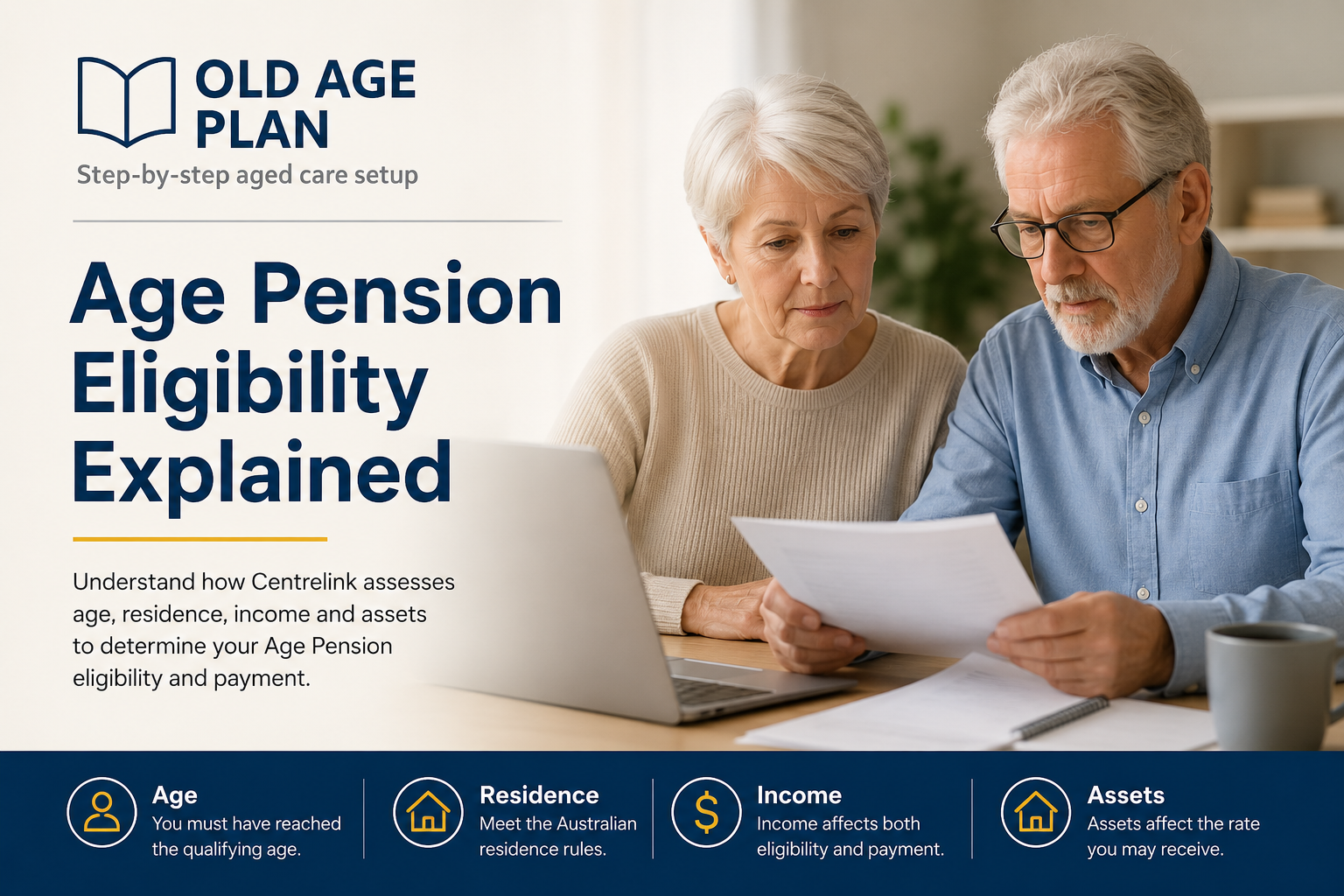

Age Pension Eligibility Explained
Age Pension eligibility is not decided by one question.
Reaching the qualifying age does not automatically mean you will receive the Age Pension. Having savings, superannuation or a home does not automatically mean you will be rejected either.
Centrelink considers several eligibility rules together, including your age, Australian residence history, income, assets, relationship circumstances and any special rules affecting your situation.
The practical question is not:
“Do I pass one eligibility test?”
It is:
“Do I satisfy the complete eligibility pathway, and what payment remains after the financial tests are applied?”
How does Age Pension eligibility work?
To qualify for the Age Pension, you must have reached the qualifying Age Pension age, meet the applicable Australian residence rules and satisfy the income and assets tests.
Centrelink considers the rules together. Meeting one condition does not override another, and your financial assessment may result in a full pension, a part pension or no payment.
Key Takeaway
Age Pension eligibility works through a series of separate gates.
You generally need to pass the qualifying rules first. Centrelink then uses the income and assets tests to determine whether a payment is available and how much you may receive.
This creates three broad possible outcomes:
- you qualify for the maximum rate available for your circumstances
- you qualify for a reduced part pension
- you do not qualify because one or more eligibility conditions are not met
If you need a high-level overview of who may qualify, read Who Can Get the Age Pension?.
The Age Pension Eligibility Pathway
It is easier to understand Age Pension eligibility when the assessment is divided into its main stages.
Four eligibility questions must be considered
Each question addresses a different part of the assessment. Passing one stage does not remove the need to satisfy the others.
1. Have you reached the qualifying age?
You must have reached the qualifying Age Pension age before payment can begin.
2. Do you meet the residence rules?
Your Australian residence history must satisfy the standard rules or an applicable exception or international agreement.
3. What income is assessable?
Centrelink considers assessable income received by you and, where relevant, your partner.
4. What assets are assessable?
Centrelink considers assessable assets and applies the limits relevant to your relationship and homeownership circumstances.
Eligibility Begins With the Qualifying Age
You must have reached the qualifying Age Pension age before you can receive the payment.
This is a qualification requirement, not a guarantee of payment.
Reaching the qualifying age does not override:
- Australian residence requirements
- the income test
- the assets test
- claim and evidence requirements
- special rules affecting particular circumstances
Age Pension age is also different from superannuation preservation age. Being able to access superannuation does not necessarily mean you have reached the qualifying age for the Age Pension.
Similarly, reaching the qualifying age does not automatically start an Age Pension payment. A claim or transfer process is generally required.
You Must Meet the Australian Residence Rules
Age Pension eligibility usually requires more than living in Australia when you submit your claim.
Centrelink may examine:
- whether you are an Australian resident when you claim
- how long you have lived in Australia as a resident
- whether part of your residence history was continuous
- whether you have lived or worked in another country
- whether an international social security agreement applies
- whether a special residence exception applies
Under the standard rule, a person generally needs at least 10 years of Australian residence in total, including a continuous period of at least five years.
However, that is not the only possible pathway.
Different rules may apply where a person:
- is a refugee or former refugee
- has residence or contribution periods in an agreement country
- has lived across several countries
- is claiming in circumstances covered by a special exception
- is outside Australia when claiming
A person with an overseas history should not assume they qualify or fail based only on the number of years they remember living in Australia. Centrelink may need to establish the legal residence periods that count.
The Income Test Affects Eligibility and Payment Rate
The income test is used to assess whether you can receive the Age Pension and how much may be payable.
Income can come from more sources than wages.
Depending on your circumstances, Centrelink may consider income connected with:
- employment or self-employment
- bank accounts and financial investments
- shares and managed investments
- superannuation income streams
- rental properties
- businesses
- trusts and companies
- overseas pensions
- other assessable payments
Some financial assets are assessed using deeming rules. This means Centrelink may calculate an assumed amount of income from those assets rather than relying only on the interest or investment return you actually receive.
Having income does not automatically prevent eligibility.
You may still qualify for:
- a full pension if your assessable income remains within the applicable full-rate limit
- a part pension if your assessable income reduces your rate but remains below the relevant cut-off
- no payment if your assessable income exceeds the applicable cut-off
The relevant limits can change through indexation and may differ according to relationship circumstances.
The Assets Test Also Affects Eligibility and Payment Rate
The assets test considers the value of assets owned by you and, where relevant, your partner.
Centrelink may assess assets held:
- in your own name
- in your partner’s name
- jointly
- in Australia
- overseas
- through certain companies, trusts or other structures
Assessable assets may include:
- cash and bank accounts
- term deposits
- shares and managed investments
- investment properties
- holiday homes and vacant land
- vehicles, caravans and boats
- business interests
- some superannuation interests
- money owed to you
- valuable personal and household assets
Your principal home is generally treated differently from other assets, but homeownership still matters because different assets-test limits apply to homeowners and non-homeowners.
Owning your home therefore does not automatically prevent eligibility, but the statement “the home is exempt” does not mean property circumstances are irrelevant.
Centrelink Applies Both Financial Tests
The income and assets tests are not alternative assessments where you can choose the more favourable result.
Centrelink applies both tests.
The test that produces the lower payment rate generally determines what you receive.
Income test produces the lower rate
Your income assessment determines the payable rate, even if your assets would otherwise allow a higher payment.
Assets test produces the lower rate
Your assets assessment determines the payable rate, even if your income would otherwise allow a higher payment.
Both remain within full-rate limits
You may qualify for the maximum rate available for your relationship and living circumstances.
One test exceeds its cut-off
You may receive no Age Pension even if you remain within the limit under the other financial test.
This is why checking only your income or only your assets can produce an incomplete answer.
Your Relationship Circumstances Affect the Assessment
The Age Pension is paid to individuals, but Centrelink may assess a couple’s combined financial circumstances.
If you are a member of a couple, Centrelink may consider both partners’ income and assets even when:
- only one partner has reached the qualifying age
- only one partner is making a claim
- one partner continues working
- most assets are legally held by one partner
- the couple keeps separate bank accounts
- one partner has substantially more superannuation
Your relationship classification can affect:
- the income limits applied
- the assets limits applied
- the maximum payment rate
- the financial information Centrelink requires
Different treatment may apply where a couple is separated because of illness, including circumstances where one partner has entered residential aged care.
The financial reality of a household and Centrelink’s relationship classification may therefore matter more than whose name appears on a particular account or asset.
Does Superannuation Affect Age Pension Eligibility?
Superannuation can affect Age Pension eligibility, but the outcome depends on whose superannuation it is, their age and how the superannuation is held or paid.
Relevant circumstances may include:
- money held in an accumulation account
- an account-based pension
- another income-stream product
- a lump-sum withdrawal
- superannuation held by a younger partner
- transfers between superannuation and other investments
Superannuation may be considered under the income test, assets test or both, depending on the arrangement.
Having superannuation does not automatically rule you out. However, moving money into or out of superannuation can change how your financial position is assessed and may have broader taxation, investment and estate-planning consequences.
Eligibility should therefore not be treated as a reason to restructure substantial assets without understanding the complete effect.
Can You Receive the Age Pension While Working?
Yes, some people receive the Age Pension while continuing to work.
Employment does not create an automatic exclusion.
However, employment income may affect the income test and reduce the payment rate.
The Work Bonus may reduce the amount of eligible employment or self-employment income included in the pension income test. The effect depends on the current rules, your earnings and whether you have an available Work Bonus balance.
The useful question is not simply:
“Am I still working?”
It is:
“How much assessable employment income remains after the applicable rules are applied?”
Can Homeowners Get the Age Pension?
Yes.
Homeownership does not automatically prevent a person from receiving the Age Pension.
Your principal home is generally exempt from the assets test while it remains your principal home. However:
- different assets limits apply to homeowners and non-homeowners
- other real estate may be assessable
- selling the home can change the treatment of the sale proceeds
- moving into residential aged care can affect how the former home is assessed
- granny-flat, life-interest and gifting arrangements can involve additional rules
The phrase “the home is exempt” is therefore a starting point, not a complete property strategy.
Can Gifting Affect Eligibility?
Giving money or assets away does not necessarily remove their effect from the Age Pension assessment.
Centrelink applies gifting rules to amounts transferred or disposed of for less than their market value.
Amounts above the allowable gifting limits may continue to be treated as:
- an assessable asset
- a financial asset subject to deeming
This treatment can continue for a specified period even though you no longer control the money or asset.
Gifting shortly before a claim is therefore not a reliable shortcut around the means tests and may leave a person with fewer resources while the disposed amount remains assessable.
Can Overseas Income or Assets Affect Eligibility?
Yes.
Age Pension assessments are not necessarily limited to income and assets held in Australia.
You may need to disclose:
- overseas bank accounts
- foreign pensions
- overseas property
- foreign investments
- business interests outside Australia
- income received in another country
Overseas residence history can also affect qualification and payment portability.
Where Australia has an international social security agreement with another country, periods of residence or contributions may assist with qualification in some circumstances.
International cases can involve both eligibility and payment-rate questions. They should not be reduced to a single assumption about citizenship or where a person currently lives.
Special Circumstances May Change the Standard Assessment
Not every Age Pension claim follows the simplest eligibility pathway.
Additional rules may apply where a person:
- is legally blind
- receives or may qualify for a Department of Veterans’ Affairs payment
- has compensation payments
- controls or benefits from a trust or company
- has entered a granny-flat or life-interest arrangement
- has recently transferred or disposed of assets
- has moved into residential aged care
- owns a farm or substantial land surrounding the principal home
- has recently returned to Australia
- plans to live or travel overseas
These circumstances do not necessarily prevent eligibility. They mean the standard explanation may not be sufficient to predict the outcome.
Eligibility Can Change Over Time
Age Pension eligibility is not always a permanent yes-or-no result.
A person who does not qualify today may qualify later. A person currently receiving a pension may later receive a different rate or lose payment eligibility.
Eligibility can change because of:
- reaching the qualifying age
- changes in employment income
- changes in investment values
- withdrawals from or transfers involving superannuation
- buying or selling property
- receiving an inheritance
- gifting money or assets
- changes in relationship circumstances
- a partner reaching the qualifying age
- moving into residential aged care
- changes to government rates and thresholds
A rejected claim does not permanently prevent a future claim if circumstances change.
Common Age Pension Eligibility Mistakes
Assuming age guarantees payment
Reaching the qualifying age satisfies only one part of the eligibility pathway.
Checking only one financial test
Centrelink applies both the income and assets tests. The less favourable result generally determines the rate.
Ignoring a partner’s circumstances
A partner’s income and assets may affect the assessment even when only one person is claiming.
Assuming the family home settles the question
The principal home is generally exempt, but homeownership status and other property interests still matter.
Moving assets without understanding the rules
Gifting, selling property or restructuring superannuation may create consequences beyond Age Pension eligibility.
Using outdated limits
Income limits, assets limits, deeming rates and payment rates can change through indexation or policy updates.
What You May Really Be Trying to Decide
Most people are not researching Age Pension eligibility because they want to memorise Centrelink rules.
They are trying to decide what to do next.
You may be asking:
- Is it worth submitting a claim?
- Do we have too much income or too many assets?
- Will my partner’s employment rule me out?
- Should we change how our money is held?
- Does owning our home help or hurt the assessment?
- Will living overseas in the past prevent eligibility?
- Could I receive enough of a part pension to make claiming worthwhile?
The risk is allowing one visible feature of your situation to answer the entire question.
A homeowner may assume they are too wealthy. A person with little employment income may assume they automatically qualify. Someone with substantial superannuation may assume there is no point claiming. A partnered person may calculate eligibility using only their own finances.
Each conclusion may be wrong because eligibility depends on the complete assessment.
Decision Support: How Should You Check Your Eligibility?
A useful eligibility review should move through the rules in a deliberate order.
Confirm the qualifying conditions
Check your Age Pension age and Australian residence history before relying on a financial estimate.
Map the household position
Identify your relationship classification and gather the income and assets of both partners where relevant.
Separate income from assets
Do not treat cash flow and asset ownership as the same test. Centrelink assesses them separately.
Identify complexity early
Overseas history, trusts, companies, gifting, property changes and aged-care transitions may require closer examination.
This process does not replace Centrelink’s formal assessment.
It helps identify whether your position appears straightforward or whether one part of the eligibility pathway requires further investigation before you claim or make major financial decisions.
If you appear broadly eligible and are ready to understand the claim process, continue to How Do You Apply for the Age Pension?.
Age Pension Eligibility FAQs
Does reaching Age Pension age mean I automatically qualify?
No. You must also meet the applicable residence, income, assets and other eligibility requirements.
Do I need to pass both the income and assets tests?
Yes. Centrelink applies both tests. The test producing the lower payment rate generally determines how much you receive.
Can I qualify for only part of the Age Pension?
Yes. You may qualify for a reduced part pension if your assessable income or assets exceed the full-rate limits but remain below the relevant cut-off.
Does owning a home make me ineligible?
No. Your principal home is generally exempt from the assets test, although different assets-test limits apply to homeowners and non-homeowners.
Does my partner’s income affect my eligibility?
It can. Centrelink generally considers the combined income and assets of a couple even when only one partner is claiming.
Can I receive the Age Pension if I still work?
Possibly. Employment income may reduce your payment under the income test, but continuing to work does not automatically prevent eligibility.
Does having superannuation prevent eligibility?
No. Superannuation does not automatically exclude you, but it may be assessed under the income test, assets test or both depending on the circumstances.
Can overseas property or pensions affect my claim?
Yes. Overseas income and assets may need to be disclosed and can affect the assessment. Your overseas residence history may also affect qualification.
Can gifting money help me qualify?
Not necessarily. Amounts gifted above the allowable limits may continue to be assessed for a specified period even though you no longer control them.
Can I claim again after being rejected?
Yes. If your circumstances change, you can make another claim. A previous rejection does not permanently prevent future eligibility.
Why can two people with similar finances receive different outcomes?
Their residence history, relationship classification, homeownership status, asset structure, income sources and other circumstances may differ even when their overall wealth appears similar.
Should I restructure my finances to qualify?
Do not make major financial, property or superannuation decisions based only on a possible Age Pension outcome. Changes may have taxation, legal, investment, aged-care and estate-planning consequences.
Sources
Disclaimer
This article provides general information only and does not constitute financial, taxation, legal or personal advice.
Age Pension eligibility rules, income and assets limits, deeming rates and government policies may change. Individual outcomes depend on residence, income, assets, relationship, superannuation, property and other circumstances. Use official Australian Government information for current requirements and seek qualified professional advice where appropriate.
Summary
Age Pension eligibility depends on several rules working together.
You must have reached the qualifying Age Pension age, meet the applicable Australian residence requirements and satisfy both the income and assets tests.
Meeting one condition does not guarantee payment. Centrelink considers the complete assessment, including your partner’s circumstances where relevant, before determining whether you qualify for a full pension, part pension or no payment.
The most useful next step is to identify which part of the eligibility pathway remains uncertain before making a claim or changing your financial arrangements.