

How Much Is the Age Pension?
There is no single Age Pension amount that everyone receives.
Your payment depends on your relationship circumstances, income, assets and whether any supplements or special rules apply.
Some people receive the maximum Age Pension rate. Others receive a reduced part pension. Some meet the age and residence requirements but receive no payment because their assessable income or assets are above the applicable limits.
The practical question is therefore not only:
“What is the maximum Age Pension?”
It is:
“What rate may apply after Centrelink assesses my complete circumstances?”
How much is the Age Pension?
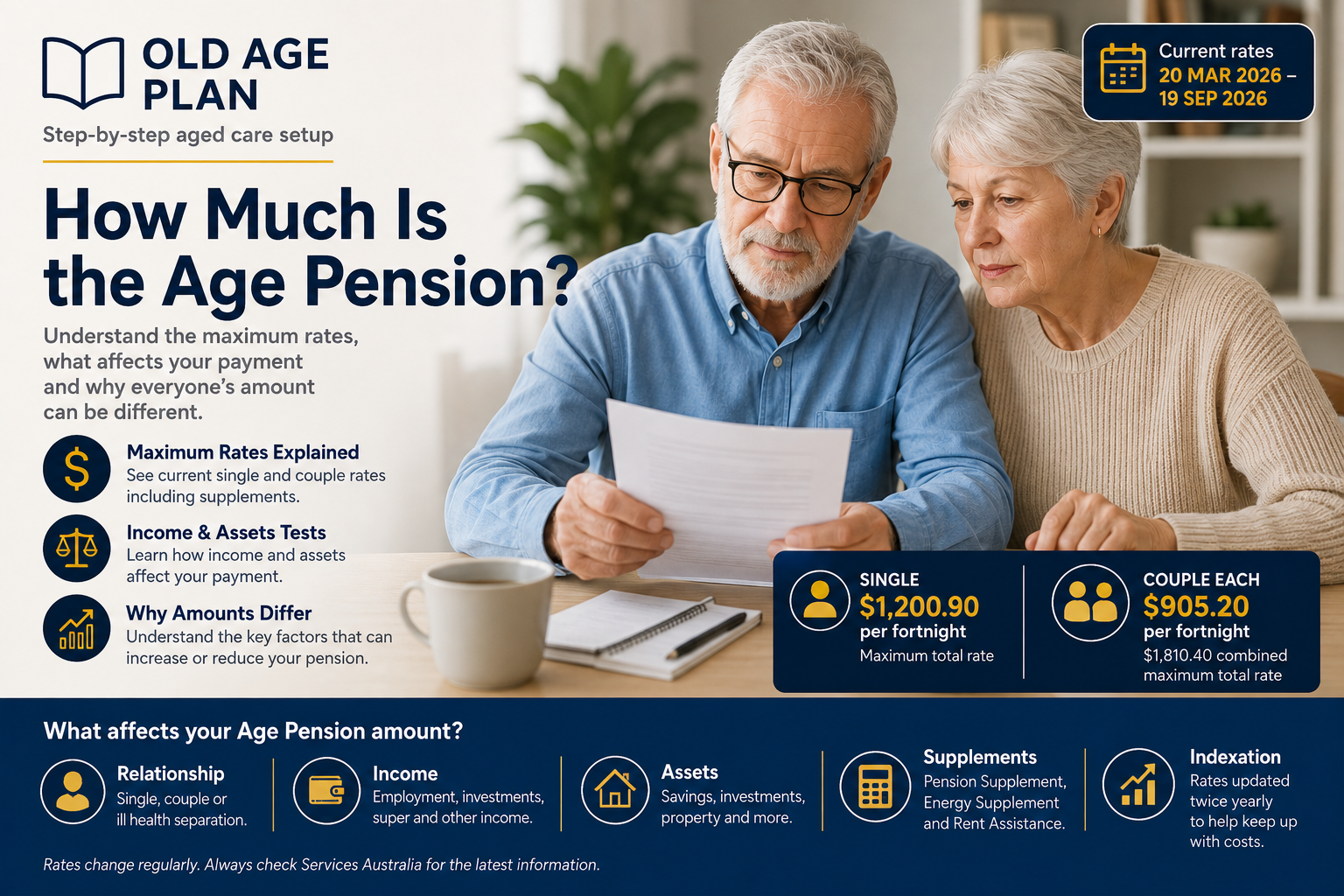
From 20 March 2026 to 19 September 2026, the maximum normal Age Pension rate is $1,200.90 per fortnight for a single person and $905.20 per fortnight for each member of a couple.
The combined maximum rate for a couple is $1,810.40 per fortnight. These totals include the maximum Pension Supplement and Energy Supplement.
Your actual payment may be lower after Centrelink applies the income and assets tests.
Key Takeaway
The published maximum rate is the highest normal Age Pension amount available for a particular relationship category.
It is not a guaranteed payment.
Centrelink calculates your rate by considering:
- whether you meet the qualifying conditions
- whether you are assessed as single or partnered
- your assessable income
- your assessable assets
- your partner’s circumstances where relevant
- whether supplements or additional assistance apply
- whether any special or transitional rules affect you
For a broader explanation of the payment itself, start with What Is the Age Pension?.
Current Maximum Age Pension Rates
The following normal rates apply from 20 March 2026 to 19 September 2026.
Single person
$1,200.90 per fortnight
This includes the maximum basic rate, Pension Supplement and Energy Supplement.
Couple living together
$905.20 each per fortnight
The combined maximum payment is $1,810.40 per fortnight.
Couple separated due to ill health
$1,200.90 each per fortnight
This higher individual rate may apply where Centrelink recognises that the couple is living apart because of illness.
These figures are maximum rates before tax.
They do not include every possible payment or concession, and they do not mean every eligible person receives the full amount.
What Makes Up the Maximum Age Pension Rate?
The maximum normal Age Pension rate is made up of separate components.
Maximum basic rate
The main pension amount before supplements are added.
Pension Supplement
An additional payment intended to assist with regular household and living costs.
Energy Supplement
A supplementary amount paid to eligible recipients under the applicable rules.
For the period from 20 March 2026 to 19 September 2026, the maximum components are:
| Payment component | Single | Couple each | Couple combined |
|---|---|---|---|
| Maximum basic rate | $1,100.30 | $829.40 | $1,658.80 |
| Maximum Pension Supplement | $86.50 | $65.20 | $130.40 |
| Energy Supplement | $14.10 | $10.60 | $21.20 |
| Total maximum rate | $1,200.90 | $905.20 | $1,810.40 |
The amount shown for a couple is not automatically paid to one household as a single combined payment. Each eligible partner is generally assessed and paid individually.
How Much Is the Age Pension Per Year?
Age Pension rates are normally quoted as fortnightly amounts because Centrelink generally pays the pension every two weeks.
Using the maximum rates applying from 20 March 2026 to 19 September 2026, the approximate annual equivalents are:
- single person: approximately $31,223.40 a year
- each member of a couple: approximately $23,535.20 a year
- couple combined: approximately $47,070.40 a year
These annual figures are simple estimates based on 26 fortnightly payments.
Your actual annual income may differ because:
- rates may change during the year
- your financial circumstances may change
- your pension may begin partway through the year
- your payment may be reduced under the income or assets test
- other supplements or deductions may apply
Why Do Single People Receive a Higher Individual Rate?
A single pensioner receives a higher individual maximum rate than each member of a couple.
This does not mean the system assumes a single person has greater total needs than a couple.
It reflects the fact that couples can often share household expenses such as:
- housing
- electricity
- internet
- insurance
- transport
- household equipment
A couple living together therefore receives a higher combined payment than a single person, but a lower amount per person.
What Is a Part Age Pension?
A part Age Pension is a reduced payment available to some people whose assessable income or assets are above the full-rate limits but remain below the relevant cut-off points.
You do not necessarily move directly from the maximum pension to no pension.
Your payment may gradually reduce as assessable income or assets increase.
Three broad payment outcomes
Your final rate depends on the complete Centrelink assessment.
Maximum rate
Your assessable income and assets remain within the full-pension limits applying to your circumstances.
Part pension
Your income or assets reduce the payment, but you remain below the applicable pension cut-off.
No payment
Your income or assets exceed the relevant cut-off, or another eligibility requirement is not met.
A small part pension may still have practical value.
Depending on your circumstances, Age Pension entitlement may also provide access to the Pensioner Concession Card and other concessions that are not reflected in the fortnightly payment alone.
How Does the Income Test Reduce the Age Pension?
Centrelink applies an income test to assess how much income you and, where relevant, your partner receive.
Under the standard rules applying from 1 July 2026:
- a single person can have up to $226 of assessable income per fortnight before the pension begins to reduce
- a couple can have up to $396 of combined assessable income per fortnight before the pension begins to reduce
Once assessable income exceeds the free area:
- a single person’s pension generally reduces by 50 cents for each additional dollar of assessable income
- each member of a couple’s pension generally reduces by 25 cents for each additional dollar of combined assessable income
This means a couple’s combined pension generally reduces by 50 cents for each dollar of combined assessable income above the free area.
The income test is more complex than adding up wages.
Assessable income may include income connected with:
- employment
- self-employment
- financial investments
- superannuation income streams
- rental properties
- businesses
- trusts and companies
- overseas pensions
- other assessable payments
Some financial investments are assessed using deeming rules rather than the return you actually receive.
The Work Bonus may also reduce the amount of eligible employment or self-employment income counted under the income test.
This article does not calculate individual income-test outcomes. The purpose here is to explain why the published maximum rate may not be the amount ultimately paid.
How Does the Assets Test Reduce the Age Pension?
The assets test considers the value of assessable assets owned by you and, where relevant, your partner.
Different limits apply depending on whether you are:
- single or partnered
- a homeowner or non-homeowner
- living with your partner or separated because of illness
From 1 July 2026, the full-pension asset limits are:
| Circumstances | Homeowner | Non-homeowner |
|---|---|---|
| Single | $333,000 | $600,000 |
| Couple combined | $499,000 | $766,000 |
| Couple separated due to illness, combined | $499,000 | $766,000 |
| Couple with only one eligible partner, combined | $499,000 | $766,000 |
Having assets above these amounts does not automatically mean you receive no pension.
It means the assets test may begin reducing your payment.
From 1 July 2026, the standard part-pension asset cut-off points are:
| Circumstances | Homeowner | Non-homeowner |
|---|---|---|
| Single | $733,500 | $1,000,500 |
| Couple combined | $1,102,500 | $1,369,500 |
| Couple separated due to illness, combined | $1,300,000 | $1,567,000 |
| Couple with only one eligible partner, combined | $1,102,500 | $1,369,500 |
Your cut-off point may be higher if Rent Assistance is included in your pension.
Asset limits can also change through indexation, so current official figures should be checked before relying on them.
Which Test Determines Your Payment?
Centrelink applies both the income and assets tests.
You do not choose which test applies.
The test producing the lower pension rate generally determines how much you receive.
Income test gives the lower rate
Your income assessment determines the payment even if the assets test would allow a higher amount.
Assets test gives the lower rate
Your assets assessment determines the payment even if the income test would allow a higher amount.
Both tests allow the maximum rate
You may receive the maximum rate available for your relationship and living circumstances.
One test reduces the payment to zero
You may receive no Age Pension even if you remain within the limits under the other test.
This is why two people with similar retirement incomes may receive different pension amounts.
One may be affected mainly by assessable income. The other may be affected mainly by assets.
Why Might Your Payment Differ From Someone Else’s?
Comparing your payment with a friend, sibling or neighbour can be misleading.
People who appear to have similar financial circumstances may receive different amounts because of differences in:
- relationship classification
- homeownership status
- employment income
- superannuation arrangements
- investment structure
- deemed financial income
- property ownership
- overseas pensions
- business or trust interests
- gifting history
- Rent Assistance eligibility
- illness-related separation
The visible value of someone’s home or bank balance rarely reveals their complete Centrelink assessment.
Does Your Partner Affect Your Age Pension Amount?
Yes.
If Centrelink considers you a member of a couple, it generally assesses the combined income and assets of both partners.
This can apply even when:
- only one partner receives the Age Pension
- only one partner has reached the qualifying Age Pension age
- one partner continues working
- assets are held mainly in one person’s name
- the couple keeps separate bank accounts
A couple’s combined circumstances can therefore reduce the eligible partner’s pension even when the other partner receives no Age Pension payment.
If a couple lives apart because of illness, different maximum rates and cut-off points may apply.
Can You Receive the Age Pension While Working?
Yes, depending on your income and other circumstances.
Continuing to work does not automatically prevent Age Pension entitlement.
Employment income may reduce the payment under the income test, but the Work Bonus can reduce the amount of eligible work income counted.
The effect depends on:
- your employment or self-employment income
- your partner’s income
- your available Work Bonus balance
- your other assessable income
- whether the assets test produces a lower rate
A person may therefore move between a maximum pension, part pension and no payment as employment income changes.
Does Superannuation Affect the Payment?
Superannuation can affect your Age Pension amount, but the treatment depends on the arrangement.
Centrelink may consider:
- money held in an accumulation account
- account-based pensions
- lifetime income streams
- other superannuation income streams
- lump-sum withdrawals
- superannuation held by a younger partner
Superannuation may affect the income test, assets test or both.
Having superannuation does not automatically prevent you from receiving the Age Pension.
However, the way retirement savings are held can affect how Centrelink assesses them. Major changes to superannuation should not be made solely to pursue a possible pension outcome without considering taxation, investment, access and estate-planning consequences.
Does Owning a Home Affect the Amount?
Your principal home is generally exempt from the Age Pension assets test while it remains your principal home.
However, homeownership still affects the assessment because lower asset limits apply to homeowners than to non-homeowners.
Other property may also be assessable, including:
- investment properties
- holiday homes
- vacant land
- commercial property
- property held overseas
- some granny-flat or life-interest arrangements
Selling your principal home can also change how the sale proceeds are treated.
The statement that “the family home is exempt” is therefore not a complete explanation of how property affects the pension.
Can Rent Assistance Increase Your Payment?
Some Age Pension recipients who pay eligible rent may receive Commonwealth Rent Assistance in addition to their pension.
Rent Assistance is not automatically included in every Age Pension payment.
Eligibility can depend on factors such as:
- the type of accommodation
- how much rent is paid
- relationship circumstances
- whether the person is treated as a homeowner
- whether another exclusion applies
This means two people receiving the same basic pension rate may receive different total Centrelink payments because one receives Rent Assistance and the other does not.
What Other Concessions May Come With the Age Pension?
The value of Age Pension entitlement is not limited to the amount deposited into your bank account.
Depending on your circumstances, receiving the Age Pension may also provide access to:
- a Pensioner Concession Card
- cheaper medicines under the Pharmaceutical Benefits Scheme
- health-related concessions
- state or territory concessions
- local council concessions
- utility or transport concessions
The availability and value of concessions depend on the relevant government, council, provider and individual circumstances.
This can make even a relatively small part pension strategically important for some households.
How Often Do Age Pension Rates Change?
Normal Age Pension rates are generally adjusted on 20 March and 20 September each year.
The purpose of indexation is to help maintain the value of pension payments over time.
Different pension components and thresholds may be adjusted using different indexation arrangements.
Income and assets test parameters can also change at different times, including March, July and September.
This means an article quoting current rates should always state the period those rates apply to.
The amount payable after the next indexation date may be different even when your personal circumstances have not changed.
Can Your Personal Rate Change Between Indexation Dates?
Yes.
Your payment can change whenever relevant circumstances change, not only when government rates are indexed.
Your personal rate may change because of:
- employment income
- changes in investment values
- changes to bank balances
- buying or selling property
- receiving an inheritance
- gifting money or assets
- starting or changing a superannuation income stream
- relationship changes
- a partner reaching the qualifying Age Pension age
- overseas travel or relocation
- changes to rent or accommodation
The Age Pension is an assessed payment rather than a permanently fixed amount.
Is the Age Pension Taxable?
The Age Pension is generally taxable income.
However, many pensioners pay little or no income tax because of their overall income and available tax offsets.
Whether tax is payable depends on matters such as:
- your Age Pension income
- employment income
- investment income
- superannuation income
- foreign income
- available tax offsets
Centrelink does not automatically deduct tax from the Age Pension, but you may ask Services Australia to make deductions.
Can the Payment Be Made Weekly?
Age Pension is normally paid fortnightly.
Some people experiencing particular financial difficulties may be able to receive half of their fortnightly payment each week.
This changes the payment schedule rather than increasing the total pension entitlement.
What Is the Transitional Age Pension Rate?
Some people who were receiving a part pension on 19 September 2009 remain under transitional rate arrangements.
The transitional system exists because changes introduced in 2009 would otherwise have reduced their pension.
Transitional rates use different calculations and should not be confused with the normal maximum rates applying to most current recipients.
A person does not enter the transitional system simply because they receive a part pension today.
Common Mistakes When Estimating the Age Pension
Assuming the maximum rate is guaranteed
The published maximum is available only when all eligibility and means-test requirements are satisfied.
Checking only income
A low income does not guarantee the maximum pension if assessable assets reduce the rate.
Checking only assets
Assets may remain within the limits while employment, investment or overseas income reduces the payment.
Ignoring a partner’s finances
Centrelink generally assesses a couple’s combined income and assets, even when only one partner receives a pension.
Using an outdated rate
Pension rates and means-test thresholds are indexed and can change several times during the year.
Comparing only the bank payment
Rent Assistance, concession cards and other entitlements can make two pensioners’ overall support packages different.
What You May Really Be Trying to Decide
Most people asking how much the Age Pension pays are not merely looking for a number.
They are trying to decide whether their retirement income will be enough.
You may be asking:
- Can I afford to retire?
- Will I receive the full pension or only part of it?
- How much will my partner’s income reduce my payment?
- Should I keep working?
- How will superannuation affect the pension?
- Will selling the family home change our entitlement?
- Is a small part pension still worth claiming?
- How much private income do we need in addition to Centrelink?
The maximum rate answers only one part of that decision.
Retirement affordability also depends on:
- housing security
- rent or mortgage costs
- health expenses
- transport
- insurance
- debt
- superannuation withdrawals
- family responsibilities
- expected care costs
Two households receiving the same pension can experience very different levels of financial pressure.
Decision Support: Which Payment Question Do You Need Answered?
The next step depends on where your uncertainty sits.
Do I qualify at all?
Start with the eligibility pathway before relying on any maximum payment figure.
Will income reduce my rate?
Identify all assessable income sources, including those of your partner where relevant.
Will assets reduce my rate?
Separate exempt assets from assessable assets and confirm which homeowner threshold applies.
Is a part pension worthwhile?
Consider the payment together with possible concession-card access and other support.
Can I retire on this amount?
Compare expected household expenses with the pension, superannuation and other income available.
Should I change my finances?
Do not restructure property, investments or superannuation without considering the broader consequences.
If you are not yet sure whether you fall within the broad qualifying group, read Who Can Get the Age Pension?.
For a deeper explanation of how the eligibility rules work together, continue to Age Pension Eligibility Explained.
Age Pension Payment FAQs
What is the maximum Age Pension for a single person?
From 20 March 2026 to 19 September 2026, the maximum normal rate for a single person is $1,200.90 per fortnight, including the maximum Pension Supplement and Energy Supplement.
What is the maximum Age Pension for a couple?
From 20 March 2026 to 19 September 2026, the maximum normal rate is $905.20 per fortnight for each eligible member of a couple, or $1,810.40 combined.
Does everyone receive the maximum rate?
No. Your actual payment depends on eligibility, relationship circumstances and the income and assets tests.
Can you receive a part Age Pension?
Yes. You may receive a reduced part pension when your income or assets exceed the full-rate limits but remain below the applicable cut-off.
Which test determines how much you receive?
Centrelink applies both the income and assets tests. The test producing the lower payment rate generally determines the amount payable.
Does your partner’s income affect your Age Pension?
It can. Centrelink generally assesses the combined income and assets of a couple even when only one partner receives the Age Pension.
Can you receive the Age Pension while working?
Possibly. Employment income may reduce your pension under the income test, although the Work Bonus may reduce the amount counted.
Does owning a home reduce the Age Pension?
Your principal home is generally exempt from the assets test, but lower asset limits apply to homeowners than to non-homeowners.
Does superannuation reduce the Age Pension?
It may. Superannuation can be assessed under the income test, assets test or both, depending on the type of account, income stream and individual circumstances.
Is Rent Assistance included in the maximum Age Pension rate?
No. Rent Assistance is a separate additional payment for eligible people who pay qualifying rent.
How often does the Age Pension increase?
Normal Age Pension rates are generally indexed on 20 March and 20 September each year. Means-test parameters may be adjusted at other times as well.
Is the Age Pension taxable?
The Age Pension is generally taxable income, although many recipients pay little or no tax depending on their total income and available tax offsets.
Can a small part pension still be valuable?
Yes. In addition to the fortnightly payment, entitlement may provide access to the Pensioner Concession Card and other concessions, depending on your circumstances.
Why did my Age Pension amount change?
Your rate may change because of indexation or changes to income, assets, investments, employment, relationships, property, superannuation, overseas circumstances or accommodation.
Sources
Disclaimer
This article provides general information only and does not constitute financial, taxation, legal or personal advice.
Age Pension rates, supplements, income limits, assets limits and government policies may change. Individual payments depend on income, assets, relationship, homeownership, superannuation, employment and other circumstances. Use official Australian Government information for current rates and seek qualified professional advice where appropriate.
Summary
From 20 March 2026 to 19 September 2026, the maximum normal Age Pension rate is $1,200.90 per fortnight for a single person and $905.20 per fortnight for each eligible member of a couple.
The combined maximum rate for a couple is $1,810.40 per fortnight.
These are maximum figures rather than guaranteed payments. Centrelink applies both the income and assets tests, and the test producing the lower rate generally determines what you receive.
Your payment may also differ because of your relationship status, partner’s finances, superannuation, employment, housing, Rent Assistance or other personal circumstances.
The most useful next step is to identify whether your uncertainty concerns eligibility, the income test, the assets test or the application process rather than relying on the maximum rate alone.