
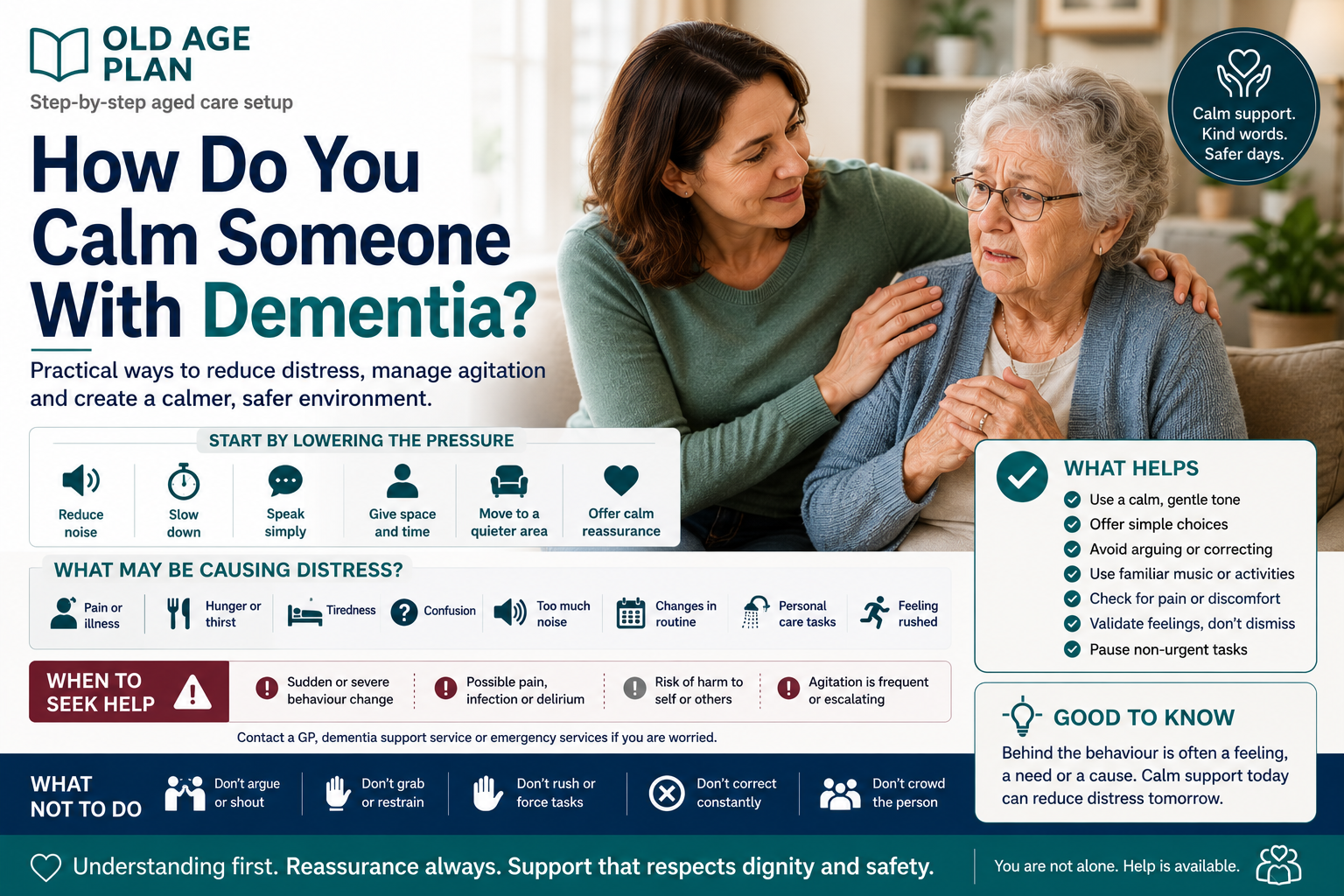

How Do You Calm Someone With Dementia?
When someone with dementia becomes distressed, agitated or frightened, it can be hard to know what to do in the moment.
Families may try to reason, correct, explain or push through the situation. Sometimes that makes things worse, not because anyone is doing the wrong thing on purpose, but because dementia can change how the person understands the situation.
Calming someone with dementia usually starts with reducing pressure, understanding what may be causing the distress and responding in a way that helps them feel safer.
Short Answer
To calm someone with dementia, stay calm yourself, reduce noise and pressure, speak slowly, offer reassurance, avoid arguing, check for pain or discomfort and move the person to a quieter, safer setting if possible.
If the distress is sudden, severe, unsafe or unusual for the person, seek medical advice. Agitation can sometimes be linked to pain, infection, delirium, medication effects or another health issue.
Key Takeaway
Calming someone with dementia is not about winning an argument or forcing cooperation. It is about lowering distress, protecting safety and working out what the person may be trying to communicate through their behaviour.
Why Someone With Dementia May Become Distressed
Dementia can make it harder to understand what is happening, remember recent events, follow instructions or explain discomfort.
Distress may be triggered by:
- too much noise
- being rushed
- confusing surroundings
- pain or illness
- hunger or thirst
- tiredness
- personal care tasks
- unfamiliar people
- changes in routine
- feeling corrected or embarrassed
What looks like “difficult behaviour” may be the person’s way of saying something is wrong.
Start By Lowering The Pressure
The first step is usually to make the situation feel less demanding.
This may mean:
- speaking more slowly
- using fewer words
- lowering your voice
- turning off television or loud noise
- giving the person more space
- pausing the task if it is not urgent
- reducing the number of people involved
If several people are talking at once, the person may become more confused or defensive.
One calm voice is usually better than several people trying to help at the same time.
Avoid Arguing Or Correcting
Arguing with someone who is distressed and confused rarely helps.
If the person believes something that is not accurate, constant correction may increase fear, shame or anger.
Instead of saying:
“That’s not true. You’re wrong.”
It may be more helpful to say:
“That sounds upsetting. I’m here with you.”
This does not mean agreeing with everything. It means responding to the feeling first, rather than forcing the facts in that moment.
Use Reassurance Before Explanation
When someone is distressed, they may not be able to process a long explanation.
Reassurance may help more than reasoning.
Helpful phrases may include:
- “You are safe.”
- “I’m here with you.”
- “We can slow down.”
- “There is no rush.”
- “Let’s sit for a moment.”
- “I’ll help you.”
The words matter, but tone matters too. A calm tone can reduce pressure even when the person does not fully understand the words.
Check For Pain, Illness Or Discomfort
Sudden agitation may have a physical cause.
Consider whether the person may be experiencing:
- pain
- infection
- constipation
- dehydration
- hunger
- tiredness
- overheating or feeling cold
- medication side effects
- poor sleep
- delirium
If behaviour changes quickly or seems very different from usual, contact a GP, nurse, pharmacist or appropriate health service for advice.
Change The Environment
The environment can make distress worse or easier to manage.
Helpful changes may include:
- moving to a quieter room
- reducing clutter
- turning down bright lights if they are uncomfortable
- playing familiar calming music
- offering a familiar object
- removing unnecessary people from the room
- making sure the person has space to move safely
A person with dementia may not be able to explain that the environment feels too busy. Their behaviour may be the signal.
Offer Simple Choices
Too many choices can increase confusion.
But no choice at all can feel controlling.
Offer simple options, such as:
- “Would you like tea or water?”
- “Would you like to sit here or in the lounge?”
- “Should we try again now or in a few minutes?”
This can help the person feel some control without overwhelming them.
Pause Non-Urgent Tasks
If the person becomes distressed during bathing, dressing, eating or leaving the house, ask whether the task must happen immediately.
Some tasks are urgent. Many are not.
Pausing for a few minutes may prevent the situation from escalating.
Trying again later, changing the wording or breaking the task into smaller steps may work better than pushing through.
Use Familiar Comforts
Familiar things may help reduce distress.
This may include:
- favourite music
- a familiar chair
- a warm drink
- a pet
- a photo album
- a blanket
- a familiar phrase
- a gentle walk
- a quiet activity
The aim is not distraction for its own sake. The aim is to reconnect the person with something that feels safe or familiar.
What Not To Do
When someone with dementia is distressed, it usually does not help to:
- argue
- shout
- corner the person
- grab them unless there is immediate danger
- force the task unless urgent
- correct every inaccurate statement
- have several people talk at once
- rush the person
- treat the behaviour as deliberate misbehaviour
These responses may increase fear or resistance.
When To Seek Help Urgently
Seek urgent help if there is immediate danger to the person or others.
Medical or professional review may also be needed if:
- distress appears suddenly
- behaviour is very different from usual
- there may be pain, infection or delirium
- the person is at risk of harm
- agitation is frequent or escalating
- family members cannot manage safely
- medication may be contributing
- there are hallucinations, severe paranoia or extreme fear
If there is an emergency, call emergency services. For non-emergency but concerning changes, contact a GP, dementia support service or health professional.
What You May Really Be Trying To Decide
If you are asking how to calm someone with dementia, you may really be trying to decide whether this is still manageable at home.
You may be asking whether the behaviour is part of dementia, whether you are responding the right way, whether medication is needed or whether extra support should now be involved.
The deeper question may be:
Is this a distress episode that can be managed with calmer support, or is it a sign that the person’s care needs have changed?
Decision Support
After the person is calmer, it may help to look for patterns.
Ask:
- What happened just before the distress?
- Was the person tired, hungry, unwell or in pain?
- Was the environment noisy or confusing?
- Was the person being rushed?
- Was there a change in routine?
- Did a particular task trigger distress?
- Did reassurance, music, space or quiet help?
- Is this happening more often?
If distress is repeated, escalating or unsafe, do not treat it as a simple behaviour problem. It may be time to involve a GP, Dementia Australia, Dementia Support Australia, My Aged Care or another appropriate service.
The goal is not to control the person. The goal is to understand what support is now needed to keep them safe, respected and as settled as possible.
Related Old Age Plan Articles
- How Do You Support Someone With Dementia?
- Can Routine Help Someone With Dementia?
- Can Music Help Dementia?
- What Non-Drug Treatments Help Dementia?
Next Steps With Old Age Plan
If distress or agitation is happening more often, it may help to record what happens before, during and after each episode.
Old Age Plan’s Free OAP Tools can help families organise observations, prepare questions and identify patterns before speaking with a GP, Dementia Australia, Dementia Support Australia or My Aged Care.
The aim is not to create a full behaviour plan on your own. The aim is to move from reacting in the moment to understanding what may need professional review or extra support.
Sources
- Dementia Australia — Changed Behaviours And Dementia
- Dementia Australia — Communication And Dementia
- Dementia Australia — Supporting A Person With Dementia Who Is Distressed
- Healthdirect Australia — Dementia Overview
- My Aged Care — Caring For Someone Living With Dementia
- Dementia Support Australia
Disclaimer
This article provides general information only and is not medical, legal or financial advice.
Dementia-related distress, agitation or behaviour changes may have many causes, including medical conditions, pain, infection, medication effects, delirium, environmental triggers or changing care needs. What helps one person may not help another.
Always seek advice from qualified health professionals, such as a GP, geriatrician, pharmacist, dementia support service or emergency service where appropriate. For current information and support, refer to Dementia Australia, Healthdirect, My Aged Care, Dementia Support Australia and relevant Australian health professionals.
Summary
To calm someone with dementia, reduce pressure, speak calmly, avoid arguing, offer reassurance, check for discomfort and make the environment quieter and safer.
Distress may be a sign of fear, confusion, pain, illness, unmet needs or environmental overwhelm.
If agitation is sudden, severe, repeated or unsafe, seek medical or professional support. The goal is to understand what the person may need, not simply to control the behaviour.