

What Questions Are Asked During A Memory Assessment?
A memory assessment can feel uncertain before you know what will happen.
What questions are asked during a memory assessment?
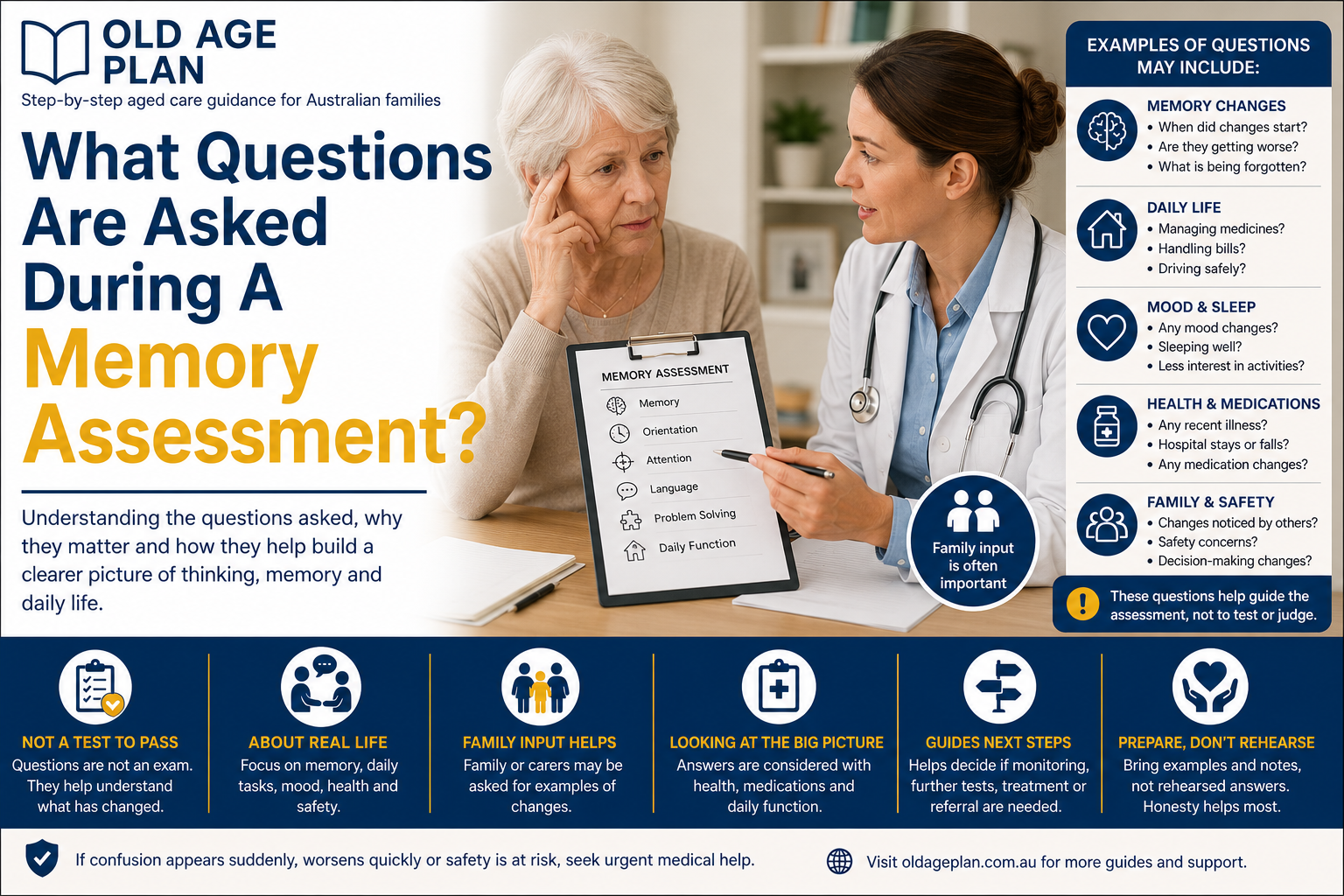
Doctors and health professionals may ask about memory changes, daily function, mood, sleep, medicines, medical history, safety and how the person manages everyday tasks.
They may also ask short cognitive questions or give simple tasks to check memory, attention, language, orientation and problem-solving.
Short Answer
During a memory assessment, questions usually focus on what has changed, when it started, whether it is getting worse and how it affects daily life.
The person may be asked questions about recent events, dates, places, words, instructions, daily routines, medicines, mood and safety.
Family or carers may also be asked for examples because memory changes are often clearer when compared with the person’s usual behaviour over time.
Key Takeaway
Key takeaway: Memory assessment questions are not designed to embarrass someone. They help build a clearer picture of thinking, daily function and possible causes so the next decision is based on evidence.
Why Memory Assessment Questions Matter
Memory concerns are rarely answered by one question.
A doctor needs to understand both the symptoms and the real-life impact.
For example, forgetting a name once is very different from forgetting appointments, medicines, bills or familiar routes.
This is why memory assessments usually ask about patterns, timing and daily function.
The goal is not only to ask whether the person forgets things.
The goal is to understand what has changed and whether it affects safety, independence or future planning.
Questions About Memory Changes
The doctor may ask questions such as:
- When did the memory problems start?
- Are they getting worse?
- Did the change happen suddenly or gradually?
- What kinds of things are being forgotten?
- Does the person repeat questions or stories?
- Do they forget recent conversations?
- Are they misplacing items more often?
- Are family or friends noticing changes?
These questions help separate occasional forgetfulness from a more consistent pattern.
Questions About Daily Life
Memory assessments often include questions about daily function.
This may include how the person manages:
- medicines
- appointments
- shopping
- cooking
- household tasks
- paying bills
- using the phone or technology
- driving or transport
- personal care
This matters because memory problems become more significant when they affect ordinary routines.
A person may do well in conversation but still struggle with complex tasks at home.
Questions About Mood, Sleep And Health
Doctors may ask about mood, sleep, appetite, pain, illness and recent life changes.
This is because depression, anxiety, poor sleep, infection, dehydration, pain and medication effects can all affect memory or concentration.
Questions may include:
- Has mood changed?
- Is the person sleeping well?
- Have they become more withdrawn?
- Have they lost interest in normal activities?
- Have there been recent illnesses or infections?
- Has there been a hospital stay or fall?
- Have medicines recently changed?
These questions help avoid jumping too quickly to one explanation.
Questions Used In Cognitive Screening
Some questions or tasks may check specific thinking skills.
The person may be asked to:
- remember a short list of words
- repeat information
- name objects
- follow simple instructions
- draw a clock or copy a shape
- answer questions about the date or place
- count backwards or complete attention tasks
- explain similarities or solve simple problems
These tasks are not about intelligence.
They are used to check different parts of thinking and memory.
Questions Family Members May Be Asked
Family members or carers may be asked what they have noticed.
This can be important because the person may not remember every example or may not recognise the full pattern.
Family may be asked:
- What changes have you noticed?
- How long has this been happening?
- Is it affecting daily life?
- Has behaviour or personality changed?
- Are there safety concerns?
- Is the person managing money, medicines and appointments?
- Has decision-making changed?
This information should be shared respectfully.
The aim is not to take control away from the person.
The aim is to help the doctor understand the situation accurately.
Should You Prepare For A Memory Assessment?
You do not need to study for a memory assessment.
In fact, rehearsing answers can make the result less useful.
However, it can help to prepare clear examples of what has changed.
Useful information may include:
- when the changes started
- specific examples
- current medicines
- recent illnesses or hospital stays
- changes in mood, sleep or appetite
- concerns about safety or daily function
- questions the family wants to ask
Good preparation is about accuracy, not performance.
Will The Questions Be Upsetting?
Some people may feel uncomfortable during a memory assessment.
They may worry about getting answers wrong or being judged.
It can help to explain that the assessment is not a school test and not a personal failure.
The purpose is to understand what support, treatment, monitoring or further assessment may be needed.
A calm, respectful approach can make the appointment easier.
What Happens After The Questions?
After the assessment, the doctor may explain what the answers suggest.
They may recommend monitoring, blood tests, medication review, cognitive assessment, brain imaging or referral to a specialist or memory clinic.
Sometimes the result is clear.
Sometimes more information is needed over time.
This does not mean the assessment has failed.
It means memory changes may need to be understood in context.
What You May Really Be Trying To Decide
Many families asking about memory assessment questions are trying to reduce uncertainty before an appointment.
The real questions may be:
- Will Mum or Dad feel embarrassed?
- Should a family member attend?
- What examples should we bring?
- Will one appointment diagnose dementia?
- What happens if the person denies there is a problem?
- Could this affect driving, care or legal planning?
The most useful approach is to focus on clear examples, respectful support and practical next steps.
The assessment is not about proving someone wrong.
It is about understanding what is happening well enough to decide what should happen next.
Decision Support Questions
Before the appointment, it may help to ask:
- What changes are most noticeable?
- Are they affecting daily life?
- Did they start suddenly or gradually?
- Has anything changed with medicines, health, sleep or mood?
- Are there safety concerns?
- Would the person benefit from having someone attend with them?
- What information would help the doctor see the full picture?
These questions can help make the appointment more useful without turning it into a confrontation.
Related Old Age Plan Articles
- What Is A Cognitive Assessment?
- What Tests Are Used To Check Memory Problems?
- When Should Memory Loss Be Checked?
- When Should You See A Doctor About Memory Problems?
- What Is Mild Cognitive Impairment?
- How Is Dementia Diagnosed?
Sources
- Dementia Australia — Dementia testing and diagnosis
- healthdirect Australia — Memory loss
- healthdirect Australia — Dementia overview
- Better Health Channel — Dementia
- Dementia Australia — Early warning signs of dementia
Disclaimer
This article provides general information only. It is not medical, legal or financial advice. Memory assessments and cognitive concerns should be discussed with qualified health professionals in the context of the person’s health, circumstances and daily function. If confusion appears suddenly, worsens quickly or safety is at risk, seek urgent medical help.
Summary
Memory assessment questions usually cover memory changes, daily function, mood, sleep, medicines, health history and safety.
The person may also be asked simple cognitive screening questions or tasks to check memory, attention, language and problem-solving.
The purpose is not to embarrass or judge the person. It is to understand what has changed, what may be causing it and what next steps may be needed.