
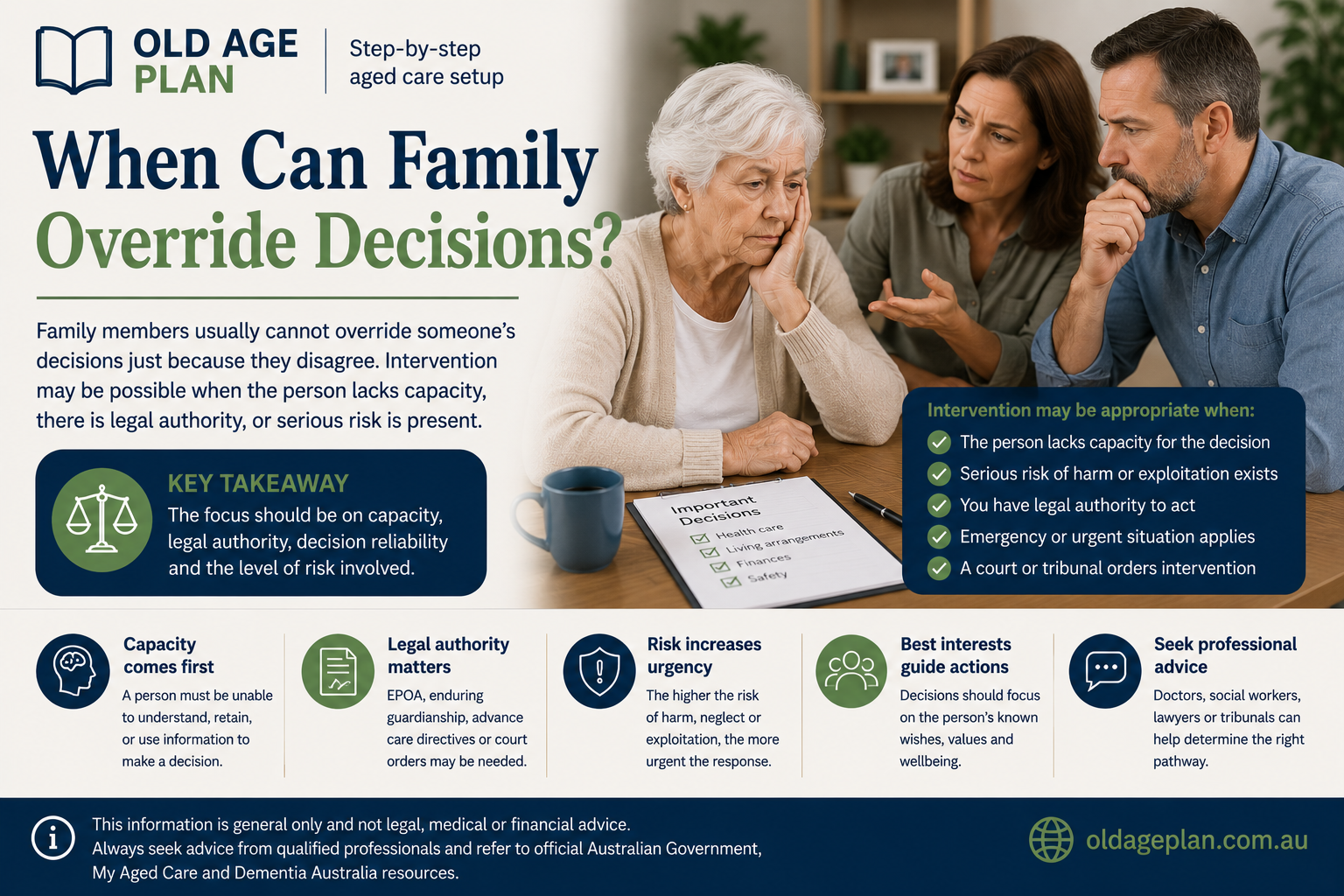

When Can Family Override Decisions?
Families often ask this when someone with dementia is making choices that seem unsafe, risky or hard to understand.
When can family override decisions?
The answer is not simply when family members disagree.
In most cases, family can only step in when the person no longer has capacity for the specific decision, there is proper legal authority, or urgent safety concerns require professional involvement.
Short Answer
Family members usually cannot override a person’s decisions just because they think the decision is wrong.
A person with dementia may still have the right to make decisions if they understand the decision, the risks and the consequences.
Family intervention may become possible when the person lacks capacity for that decision and a legally authorised person or process applies.
The key issue is whether decision reliability has declined enough that autonomy is now creating serious risk.
Key Takeaway: Family disagreement does not automatically give family members the right to override decisions. The focus should be on capacity, legal authority, decision reliability and the level of risk involved.
Disagreeing With A Decision Is Not Enough
Older people have the right to make decisions that others may not agree with.
This can include decisions about care, money, health, home life and daily routines.
A decision may seem unwise and still be legally valid if the person has capacity.
This is important because families can sometimes mistake disagreement for incapacity.
The question is not whether the family would make a different choice.
The question is whether the person understands the decision well enough to make it.
Capacity Comes First
Before family can override a decision, capacity usually needs to be considered.
Capacity is decision-specific.
A person may lack capacity for one decision but still have capacity for another.
For example, someone may still decide what they want to eat or wear but no longer understand a complex financial transaction or medical decision.
This is why family intervention should not be broader than necessary.
Decision Reliability Matters
The real question is not only whether the person has dementia.
The deeper question is whether their decision-making remains reliable enough for the decision in front of them.
Can they explain what they are deciding?
Do they understand the risk?
Is the decision consistent over time?
Are they free from pressure?
A useful OAP question is:
Has decision reliability declined enough that autonomy is now creating serious risk?
When Family May Be Able To Step In
Family may be able to step in when there is both a capacity concern and the right legal authority.
This may involve:
- an Enduring Power of Attorney for financial or legal matters
- an Enduring Guardian for lifestyle, health or care decisions
- an Advance Care Directive for healthcare wishes
- a tribunal-appointed guardian or financial manager
- urgent medical or emergency intervention where serious risk exists
The exact rules depend on the decision and the state or territory involved.
What If There Is No Legal Authority?
If there is no legal authority in place, family members may have limited ability to take over decisions.
They may still raise concerns, speak with professionals, contact My Aged Care or seek legal advice.
If the person lacks capacity and important decisions must be made, a tribunal application may be needed.
This can include applications for guardianship, financial management or administration depending on the state or territory.
Can Family Override Medical Decisions?
Medical decisions usually depend on whether the person has capacity for the treatment decision.
If they have capacity, their decision usually matters, even if family disagrees.
If they lack capacity, healthcare professionals may look to an appointed substitute decision-maker, guardian, Advance Care Directive or the relevant state or territory process.
In urgent situations, doctors may act according to emergency treatment rules.
Can Family Override Care Refusal?
Care refusal can be one of the hardest situations.
A person may refuse home care, hygiene support, medication assistance, hospital care or residential aged care.
If they understand the risks and have capacity, family may not be able to simply force the care.
If the refusal is based on confusion, impaired insight or inability to understand serious risk, professional assessment may be needed.
The higher the risk, the more important it becomes to involve the right professionals early.
Can Family Override Financial Decisions?
Financial decisions usually require proper legal authority.
An Enduring Power of Attorney may allow an appointed attorney to act, depending on the document and when it takes effect.
However, family members who are not legally appointed generally cannot just take control of someone’s money.
If there is no attorney and the person lacks financial capacity, tribunal involvement may be needed.
Bad Decisions Are Not Always Incapacity
This is a difficult but important distinction.
A person can make a bad decision and still have capacity.
Capacity is not about whether the decision is perfect.
It is about whether the person understands the decision and its consequences.
Family intervention becomes more relevant when decisions are not just unpopular, but unreliable, unsafe or no longer based on real understanding.
Risk Changes The Urgency
The level of risk matters.
Low-risk choices may not justify intervention, even if family disagrees.
Higher-risk situations may require faster action.
Examples of higher-risk concerns include:
- serious self-neglect
- unsafe driving
- financial exploitation
- refusing essential medical care without understanding the risk
- wandering or getting lost
- unsafe living conditions
- medication mismanagement
When risk increases, the question becomes less about preference and more about protection.
What You May Really Be Trying To Decide
If you are asking when family can override decisions, you may not only be asking about legal authority.
You may be trying to work out whether it is time to step in because waiting feels increasingly unsafe.
You may be wondering whether:
- Dad can still refuse care
- Mum can keep making financial decisions
- you can stop unsafe driving
- an Enduring Power of Attorney can be used now
- guardianship may be needed
- the family is acting too early or too late
The practical question is this:
Has the person’s decision-making become unreliable enough that serious harm may follow if no one intervenes?
How Families Can Approach This Carefully
Families should avoid two common mistakes.
The first mistake is overriding too early because a decision feels uncomfortable.
That can unnecessarily reduce independence and dignity.
The second mistake is waiting too long when decision-making has clearly become unsafe.
That can allow preventable harm to grow.
A careful approach is to identify the exact decision, assess the level of risk, check what legal authority exists and seek professional advice where capacity is unclear.
Related Old Age Plan Articles
- Can Someone With Dementia Refuse Care?
- Can Someone With Dementia Make Medical Decisions?
- Who Decides If Someone Has Lost Capacity?
- When Does Someone With Dementia Lose Capacity?
- Can Capacity Be Partial?
- What Is An Enduring Power Of Attorney?
- What Is Enduring Guardianship?
Sources
- NSW Government — Capacity Toolkit
- My Aged Care — Appointed Decision-Makers
- Dementia Australia — Planning Ahead
- OPAN — Supported Decision-Making
Disclaimer
This article provides general information only. It is not legal, medical or financial advice.
Dementia symptoms, medication guidance, medical advice, aged care services and government policies may change over time and individual circumstances can vary.
Always seek advice from qualified healthcare professionals and refer to official Australian Government, My Aged Care and Dementia Australia resources for current information.
Summary
Family members usually cannot override decisions simply because they disagree.
The key issues are capacity, legal authority, decision reliability and risk.
If the person still understands the decision, their choice usually matters.
If decision-making has become unreliable and serious risk is present, family may need professional, medical, legal or tribunal guidance before stepping in.