
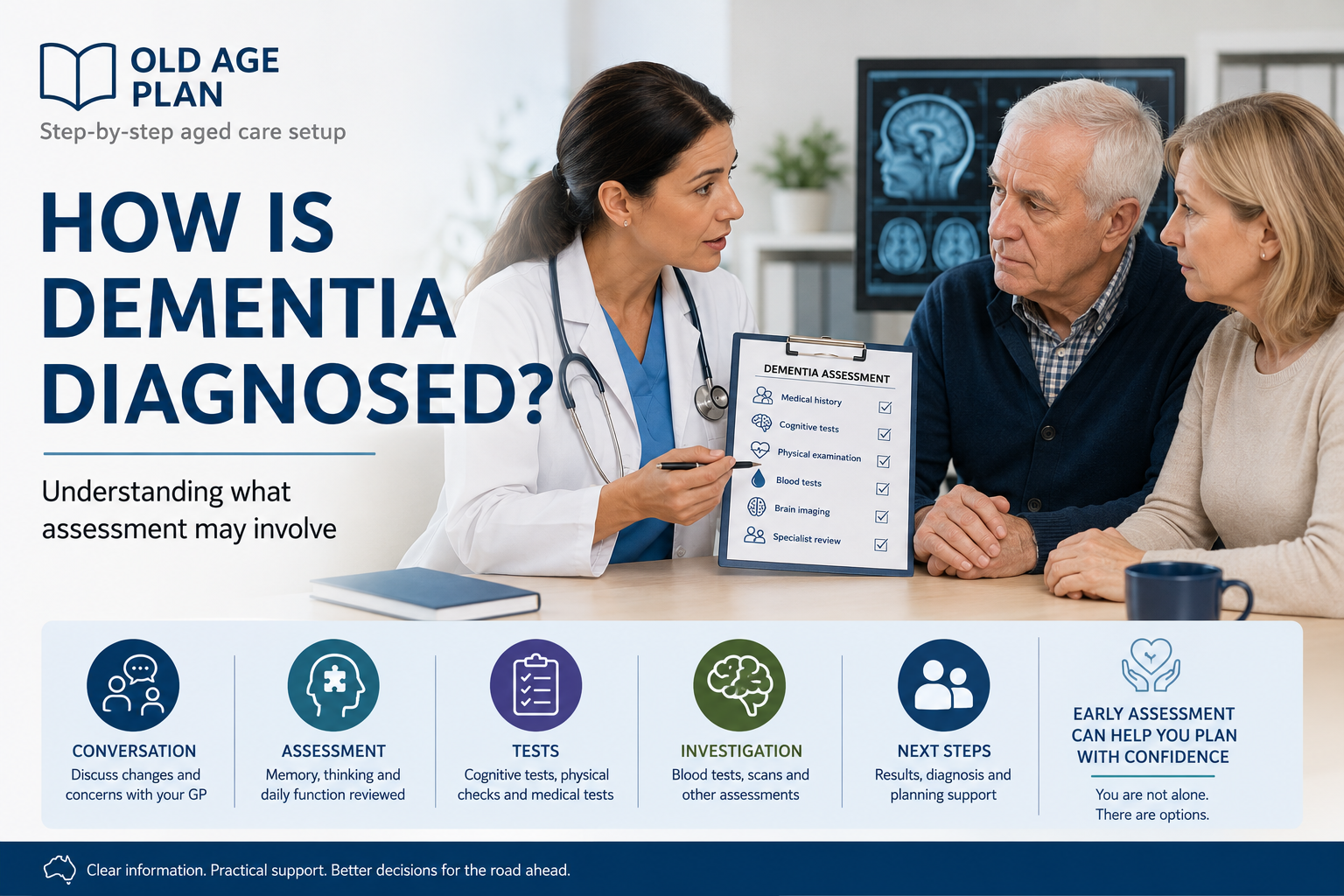

How Is Dementia Diagnosed?
Memory and thinking changes can be difficult to understand, especially when you are not sure whether they are part of normal ageing or something more serious.
If you are wondering whether it is time to speak with a doctor, understanding how dementia is diagnosed can help you know what the assessment process may involve.
Dementia is usually diagnosed through a medical assessment that looks at memory, thinking, behaviour, daily function, health history and possible other causes of symptoms.
There is not one single test that confirms dementia in every case.
For many families, the first step is speaking with a GP.
The doctor may ask questions, complete screening tests, review medicines and organise further tests.
Sometimes a referral to a specialist may also be needed.
Understanding how dementia is diagnosed can help families know what to expect and what questions to ask.
Short Answer
Dementia is diagnosed through a combination of medical history, family observations, cognitive testing, physical checks, blood tests, scans and sometimes specialist assessment.
A GP is often the first step.
The goal is to understand whether symptoms are caused by dementia or by another health issue that may need different treatment.
Key Takeaway
Dementia diagnosis usually involves more than one test or appointment.
A GP may assess memory, thinking, health history, medications and daily function before arranging further tests or referral.
If symptoms are becoming more frequent or affecting daily life, seeking medical advice early can help families understand what may be happening.
Why Dementia Diagnosis Matters
A dementia diagnosis can help explain changes in memory, thinking, communication, behaviour or daily function.
It can also help families understand what support may be needed next.
Early diagnosis may give the person more time to take part in decisions about care, finances, legal documents and future wishes.
It may also help doctors identify other health problems that can look like dementia.
When Families Usually Start Asking Questions
Families often begin looking for answers after noticing repeated changes that are hard to explain.
This may include:
- asking the same questions again and again
- forgetting appointments or conversations
- getting confused in familiar places
- making mistakes with medication
- struggling with bills or money
- changes in judgement, mood or behaviour
- finding everyday tasks harder than before
At first, the question may not be “Is this dementia?”
It may simply be:
Is this normal ageing, or should we get it checked?
That is why a medical assessment can be helpful.
Who Should You See First?
In many cases, the first step is booking an appointment with a GP.
The Australian Institute of Health and Welfare notes that there is no single pathway to diagnosis, but a GP visit is often the first step.
The GP may complete an initial assessment and decide whether further tests or specialist referral are needed.
What The GP May Ask About
The GP may ask about changes in:
- memory
- thinking
- communication
- mood
- behaviour
- daily routines
- personal care
- medication management
- finances
- safety at home
The doctor may also ask about medical history, family history, current medicines, sleep, mood and recent changes in health.
Family observations can be useful because relatives may notice changes that the person has not recognised.
Cognitive Tests
Cognitive tests are commonly used during dementia assessment.
These tests may check memory, attention, language, problem-solving, orientation and thinking skills.
Dementia Australia explains that cognitive tests may include tools such as the Mini-Mental State Examination, known as the MMSE, and other more detailed assessments.
These tests do not always diagnose dementia by themselves.
However, they can help show whether further assessment is needed.
Physical And Neurological Checks
A doctor may also complete a physical examination.
This may include checking blood pressure, movement, reflexes, balance, vision, hearing and general health.
Healthdirect notes that doctors may use physical and neurological examinations as part of dementia diagnosis.
These checks can help identify other issues that may be contributing to symptoms.
Blood Tests And Other Medical Tests
Blood tests may be used to check for other conditions that can affect memory or thinking.
These may include vitamin deficiencies, thyroid problems, infection, inflammation or other health concerns.
Some conditions can cause dementia-like symptoms.
This is why testing for other causes matters.
Brain Scans
Brain imaging may be used in some assessments.
This may include CT scans or MRI scans.
Scans can help doctors look for changes in the brain, strokes, tumours, bleeding, shrinkage or other possible explanations for symptoms.
Not every person will need the same type of scan.
The doctor will decide what is appropriate based on the person’s symptoms and medical history.
Specialist Assessment
Some people may be referred to a specialist.
This may include a geriatrician, neurologist, psychogeriatrician, psychiatrist, memory clinic or other specialist service.
A specialist may complete more detailed testing or help identify the likely type of dementia.
This can be useful when symptoms are complex, early, unusual or difficult to explain.
Can A GP Diagnose Dementia?
A GP can often begin the assessment process.
In some cases, a GP may diagnose dementia.
In other cases, they may refer the person to a specialist for further assessment.
The pathway can depend on the symptoms, test results, medical history and local services available.
How Long Does A Dementia Diagnosis Take?
The time can vary.
Some people may receive a diagnosis after several appointments and tests.
Others may need specialist review or follow-up over time.
Diagnosis can take longer when symptoms are mild, mixed with other health issues or changing slowly.
Families should not assume a delay means nothing is wrong.
It may simply mean more information is needed.
Can Other Conditions Look Like Dementia?
Yes.
Some conditions can cause memory, thinking or behaviour changes that look similar to dementia.
These may include:
- depression
- infection
- delirium
- sleep problems
- medication side effects
- vitamin deficiencies
- thyroid problems
- dehydration
- hearing or vision problems
This is one reason medical assessment is important.
Not every memory problem is dementia.
What Should Families Prepare Before The Appointment?
Before seeing the doctor, families may want to write down specific examples of changes.
This may include when the changes started, how often they happen and how they affect daily life.
It may also help to bring a list of medicines, existing health conditions and any concerns about safety, driving, finances or home routines.
Preparing examples before the appointment can make the discussion with the GP much clearer.
Many families find it helpful to use a structured observation checklist so important changes are not forgotten during the appointment.
Decision Support
If you are trying to decide whether to book an appointment, consider whether the changes are becoming more frequent, noticeable or disruptive.
You may want to ask:
- Are memory or thinking changes affecting daily life?
- Are family members noticing repeated changes?
- Is the person struggling with tasks they used to manage?
- Are there concerns about safety, medication, money or driving?
- Would writing down examples help the GP understand the pattern?
If the answer is yes to any of these, a medical appointment may be sensible.
What Could Happen After Assessment?
After the first assessment, the doctor may:
- organise blood tests
- complete cognitive screening
- review medications
- arrange brain imaging
- refer to a specialist
- suggest monitoring symptoms over time
- discuss support services
- recommend planning conversations
If dementia is diagnosed, families may need to think about care planning, legal documents, support at home and future decision-making.
What You May Really Be Trying To Decide
If you are searching for dementia diagnosis, you may not only be looking for medical information.
You may also be trying to understand:
- whether the changes are serious
- whether it is time to book a GP appointment
- what questions to ask
- what support may be needed next
- what decisions may follow if dementia is diagnosed
Those are practical questions.
Taking one step at a time can make the next decision clearer.
Related Old Age Plan Articles
- What Is Dementia?
- What Are The Early Signs Of Dementia?
- What Causes Dementia?
- What Types Of Dementia Are There?
- Can Dementia Be Treated?
- What Happens After A Dementia Diagnosis?
- Can Someone With Dementia Make Legal Decisions?
Sources
- Dementia Australia — Dementia Testing And Diagnosis
- Healthdirect Australia — Tests Used In Diagnosing Dementia
- Australian Institute Of Health And Welfare — How Is Dementia Diagnosed?
- Dementia Australia — About Dementia
- Australian Government Department Of Health — Dementia
Summary
Dementia is usually diagnosed through a combination of medical history, family observations, cognitive testing, physical checks, blood tests, scans and sometimes specialist assessment.
A GP is often the first step.
There is no single test that confirms dementia in every case.
If symptoms are becoming more frequent or affecting daily life, seeking medical advice can help families understand what may be happening and what steps may come next.