

What Types Of Dementia Are There?
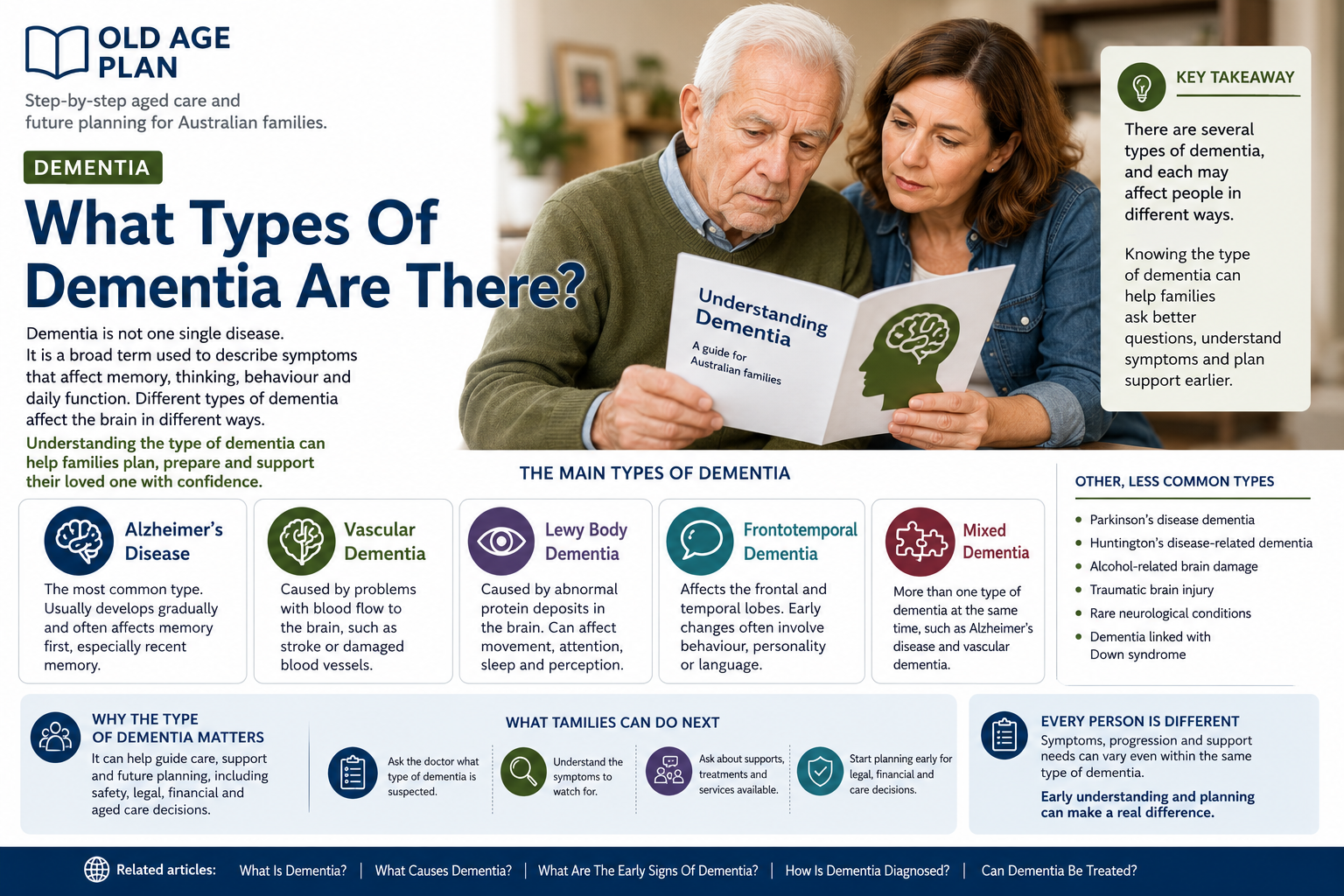
What types of dementia are there? There are several types of dementia, including Alzheimer’s disease, vascular dementia, Lewy body dementia, frontotemporal dementia and mixed dementia.
Dementia is not one single disease.
It is a broad term used to describe symptoms that affect memory, thinking, behaviour and daily function.
Different types of dementia affect the brain in different ways.
This means symptoms, progression and support needs can vary from person to person.
For families, understanding the type of dementia can make the diagnosis easier to understand and help guide future planning.
Short Answer
The main types of dementia include Alzheimer’s disease, vascular dementia, Lewy body dementia, frontotemporal dementia and mixed dementia.
There are also less common types linked with other brain conditions, injuries or diseases.
The type of dementia can affect symptoms, care needs and future planning.
Key Takeaway
Dementia is not just one condition.
There are different types of dementia, and each may affect people in different ways.
Knowing the type of dementia can help families ask better questions, understand symptoms and plan support earlier.
Why Dementia Has Different Types
Dementia can be caused by different diseases or changes in the brain.
These changes may affect different parts of the brain.
That is why one person may mainly have memory problems, while another may first show changes in behaviour, language, movement or judgement.
Knowing the type of dementia can help doctors, families and carers understand what support may be needed.
Alzheimer’s Disease
Alzheimer’s disease is one of the most common types of dementia.
It usually develops gradually over time.
Memory problems are often one of the first signs.
A person may forget recent conversations, repeat questions or struggle to remember recent events.
Over time, Alzheimer’s disease can also affect language, judgement, planning, mood, behaviour and daily activities.
Vascular Dementia
Vascular dementia is linked to reduced blood flow or damage to blood vessels in the brain.
It can happen after a stroke.
It can also develop more gradually when blood vessels are damaged over time.
Vascular dementia may affect planning, concentration, judgement, movement and memory.
Symptoms may appear suddenly after a stroke or slowly over time.
Lewy Body Dementia
Lewy body dementia is linked with abnormal protein deposits in the brain called Lewy bodies.
It can affect thinking, movement, sleep, attention and behaviour.
Some people may experience visual hallucinations.
Symptoms may also fluctuate, meaning the person may seem clearer at some times and more confused at others.
Lewy body dementias can include dementia with Lewy bodies and Parkinson’s disease dementia.
Frontotemporal Dementia
Frontotemporal dementia affects the frontal and temporal lobes of the brain.
These areas are involved in behaviour, personality, language and decision-making.
Early signs may include changes in behaviour, reduced empathy, poor judgement, impulsive actions or difficulty with speech and language.
Frontotemporal dementia can appear at a younger age than some other types of dementia.
This can be especially difficult for families because the person may seem very different from how they were before.
Mixed Dementia
Mixed dementia means a person has more than one type of dementia at the same time.
For example, a person may have changes linked to both Alzheimer’s disease and vascular dementia.
This can make symptoms more complex.
It may also make the diagnosis harder to explain clearly.
Other Less Common Types Of Dementia
Some people develop dementia linked with other conditions or causes.
These may include:
- Parkinson’s disease dementia
- Huntington’s disease-related dementia
- alcohol-related brain damage
- traumatic brain injury
- rare neurological conditions
- dementia linked with Down syndrome
These types may need specific medical advice and support.
Can The Type Of Dementia Affect Symptoms?
Yes.
The type of dementia can affect which symptoms appear first.
For example:
- Alzheimer’s disease often begins with memory changes.
- Vascular dementia may affect planning, concentration or movement.
- Lewy body dementia may affect attention, movement, sleep and visual perception.
- Frontotemporal dementia may first affect behaviour, personality or language.
- Mixed dementia may involve symptoms from more than one type.
These are general patterns only.
Each person can experience dementia differently.
Can Doctors Always Identify The Type?
Not always.
Sometimes the type of dementia is clear.
Other times, the symptoms overlap.
A doctor may use medical history, family observations, memory tests, blood tests, brain scans and specialist assessment to help understand the likely type.
In some cases, the diagnosis may change over time as symptoms become clearer.
Why The Type Of Dementia Matters
Understanding the type of dementia can help families prepare.
It may influence:
- what symptoms to watch for
- what support may be useful
- how communication may change
- how behaviour may change
- what safety issues may arise
- what questions to ask doctors
- how future care may need to be planned
The type of dementia does not remove the need for practical planning.
All forms of dementia can affect daily life over time.
What Should Families Ask After A Diagnosis?
After a dementia diagnosis, families may want to ask the doctor:
- What type of dementia is suspected?
- How certain is the diagnosis?
- Are more tests needed?
- What symptoms should we watch for?
- Are there treatments or supports that may help?
- Should legal, financial or care planning happen now?
- When should the diagnosis be reviewed?
A planner or checklist may help families organise these questions before appointments.
Related Old Age Plan Articles
- What Is Dementia?
- What Causes Dementia?
- What Is The Difference Between Dementia And Alzheimer’s Disease?
- What Are The Early Signs Of Dementia?
- How Is Dementia Diagnosed?
- Can Dementia Be Treated?
Sources
- Dementia Australia — Causes And Types Of Dementia
- Dementia Australia — About Dementia
- Healthdirect Australia — Dementia
- Better Health Channel — Conditions That Can Lead To Dementia
- Australian Institute Of Health And Welfare — What Is Dementia?
Summary
There are several types of dementia, including Alzheimer’s disease, vascular dementia, Lewy body dementia, frontotemporal dementia and mixed dementia.
Each type can affect people differently.
Understanding the type of dementia can help families ask better questions, understand symptoms and plan future support.