
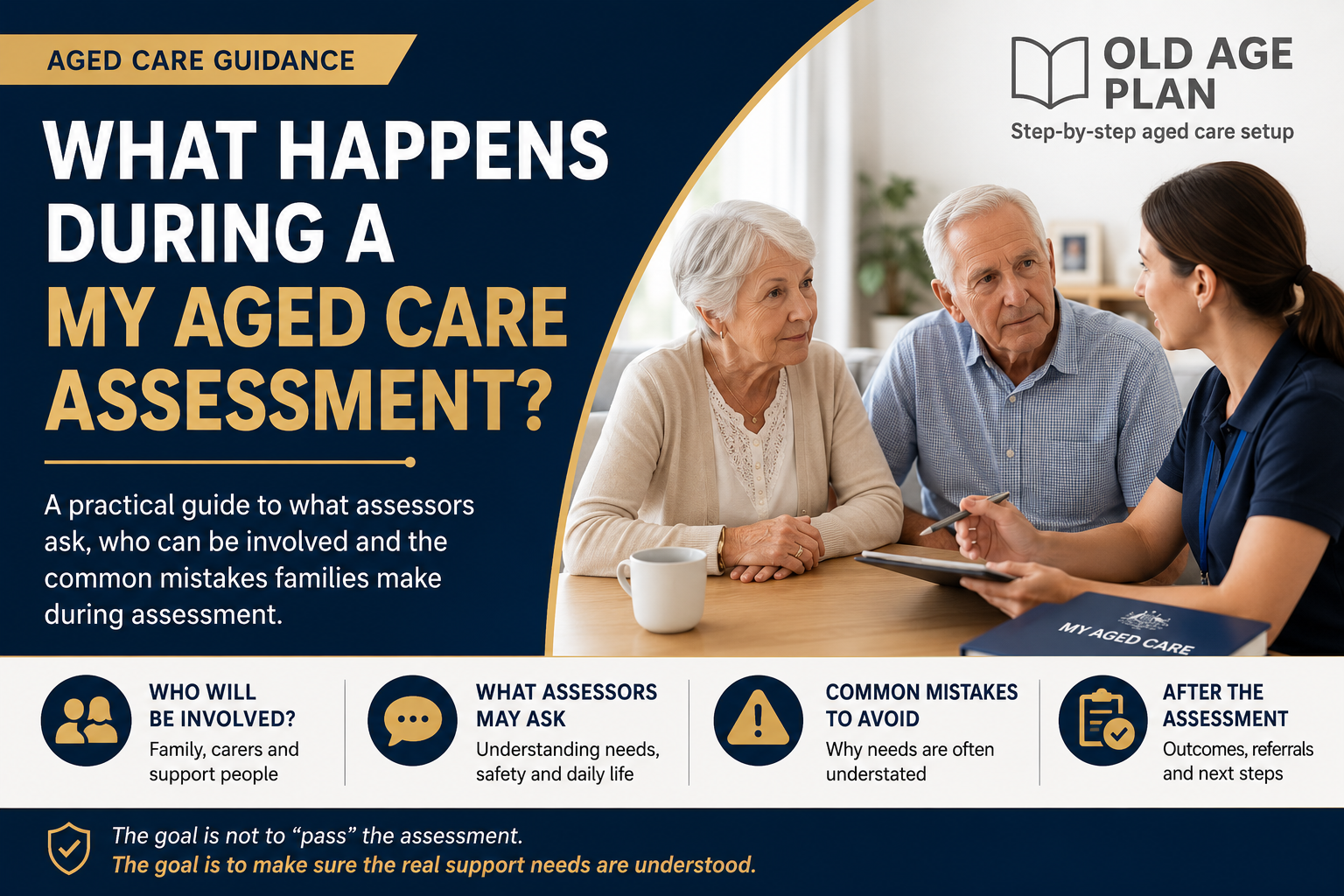

What Happens During A My Aged Care Assessment?
Most families do not worry about a My Aged Care assessment because they love paperwork.
They worry because someone is coming to ask questions about Mum or Dad’s daily life, safety, independence and support needs. And underneath that worry is a quieter fear:
What if the assessment does not show how hard things have really become?
That is the red line in this article. This guide explains what usually happens during a My Aged Care assessment. It does not replace assessment preparation, evidence organisation or a structured planning system. It helps you understand the conversation before it happens.
Short Answer
During a My Aged Care assessment, an assessor talks with the older person about their current situation, daily needs, health, safety, support network and goals. The assessor uses that conversation to understand what services may suit the person and whether they may be eligible for government-subsidised aged care support.
The assessment may happen at home or another suitable location. A family member, carer, registered supporter or other trusted person may be involved where appropriate.
Key Takeaway
A My Aged Care assessment is not just a checklist. It is a conversation that can shape what support pathway opens next. The safest approach is to be honest, specific and realistic without turning the article itself into a full preparation workbook.
Where This Assessment Fits In The My Aged Care Pathway
A My Aged Care assessment usually happens after a person has applied for an assessment or been referred into the My Aged Care pathway.
The broad sequence is:
- the person applies or is referred for assessment
- an assessment organisation contacts the person, primary contact or appointed decision-maker
- an assessment time is arranged if appropriate
- the assessor talks with the person about their needs and situation
- a decision is made about eligibility and next steps
- the person receives an assessment outcome or Notice of Decision
My Aged Care says an assessment organisation may call the person, primary contact or appointed decision-maker to discuss needs and arrange the assessment. The assessment itself is used to recommend support and services that may suit the person’s situation.
Who May Be Involved In The Assessment?
The assessment usually focuses on the older person, but other people may be involved.
That may include:
- a family member
- a carer
- a registered supporter
- an appointed decision-maker
- a nominated Elder Care support person
- a hospital or health professional, depending on the situation
Before the assessment starts, My Aged Care says the assessor will ask if the person agrees to the assessment. They may also ask permission to talk with people who support the person, such as family, carers, registered supporters or other nominated support people.
This matters because some people explain their situation clearly. Others forget details, minimise problems, become anxious, or describe the day they wish they were having rather than the week they are actually living.
What The Assessor May Ask About
The assessor may ask about the person’s current circumstances, daily routines, needs, preferences and goals.
The conversation may include areas such as:
- personal care
- mobility and falls
- meals and nutrition
- memory, confusion or decision reliability
- medication routines
- home safety
- social connection
- transport and appointments
- support already provided by family or carers
- whether current support is still sustainable
This list is not a preparation system. It is a broad overview of the types of life areas that may come up. The important point is that the assessor is trying to understand what support may suit the person, not simply whether the person can answer questions politely for one meeting.
What Actually Happens During The Assessment?
The assessment is usually a structured conversation.
The assessor may ask what has changed, what the person can still do, what has become difficult, what support already exists and what the person would like to achieve.
They may also ask about safety concerns, health changes, family support and whether the person’s current living arrangement is still working.
Risk point: A person may appear calm and capable during one conversation while still struggling with meals, medication, hygiene, falls or memory across the week.
This is why assessment conversations can be emotionally difficult. Families are often trying to respect dignity while also making sure the assessor hears what is actually happening.
The Biggest Mistake Families Make During Assessment
The biggest mistake is not usually saying the wrong word.
It is making the situation sound more stable than it is.
This often happens without anyone meaning to mislead the assessor.
The older person may say, “I manage,” because they do not want to feel dependent. A spouse may say, “We cope,” because they have been coping for years. Adult children may avoid raising uncomfortable details because they do not want to embarrass Mum or Dad in front of someone else.
So the assessment hears a polished version of daily life.
Not the full version.
It hears:
“She has a little trouble sometimes.”
But not:
“She only eats properly because someone checks every day.”
It hears:
“Dad is still independent.”
But not:
“Dad is independent only because his son manages the bills, medication, appointments, shopping and every unexpected problem.”
That gap matters.
Not because families are trying to cheat the system. Because aged care decisions are often made from the information available. If the information is too neat, the pressure underneath may stay invisible.
Assessment coming up?
The My Aged Care Assessment Protection System helps families prepare before assessment so hidden risk, support dependency and caregiver load are not quietly understated.
When “They Seem Fine Today” Becomes Misleading
Assessment day can be deceptive.
Some older people lift for important conversations. They dress well, answer politely and present their best version of independence.
That does not mean the difficulties are not real.
It may mean the assessor is seeing a good hour, not the full pattern.
The key question is not whether the person can still make some decisions. The real question is whether their decisions remain reliable enough for this specific decision.
That distinction is important during aged care assessment because confidence and reliability are not the same thing. A person may confidently say they are safe at home while forgetting the fall last week, the stove left on, the medication mistakes or the neighbour who keeps stepping in.
Risk point: If the assessment only captures the person’s best presentation, it may miss the ordinary days when support needs are more obvious.
What Families Can Do Without Turning The Assessment Into A Performance
The aim is not to rehearse answers or exaggerate problems.
The aim is to make sure the assessment conversation is honest.
That means families may need to:
- avoid minimising serious safety concerns
- avoid speaking over the older person unnecessarily
- raise important risks respectfully
- explain support that is already happening
- clarify whether current arrangements are sustainable
This article stops there deliberately.
A full preparation structure, evidence system or risk-mapping process belongs inside a proper assessment preparation product, not inside a free article.
What Happens After The Assessment?
After the assessment, the person receives an assessment outcome letter, sometimes called a Notice of Decision. My Aged Care says this letter explains whether the person is eligible for government-subsidised aged care services. If the person is eligible, they may also receive a support plan.
The outcome may lead to different next steps depending on the person’s needs and the type of support approved.
These may include:
- entry-level support
- support at home
- short-term care
- respite care
- transition care
- residential aged care pathways
Risk point: Approval is not the same as everything being organised. Families may still need to use referral codes, choose providers and follow up next steps.
My Aged Care explains that referral codes may be used so providers can view the person’s client record and support plan, accept a referral and begin organising services.
What You May Really Be Trying To Decide
If you are searching for what happens during a My Aged Care assessment, you may not only be asking about process.
You may be trying to decide:
- Should family be present?
- What if Mum or Dad minimises everything?
- What if the assessor does not see the real situation?
- How honest should we be about carer burnout?
- What happens if the person refuses help?
- Are we asking for too much support or not enough?
- What happens if the outcome does not match reality?
Those are the real questions underneath the search.
Decision Support
A My Aged Care assessment should be approached with calm honesty.
Do not treat it like an exam. Do not treat it like a sales pitch. Do not treat it like a family argument.
The assessment needs a realistic picture of the person’s ordinary life, not only their best day or worst day.
Families should be especially careful when:
- the person is proud and likely to minimise support needs
- memory changes affect how accurately they describe daily life
- one carer is quietly carrying most of the support load
- falls, medication issues or safety risks are being explained away
- family members disagree about how serious the situation is
The aim is not to take control away from the older person. It is to make sure decisions are based on the full support picture.
Old Age Plan Pathway
Different families need different levels of support depending on where they are in the assessment journey.
- Starting point: Use Free Tools to begin organising what has changed before the assessment conversation.
- Focused planning: Browse the $19 Planners if you need help organising one specific part of the aged care pathway.
- Assessment preparation: Use the My Aged Care Assessment Protection System if an assessment is coming and you need to avoid understating risk, dependency or caregiver load.
- System orientation: Use the Aged Care Starter Pack if you need to understand how assessment fits into the broader aged care system.
- Home care setup: Use the In Home Care Setup System if support has been approved and the next challenge is organising care at home.
Frequently Asked Questions
Does the assessor come to your home?
My Aged Care says an assessor may come to your home or current residence to ask questions about your situation and needs. The exact arrangement can depend on the assessment pathway and circumstances.
Can family be present during a My Aged Care assessment?
Yes, family, carers, registered supporters or other support people may be involved where appropriate. The assessor may ask permission to speak with people who support the older person.
What questions are asked during a My Aged Care assessment?
The assessor may ask about the person’s current situation, daily needs, health, safety, support network, goals and what services may help. The exact questions depend on the person’s circumstances.
Should you tell the assessor about carer stress?
Yes. Carer stress can be relevant because it may show that the current support arrangement is becoming unsustainable. It should be explained honestly and respectfully.
What should you not do during the assessment?
Do not minimise serious risks to avoid embarrassment. The assessment needs a realistic picture of daily life, including support already provided by family or carers.
What happens after a My Aged Care assessment?
The person receives an assessment outcome letter or Notice of Decision. If eligible, they may receive a support plan and referral information for approved services.
What is a referral code?
A referral code is a unique reference number for receiving services. It allows a provider to view the client record and support plan, accept the referral and start organising services.
What if the assessment outcome seems wrong?
If the outcome does not seem to reflect the person’s real needs, families may need to contact My Aged Care, speak with the assessment organisation or seek advice about review options.
Related Old Age Plan Guides
This guide sits inside the My Aged Care and assessment pathway. Related guides in this series include:
- What Is My Aged Care And How Does It Work?
- What Is An ACAT Assessment?
- How To Apply For My Aged Care
- Home Care Packages Explained
- Residential Aged Care Explained
Next Steps With Old Age Plan
If your assessment is coming up, start by writing down what has changed, what support is already being provided and what risks may be easy to forget during the conversation.
The strongest next step is the My Aged Care Assessment Protection System. It is designed to help families prepare before assessment without turning serious care needs into a vague or overly neat version of daily life.
If you are still trying to understand the bigger aged care pathway, the Aged Care Starter Pack can help you place the assessment in context. If care has been approved and the next challenge is practical home support, the In Home Care Setup System may be the better next step.
Sources
- My Aged Care — How To Get Assessed
- My Aged Care — Preparing For Your Assessment
- My Aged Care — How To Apply For An Assessment
- My Aged Care — What Happens After An Assessment
- My Aged Care — Receiving Your Assessment Outcome
- My Aged Care — Assessment Outcome: Commonwealth Home Support Program
Disclaimer
This article provides general information only. It is not legal, medical, financial or aged care advice.
Aged care laws, policies, procedures, eligibility rules, fees and service availability may change. Individual circumstances can vary significantly.
You should seek qualified professional advice where appropriate and refer to official Australian Government resources, including My Aged Care, for current information about aged care assessments, eligibility and service pathways.