
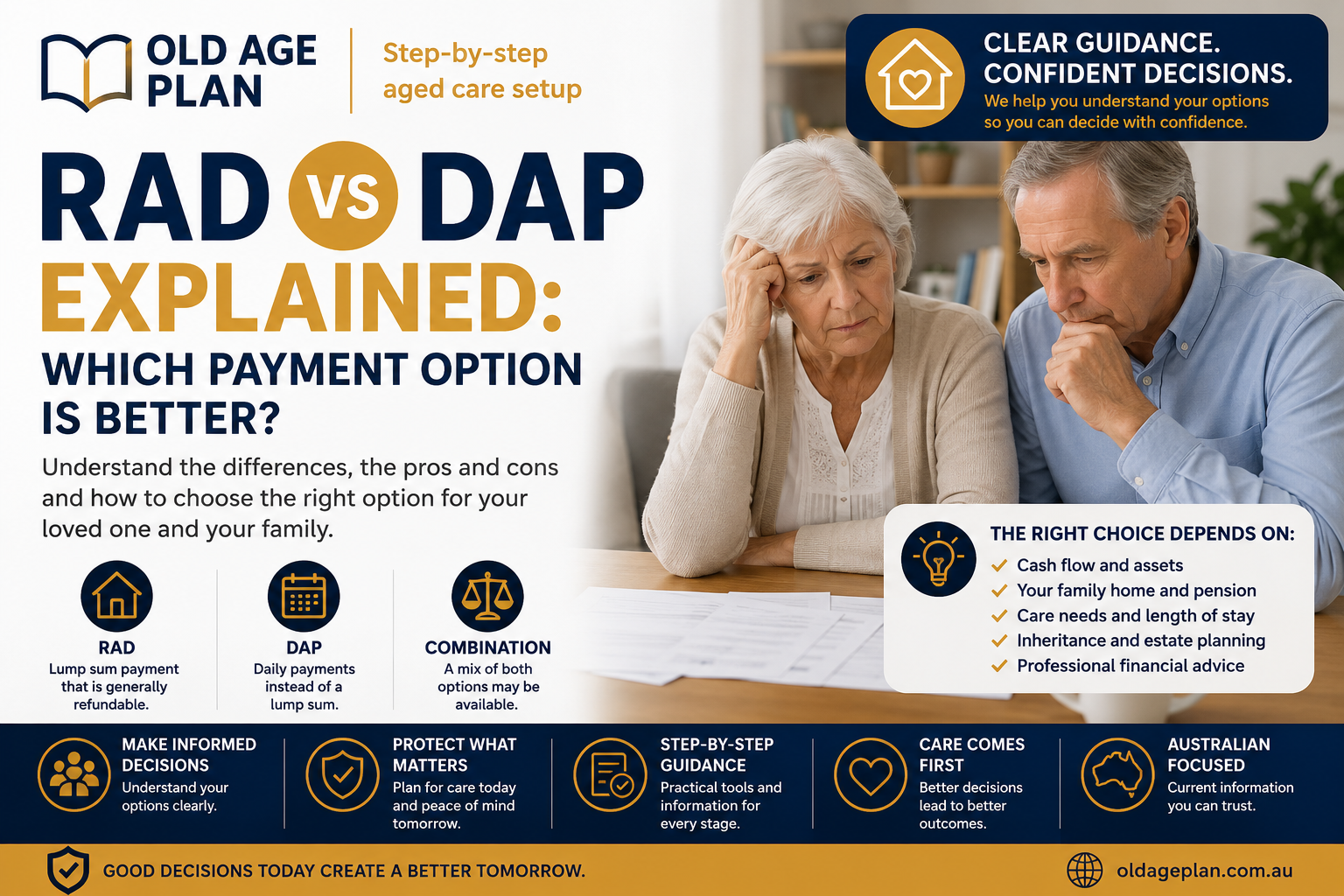

RAD Vs DAP Explained: Which Payment Option Is Better?
RAD and DAP are two of the most confusing terms families meet when residential aged care becomes real.
By the time these words appear, the family may already be dealing with a hospital discharge, a care home offer, a room price, pressure from siblings and fear about what happens to the family home.
The question is rarely only:
What do RAD and DAP mean?
It is usually:
Should we pay a lump sum, pay daily, use a mix, sell assets, protect cash flow or stop before we make a financial decision we do not properly understand?
Short Answer
A RAD is a refundable lump sum accommodation payment. A DAP is a non-refundable daily accommodation payment. Some families may choose to pay accommodation costs as a RAD, a DAP or a combination of both, depending on the aged care home, the resident’s circumstances and financial advice.
There is no single best option for everyone. The better option depends on cash flow, assets, the family home, pension effects, estate planning, risk tolerance and how long the person may remain in care.
Key Takeaway
The biggest mistake is treating RAD versus DAP as a simple maths question. It is often a major family financial decision involving care needs, cash flow, property, inheritance expectations and emotional pressure.
What Is A RAD?
RAD stands for Refundable Accommodation Deposit.
It is a lump sum accommodation payment made to an aged care home. If paid as a lump sum, the balance is generally refundable when the person leaves the aged care home, subject to permitted deductions and rules that apply at the time.
A RAD can feel attractive because it may reduce or remove the need to pay the daily accommodation payment. But it can also require access to a large amount of money.
That may lead families to consider using savings, selling investments, drawing on property value or selling the family home.
What Is A DAP?
DAP stands for Daily Accommodation Payment.
It is a daily payment made instead of paying the full accommodation amount as a lump sum. My Aged Care describes daily accommodation payments as working like rent payments, and they are not refunded when the person leaves care.
A DAP may help preserve capital because the family does not need to pay the full lump sum upfront. But it can create an ongoing daily cost that must be affordable over time.
A $750,000 room price with an 8.17% MPIR could create a DAP of about $167.88 per day ( around $5,036 per month) .
From 1 November 2025, DAP indexation may apply under newer accommodation arrangements, so families should check current rules before relying on old assumptions.
RAD Vs DAP: The Core Difference
The core difference is simple at the surface.
A lump sum accommodation payment. The balance is generally refundable when the person leaves care, subject to rules and permitted deductions.
A daily accommodation payment. It avoids paying the full lump sum upfront, but the daily payments are not refunded.
Some families may use part RAD and part DAP, depending on affordability, available assets and advice.
The right option depends on personal circumstances. This is not a decision to make from guesswork or pressure.
The emotional difference is often harder.
A RAD may feel like handing over a large part of the person’s savings or property value. A DAP may feel safer because the lump sum is not paid upfront, but ongoing payments can create long-term cash flow pressure.
Neither option is automatically better.
Can You Pay A Combination Of RAD And DAP?
In many situations, accommodation costs can be paid as a lump sum, daily payments or a combination.
For example, a family may pay part of the accommodation amount as a RAD and pay the remaining amount as a DAP.
This may help balance capital preservation and daily affordability, but it still needs careful review. A combination option is not automatically a compromise that solves everything.
It can still affect cash flow, assets, pension outcomes and estate expectations.
When Cost Decisions Become Family Conflict
RAD and DAP decisions do not only create financial pressure.
They often expose family tension that has been sitting quietly for years.
One sibling may focus on care.
Another may focus on protecting inheritance.
Someone may insist the house should never be sold.
Someone else may already be carrying most of the caregiving burden and feel unsupported.
The conflict is rarely just about money. It is often about guilt, fairness, resentment and unspoken expectations.
Questions that sound financial may actually be emotional:
- Why should we sell the family home?
- Why should Mum spend her savings?
- Why am I doing all the caring while everyone else argues about assets?
- Are we protecting Mum, or protecting inheritance?
This is where families can become dangerous to their own decision-making.
Not because anyone is evil.
Because financial fear can quietly shift the question from:
What is safest and most suitable for Mum or Dad?
To:
What feels least painful for the family financially?
Those are not always the same decision.
Common RAD And DAP Mistakes Families Make
The biggest risk is not simply choosing the wrong payment method.
It is making a rushed accommodation decision while the family is emotionally exhausted, financially anxious and unclear about the consequences.
Do You Have To Sell The House To Pay A RAD?
Not always.
But the family home often becomes part of the conversation because a RAD may require access to a large lump sum.
Some families may consider selling the home. Others may consider retaining it, renting it, using other assets or paying a DAP instead.
This is where professional advice matters. Decisions about the family home can affect pension, cash flow, estate planning, aged care affordability and family expectations.
This article does not provide a property or asset decision framework. That type of decision should be reviewed carefully with qualified financial advice.
What You May Really Be Trying To Decide
If you are searching for RAD versus DAP, you may not only be asking what the terms mean.
You may be trying to decide:
- Should we sell the family home?
- Should we pay the lump sum?
- Can we afford the daily payment?
- Are we protecting Mum or Dad, or protecting inheritance?
- Will this affect the pension?
- Should we involve a financial adviser?
- Are siblings making this harder than it needs to be?
Those are not simple accommodation questions. They are high-stakes family decision questions.
Decision Support
The safest way to approach RAD versus DAP is to slow the decision down and separate the issues.
Before deciding, families should understand:
- the room price and accommodation agreement
- whether RAD, DAP or a combination is available
- what daily cash flow would look like
- what assets may need to be used
- how the family home may be affected
- whether pension, tax or estate issues may arise
- whether the decision is being distorted by inheritance pressure
Do not make this decision only from a provider conversation, a sibling argument or a rushed hospital discharge timeline.
RAD and DAP decisions can have long-term financial consequences. The right next step is usually to understand the options clearly, then seek qualified financial advice before committing.
Frequently Asked Questions
What does RAD mean in aged care?
RAD stands for Refundable Accommodation Deposit. It is a lump sum accommodation payment paid to an aged care home. The balance is generally refundable when the person leaves care, subject to rules and permitted deductions.
What does DAP mean in aged care?
DAP stands for Daily Accommodation Payment. It is a non-refundable daily payment made for accommodation instead of paying the full lump sum upfront.
Is RAD better than DAP?
Not always. RAD may suit some people, while DAP may suit others. The better option depends on cash flow, assets, property decisions, pension effects and financial advice.
Can you pay part RAD and part DAP?
In many situations, accommodation can be paid as a lump sum, a daily payment or a combination. Families should check the accommodation agreement and seek advice before deciding.
Is a DAP refunded?
No. A DAP is a daily accommodation payment and is not refunded when the person leaves care.
Is a RAD refunded?
A RAD balance is generally refunded when the person leaves the aged care home, subject to rules and permitted deductions that apply at the time.
Do you have to sell the house to pay a RAD?
Not always. Some families may use other assets or choose a DAP or combination option. Decisions involving the family home should be reviewed with qualified financial advice.
Should families get financial advice before choosing RAD or DAP?
Yes. RAD and DAP decisions can affect cash flow, assets, pension outcomes, property decisions and estate planning. Qualified financial advice is strongly recommended.
Sources
- My Aged Care — Understanding Aged Care Home Accommodation Costs
- My Aged Care — Aged Care Home Accommodation Refunds
- My Aged Care — Working Out Your Costs
- Department of Health, Disability and Ageing — Accommodation Payments And Contributions
- Department of Health, Disability and Ageing — Daily Accommodation Payment Indexation
- Department of Health, Disability and Ageing — Fee And Accommodation Arrangements
Disclaimer
This article provides general information only. It is not legal, financial, medical or aged care advice.
Aged care laws, policies, fees, thresholds and procedures may change. Individual circumstances can vary significantly.
You should seek qualified financial, legal and aged care advice where appropriate and refer to official Australian Government resources, including My Aged Care, Services Australia and the Department of Health, Disability and Ageing, for current information about RAD, DAP and residential aged care accommodation costs.