
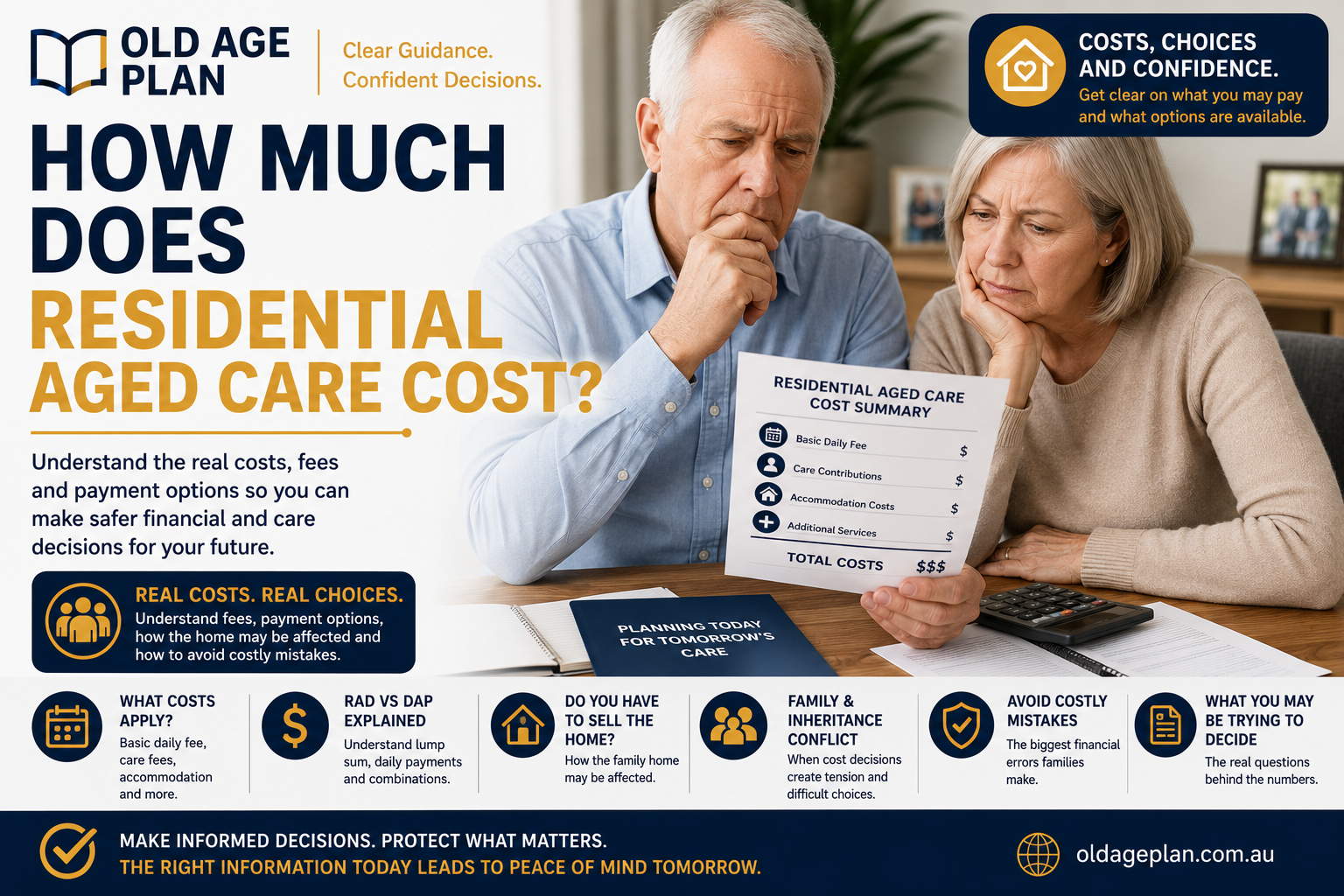

How Much Does Residential Aged Care Cost?
Residential aged care costs can feel frightening because families are often trying to make financial decisions at the same time as care decisions.
Someone may have had a fall. A hospital discharge may be approaching. Dementia may have progressed. Home care may no longer be enough. Suddenly the family is not only asking whether residential aged care is needed.
They are asking:
What will this cost, what happens to Mum or Dad’s money, and are we about to make a decision we do not properly understand?
Short Answer
Residential aged care costs can include a basic daily fee, care-related contributions, accommodation costs and optional additional services where agreed. The exact amount depends on the person’s financial situation, the aged care home, the accommodation price and government means assessment rules.
Families should treat online figures as a starting point only. Residential aged care costs can change, and major financial decisions should be checked against official My Aged Care information and qualified financial advice.
Key Takeaway
The biggest residential aged care cost mistake is assuming one number tells the whole story. Families need to understand the difference between daily living fees, care contributions, accommodation payments and optional services before making decisions about an aged care home.
What Costs Usually Apply In Residential Aged Care?
Residential aged care costs may include several different parts.
These can include:
- a basic daily fee
- care-related contributions or means-tested charges
- accommodation costs
- optional or additional service fees where agreed
Not everyone pays the same amount. Some costs are influenced by income and assets. Some depend on the aged care home and the room chosen. Some depend on extra services the person agrees to receive.
That is why families should be careful with simple answers such as “aged care costs this much.” The real answer depends on the person’s circumstances.
The Basic Daily Fee
The basic daily fee helps cover day-to-day living costs such as meals, cleaning, laundry and general living expenses.
This fee is usually linked to a percentage of the single Age Pension and can change over time. Families should check the current amount on My Aged Care before relying on any figure.
The important point is that the basic daily fee is separate from accommodation costs and other possible contributions.
Care Contributions And Means Assessment
Some people may need to pay additional care-related contributions depending on their income and assets.
My Aged Care explains that means-tested care fees can apply and that annual and lifetime caps may limit how much a person pays over time. For newer aged care rules, contribution structures may differ depending on when the person enters care and the current government rules.
Because these rules can change, families should not guess. A means assessment through Services Australia or the Department of Veterans’ Affairs may be needed to work out what the person may be asked to pay.
Old Age Plan note: Residential aged care costs are not only about what the aged care home charges. They are also about how the person’s income, assets and government assessment interact.
Accommodation Costs
Accommodation costs are one of the most confusing parts of residential aged care.
Depending on the person’s means assessment and the aged care home, accommodation may be paid in different ways.
You may see terms such as:
- RAD — Refundable Accommodation Deposit
- DAP — Daily Accommodation Payment
- RAC — Refundable Accommodation Contribution
- DAC — Daily Accommodation Contribution
A RAD is a lump sum accommodation payment. A DAP is a daily accommodation payment. Some people pay a combination of both.
My Aged Care explains that daily accommodation payments work like rent payments and are not refunded when the person leaves care.
RAD Vs DAP Explained
Families often get stuck on whether to pay a RAD, a DAP or a combination.
This is not a decision to rush.
A RAD may involve using savings or selling assets. A DAP may preserve capital but create ongoing daily costs. A combination may suit some families, but it still needs careful consideration.
This article does not provide a RAD versus DAP decision framework. That type of decision can involve pensions, cash flow, estate planning, tax, property and family priorities.
The safer approach is to understand the options, then seek appropriate financial advice before committing.
Do You Have To Sell The House?
Not always.
But the family home may become part of the financial conversation, depending on the person’s circumstances, means assessment, accommodation costs and how the family plans to pay.
This is where many families panic.
The question is rarely just:
Do we have to sell the house?
It is usually:
How do we fund care without making a rushed financial decision we regret later?
Because property, pension, estate and accommodation decisions can interact, families should seek qualified financial advice before making major decisions about selling, renting or retaining the home.
When Cost Decisions Become Family Conflict
Residential aged care cost decisions do not only create financial pressure.
They often expose family tension that has been sitting quietly for years.
This is where the conversation can become painful very quickly.
One sibling may focus on care.
Another may focus on protecting inheritance.
Someone may insist the house should never be sold.
Someone else may already be carrying most of the caregiving burden and feel unsupported.
The conflict is rarely just about money.
It is often about guilt, fairness, resentment and unspoken expectations.
Questions that sound financial may actually be emotional:
- Why should we sell the family home?
- Why should Mum spend her savings?
- Why am I doing all the caring while everyone else argues about assets?
- Are we protecting Mum, or protecting inheritance?
This is where families can become dangerous to their own decision-making.
Not because anyone intends harm.
Because emotion starts distorting priorities.
The real question can quietly shift from:
What is safest for Mum or Dad?
To:
What feels least painful for the family financially or emotionally?
Those are not always the same decision.
Old Age Plan warning: If inheritance concerns begin driving care decisions, families can unintentionally delay necessary care, resist realistic options or create conflict that harms both the older person and the people supporting them.
The Biggest Cost Mistake Families Make
The biggest mistake is treating residential aged care costs as a single bill.
Families often ask:
How much does aged care cost?
But that question is too simple for the decision they are actually facing.
The real cost picture may involve:
- what the resident pays each day
- what accommodation payment option is chosen
- whether income and assets change the contribution
- whether the family home is involved
- whether optional services are added
- whether cash flow can support the arrangement
- whether the decision affects other family or estate planning issues
The danger is not only paying too much.
The danger is making a fast decision while emotionally exhausted, then discovering later that the family did not understand what they had agreed to.
Old Age Plan warning: If the cost conversation starts only after a bed is available, the family may feel pressured to make financial decisions before they understand the consequences.
What You May Really Be Trying To Decide
If you are searching for residential aged care costs, you may not only be asking for a price.
You may be trying to decide:
- Can we afford residential aged care?
- Will Mum or Dad lose the house?
- Should we pay a lump sum or daily amount?
- Are we about to make a bad financial decision under pressure?
- What does the aged care home actually charge?
- What does the government pay?
- Should we get financial advice before choosing a home?
Those are not simple fee questions. They are high-stakes family decision questions.
Decision Support
The safest way to approach residential aged care costs is to separate the decision into parts.
Ask:
- What care is needed?
- What aged care homes are suitable?
- What fees apply at each home?
- What accommodation payment options are available?
- What will the person pay after means assessment?
- What financial advice is needed before committing?
Do not make cost decisions only from family assumptions, provider marketing or rushed conversations.
Residential aged care can involve major financial consequences. It is worth slowing down before signing, selling, transferring or committing to payment arrangements.
Old Age Plan Pathway
Different families need different support depending on where they are in the residential aged care pathway.
- Starting point: Use Free Tools if you are still trying to understand what has changed and what questions to ask.
- Assessment preparation: Use the My Aged Care Assessment Protection System if an assessment or reassessment is coming and support needs may be understated.
- System orientation: Use the Aged Care Starter Pack if you need to understand how residential care fits into the wider aged care pathway.
- Home care setup: Use the In Home Care Setup System if home support may still work but needs clearer organisation before residential care becomes urgent.
Frequently Asked Questions
How much does residential aged care cost?
Residential aged care costs vary depending on the aged care home, the person’s income and assets, accommodation arrangements and any optional services. Costs may include a basic daily fee, care contributions and accommodation costs.
What is a RAD?
A RAD is a Refundable Accommodation Deposit. It is a lump sum accommodation payment paid to an aged care home. Families should check the terms carefully before agreeing to a RAD.
What is a DAP?
A DAP is a Daily Accommodation Payment. It is a daily payment for accommodation. My Aged Care explains that daily accommodation payments work like rent and are not refunded when the person leaves care.
Can you pay a mix of RAD and DAP?
In many situations, accommodation can be paid as a lump sum, a daily amount or a combination. The available options and consequences should be checked carefully with the aged care home and a qualified adviser.
Do you have to sell the family home for aged care?
Not always. Whether the home is sold, retained or rented depends on personal circumstances, affordability, means assessment rules and family decisions. Financial advice is strongly recommended before making property decisions.
Does the government pay for residential aged care?
The Australian Government may subsidise care for eligible residents, but residents may still need to contribute to daily living, care and accommodation costs depending on their circumstances.
Are residential aged care fees capped?
Some care-related contributions may have caps, but accommodation and other costs can still be significant. Families should check current My Aged Care information because caps and thresholds can change.
Should families get financial advice before entering residential aged care?
Yes, especially where accommodation payments, the family home, pensions, cash flow or estate planning are involved. Residential aged care cost decisions can have long-term financial consequences.
Related Old Age Plan Guides
This guide sits inside the residential aged care and My Aged Care pathway. Related guides in this series include:
- Residential Aged Care Explained
- What Is My Aged Care And How Does It Work?
- What Is An ACAT Assessment?
- Home Care Packages Explained
- How To Apply For My Aged Care
Next Steps With Old Age Plan
If you are still deciding whether residential care is the right direction, start with the broader Residential Aged Care Explained guide.
If an assessment or reassessment is likely, the My Aged Care Assessment Protection System can help families avoid understating risks, dependency or caregiver load.
If you need to understand the wider aged care pathway before committing to major decisions, the Aged Care Starter Pack may be the best starting point.
Sources
- My Aged Care — Aged Care Home Costs And Fees
- My Aged Care — How Do Aged Care Costs Work?
- My Aged Care — Understanding Aged Care Home Accommodation Costs
- Department of Health, Disability and Ageing — Means Assessment For Residential Aged Care
- My Aged Care — Working Out Your Costs
Disclaimer
This article provides general information only. It is not legal, financial, medical or aged care advice.
Aged care laws, policies, fees, thresholds and procedures may change. Individual circumstances can vary significantly.
You should seek qualified financial, legal and aged care advice where appropriate and refer to official Australian Government resources, including My Aged Care, Services Australia and the Department of Health, Disability and Ageing, for current information about residential aged care costs, fees and assessment rules.