
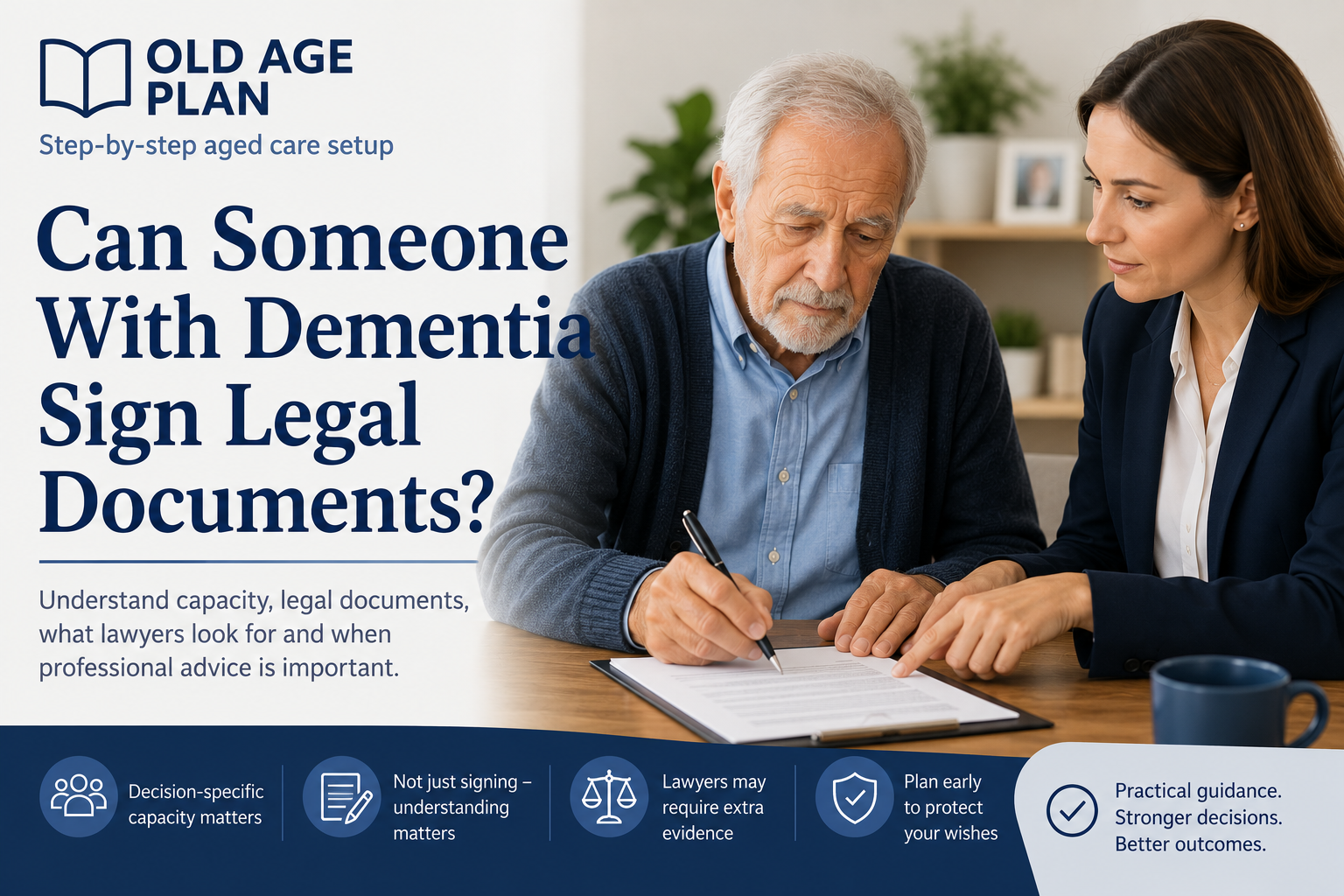

Can Someone With Dementia Sign Legal Documents?
Families often ask this question when important paperwork has not yet been completed.
Can someone with dementia sign legal documents?
The answer depends on whether the person still has capacity for the specific document they are signing.
A dementia diagnosis does not automatically stop someone from signing legal documents, but the decision must be reliable, informed and free from pressure.
Short Answer
Yes, someone with dementia may be able to sign legal documents if they still have the required capacity for that specific document.
The key issue is not whether they have dementia.
The key issue is whether they understand what they are signing, what it means, and what consequences may follow.
Someone may be able to sign one type of document but not another if the decisions involved are more complex.
Key Takeaway: Physical ability to sign is not the same as legal capacity. The real question is whether the person’s decision-making is reliable enough for the specific legal document.
Signing A Document Is Not The Same As Understanding It
A person may physically sign their name while not fully understanding the document.
This is where families can get caught.
The issue is not whether the pen reached the paper.
The issue is whether the person understood the decision behind the signature.
For legal documents, this may include understanding who is being given authority, what powers are being created, what property or rights may be affected, and what could happen later.
Capacity Depends On The Legal Document
Not all legal documents require the same level of understanding.
A simple form may be very different from a will, property transfer, Enduring Power of Attorney or guardianship document.
The more serious the consequences, the more carefully capacity may need to be considered.
This is why someone may be able to sign one document but not another.
Decision Reliability Matters
The deeper question is not simply whether the person can answer questions on the day.
The question is whether their decision-making is reliable enough for this document.
Can they explain what they are signing in their own words?
Do they understand the consequences?
Is their decision consistent over time?
Are they free from pressure?
A useful OAP question is:
Is this decision still reliable, or has it become uncertain, inconsistent or easily influenced?
Examples Of Legal Documents That May Raise Capacity Concerns
Capacity concerns may arise with documents such as:
- wills
- Enduring Power of Attorney documents
- Enduring Guardianship documents
- Advance Care Directives
- property sale or transfer documents
- loan documents
- banking authority forms
- aged care contracts
Each document may involve different legal requirements.
Professional advice is especially important where the document has major financial, legal or care consequences.
Can Someone With Dementia Sign An Enduring Power Of Attorney?
A person with dementia may be able to sign an Enduring Power of Attorney if they still understand what the document does.
They usually need to understand that they are giving another person authority to make certain decisions for them.
They should also understand when that authority may operate and what risks may follow if the wrong person is appointed.
If the person cannot understand those matters, signing may not be valid.
Can Someone With Dementia Sign A Will?
A person with dementia may still be able to make or update a will if they have testamentary capacity.
This generally means they understand they are making a will, broadly understand what they own, recognise who may have a claim on their estate, and understand the effect of their decisions.
If there are concerns, a lawyer may ask for medical evidence before proceeding.
This can help reduce the risk of the will being challenged later.
Can Someone With Dementia Sign Care Or Aged Care Documents?
Some care documents may be administrative.
Others may involve important financial obligations, service agreements or accommodation decisions.
The person’s capacity should be considered in relation to the actual document and its consequences.
If the document is complex or high-risk, it may be better to seek advice before signing.
What If Capacity Is Unclear?
If capacity is uncertain, do not treat the signature as a simple paperwork step.
Unclear capacity can create problems later.
A document may be challenged, rejected or questioned if there is doubt about whether the person understood what they signed.
A GP, specialist, lawyer or other appropriate professional may need to assess or document capacity.
When A Lawyer May Refuse To Proceed
A lawyer may refuse to prepare or witness a document if they are not satisfied the person has capacity.
This does not always mean the person definitely lacks capacity.
It may mean the lawyer needs more evidence before proceeding.
That evidence may include a medical opinion, specialist assessment or further discussion with the person alone.
Pressure And Influence Matter
Capacity is not only about memory.
Pressure, coercion or influence can also affect whether a legal decision is safe and reliable.
This is especially important if someone with dementia is being encouraged to change a will, appoint one family member, transfer property or sign documents quickly.
A decision should reflect the person’s own understanding and wishes, not pressure from someone else.
What You May Really Be Trying To Decide
If you are asking whether someone with dementia can sign legal documents, you may not only be asking about paperwork.
You may be trying to work out whether there is still time to complete important planning before options narrow.
You may be wondering whether:
- an Enduring Power of Attorney can still be arranged
- a will can still be updated
- a lawyer will accept the person’s instructions
- a document could be challenged later
- family disagreement could create problems
The practical question is this:
Is the person’s decision reliable enough for this document to be valid and respected later?
How Families Can Approach This Carefully
Families should avoid two opposite mistakes.
The first mistake is assuming dementia means the person can no longer sign anything.
That may remove independence too early.
The second mistake is rushing documents through when decision-making has already become unreliable.
That may create legal risk later.
A careful approach is to identify the document, consider the complexity, check whether the person understands the consequences, and seek professional advice where there is doubt.
Related Old Age Plan Articles
- Can Someone With Dementia Make Legal Decisions?
- When Does Someone With Dementia Lose Capacity?
- Who Decides If Someone Has Lost Capacity?
- Can Capacity Be Partial?
- What Is An Enduring Power Of Attorney?
- What Is Enduring Guardianship?
- What Is A Will?
Sources
- NSW Government — Capacity Toolkit
- Dementia Australia — Planning Ahead
- Legal Aid NSW — Making A Will
- My Aged Care — Appointed Decision-Makers
- OPAN — Supported Decision-Making
Disclaimer
This article provides general information only. It is not legal, medical or financial advice.
Dementia symptoms, medication guidance, medical advice, aged care services and government policies may change over time and individual circumstances can vary.
Always seek advice from qualified healthcare professionals and refer to official Australian Government, My Aged Care and Dementia Australia resources for current information.
Summary
Someone with dementia may be able to sign legal documents if they still have capacity for the specific document.
The key issue is not the diagnosis alone.
The key issue is whether the person understands what they are signing and whether their decision-making is reliable enough for that decision.
If capacity is unclear, professional legal or medical advice should be sought before important documents are signed.