
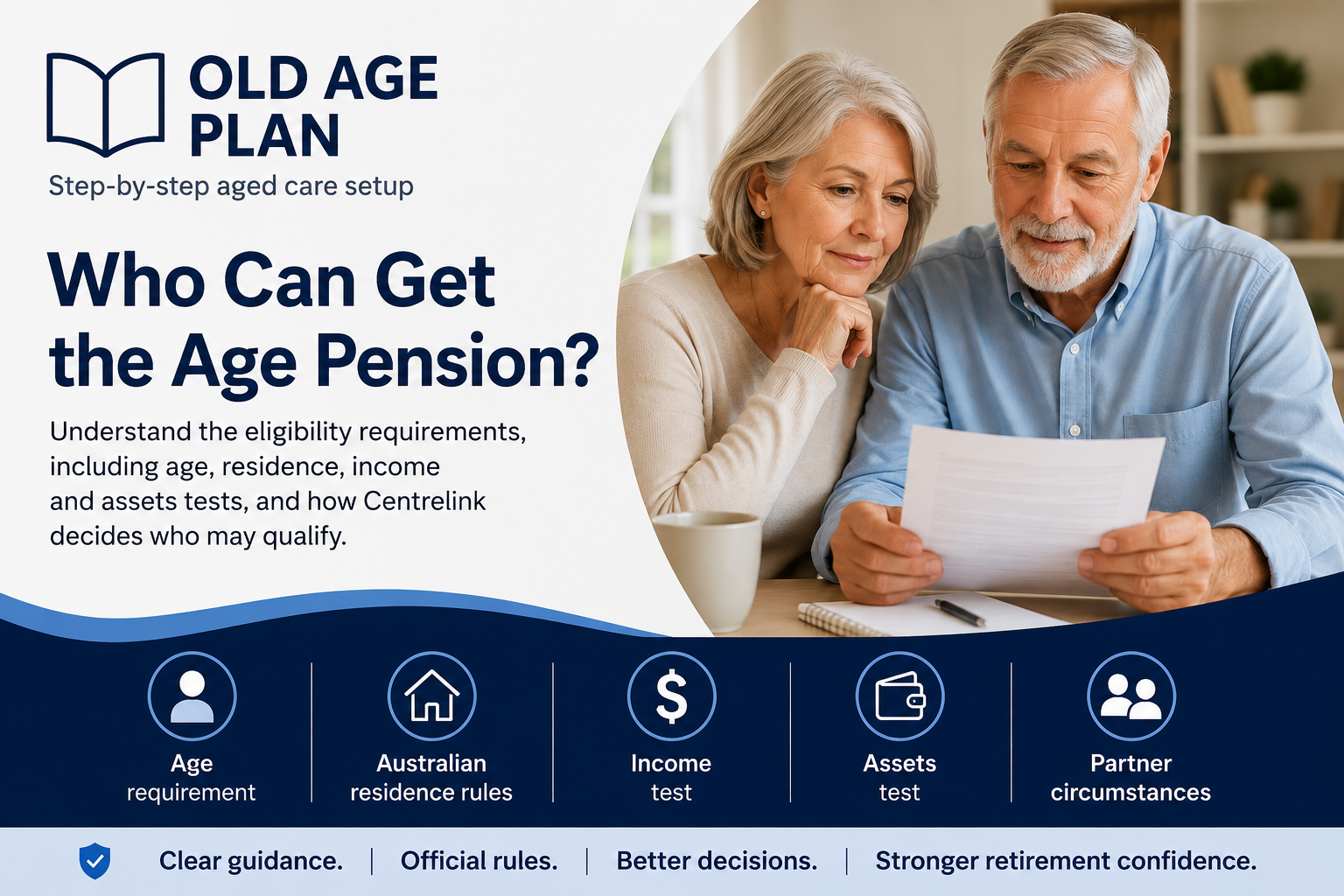

Who Can Get the Age Pension?
Reaching retirement age does not automatically mean you will receive the Age Pension.
Age Pension eligibility is assessed using several separate rules. Your age matters, but Centrelink may also consider your Australian residence history, income, assets, relationship circumstances and whether another government payment affects your entitlement.
The practical question is therefore not simply, “Am I old enough?” It is:
“Do I meet all of the eligibility conditions that apply to my circumstances?”
Who can qualify for the Age Pension?
You may be able to get the Age Pension if you are at least 67 years old, meet the Australian residence rules and remain within the applicable income and assets test limits.
Meeting the age requirement alone does not guarantee payment. Centrelink assesses the complete eligibility picture before deciding whether you qualify and how much you may receive.
Key Takeaway
The Age Pension is not limited to people who have no income, no savings or no assets.
Some people qualify for a full pension, some qualify for a part pension and others do not qualify because one or more eligibility rules are not met.
The safest starting point is to check each eligibility gate separately rather than assuming that one part of your situation determines the entire outcome.
1. Age
You generally need to be at least 67 years old before you can receive the Age Pension.
2. Residence
You need to meet Australian residence rules. Your citizenship, residence history and time spent living or working overseas may affect the assessment.
3. Income
Your assessable income, and your partner’s income where relevant, can affect whether you qualify and the rate you receive.
4. Assets
Your assessable assets, homeownership status and relationship circumstances can affect whether you receive a full pension, part pension or no pension.
You Must Be Age Pension Age
The current Age Pension age is 67 for both men and women.
Historically, the qualifying Age Pension age differed between men and women. Those differences were progressively removed during the transition to a uniform qualifying age of 67.
This is different from your superannuation preservation age. You may be able to access superannuation before 67 if you meet the relevant superannuation conditions, but that does not make you eligible for the Age Pension earlier.
You can usually begin preparing before you turn 67. A claim may generally be submitted up to 13 weeks before you reach Age Pension age, although payment cannot begin until you become eligible.
For a broader explanation of the payment itself, start with What Is the Age Pension?.
You Must Meet the Residence Rules
Age Pension eligibility normally requires more than simply living in Australia when you apply.
In many cases, a person must have been an Australian resident for at least 10 years in total, including a continuous period of at least five years.
However, the residence rules contain exceptions and alternative pathways. Your position may be different if you:
- are a refugee or former refugee
- have lived or worked in a country with an international social security agreement
- have periods of residence in more than one country
- are claiming after the death of a partner in circumstances covered by special rules
- are living outside Australia when you claim
This means a person should not assume they are automatically excluded merely because they have lived overseas or have been an Australian resident for less than 10 years.
Residence questions can become highly individual. Centrelink may need to examine when you became an Australian resident, how long you remained a resident and whether an international agreement applies.
Your Income Must Be Within the Applicable Limits
The Age Pension income test helps determine both:
- whether you can receive the Age Pension
- how much Age Pension you may receive
You do not necessarily need to stop working or have no other income to qualify.
Depending on the amount and type of income you receive, you may still qualify for a full or part pension. Centrelink can assess income from sources such as employment, financial investments, superannuation income streams, businesses, trusts and property.
If you are a member of a couple, Centrelink will generally consider the income of both partners, even where only one partner is old enough to claim the Age Pension.
The important distinction is that having income does not automatically make you ineligible. The effect depends on what income is assessable, how the rules apply to that income and whether your assessed amount remains below the relevant cut-off.
Your Assets Must Be Within the Applicable Limits
The assets test also affects whether you qualify and how much you may receive.
Centrelink may assess assets you own in Australia and overseas, including assets held individually, jointly or through certain financial or legal structures.
Assessable assets may include:
- bank accounts and term deposits
- shares and managed investments
- investment properties and other real estate
- vehicles, caravans and boats
- business interests
- some superannuation interests
- money owed to you
- valuable personal assets and household contents
Your principal home is generally treated differently from many other assets, but being a homeowner still affects which assets-test thresholds apply.
Your relationship status also matters. Different thresholds may apply depending on whether you are single, partnered or separated from your partner because of illness.
Owning a home, having superannuation or holding savings does not automatically prevent you from receiving the Age Pension. The outcome depends on your total assessable position and the rules applying at the time of assessment.
Centrelink Uses Both the Income and Assets Tests
The income and assets tests are not alternatives where you can simply choose the more favourable one.
Centrelink assesses your position under both tests. The test producing the lower payment rate generally determines how much you receive.
For example:
- your income may be low enough for a pension, but your assets may reduce or eliminate the payment
- your assets may be below the applicable limit, but your income may reduce or eliminate the payment
- you may satisfy both tests but receive a reduced part pension
- you may remain within both full-rate thresholds and receive the maximum rate available for your circumstances
This is why checking only your bank balance, employment income or homeownership status can produce the wrong conclusion.
Your Partner’s Circumstances May Affect Your Claim
Age Pension assessments often consider the financial position of a couple rather than examining each partner in isolation.
If you have a partner, Centrelink may require information about both partners’ income and assets even when:
- only one person is applying
- only one person has reached Age Pension age
- assets are held mainly in one partner’s name
- one partner is still working
- the couple keeps some finances separately
This does not necessarily mean both partners receive the same payment. It means the couple’s combined financial circumstances may affect the eligible partner’s assessment.
Some People Have Different Eligibility Rules
Standard eligibility rules do not apply identically in every case.
For example, a person who is legally blind and is not claiming Rent Assistance may be able to receive the Age Pension without being assessed under the ordinary income and assets tests. Supporting medical evidence is required.
Your eligibility may also be affected if you or your partner receive certain payments from the Department of Veterans’ Affairs.
People with overseas residence, international pensions, compensation payments, trusts, companies or complex financial arrangements may also require a more detailed assessment.
Who May Not Qualify?
You may not qualify for the Age Pension if:
- you have not reached Age Pension age
- you do not meet the applicable residence rules or an available exception
- your assessable income is above the relevant cut-off
- your assessable assets are above the relevant cut-off
- another government payment prevents you from receiving the Age Pension
- Centrelink cannot establish your eligibility from the information and evidence provided
Not qualifying today does not always mean you will never qualify.
Your eligibility may change if:
- you reach Age Pension age
- your employment income changes
- your assets change
- you sell or acquire property
- your relationship circumstances change
- your residence position changes
- the government adjusts pension thresholds
A previous rejection also does not permanently prevent another claim if your circumstances later change.
Which question should you answer next?
Broad eligibility is only the starting point. The next useful article depends on what you are trying to work out.
Do I meet all the rules?
Continue to Age Pension Eligibility Explained for a closer look at how the eligibility conditions work together.
How do I make a claim?
Read How Do You Apply for the Age Pension? to understand the application pathway and what happens next.
How much could I receive?
Read How Much Is the Age Pension? to understand full rates, part rates and why payment amounts differ.
Where does Centrelink fit?
Return to How Can Centrelink Help Me? for a broader orientation to Centrelink payments and support pathways.
What You May Really Be Trying to Decide
For many people, the real question is not simply whether they satisfy a list of government rules.
They are trying to decide whether it is worth applying.
You may be wondering:
- Do we have too much money to qualify?
- Does my partner’s income rule me out?
- Will owning our home prevent a pension?
- Does living overseas in the past make me ineligible?
- Should I apply even if I expect only a small part pension?
- What happens if I get the figures wrong?
The danger is making a final decision from one isolated fact.
A person may assume they cannot qualify because they still work, own a home or have superannuation. Another person may assume they will automatically qualify because they are 67 and retired.
Both assumptions can be wrong.
Eligibility depends on the combined assessment, not a single feature of your circumstances.
Decision Support: Is It Worth Checking Your Eligibility?
It is generally worth examining your eligibility if you have reached, or are approaching, Age Pension age and are uncertain about how the tests apply.
A useful first-pass check is to ask:
- Am I at least 67, or will I turn 67 within the next 13 weeks?
- What is my Australian residence history?
- What income do my partner and I receive?
- What assets do we own or have an interest in?
- Are any overseas, business, trust or DVA circumstances involved?
This does not calculate your entitlement. It identifies where your uncertainty sits.
If your situation is straightforward, you may be able to move directly to preparing a claim. If your residence, relationship or financial circumstances are complex, clarification before claiming may reduce delays, missing evidence and avoidable confusion.
Age Pension Eligibility FAQs
Does everyone get the Age Pension when they turn 67?
No. Turning 67 satisfies the age requirement, but you must also meet the residence rules and the applicable income and assets tests.
Can I get the Age Pension if I still work?
Possibly. Employment does not automatically prevent eligibility. Your employment income is assessed under the income test and may reduce the amount you receive.
Can I get the Age Pension if I own my home?
Possibly. Your principal home is generally treated differently from other assets. However, your homeownership status affects which assets-test thresholds apply.
Can I get the Age Pension if my partner is still working?
Possibly. Centrelink generally considers both partners’ income and assets when assessing a member of a couple. Your partner’s earnings may affect your rate or eligibility.
Can I get a part Age Pension?
Yes. A person whose income or assets are above the full-pension thresholds may still qualify for a reduced part pension if they remain below the relevant cut-off limits.
Can I qualify if I have lived overseas?
Possibly. Your residence history and whether Australia has a social security agreement with another country may affect your eligibility. Overseas residence does not automatically rule you out.
Can I apply before I turn 67?
You can generally submit an Age Pension claim up to 13 weeks before reaching Age Pension age. Payment cannot begin until you meet the eligibility conditions.
What if Centrelink rejected an earlier claim?
You may claim again if your circumstances change. A previous rejection does not create a permanent ban on future Age Pension eligibility.
Sources
Disclaimer
This article provides general information only and does not constitute financial, legal or personal advice.
Age Pension eligibility rules, payment thresholds and government policies may change. Individual outcomes depend on personal residence, income, assets, relationship and other circumstances. Use official Australian Government information for current rules and seek qualified professional advice where appropriate.
Summary
You may be able to get the Age Pension if you are at least 67, meet the Australian residence rules and remain within the applicable income and assets limits.
Age alone does not guarantee eligibility, and having income, savings, superannuation or a home does not automatically rule you out.
The most useful next step is to identify which eligibility gate remains uncertain and examine that part of your circumstances before deciding whether to claim.