
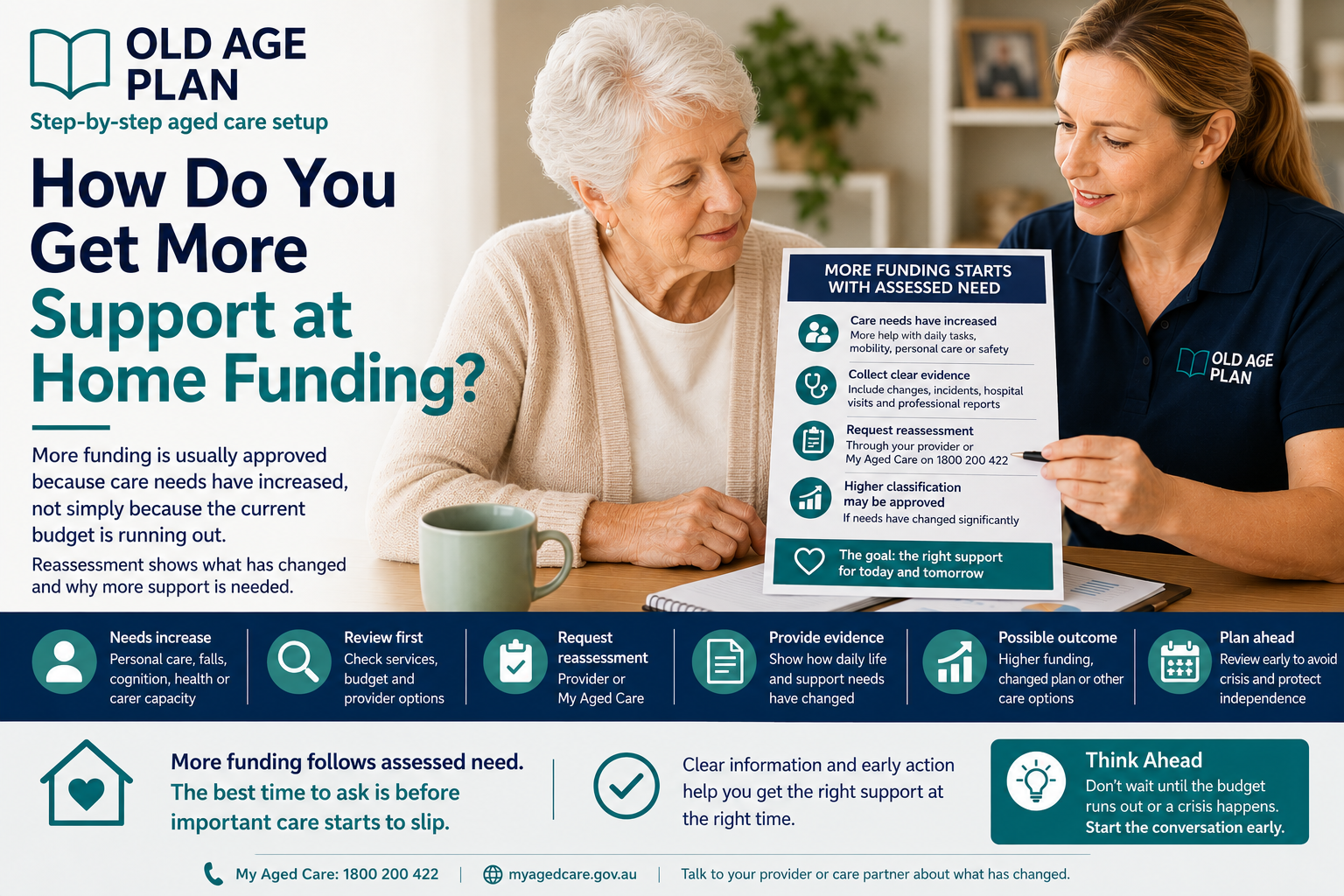

To receive more Support at Home funding, the older person generally needs a reassessment showing that their care needs have increased beyond what their current funding classification can reasonably support.
Your provider cannot simply increase the government-funded budget. It can review the existing services, reorganise available funding and help request reassessment, but a higher classification must be approved through the My Aged Care assessment process.
The strongest reason for requesting more funding is not that the existing budget is nearly empty. It is that the person’s assessed needs, risks or dependence have materially increased.
How Can You Get More Support at Home Funding?
Start by asking your provider or care partner to review the person’s care plan, current services and individualised budget.
If changed services cannot meet the person’s needs within their existing approval and budget, request a reassessment through My Aged Care. The reassessment may result in approval for a higher ongoing Support at Home classification.
You can ask your provider to help arrange reassessment or contact My Aged Care directly on 1800 200 422.
Key Takeaway
More funding is approved because assessed care needs have increased—not simply because the current budget has been spent.
The reassessment needs to show what has changed, how daily life is now affected and why the current classification can no longer provide enough appropriate support.
Who Decides How Much Support at Home Funding You Receive?
The Support at Home provider does not decide the participant’s government-funded classification.
Funding approval comes through the My Aged Care assessment process. The assessment outcome may include one of eight ongoing Support at Home classifications, with higher classifications providing larger quarterly and annual budgets.
The provider is responsible for working within the approved classification by:
- developing the care plan
- preparing the individualised budget
- coordinating approved services
- monitoring changing needs and risks
- reviewing whether the arrangement remains suitable
- helping initiate reassessment when necessary
The provider can recommend that the person’s needs be reviewed. It cannot guarantee that additional government funding will be approved.
How Do You Know When The Current Funding Is No Longer Enough?
A budget shortage can occur for different reasons. Before requesting a higher classification, identify what is actually creating the gap.
Needs Have Increased
The person now requires more care, more frequent support or services not previously needed.
Provider Prices Are High
The current funding may purchase fewer service hours because of the provider’s prices.
The Service Mix Is Poorly Prioritised
Funding may be directed towards lower-priority services while essential needs remain unmet.
Services Are Being Delivered Inefficiently
Scheduling, travel, cancellations or unsuitable arrangements may reduce the practical value of the budget.
Family Support Has Reduced
Formal services may now need to replace substantial unpaid care previously provided by relatives or friends.
The Classification Is Too Low
The person’s current level of government funding may no longer reflect their assessed care needs.
A higher classification may be appropriate when needs have materially increased. It is not necessarily the first solution when the main problem is provider pricing, poor service design or unreliable delivery.
What Signs Suggest More Funding May Be Needed?
Essential Services Are Being Reduced
Personal care, nursing, transport or meal support cannot be maintained within the available budget.
Family Is Filling Major Gaps
The arrangement appears adequate only because relatives are performing substantial unpaid care every day.
Personal Care Needs Have Increased
The person now needs more help showering, dressing, toileting, eating or transferring.
Falls Or Mobility Problems Are Increasing
More supervision, allied health, equipment or hands-on assistance may be required.
Cognition Has Declined
Memory loss, confusion or unsafe decisions may require more frequent support and monitoring.
Repeated Hospital Admissions Occur
Health deterioration may have changed the level and type of support required at home.
Should You Review The Current Budget First?
Yes. Before seeking more funding, ask the care partner to review how the existing budget is being used.
The review should consider:
- which services are essential
- which services are producing useful outcomes
- whether some services can be reduced or replaced
- whether provider prices are limiting service hours
- whether participant contributions are affecting affordability
- whether available carryover funding can help temporarily
- whether services are being missed or cancelled
- whether another provider could deliver better value
This does not mean the participant must remove useful services before requesting reassessment.
It means the provider and assessor should be able to distinguish between a budget-management problem and a genuine increase in care need.
Can The Provider Increase Services Without More Funding?
The provider may be able to adjust the arrangement within the existing approval and available quarterly budget.
Possible changes include:
- changing service times
- increasing one approved service while reducing another
- redirecting funding towards a higher-priority need
- changing workers or subcontractors
- adding an approved clinical service
- reviewing equipment or home-modification needs
This may be enough when the change is limited or temporary.
It is unlikely to solve the problem when every additional essential service requires removing another essential service.
If the budget only works because important care is repeatedly sacrificed, the current classification may no longer be adequate.
What Is The Difference Between A Support Plan Review And Reassessment?
Support Plan Review
Checks whether the existing support plan still reflects the person’s needs, goals and circumstances.
The assessor may update the plan or decide that a more complete reassessment is required.
Reassessment
Reconsiders the person’s eligibility, care needs and appropriate level of funded support.
It may result in a different approval or a higher ongoing Support at Home classification.
A Support Plan Review may be enough when the person needs a different approved service or their plan no longer describes their circumstances accurately.
A reassessment is more likely when needs have changed significantly or the existing funding classification is no longer sufficient.
How Do You Request A Reassessment?
You can begin through either the provider or My Aged Care.
Ask The Provider
Tell the care partner that the current arrangement cannot safely or reasonably meet the person’s changed needs.
The provider can review the care plan and contact the assessment organisation.
Contact My Aged Care
Call 1800 200 422 and explain that the person’s needs have changed and reassessment may be required.
The participant, registered supporter or appropriate representative may make contact.
When making the request, explain the practical changes rather than focusing only on the remaining budget balance.
For example:
“Mum now needs hands-on help with showering every day, has fallen twice this month and can no longer prepare meals safely. Her current funding only covers three personal-care visits each week.”
This identifies the changed functions, risks and service gap more clearly than saying only that more funding is needed.
What Evidence Can Help Demonstrate Increased Need?
The reassessment is not a legal case that families must prove through a large bundle of documents.
However, clear and consistent information can help the assessor understand what has changed.
Care Records
Notes about increased assistance, missed tasks, supervision needs and changes in daily function.
Incident Records
Dates and details of falls, medication errors, wandering, injuries or safety concerns.
Hospital Information
Discharge summaries, changed medication, new diagnoses and instructions for care at home.
Professional Reports
Relevant recommendations from a GP, nurse, physiotherapist, occupational therapist or other professional.
Family-Care Information
The actual assistance relatives provide, how often it occurs and whether it can continue.
Provider Information
Care-plan reviews, service records and evidence that current funding cannot cover essential approved support.
The purpose is to reveal the person’s real level of dependence rather than create a perfect presentation.
Why Is Describing Daily Function So Important?
A diagnosis alone does not show how much aged care support someone needs.
Two people with the same condition may have very different functional abilities and support requirements.
Describe what the person can and cannot reliably do in areas such as:
- showering and dressing
- toileting
- getting in and out of bed
- walking and transferring
- preparing and eating meals
- taking medication
- using transport
- managing household tasks
- remembering appointments and routines
- remaining safely alone
Also explain whether the task can be completed consistently, safely and without another person stepping in.
Should You Include Help Provided By Family?
Yes. Informal care is part of the person’s real support environment.
Explain:
- which tasks family members perform
- how often they provide help
- whether they provide overnight or emergency support
- whether they are physically capable of continuing
- whether work, health or family responsibilities limit their availability
- what would happen if that support stopped
Families sometimes understate their workload because the tasks have gradually become routine.
The arrangement may appear more sustainable than it really is when unpaid support remains invisible.
What If Dementia Has Progressed?
Dementia progression may increase support needs even when the person remains physically mobile.
Relevant changes may include:
- unsafe medication decisions
- missed meals
- wandering or becoming lost
- unsafe use of appliances
- difficulty recognising workers
- repetitive distress or agitation
- sleep disruption
- increasing personal-care dependence
- greater need for prompting or supervision
Do not describe the person only as having “worse dementia”.
Explain how decision reliability, safety and daily function have changed for the specific activities that now require support.
What If Mobility Has Declined?
Mobility decline may affect several parts of the care arrangement at once.
The person may need:
- more personal-care time
- transfer assistance
- physiotherapy
- occupational therapy
- mobility equipment
- home modifications
- additional transport support
- falls-prevention measures
Record falls and near falls, not only serious injuries.
A pattern of instability may demonstrate that the existing arrangement is becoming unreliable before a major incident occurs.
What If Personal Care Needs Have Increased?
Explain whether the person now needs more assistance with:
- showering
- dressing
- grooming
- toileting
- continence support
- eating and drinking
- getting in and out of bed
- moving around the home
Also identify whether visits need to occur more frequently or at particular times of day.
Needing one longer visit each week is different from needing reliable hands-on assistance every morning and evening.
What If Medication Has Become More Complex?
Medication changes can increase the need for nursing, prompting, monitoring or coordination.
Tell the provider and assessor about:
- new medicines
- changed dosing schedules
- missed or duplicate doses
- difficulty opening packaging
- confusion about instructions
- side effects
- the amount of family supervision required
Sudden confusion or a significant medication reaction may require urgent clinical review rather than waiting for reassessment.
What If The Main Change Is Carer Burnout?
A reassessment may still be appropriate when the older person’s condition appears relatively stable but the informal care arrangement is no longer sustainable.
Examples include:
- a spouse becoming unwell
- an adult child returning to work
- the carer losing sleep
- unsafe lifting or transfers
- the person being unable to remain alone
- the carer moving away
- stress reaching a level that threatens the relationship or care arrangement
The care arrangement has changed when the family’s capacity changes—even if the diagnosis has not.
Funding decisions should reflect the support that is realistically available, not care that relatives are assumed to provide indefinitely.
What Happens During Reassessment?
The assessor reviews the person’s current circumstances, goals, abilities, risks and support environment.
The discussion may cover:
- personal care
- mobility and falls
- health conditions
- medication
- cognition and decision-making
- nutrition
- household tasks
- social support
- family and informal care
- current aged care services
- what has changed since the previous assessment
The assessor may also consider information from providers, supporters and relevant health professionals.
The participant should describe ordinary difficult days, not only what they can manage under ideal conditions.
What Can Happen After Reassessment?
Higher Classification Approved
The participant may receive approval for a higher ongoing Support at Home classification and increased quarterly funding.
Existing Classification Continues
The assessor may decide that the current classification remains appropriate.
Different Services Or Pathways Approved
The person may receive changed service approvals or eligibility for another appropriate Support at Home pathway.
Other Care Options Discussed
If care at home can no longer meet the person’s needs safely, other aged care options may be considered.
The outcome should be provided in a Notice of Decision with an updated support plan where applicable.
Does Higher Approval Mean Funding Starts Immediately?
Not always.
The assessment decision and the availability of the full approved funding may occur at different times.
The participant may receive a priority rating and may need to wait for the higher ongoing allocation to become available.
Ask:
- what classification has been approved
- what priority rating applies
- whether interim funding will be provided
- when the increased allocation is expected to begin
- how current essential services will be managed while waiting
Do not organise services against funding that has been approved but has not yet become available without confirming who will pay for them.
Can You Receive Interim Funding?
Some participants may receive interim funding while waiting for their full ongoing classification allocation.
Interim funding is generally a portion of the approved classification and is intended to help provide priority services during the waiting period.
The provider and participant should develop a realistic temporary plan around the funding that is actually available.
Interim funding may not be enough to deliver the complete service arrangement expected under the full classification.
Can Short-Term Pathways Provide Additional Support?
Support at Home also includes separate short-term pathways for particular needs.
Assistive Technology And Home Modifications
Separate approved funding may help provide equipment or home changes connected to safety and independence.
Restorative Care Pathway
Short-term coordinated support may help improve or maintain function after illness, injury or decline.
End-of-Life Pathway
Eligible people approaching the end of life may receive additional short-term support to remain at home.
These pathways have specific eligibility and approval requirements. They are not automatic extensions of the ordinary quarterly budget.
Can You Pay Privately For Extra Services?
Yes. A participant may enter into a private agreement with the provider to purchase services beyond the available government-funded budget.
Privately purchased services:
- are paid for by the participant
- sit outside the government-funded budget
- should be clearly identified in writing
- should not be confused with participant contributions
- do not guarantee that a higher classification will later be approved
Private services may provide a temporary bridge, but they may not be financially sustainable over a long waiting period.
What If More Funding Is Not Approved?
Read the Notice of Decision carefully and ask why the existing classification was considered appropriate.
Possible next steps include:
- Ask the assessor or My Aged Care to explain the outcome.
- Check whether important information was missing or misunderstood.
- Review whether current services can be reorganised.
- Ask whether another service or short-term pathway is available.
- Consider privately purchased support where affordable.
- Use the review or appeal pathway described in the decision letter.
The participant has the right to raise concerns about their assessment outcome, including the classification or priority level.
Can You Appeal The Funding Decision?
The Notice of Decision should explain how concerns about the assessment outcome can be reviewed or appealed.
Before challenging the decision, identify the issue clearly:
- Was the level of dependence understated?
- Was recent deterioration not considered?
- Was family support assumed to be greater than it is?
- Was relevant clinical information missing?
- Does the approved classification fail to cover essential care needs?
- Is the real problem waiting time rather than the classification itself?
A disagreement is easier to address when the specific assessment or decision problem is clear.
Common Mistakes To Avoid
Waiting Until The Budget Is Empty
Begin review when needs increase, not only when services are about to stop.
Asking Only For More Money
Explain the changed needs, risks and daily support gap that justify reassessment.
Understating Family Care
Describe the unpaid support currently preventing the arrangement from failing.
Using Diagnoses Without Functional Detail
Explain what the person can no longer do reliably and safely.
Assuming The Provider Controls Approval
The provider can support the request but cannot grant a higher government-funded classification.
Ignoring Provider Performance
More funding may not solve poor pricing, missed visits or weak service coordination.
What You May Really Be Trying To Decide
The visible question is:
“How do we get more Support at Home funding?”
The deeper question is usually:
“Can we clearly show that the person now needs more care than their current classification was designed to provide?”
A depleted budget does not automatically prove increased care need.
But when essential services cannot be maintained, risks are increasing and family members are carrying growing unrecognised care, the present classification may no longer match reality.
Decision Support
Before deciding the next step, separate four questions.
Have Needs Increased?
Identify changes in function, safety, cognition, health and dependence.
Is The Existing Budget Being Used Well?
Check service priorities, prices, delivery and provider performance.
Can The Current Plan Adapt?
Determine whether approved services can be reorganised without creating another serious care gap.
Is Reassessment Now Justified?
Request reassessment when the person’s changed needs have moved beyond the existing approval or classification.
Families often wait because they fear appearing demanding or worry that the change is not serious enough.
Requesting reassessment does not guarantee more funding. It allows the current care needs to be considered while options may still be available.
The strongest time to begin is usually before essential services are removed, family support collapses or the person reaches crisis.
Summary
More Support at Home funding generally requires reassessment and approval for a higher ongoing classification.
The provider may review and reorganise existing services, but it cannot independently increase the government-funded classification.
A reassessment request should focus on changed care needs, daily function, safety risks, family-care capacity and why essential support can no longer be maintained within the current arrangement.
Clear information from the participant, family, provider and relevant health professionals can help the assessor understand how circumstances have changed.
A higher classification may be approved, the current classification may continue or different services and pathways may be recommended.
The central question is not simply whether the budget is running out. It is whether the person’s present care needs have moved beyond what their existing classification can reliably support.
More Support at Home Funding FAQs
Can a Support at Home provider increase your funding?
No. The provider can review services and help request reassessment, but a higher government-funded classification must be approved through the My Aged Care assessment process.
Do you need another assessment to get more funding?
Generally, a reassessment is required when changed needs mean the person may need a higher ongoing Support at Home classification.
Can you request reassessment yourself?
Yes. You can contact My Aged Care on 1800 200 422. Your provider can also help initiate the process.
What evidence helps when requesting more funding?
Useful information may include changed daily function, falls, hospital records, professional recommendations, provider records and details of unpaid family care.
Does running out of funding guarantee a higher classification?
No. A higher classification depends on assessed care needs. Budget problems may also result from provider prices, service priorities or inefficient delivery.
Can you buy extra services while waiting?
Yes. You may enter into a private agreement with the provider, but privately purchased services are paid for by the participant and sit outside the government-funded budget.
Will higher funding begin immediately after approval?
Not necessarily. A person may need to wait for the full allocation and may receive interim funding depending on their priority and circumstances.
Can you challenge a Support at Home classification decision?
Yes. The Notice of Decision should explain how to raise concerns or seek review of the assessment outcome, classification or priority level.
Sources
-
My Aged Care — Managing Your Support at Home Budget
-
My Aged Care — When To Get A Support Plan Review Or Reassessment
-
My Aged Care — How To Change Your Current Services
-
My Aged Care — Assessment Outcome: Support at Home
-
Australian Government Department of Health, Disability and Ageing — Funding Classifications for Support at Home
-
Australian Government Department of Health, Disability and Ageing — How the Support at Home Program Works
Disclaimer
This article provides general information only and is not legal, medical, financial or aged care advice.
Support at Home classifications, funding amounts, reassessment processes, priority arrangements, waiting periods and government policies may change. Individual assessment outcomes also vary according to care needs, circumstances and available information.
For current information, speak with the participant’s provider or My Aged Care and refer to the Australian Government Department of Health, Disability and Ageing. Seek urgent medical assistance where immediate health or safety concerns exist.