
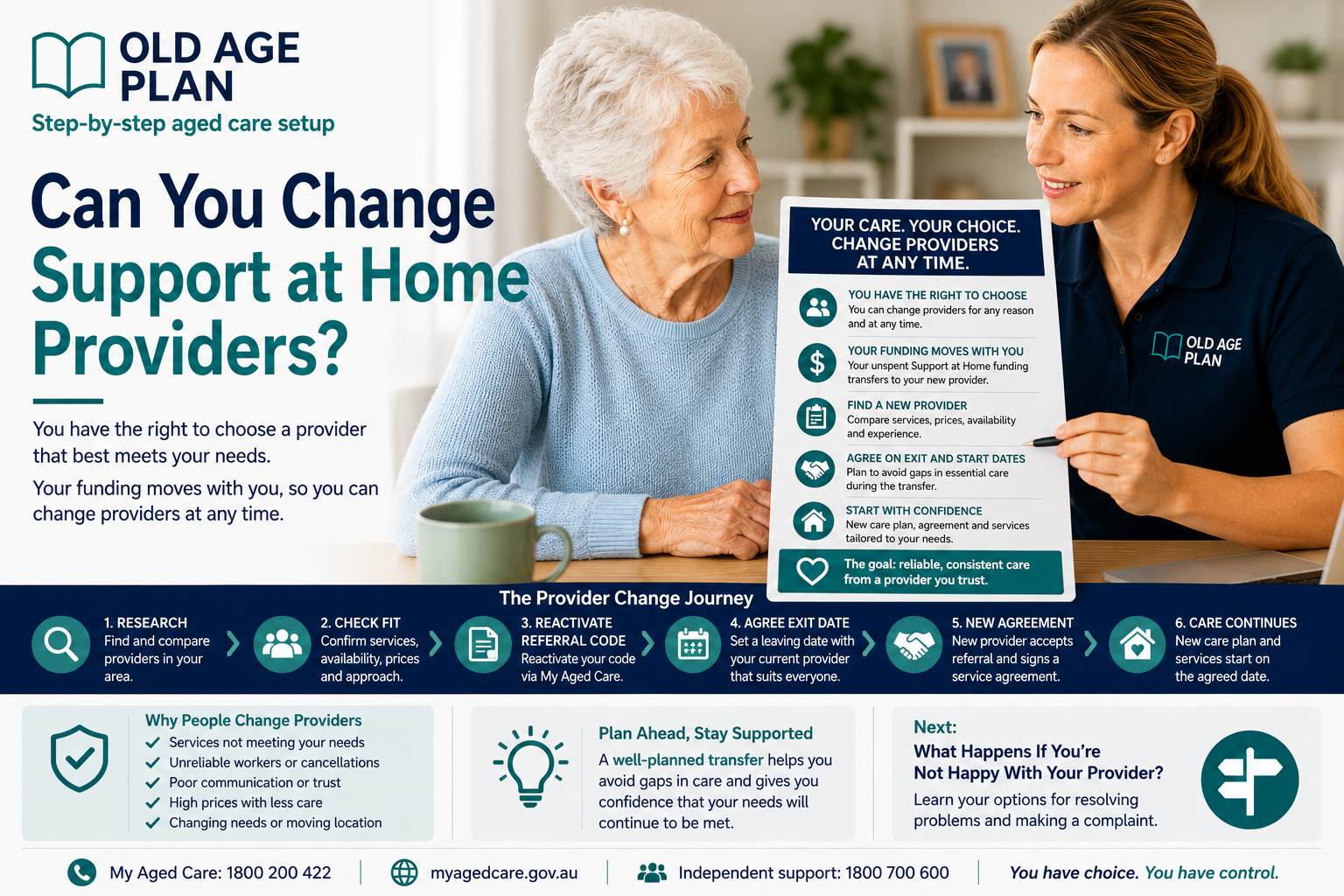

Can You Change Support at Home Providers?
Yes. You can change your Support at Home provider at any time and for any reason.
You may decide to change because the provider cannot deliver the services you need, workers are unreliable, prices no longer suit your budget, communication has broken down or you are moving to an area the provider does not service.
Your Support at Home approval and government funding belong to you rather than the provider. Your funding, including eligible unspent ongoing-service funds, moves with you when the transfer is completed correctly.
How Do You Change Support at Home Providers?
Find a suitable new provider before agreeing on an exit date with your current provider.
Ask My Aged Care to reactivate or transfer your referral code, tell your current provider you are leaving and agree on the date its services will stop.
Your new provider must accept the referral, enter into a new service agreement with you and prepare a new care plan and individualised budget. Try to coordinate the old provider’s exit date with the new provider’s start date so essential care is not interrupted.
Key Takeaway
You are not required to remain with a provider simply because changing feels difficult.
However, leaving without confirming a suitable replacement may create a gap in essential care. The safest transfer protects continuity first and ends the old arrangement second.
Do You Have The Right To Change Providers?
Yes. A Support at Home participant can choose to change providers for any reason.
You do not need to prove that the current provider has committed serious misconduct before you can leave.
You may change because:
- the provider does not offer a service you now require
- workers are frequently unavailable
- services are repeatedly cancelled or delayed
- communication is poor
- the provider’s prices reduce the amount of care your budget can purchase
- the participant does not feel comfortable or respected
- cultural, language or personal preferences are not being met
- care needs have become more complex
- you are moving to another location
- you have found another provider that appears more suitable
Changing providers is a choice. It is not limited to situations where the existing provider agrees that you should leave.
Do You Need Another My Aged Care Assessment?
You do not usually need another assessment simply because you want to change providers.
Your existing Support at Home approval can generally be used with another registered provider that can deliver the approved services.
A reassessment may still be relevant when:
- your needs have materially increased
- you require services outside the current support plan
- your present funding classification is no longer adequate
- the provider problem has exposed a larger change in care needs
Changing providers and changing your assessed level of support are different processes.
Provider Change
You keep your existing approval but choose a different organisation to deliver the services.
Reassessment
Your care needs and approvals are reconsidered because your circumstances have changed.
Why Do People Change Support at Home Providers?
Some provider problems are isolated and can be corrected. Others show that the provider is no longer a suitable match.
Repeated Missed Services
Important visits are regularly cancelled, shortened or left without a suitable replacement.
Poor Worker Continuity
The participant repeatedly receives unfamiliar workers who do not understand the care plan.
Services Are Unavailable
The provider cannot offer the nursing, allied health, personal care or other approved support now required.
Prices Reduce Usable Care
The provider’s charges mean the available budget purchases substantially less support than expected.
Weak Care Management
Changing needs, risks or service failures are not being recognised and addressed.
Trust Has Broken Down
The participant or family no longer believes concerns, preferences or agreed responsibilities will be handled reliably.
Should You Try To Resolve The Problem Before Leaving?
It may be worth raising the issue first when the problem appears capable of being corrected safely and promptly.
For example, the provider may be able to:
- replace an unsuitable worker
- correct a billing error
- change service times
- improve communication arrangements
- review the care plan
- arrange a subcontracted service
- assign a different care partner
Trying to resolve the concern is not a mandatory test you must pass before changing providers.
Leaving may be more appropriate when:
- the provider cannot deliver an essential service
- the same failures continue after being raised
- the participant feels unsafe
- trust has materially broken down
- the provider lacks the capability required for changing needs
- the provider does not operate in the participant’s new location
Urgent health, safety, abuse or neglect concerns should not be treated only as an ordinary customer-service problem.
What Should You Do Before Telling Your Current Provider?
Where possible, begin by researching and speaking with alternative providers.
Finding a new provider first reduces the risk that the participant will be left without essential services after the old arrangement ends.
Before committing to a transfer, confirm that the prospective provider:
- is registered to deliver Support at Home services
- operates in the participant’s location
- offers the required approved services
- has workers available at the necessary times
- can support the participant’s clinical or cognitive complexity
- can accommodate language, cultural or communication needs
- has explained its prices clearly
- can begin services around the proposed exit date
Do not choose a new provider based only on what its brochure says it offers.
Ask whether the specific service, worker and schedule you need are actually available in your location now.
How Do You Find A New Provider?
You can search for providers using the My Aged Care Find a Provider tool or call My Aged Care for assistance.
When comparing providers, look beyond the organisation’s general service list.
Ask:
Can You Deliver The Services?
Confirm that the provider offers every essential service in the participant’s current plan.
Do You Have Capacity?
Ask whether suitable workers are available on the required days and at the required times.
What Will Services Cost?
Request current prices and estimate how many hours or visits will fit within the quarterly budget.
How Do You Handle Cancellations?
Ask what happens when a regular worker is unavailable and how replacement support is arranged.
Who Provides Care Management?
Ask who the care partner will be and how changing needs and service failures are reviewed.
How Will The Transfer Work?
Confirm what the provider needs before it can accept the referral and begin services.
Should You Compare Provider Prices?
Yes. Provider prices affect how far the participant’s Support at Home budget stretches.
Compare the proposed prices for the services the participant will actually use, such as:
- personal care
- domestic assistance
- nursing
- allied health
- transport
- respite
- social support
- meal-related support
Also ask what each price includes.
The cheapest price does not automatically produce the best arrangement. A lower rate may offer little value if workers are frequently unavailable or the provider cannot maintain continuity.
The stronger comparison considers:
- price
- availability
- worker capability
- reliability
- continuity
- care-management quality
- the participant’s comfort and preferences
Do You Need To Check Your Current Service Agreement?
Yes. Review your existing service agreement before setting the exit date.
Look for provisions covering:
- how services can be ended
- how the exit date is agreed
- cancellation arrangements
- outstanding participant contributions
- privately purchased services
- equipment or home modifications currently being organised
- how records and budget information will be transferred
The exit date should account for the participant’s circumstances and should not disadvantage them unnecessarily.
The current provider cannot charge an exit amount merely because the participant chooses to leave.
Is There A Mandatory Notice Period?
The participant and current provider need to agree on an exit date.
The timing should take account of:
- the service agreement
- the participant’s care needs
- the new provider’s readiness
- existing service bookings
- the need to preserve continuity of care
Do not assume the old provider can stop immediately or that the new provider can begin the next morning.
Try to agree on a date that allows the current provider to continue delivering the care plan until the transfer and allows the new provider to begin without an avoidable gap.
How Do You Reactivate Your Referral Code?
A referral code allows the new provider to access the participant’s relevant My Aged Care information and accept the referral.
When changing providers, the referral code needs to be reactivated.
You can do this through:
- the participant’s My Aged Care Online Account
- My Aged Care on 1800 200 422
Once reactivated, give the code to the new provider so it can accept the referral and begin arranging services.
Do not give the referral code to a provider until you are comfortable allowing that organisation to access the information needed to organise care.
What Does Your Current Provider Have To Do?
The outgoing provider must support an orderly transfer.
Its responsibilities include:
- agreeing on an exit date with the participant
- continuing services under the existing agreement and care plan until that date
- notifying Services Australia of the exit
- finalising claims for services already delivered
- issuing final invoices for participant contributions
- providing a final monthly statement
- sharing required remaining-budget information with the new provider
- providing requested care records within the required period
The provider should not obstruct the participant’s decision or withhold necessary transfer information because it disagrees with the choice to leave.
What Does The New Provider Have To Do?
The new provider must complete its own onboarding and service-planning requirements.
It must:
- accept the participant’s referral
- confirm the exit date with the outgoing provider
- enter into a new service agreement with the participant
- create a new care plan with the participant
- prepare a new individualised budget
- review transferred care and budget information
- organise workers and approved services
- notify Services Australia after the agreement is signed
The new service agreement start date must be on or after the agreed exit date from the old provider.
The participant should receive and understand the new documents rather than assuming the old service agreement automatically carries across unchanged.
Does Your Support at Home Funding Transfer?
Yes. Your Support at Home funding moves with you to the new provider.
This includes eligible unspent funding for ongoing services.
The outgoing provider must provide the new provider with information about:
- the remaining budget
- the cost of services delivered before the exit date
- services already delivered but not yet claimed
This information matters because the apparent balance may change after final claims are submitted.
The new provider should not create the new budget on the assumption that every dollar shown before transfer remains available for future services.
Can The Old Provider Charge An Exit Fee?
No. The outgoing provider cannot charge an exit amount because the participant is changing providers.
That does not erase legitimate amounts already owed for:
- services delivered before the exit date
- participant contributions connected with delivered services
- privately purchased services properly agreed and delivered
Ask for the final statement and question any charge described as an exit, transfer or departure fee.
What Happens To Unspent Home Care Package Funds?
Some participants who transitioned from the former Home Care Packages Program may still have unspent funds.
The government-held portion is available to the new provider through the participant’s home-care account.
Where the outgoing provider holds an eligible participant portion of unspent Home Care Package funds, it must calculate and transfer that amount under the applicable transfer rules.
Ask both providers to explain:
- which unspent funds exist
- who currently holds them
- what amount will transfer
- whether outstanding claims will reduce the final balance
- when the transferred funds will become available
Does Your Existing Care Plan Transfer?
The new provider may receive relevant care records from the outgoing provider, but it must create a care plan with the participant.
The transfer is an opportunity to check whether the existing plan still reflects:
- current needs
- goals and preferences
- known risks
- worker instructions
- family involvement
- service timing and frequency
- the participant’s available funding
Do not assume that an outdated plan becomes accurate merely because it is transferred to a new provider.
Does Your Care Partner Transfer?
Usually not. The care partner is generally employed or engaged by the current provider.
The new provider will allocate its own care partner or responsible staff member.
Before signing, ask:
- who will be responsible for care management
- how that person can be contacted
- what experience they have with the participant’s needs
- how often direct care-management contact will occur
- what happens when the allocated care partner is unavailable
What Happens To Existing Workers?
Workers do not necessarily transfer with the participant.
The outcome depends on:
- whether the worker is employed by the outgoing provider
- whether the worker is an independent subcontractor
- whether the new provider is willing and permitted to engage them
- whether workforce and service requirements are satisfied
Do not assume a favourite worker can automatically continue under the new provider.
Ask the prospective provider what options exist before finalising the transfer.
What Happens To Assistive Technology Or Home Modifications?
Tell both providers about any equipment, assistive technology or home-modification work that is:
- being assessed
- awaiting approval
- already ordered
- being installed
- awaiting payment or final claim
The outgoing and new providers should work together so approved items and services continue as smoothly as possible.
Outstanding claims may need to be finalised or transferred with the participant’s agreement.
Do not leave these arrangements out of the transfer discussion simply because they are not ordinary weekly services.
How Do You Avoid A Gap In Care?
Continuity should be planned before the exit date is confirmed.
Find The New Provider First
Confirm that a replacement provider is willing and able to accept the participant.
Confirm Essential Services
Check the actual start dates for personal care, nursing, meals, transport and other critical support.
Align The Dates
Try to make the final day with the old provider and first day with the new provider connect without interruption.
Share Critical Instructions
Make sure the new provider receives current risk, medication, mobility and personal-care information.
Confirm Worker Availability
A signed agreement does not guarantee every preferred worker or time slot is ready immediately.
Plan For Delays
Discuss what will happen if records, budget details or preferred workers are not ready by the proposed start date.
Which Services Need The Most Careful Transfer Planning?
Every service matters, but interruption may create greater risk in some areas.
Give particular attention to:
- personal care needed for showering, toileting or transfers
- nursing and wound care
- medication-related support
- meal assistance for someone at nutrition risk
- essential transport to treatment or health appointments
- respite relied on by an exhausted family carer
- services supporting a person who cannot remain safely alone
A short gap may be manageable for some lower-frequency household tasks but unsafe for essential daily care.
What Should You Ask The New Provider Before Signing?
Ask questions that test what the arrangement will look like in practice.
- Can you provide every essential service in the current support plan?
- When can each service begin?
- Are workers available at the times we need?
- How many different workers are likely to attend?
- How do you replace workers after cancellations?
- What are your current service prices?
- What participant contributions may apply?
- Who will be the care partner?
- How do you respond when needs change?
- How are complaints handled?
- How will existing equipment or modification arrangements be managed?
- What must happen before you can confirm the start date?
Ask for important commitments in writing.
A verbal assurance that the provider “should be able to help” is not the same as a confirmed service arrangement.
What If You Are Moving House?
You may need to change providers if the current provider does not deliver services in the new location.
Start planning before the move where possible.
Confirm:
- the last service date at the old address
- the first required service date at the new address
- whether the existing provider operates in both areas
- whether a new provider has capacity
- how equipment and home modifications will be affected
- whether the new home changes any care or safety needs
A move may also justify reviewing the care plan because the new environment, access, transport and informal support may be different.
What If The New Provider Cannot Offer Everything?
Support at Home participants generally receive ongoing services through one registered provider and service-delivery branch.
The provider may arrange subcontractors, but it remains responsible for coordinating the participant’s Support at Home services.
Before choosing a provider that lacks an essential service, ask:
- whether it can arrange an appropriate subcontractor
- who remains accountable for service quality
- what the subcontracted service will cost
- whether the service can start when required
- how communication and care records will be coordinated
Do not assume the participant can independently divide their ongoing Support at Home funding across several unrelated registered providers.
What If You Change Your Mind?
Before the exit and new service agreement are finalised, speak with both providers immediately.
Whether the original arrangement can continue may depend on:
- whether services have already been cancelled
- whether workers have been reassigned
- whether the referral has been accepted by the new provider
- whether the old provider still has capacity
- the agreed exit date and service agreements
Do not assume the transfer can be reversed automatically once operational changes are underway.
What If The Current Provider Makes Leaving Difficult?
Ask the provider to explain any delay, requirement or disputed charge in writing.
Keep copies of:
- the service agreement
- emails and letters
- the agreed exit date
- monthly statements
- disputed invoices
- requests for care records
- communications with the new provider
If the issue is not resolved, options may include:
- Using the provider’s complaints process.
- Contacting My Aged Care.
- Seeking help from an independent aged care advocate.
- Contacting the Aged Care Quality and Safety Commission about unresolved service or rights concerns.
Do not allow a transfer dispute to leave immediate health and safety risks unattended.
Common Provider-Change Mistakes To Avoid
Leaving Before Finding A Replacement
The participant may face an avoidable gap in essential support.
Choosing On Price Alone
Lower prices do not help when suitable workers or required services are unavailable.
Assuming Funding Is Lost
Support at Home funding moves with the participant when the transfer is completed correctly.
Forgetting The Referral Code
The code must be reactivated so the new provider can accept the referral.
Ignoring Final Claims
The remaining balance may change when the outgoing provider finalises services delivered before exit.
Signing Before Confirming Capacity
A provider’s general service list does not prove that the required workers and times are available.
What You May Really Be Trying To Decide
The visible question is:
“Can we change Support at Home providers?”
The deeper question is often:
“Has confidence in this provider become less reliable than the person’s need for consistent care?”
Changing providers creates work and temporary uncertainty.
Remaining with an unsuitable provider can also create disruption—through repeated missed care, declining trust, exhausted family members and needs that remain unaddressed.
The decision should compare the manageable disruption of a planned transfer with the continuing risk of the present arrangement.
Decision Support
Before deciding whether to stay or leave, consider four questions.
Can The Problem Be Fixed?
Is the issue isolated, clearly understood and capable of being corrected within a reasonable timeframe?
Can The Provider Meet Current Needs?
Does it have the services, workers, capability and availability the participant now requires?
Is Trust Still Reliable?
Can the participant reasonably rely on agreed services, communication and care-management commitments?
Can A Transfer Be Made Safely?
Is a suitable new provider ready to begin without interrupting essential care?
The existence of one complaint does not automatically mean changing providers is necessary.
But repeated failure without meaningful correction is not stability. It is a warning that the current arrangement may no longer be dependable.
Summary
You can change your Support at Home provider at any time and for any reason.
You do not usually need another assessment solely to change providers. Your existing approval and eligible funding move with you to the new provider.
Find a suitable replacement first, reactivate your referral code, agree on an exit date with the current provider and enter into a new service agreement with the replacement provider.
The outgoing provider must continue delivering agreed services until the exit date, finalise claims and statements, and provide required budget and care information. It cannot charge an exit amount.
The new provider must accept the referral, create a new care plan and individualised budget, and arrange services from the agreed start date.
The strongest transfer is not merely the quickest one. It is the one that moves the participant to a more suitable provider without leaving essential care unprotected.
Changing Support at Home Providers FAQs
Can you change Support at Home providers at any time?
Yes. A participant can change providers at any time and for any reason.
Do you lose your Support at Home funding when changing providers?
No. The participant’s funding moves to the new provider, including eligible unspent funding for ongoing services.
Do you need another aged care assessment to change providers?
No. Another assessment is not usually required solely because you want a different provider. Reassessment may be needed if your care needs or approvals have changed.
Do you need a new referral code?
Your referral code must be reactivated so the new provider can accept the referral. You can do this through your My Aged Care Online Account or by calling My Aged Care.
Can a provider charge an exit fee?
No. A Support at Home provider cannot charge an exit amount when a participant leaves its care.
Should you find a new provider before ending the old arrangement?
Yes. Finding a replacement first helps reduce the risk of a gap in essential service delivery.
Does the new provider use the old care plan?
The new provider may receive relevant records, but it must create a care plan and individualised budget with the participant.
Can the same care workers move to the new provider?
Not automatically. This depends on the workers’ employment or subcontracting arrangements and whether the new provider can appropriately engage them.
What happens to services until the exit date?
The current provider must continue delivering services under the existing service agreement and care plan until the agreed exit date.
What if the provider refuses to help with the transfer?
Use the provider’s complaints process, contact My Aged Care and consider seeking help from an independent aged care advocate or the Aged Care Quality and Safety Commission.
Sources
- Australian Government Department of Health, Disability and Ageing — Changing Support at Home Providers
- My Aged Care — How To Change Providers
- My Aged Care — Managing Your Support at Home Services
- My Aged Care — Assessment Outcome: Support at Home
- My Aged Care — Find A Provider
- Australian Government Department of Health, Disability and Ageing — Ceasing Support at Home Services
Disclaimer
This article provides general information only and is not legal, medical, financial or aged care advice.
Support at Home transfer processes, provider responsibilities, service-agreement terms, funding arrangements and government procedures may change. Transfer timing and service availability also vary according to location, provider capacity and individual care needs.
Before ending services, confirm the transfer requirements with your current provider, proposed new provider and My Aged Care. Seek urgent professional assistance where an immediate health or safety concern exists.