
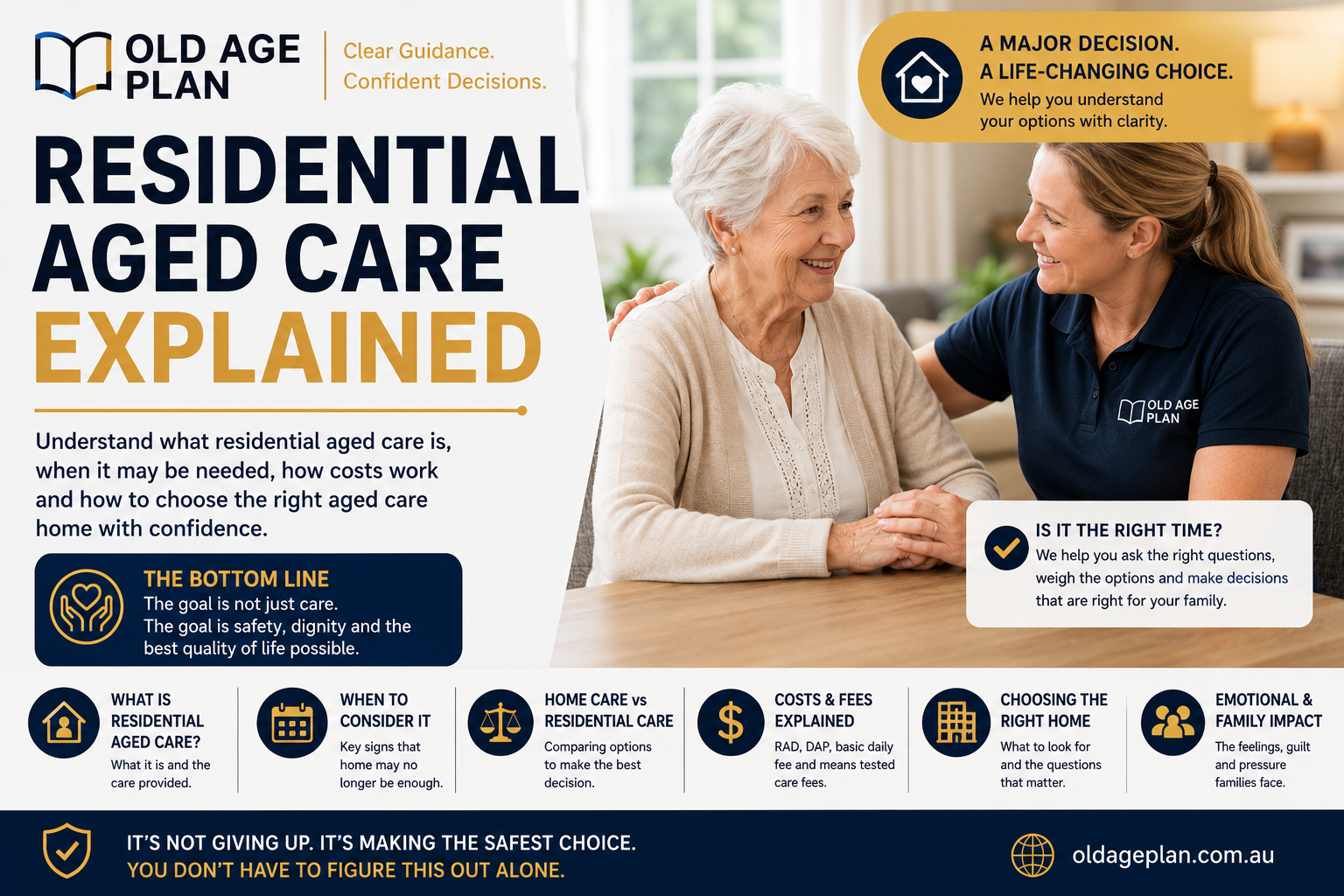

Residential Aged Care Explained
Residential aged care is usually not the first option families want to think about.
Most families begin by trying to keep someone safe at home. They organise meals, check medication, arrange appointments, manage falls, increase visits and hope home support will be enough.
But sometimes the question changes.
It is no longer only:
How do we keep Mum or Dad at home?
It becomes:
Is home still safe, realistic and sustainable?
Short Answer
Residential aged care is accommodation and care provided in an aged care home for older people who can no longer live safely or practically at home with informal support and home-based services alone.
It may provide personal care, nursing care, meals, accommodation, social support and ongoing supervision depending on the person’s needs and the aged care home.
Key Takeaway
Residential aged care is not simply a building. It is a major care decision. The central question is whether the person’s needs, risks and support requirements have reached a point where home care is no longer enough to hold the situation safely.
What Residential Aged Care Actually Is
Residential aged care means living in an aged care home where care and support are provided on an ongoing basis.
It may be considered when an older person needs more regular care, supervision or support than can realistically be provided at home.
Residential aged care may include:
- personal care, such as help with showering, dressing and toileting
- meals and daily living support
- medication support
- nursing care where needed
- mobility support
- social activities
- laundry and cleaning
- care planning and monitoring
The exact care provided depends on the person’s assessed needs, the aged care home and the care arrangements in place.
When Families Start Considering Residential Aged Care
Families usually start considering residential aged care when home no longer feels stable.
This may happen after:
- repeated falls
- hospital admission or discharge pressure
- worsening dementia or confusion
- unsafe wandering
- medication problems
- night-time risks
- carer burnout
- home care no longer being enough
- family support becoming unsustainable
Sometimes the person still wants to stay home. Sometimes the family wants that too. The problem is that wanting home to work does not always mean home is still safe enough.
Old Age Plan note: Residential aged care is often considered late because families keep adapting. By the time the question becomes unavoidable, the situation may already be under serious pressure.
Residential Care Vs Staying At Home
The decision is rarely simple.
Staying at home may preserve familiarity, routine and independence. It may also work well when risks are manageable and support can be organised properly.
Residential aged care may become more realistic when support needs are continuous, safety risks are increasing or one unpaid carer is carrying too much of the system alone.
The better question is not:
Which option sounds nicer?
It is:
Which option can safely and realistically meet the person’s needs now?
When Home Care Is No Longer Holding
This is one of the hardest points for families to recognise.
Home care can appear to be working because everyone keeps filling the gaps.
A daughter visits more often. A spouse sleeps lightly in case something happens overnight. A neighbour checks in. Paid support covers some tasks, but family quietly covers the rest.
From the outside, the person is still “at home.”
But underneath, the home care arrangement may be held together by exhaustion.
That is the dangerous point.
Not because residential aged care is automatically the answer.
Because the family may be making decisions based on the appearance of stability rather than the real support load underneath it.
Old Age Plan warning: If staying at home only works because one person is constantly rescuing the situation, the question may no longer be whether home care is preferred. It may be whether home care is still sustainable.
How Residential Aged Care Fits With My Aged Care
Government-subsidised residential aged care is accessed through My Aged Care assessment and approval pathways.
Families generally need to go through assessment before a person can access subsidised permanent residential aged care.
The broad pathway may include:
- applying through My Aged Care
- assessment of care needs
- approval for residential aged care if eligible
- understanding costs and financial obligations
- searching for suitable aged care homes
- applying to homes and considering offers
- moving into care if a place is accepted
Approval is important, but it does not choose the aged care home for you. Families still need to compare options, understand costs and decide whether a facility is suitable.
Understanding Residential Aged Care Costs At A High Level
Residential aged care costs can be confusing because there may be several different types of fees.
My Aged Care explains that people moving into permanent residential aged care may need to understand care costs, accommodation costs and whether they are eligible for government assistance with accommodation. Accommodation may be paid as a refundable accommodation deposit, a daily accommodation payment or a combination depending on the arrangement.
Broadly, costs may include:
- a basic daily fee
- care-related contributions or means-tested charges
- accommodation costs
- additional or optional service fees, where agreed
Costs depend on personal circumstances, means assessment, the aged care home and the accommodation price. Families should not rely on guesses or informal advice when making financial decisions.
Important: Residential aged care costs can affect major financial decisions. Families should check official My Aged Care information and consider qualified financial advice before committing to an aged care home.
The Biggest Mistake Families Make
The biggest mistake is waiting until residential aged care becomes a crisis decision.
Families often avoid the topic because it feels like failure.
It can feel like giving up.
It can feel like betraying the promise to keep someone at home.
So the conversation gets delayed.
Everyone keeps stretching. Everyone keeps hoping. Everyone keeps patching the gaps.
Then something happens.
A fall. A hospital admission. A wandering incident. A carer collapse. A sudden deterioration.
Now the decision has to be made quickly, emotionally and with fewer options.
That is the real danger.
Not choosing residential aged care.
Being forced to choose it under pressure because the family waited until the situation broke.
Choosing A Residential Aged Care Home
Choosing an aged care home should not be based on appearance alone.
A facility may look pleasant during a tour, but families still need to understand whether it can meet the person’s actual needs.
Questions may include:
- Can the home support the person’s care needs?
- How are medication, falls and behaviour concerns managed?
- What staffing and clinical support is available?
- How does the home communicate with families?
- What costs apply?
- What happens if care needs increase?
- How are complaints or concerns handled?
This article does not provide a full facility comparison system. That belongs in a structured decision-support resource.
What You May Really Be Trying To Decide
If you are searching for residential aged care, you may not only be asking what it is.
You may be trying to decide:
- Is it time?
- Are we failing if we consider residential care?
- Can home care still work?
- Is one carer carrying too much?
- How do we choose a safe aged care home?
- What will it cost?
- What happens if the person refuses?
- Are we waiting because home is safe, or because the decision is painful?
These are not just aged care questions. They are family decision questions.
Decision Support
The decision is not home care versus residential care in a moral sense.
It is a practical care question:
Which setting can meet the person’s needs safely, consistently and sustainably?
Residential aged care may need to be considered when:
- the person is unsafe for long periods alone
- home support is no longer enough
- carer burnout is becoming serious
- night-time supervision is needed
- dementia-related risks are increasing
- falls or medical risks are recurring
- family conflict is preventing realistic planning
Residential care may not be the next step if risks can still be managed safely at home with the right support, the person’s wishes are clear and the care arrangement remains sustainable.
The goal is not to force a move. The goal is to avoid confusing love with unsustainable care.
Old Age Plan Pathway
Different families need different support depending on where they are in the aged care pathway.
- Starting point: Use Free Tools if you are still trying to understand what has changed and what questions to ask.
- Assessment preparation: Use the My Aged Care Assessment Protection System if an assessment or reassessment is coming and support needs may be understated.
- System orientation: Use the Aged Care Starter Pack if you need to understand how residential care fits into the wider aged care system.
- Home care setup: Use the In Home Care Setup System if home support is still possible but needs to be organised more clearly.
Frequently Asked Questions
What is residential aged care?
Residential aged care is care and accommodation in an aged care home for older people who can no longer live safely or practically at home with informal care and home-based services alone.
Do you need My Aged Care approval for residential aged care?
Government-subsidised residential aged care is accessed through My Aged Care assessment and approval pathways. Families should check My Aged Care for current assessment requirements.
Is residential aged care the same as a nursing home?
Many people still use the term nursing home, but the current term commonly used in Australia is residential aged care or aged care home.
When should residential aged care be considered?
It may need to be considered when home is no longer safe, support needs are continuous, carer burnout is serious or home care cannot realistically meet the person’s needs.
Can someone with dementia move into residential aged care?
Yes, some people with dementia move into residential aged care when their needs can no longer be safely supported at home. The suitability of a home depends on the person’s needs and the facility’s ability to support them.
How much does residential aged care cost?
Costs vary. My Aged Care explains that people may need to consider care costs, accommodation costs and any additional agreed fees. Accommodation may involve refundable or daily payment arrangements depending on the person’s situation and the aged care home.
Can you choose the aged care home?
Families can search for and apply to aged care homes, but availability, approval, suitability and costs all matter. A home must also be able to meet the person’s care needs.
What if the person refuses residential aged care?
Refusal can be difficult, especially if safety concerns are increasing. Families may need to involve a GP, hospital team, aged care assessor, advocate or appropriate legal authority pathway depending on capacity, risk and urgency.
Related Old Age Plan Guides
This guide sits inside the residential aged care and My Aged Care pathway. Related guides in this series include:
- What Is My Aged Care And How Does It Work?
- How To Apply For My Aged Care
- What Is An ACAT Assessment?
- What Happens During A My Aged Care Assessment?
- Home Care Packages Explained
Next Steps With Old Age Plan
If you are still deciding whether home care can work, start by reviewing what support is already being provided and whether that arrangement is still sustainable.
If an assessment or reassessment is likely, the My Aged Care Assessment Protection System can help families avoid understating risk, dependency or caregiver load.
If you need to understand the wider aged care pathway before making major decisions, the Aged Care Starter Pack may be the best starting point. If home care is still realistic but poorly organised, the In Home Care Setup System may help structure support before residential care becomes the only option.
Sources
- My Aged Care — Aged Care Home Costs And Fees
- My Aged Care — Understanding Aged Care Home Accommodation Costs
- My Aged Care — How To Get Assessed
- My Aged Care — Find A Provider
- Department of Health, Disability and Ageing — Means Tested Fees For Residential Aged Care
- Department of Health, Disability and Ageing — Accommodation Payments And Contributions
Disclaimer
This article provides general information only. It is not legal, medical, financial or aged care advice.
Aged care laws, policies, procedures, eligibility rules, fees and service availability may change. Individual circumstances can vary significantly.
You should seek qualified professional advice where appropriate and refer to official Australian Government resources, including My Aged Care and the Department of Health, Disability and Ageing, for current information about residential aged care, fees, eligibility and service pathways.