
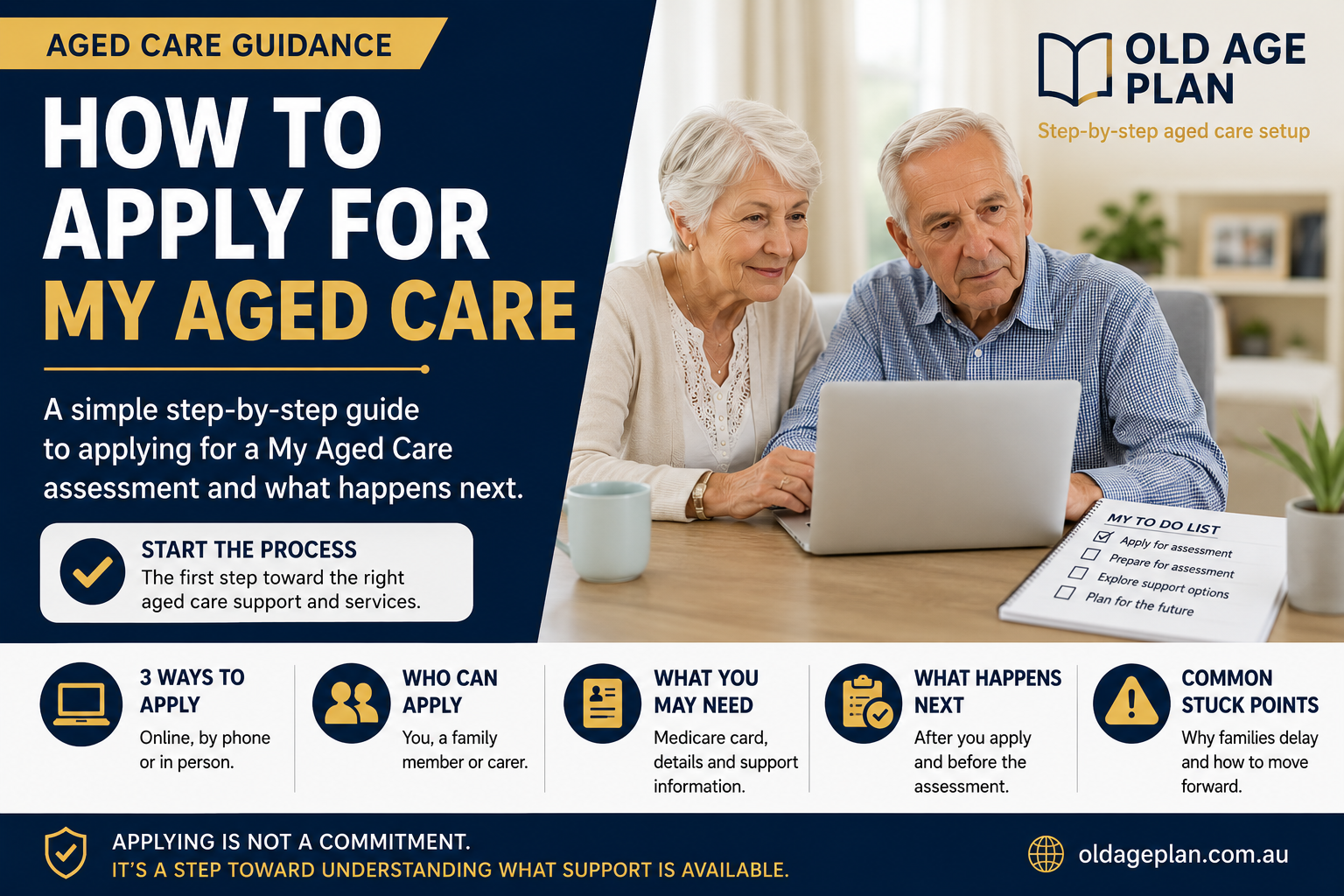

How To Apply For My Aged Care
Most families do not apply for My Aged Care because everything is neatly organised.
They apply because something has started to change. An older person may be struggling at home. A carer may be doing more than anyone realises. A hospital discharge may be approaching. Or the family may finally accept that “we’ll keep an eye on it” is no longer enough.
Applying for My Aged Care is not the same as accepting services. It is the first step toward finding out what support the person may be eligible for, what assessment pathway applies and what decisions may come next.
Short Answer
You can apply for a My Aged Care assessment online, by phone or in person. A family member, friend or carer can support the application, and with permission they may complete the application or speak on the person’s behalf.
My Aged Care says the application usually asks about the person’s current situation, the help they need and personal details such as Medicare information.
Key Takeaway
The application is not the final care decision. It starts the assessment process. The main risk is not applying too early. It is waiting until support needs become urgent, then trying to explain a complicated situation under pressure.
Before You Apply For My Aged Care
Before applying, it helps to be clear about why support may be needed.
You do not need to have every answer. But the application will be easier if the family has thought about what has changed.
Common reasons people apply include:
- falls or reduced mobility
- difficulty showering, dressing or managing personal care
- missed medication or health management problems
- difficulty cooking, eating properly or shopping
- memory changes or confusion
- carer stress or family support becoming unsustainable
- hospital discharge planning
- loneliness, isolation or difficulty attending appointments
Old Age Plan note: The first question is not “Are we ready for aged care?” It is “Has enough changed that we should find out what support may be available?”
Ways To Apply For My Aged Care
There are three main ways to apply for a My Aged Care assessment.
1. Apply online
My Aged Care says you can apply online for yourself or on behalf of someone else. You will need a Medicare card, and the application generally takes around 15 to 20 minutes.
2. Apply by phone
You can call My Aged Care on 1800 200 422. My Aged Care can talk with you about needs and complete the application while you are on the phone.
3. Apply in person
My Aged Care also refers to in-person support options. This may be useful for people who need help understanding the process or who are not comfortable applying online or by phone.
A health or aged care professional may also make an online request for an assessment on behalf of a person with consent.
Can You Apply For My Aged Care For Someone Else?
Yes. My Aged Care says a family member, friend or carer can support a person to apply online or over the phone. With the person’s permission, they may also complete the application or talk on the person’s behalf.
This matters when the older person is anxious, overwhelmed, forgetful or unsure how to explain what has changed.
But applying for someone else should still be handled carefully. Where possible, the older person should understand what is happening and be involved in the process.
Risk point: If the person refuses help but risks are increasing, the problem may not be the form. It may be disagreement, fear, capacity, safety or trust.
What Information You May Need
My Aged Care says you will need the person’s Medicare card when applying online. The application may also ask about personal details, contact details, current situation and who the assessment organisation should contact to confirm needs and arrange the assessment.
You may also need to think about:
- who should be the main contact
- whether someone should be registered as a supporter
- what help the person currently receives
- what has become harder at home
- whether language, advocacy or communication support is needed
- whether the situation is urgent
This article deliberately keeps this section high-level. A full evidence and preparation structure belongs in a proper assessment preparation tool, not inside a free application guide.
Starting the process?
Use the Old Age Plan Free Tools to begin organising what has changed, what support is already being provided and what questions need to be raised before the assessment pathway begins.
What Happens After You Apply?
After the application is complete, My Aged Care says an assessment organisation will call the person, primary contact or appointed decision-maker to discuss needs. This may include confirming eligibility, checking whether language or advocacy support is needed and arranging a time for assessment.
The application does not usually solve the support issue immediately. It starts the next stage.
That next stage may involve:
- a screening or assessment conversation
- confirmation of what type of assessment is needed
- a home or other suitable assessment appointment
- discussion of support needs and goals
- an assessment outcome or Notice of Decision
- referral information if services are approved
Risk point: Applying starts the process. It does not guarantee immediate service access. Families may still need to prepare for assessment, wait for outcomes and choose providers later.
Where Families Get Stuck When Applying
The application itself may only take a short time. The hesitation around it can last much longer.
Families often get stuck because:
- the older person says they are fine
- family members disagree about whether help is needed
- no one wants to upset Mum or Dad
- the main carer keeps saying they are coping
- the family is unsure whether the situation is serious enough
- people confuse applying with committing to services
- everyone waits for a crisis to make the decision obvious
This is where the real decision often sits.
Not in the application form.
In the family’s willingness to admit that the current arrangement may not be as stable as it looks.
When Waiting Feels Respectful But Becomes Risky
Many families wait because they do not want to take independence away.
That instinct is understandable.
But waiting is not always neutral.
If the person is missing medication, eating poorly, falling, becoming confused, relying heavily on one carer or avoiding daily tasks, delay can create a different kind of harm.
The issue is not whether someone deserves support.
It is whether the current situation is already depending on hidden rescue work that cannot continue forever.
Old Age Plan warning: If the family is only applying because the situation has finally become undeniable, the process may already be starting later than ideal.
What You May Really Be Trying To Decide
If you are searching how to apply for My Aged Care, you may not only be asking where the form is.
You may be trying to decide:
- Is it too early to apply?
- Will applying upset the older person?
- Can I apply on their behalf?
- What if they refuse help?
- What should we say about what has changed?
- Are we understating how much support is already being provided?
- What happens after we apply?
Those questions matter because applying is not just an administrative step. It is often the first time the family formally admits that support may be needed.
Decision Support
A useful way to think about the application is this:
Applying for My Aged Care is not a loss of independence. It is a request to understand available support.
That does not mean services must start immediately. It does not mean every later decision is already made. It means the family is beginning the process before the situation becomes harder to explain and harder to manage.
Consider applying when:
- daily support needs are increasing
- one carer is carrying too much
- health or memory changes are affecting safety
- hospital discharge or decline has changed the situation
- you are unsure what help may be available
- you are waiting because the conversation feels uncomfortable
Be especially careful if the older person is likely to minimise problems. The key question is not whether they can still express a preference. The real question is whether their decisions remain reliable enough for this specific decision.
Assessment pathway starting?
The My Aged Care Assessment Protection System is designed for families preparing for assessment who need to avoid understating risk, dependency or caregiver load once the process begins.
Old Age Plan Pathway
Different families need different support depending on where they are in the My Aged Care process.
- Starting point: Use Free Tools to organise what has changed before applying.
- Focused planning: Browse the $19 Planners if you need help organising one specific planning issue.
- Assessment preparation: Use the My Aged Care Assessment Protection System if the assessment pathway has started and you need to avoid understating the situation.
- System orientation: Use the Aged Care Starter Pack if you need to understand how applying fits into the broader aged care system.
- Home care setup: Use the In-Home Care Setup System if support has been approved and the next challenge is organising care at home.
Frequently Asked Questions
How do you apply for My Aged Care?
You can apply for a My Aged Care assessment online, by phone or in person. A health or aged care professional may also make a request for assessment with consent.
Can I apply for My Aged Care for my parent?
Yes. My Aged Care says a family member, friend or carer can support the person to apply, and with permission they may complete the application or speak on the person’s behalf.
Do you need a Medicare card to apply?
My Aged Care says you will need the person’s Medicare card when applying online. If applying on behalf of someone else, you will need to provide their information.
How long does the My Aged Care application take?
My Aged Care says the application generally takes around 15 to 20 minutes. Some online account steps may take less time, but families should allow enough time to explain the situation properly.
What happens after applying for My Aged Care?
An assessment organisation will usually call the person, primary contact or appointed decision-maker to discuss needs, confirm support requirements and arrange the next assessment step if appropriate.
Can someone refuse My Aged Care?
A person may refuse support, and this can be difficult if safety concerns are increasing. Families may need to speak with a GP, hospital team, aged care professional or appropriate support service if refusal creates serious risk.
Is applying for My Aged Care the same as accepting services?
No. Applying starts the assessment process. Later decisions about services, providers and care arrangements depend on assessment outcomes, eligibility and the person’s circumstances.
What if the situation is urgent?
My Aged Care says people can call 1800 200 422 if ongoing care is needed urgently or circumstances have changed unexpectedly. In an emergency, call emergency services.
Related Old Age Plan Guides
This guide sits inside the My Aged Care and assessment pathway. Related guides in this series include:
- What Is My Aged Care And How Does It Work?
- What Is An ACAT Assessment?
- What Happens During A My Aged Care Assessment?
- Home Care Packages Explained
- Residential Aged Care Explained
Next Steps With Old Age Plan
If you are just starting, begin with the Old Age Plan Free Tools and write down what has changed before applying.
If the assessment pathway has started, the strongest next step is the My Aged Care Assessment Protection System. It helps families prepare for assessment without turning serious support needs into vague or incomplete answers.
If you need broader aged care orientation, the Aged Care Starter Pack can help you understand the bigger pathway. If care has been approved and the next challenge is home support setup, the In Home Care Setup System may be the better fit.
Sources
- My Aged Care — How To Apply For An Assessment
- My Aged Care — How To Get Assessed
- My Aged Care — Apply For An Assessment Online
- My Aged Care — Preparing For Your Assessment
- My Aged Care — Registering A Supporter
- My Aged Care — Frequently Asked Questions
- My Aged Care — Help From A Care Finder
Disclaimer
This article provides general information only. It is not legal, medical, financial or aged care advice.
Aged care laws, policies, procedures, eligibility rules, fees and service availability may change. Individual circumstances can vary significantly.
You should seek qualified professional advice where appropriate and refer to official Australian Government resources, including My Aged Care, for current information about aged care assessments, eligibility and service pathways.