
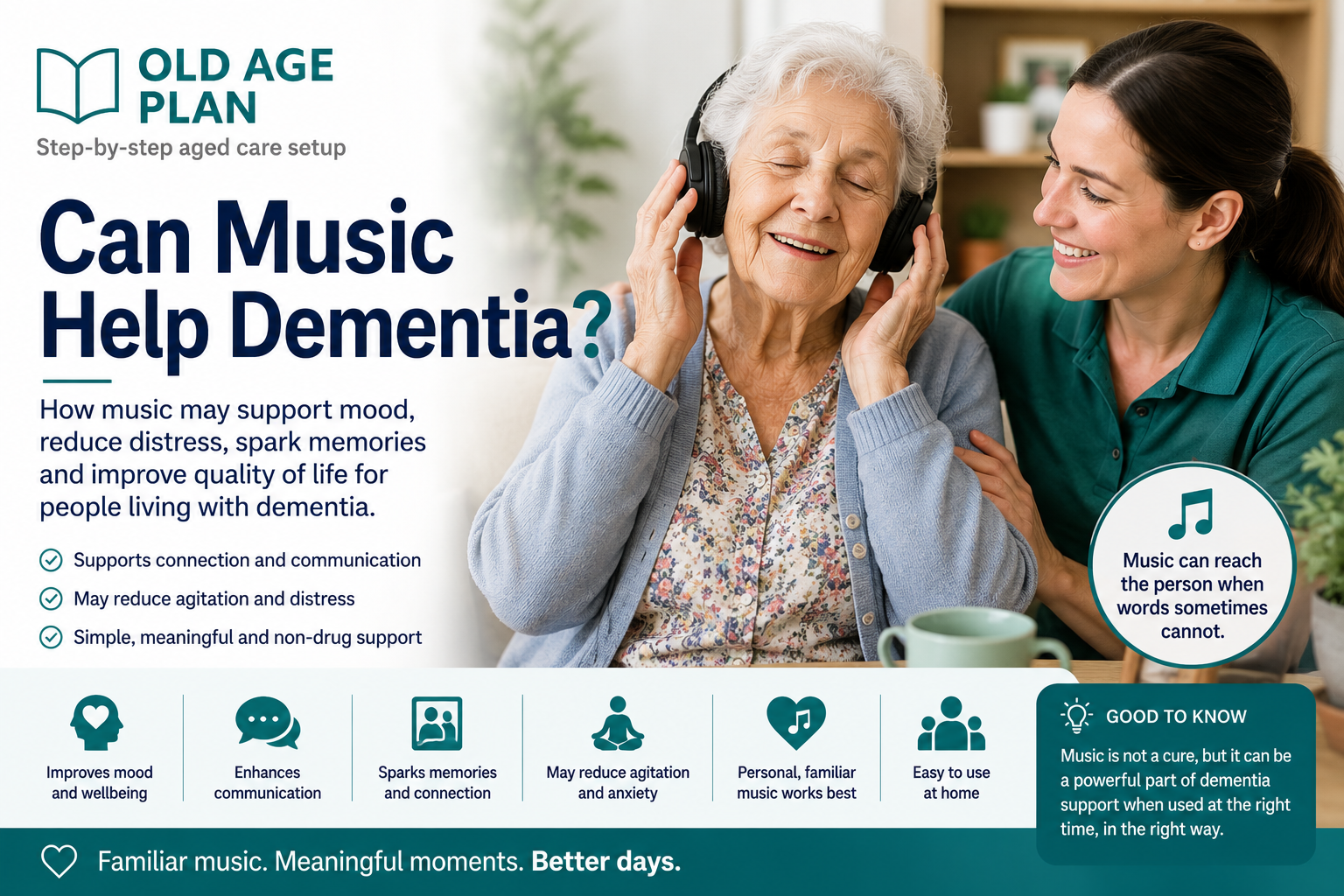

Can Music Help Dementia?
Music can sometimes reach a person with dementia when ordinary conversation becomes harder.
A familiar song may calm distress, support connection, prompt memories or help someone participate in a moment when other approaches are not working well.
Music does not cure dementia. But for some people, it can be a useful non-drug support when it is chosen carefully and used at the right time.
Short Answer
Yes, music may help some people living with dementia.
Music may support mood, communication, memory, engagement and relaxation. It may also help reduce distress or agitation for some people. The benefit depends on the person, the music chosen, the setting, the stage of dementia and whether the music is calming or overstimulating.
Key Takeaway
Music can be helpful in dementia care when it is personal, familiar and used respectfully. The goal is not to force a response. The goal is to create moments of connection, comfort, recognition or calm.
Why Music May Help
Dementia can affect memory, language, reasoning and daily function.
But music may remain meaningful for some people even when other abilities change. A song connected to earlier life, family, culture, faith, work, dancing or important memories may still feel familiar.
This can make music useful because it may support:
- emotional connection
- relaxation
- reminiscence
- communication
- routine
- participation
- identity
For families, this matters because dementia support is not only about managing symptoms. It is also about preserving the person’s sense of self where possible.
What Kind Of Music May Help?
The most useful music is usually music that has personal meaning.
This may include:
- songs from the person’s younger years
- music they used to dance to
- religious or cultural music
- songs from family events
- music linked to work, travel or hobbies
- calm instrumental music
- music the person already enjoys
Generic relaxing music may help some people, but familiar music often has stronger emotional value.
The practical question is not “What music helps dementia?”
It is:
What music matters to this person?
How Music May Support Communication
When speech becomes harder, music may offer another way to connect.
A person may hum, tap, move, smile, sing a few words or simply become more settled.
These responses may seem small, but they can be meaningful. They may show that the person is still engaging, even if they cannot explain what they are feeling.
Music may also help families spend time together without needing constant conversation.
Can Music Reduce Agitation Or Distress?
Music may reduce agitation or distress for some people, especially when the music is familiar and the environment is calm.
However, music is not automatically calming.
Some music may be too loud, too fast, unfamiliar or emotionally upsetting. A song linked to grief, loss or difficult memories may distress one person even if it comforts another.
This is why observation matters. If the person relaxes, smiles, sings, settles or becomes more engaged, the music may be helping. If they become tense, restless, tearful or irritated, the music may not be right at that time.
When Music May Be Useful
Music may be worth trying during:
- quiet afternoon periods
- personal care routines
- meal preparation
- restlessness or agitation
- family visits
- reminiscence activities
- light exercise or movement
- transition times during the day
Music may also support routine. For example, a familiar song at a certain time of day may become a gentle cue for activity, rest or connection.
When Music May Not Be Enough
Music can help, but it should not be used to ignore serious problems.
If a person with dementia is distressed, agitated or withdrawn, there may be another cause that needs attention.
Possible causes include:
- pain
- infection
- delirium
- constipation
- dehydration
- medication side effects
- fear or confusion
- too much noise
- unmet needs
- changes in routine
If distress is new, severe, repeated or unsafe, it should be discussed with a GP or appropriate health professional.
Music Therapy And Informal Music Use
There is a difference between informal music use and music therapy.
Informal music use may involve family members playing familiar songs, singing together, using playlists or including music in daily routines.
Music therapy is usually provided by a trained music therapist. It may involve structured sessions designed to support communication, mood, behaviour, memory or emotional wellbeing.
Both may have value, but they are not the same. Families do not need to turn every music moment into therapy. Sometimes the most useful thing is simply playing music the person recognises and enjoys.
How To Use Music Safely And Respectfully
Music should support the person, not overwhelm them.
Helpful principles include:
- start with familiar music
- keep the volume comfortable
- avoid too many songs at once
- watch the person’s response
- stop if the music causes distress
- avoid forcing singing or participation
- use music in calm settings where possible
- match the music to the moment
The person does not need to perform, remember lyrics or respond in a particular way. Quiet listening may still be meaningful.
What You May Really Be Trying To Decide
If you are asking whether music can help dementia, you may really be asking whether there is still a way to connect.
That question often becomes important when conversation is harder, behaviour has changed or the person seems less reachable than before.
Music may not solve every problem. But it may create moments where the person feels calmer, more familiar, more connected or more themselves.
The deeper decision may be:
What helps this person feel safe, recognised and connected right now?
Decision Support
A simple way to decide whether music is useful is to observe before, during and after.
Ask:
- Does the person seem calmer?
- Do they appear more engaged?
- Does the music trigger distress?
- Is the volume comfortable?
- Is the setting too busy?
- Is the music personally meaningful?
- Would a different time of day work better?
This avoids two common mistakes.
The first mistake is dismissing music as “just entertainment.” For some people, it may be a real support for mood and connection.
The second mistake is assuming music will always help. Like any support, it needs to fit the person and the situation.
Related Old Age Plan Articles
- What Non-Drug Treatments Help Dementia?
- Can Dementia Be Treated?
- Can Dementia Medication Slow Progression?
- What Happens After A Dementia Diagnosis?
Next Steps With Old Age Plan
If music seems to help, it may be useful to record which songs, times of day and settings work best.
Old Age Plan’s Free OAP Tools can help families organise observations, prepare questions and notice patterns before speaking with a GP, dementia support service or care provider.
The goal is not to turn music into a formal treatment plan by yourself. The goal is to understand what helps this person feel calmer, safer and more connected.
Sources
- Dementia Australia — Treatment And Management Of Dementia
- Dementia Australia — Non-Pharmacological Treatments For Dementia
- Healthdirect Australia — Dementia Overview
- NICE — Dementia Assessment, Management And Support Recommendations
- My Aged Care — Living With Memory Loss, Dementia Or Depression
Disclaimer
This article provides general information only and is not medical, legal or financial advice.
Dementia support needs vary depending on the person’s diagnosis, symptoms, health conditions, communication ability, environment and available support. Music may help some people, but it may not be suitable or effective in every situation.
Always seek advice from qualified health professionals, such as a GP, geriatrician, occupational therapist, music therapist or dementia support service, if behaviour changes, distress or care concerns are present. For current information, refer to Dementia Australia, Healthdirect, My Aged Care and relevant Australian health professionals.
Summary
Music may help some people living with dementia by supporting mood, memory, communication, relaxation and connection.
The most useful music is usually familiar and personally meaningful. It should be used gently, with attention to how the person responds.
Music is not a cure and should not replace medical or care review when distress or behaviour changes may have another cause. But used well, it can become a simple and meaningful part of dementia support.