
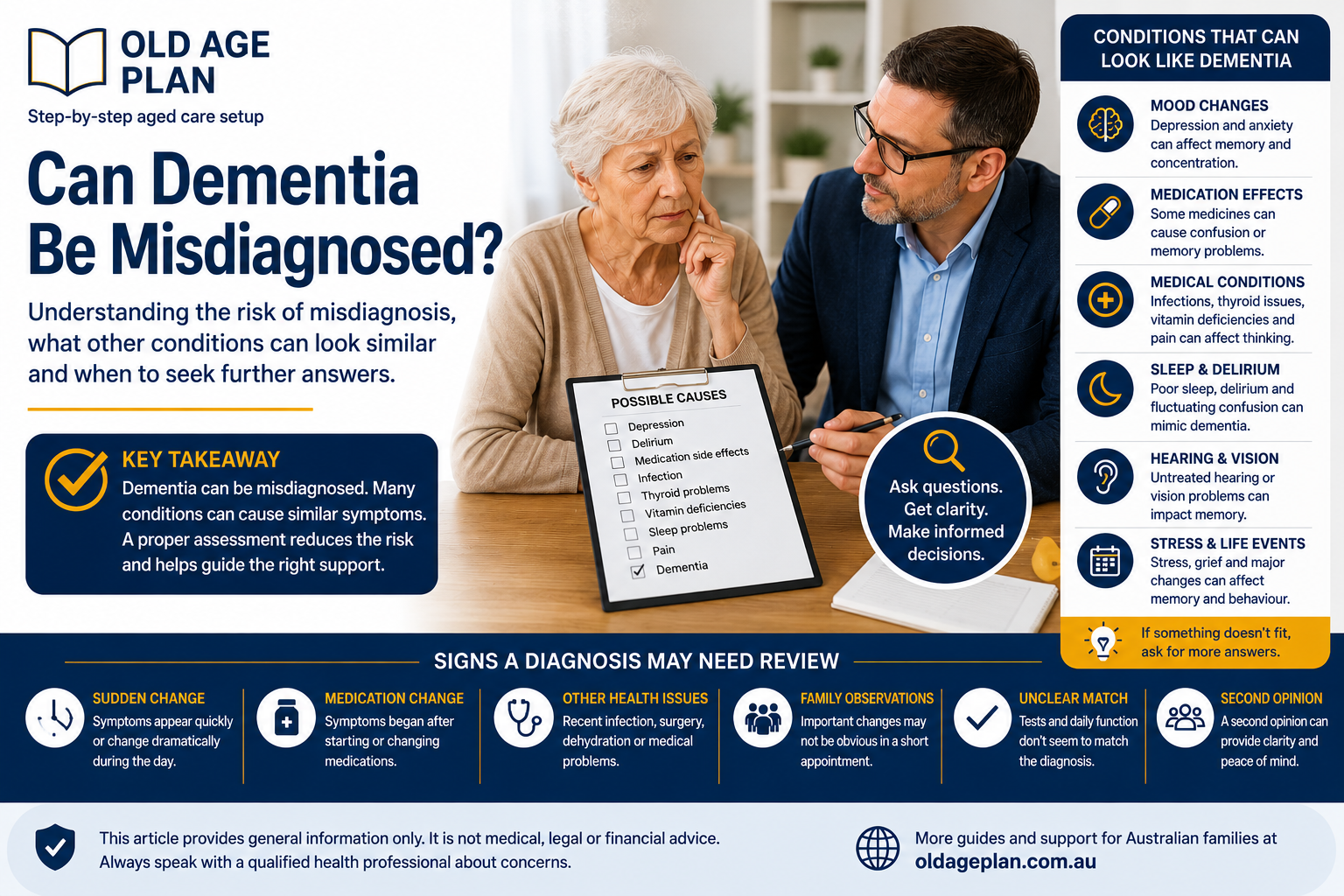

Can Dementia Be Misdiagnosed?
A dementia diagnosis can affect care, legal planning, family decisions and future support.
Can dementia be misdiagnosed?
Yes. Dementia can sometimes be misdiagnosed, especially when symptoms are mild, mixed with other health problems or caused by conditions that affect memory and thinking in similar ways.
This does not mean every diagnosis should be doubted. It means the diagnosis should be based on proper assessment, clear evidence and review when symptoms do not fit the expected pattern.
Short Answer
Dementia can be misdiagnosed because memory loss, confusion and behaviour changes can have many causes.
Depression, delirium, medication side effects, infection, sleep problems, thyroid issues, vitamin deficiencies, hearing problems and other medical conditions can sometimes look like dementia.
If the diagnosis feels unclear, symptoms changed suddenly, or the person’s condition does not match what was explained, it may be reasonable to ask further questions or seek a second opinion.
Key Takeaway
Key takeaway: Dementia diagnosis should not rely on one symptom or one quick test. If symptoms are unusual, sudden, mixed or unclear, further assessment may help reduce the risk of misunderstanding what is really happening.
Why Dementia Can Be Difficult To Diagnose
Dementia is not one single disease.
It is a group of symptoms caused by conditions that affect the brain.
Different types of dementia can affect memory, language, judgement, behaviour, movement or daily function in different ways.
Diagnosis can be especially difficult when symptoms are early, subtle or affected by other health issues.
This is why doctors usually look at more than one piece of information.
They may consider medical history, daily function, family observations, cognitive testing, blood tests, medication review, scans and specialist assessment.
Conditions That Can Look Like Dementia
Some conditions can cause dementia-like symptoms.
These may include:
- depression
- anxiety
- delirium
- infection
- dehydration
- medication side effects
- poor sleep
- pain
- thyroid problems
- vitamin deficiencies
- hearing or vision problems
- alcohol-related health issues
- stroke or other neurological conditions
Some of these conditions may be treatable or manageable.
That is why a proper assessment matters before assuming symptoms are definitely dementia.
Can Dementia Be Missed?
Yes. Dementia can also be missed, especially in the early stages.
Some people remain socially confident and conversational even while they are struggling with more complex tasks.
Others may cover memory gaps, avoid difficult tasks or rely heavily on routines.
Family members may notice changes before they are obvious during a short appointment.
This is why clear examples can be important.
A person may appear well in a consultation but still be struggling with bills, medicines, appointments, driving or decision-making at home.
Signs A Diagnosis May Need Review
A dementia diagnosis may need further review if something does not fit.
Possible reasons to ask more questions include:
- symptoms appeared suddenly
- confusion changes dramatically during the day
- symptoms began after medication changes
- there was recent infection, dehydration, surgery or hospitalisation
- mood, sleep or pain issues are significant
- test results and daily function do not seem to match
- the diagnosis was made without much assessment
- the person is much better or worse than expected
- family observations were not considered
These signs do not prove the diagnosis is wrong.
They simply suggest that further clarification may be helpful.
Can A Different Type Of Dementia Be Diagnosed Incorrectly?
Sometimes the issue is not whether dementia exists, but which type of dementia is present.
Different types of dementia can overlap in symptoms.
For example, Alzheimer’s disease, vascular dementia, Lewy body dementia and frontotemporal dementia can present differently, but real-life symptoms may not always be neat or obvious.
The likely type may affect treatment, planning, safety issues and what families should watch for.
If symptoms are unusual or changing in unexpected ways, specialist review may be useful.
Why Family Observations Matter
Family observations can help reduce diagnostic uncertainty.
A doctor may only see the person for a short time.
Family members may notice patterns across weeks, months or years.
Useful examples may include:
- missed bills or appointments
- repeated questions
- medication mistakes
- getting lost
- changes in judgement
- difficulty using familiar appliances
- changes in hygiene, meals or routines
- new vulnerability to pressure or scams
Specific examples are more useful than general statements such as “something is wrong”.
Should You Challenge A Dementia Diagnosis?
It is reasonable to ask questions about a diagnosis.
That does not mean being difficult or refusing to accept medical advice.
It means understanding what evidence was used and whether other causes were considered.
Useful questions may include:
- What evidence supports the diagnosis?
- What other causes were ruled out?
- Were medicines reviewed?
- Were blood tests or scans needed?
- What type of dementia is suspected?
- How certain is the diagnosis?
- Should symptoms be reviewed again over time?
- Would specialist assessment be useful?
These questions can help families understand the diagnosis without turning the appointment into a confrontation.
When A Second Opinion May Be Helpful
A second opinion may be worth considering when the diagnosis is unclear, symptoms are unusual, or major decisions depend on the result.
This may be especially relevant if the diagnosis affects:
- driving
- living alone
- work
- legal documents
- financial decisions
- care arrangements
- residential aged care planning
A second opinion does not always change the diagnosis.
But it may confirm the diagnosis, clarify the type of dementia or identify other factors that need attention.
Why Misdiagnosis Matters For Future Decisions
A dementia diagnosis can influence many decisions beyond medical care.
It may affect legal planning, financial arrangements, family roles, home support, care services and safety planning.
If the diagnosis is wrong, unclear or incomplete, families may make decisions too early, too late or in the wrong direction.
Old Age Plan’s approach is to avoid both extremes.
Do not dismiss concerning symptoms.
Do not rush into major decisions without enough evidence.
The aim is to understand the diagnosis well enough to make the next decision more safely.
What A Wrong Diagnosis Can Trigger
A dementia diagnosis does not only affect medical records.
It can change how family, providers and institutions respond to the person.
A wrong or incomplete diagnosis may lead to decisions such as:
- stopping driving earlier than necessary
- activating Enduring Power of Attorney too soon
- reducing independence unnecessarily
- moving toward aged care before support at home is properly explored
- changing financial control or legal authority
This is why diagnostic confidence matters.
The cost of a wrong diagnosis is not only emotional.
It can permanently change future decision pathways.
What You May Really Be Trying To Decide
Many people asking whether dementia can be misdiagnosed are trying to decide whether they can trust what they have been told.
The real questions may be:
- Could this be something treatable?
- Did the doctor check enough?
- Should we ask for more tests?
- Should we see a specialist?
- Should we get a second opinion?
- Can we make legal or care decisions based on this diagnosis?
These are sensible questions.
A diagnosis should create clarity, not leave the family guessing about whether important causes were missed.
Decision Support Questions
If you are unsure about a dementia diagnosis, it may help to ask:
- Was the change sudden or gradual?
- Were other possible causes checked?
- Were medicines reviewed?
- Were family observations included?
- Does the diagnosis match what is happening day to day?
- Are symptoms improving, worsening or fluctuating?
- Are major legal, financial or care decisions depending on this diagnosis?
- Would a second opinion reduce uncertainty?
If major decisions depend on the diagnosis, it is reasonable to seek more clarity before acting.
Related Old Age Plan Articles
- How Is Dementia Diagnosed?
- What Happens After A Dementia Diagnosis?
- Can Delirium Be Mistaken For Dementia?
- Can Medication Cause Confusion In Older Adults?
- Can Depression Cause Dementia-Like Symptoms?
- What Tests Are Used To Check Memory Problems?
Sources
- Dementia Australia — Dementia testing and diagnosis
- healthdirect Australia — Tests used in diagnosing dementia
- healthdirect Australia — Dementia overview
- Better Health Channel — Dementia
- Better Health Channel — Conditions that can lead to dementia
Disclaimer
This article provides general information only. It is not medical, legal or financial advice. Dementia diagnosis and cognitive concerns should be assessed by qualified health professionals. If symptoms appear suddenly, worsen quickly or safety is at risk, seek urgent medical help.
Summary
Dementia can be misdiagnosed because memory loss, confusion and behaviour changes can have many possible causes.
Some conditions can look like dementia, while early dementia can also be missed or difficult to recognise.
If symptoms are sudden, unusual, unclear or major decisions depend on the diagnosis, asking further questions or seeking a second opinion may help families make safer decisions.