
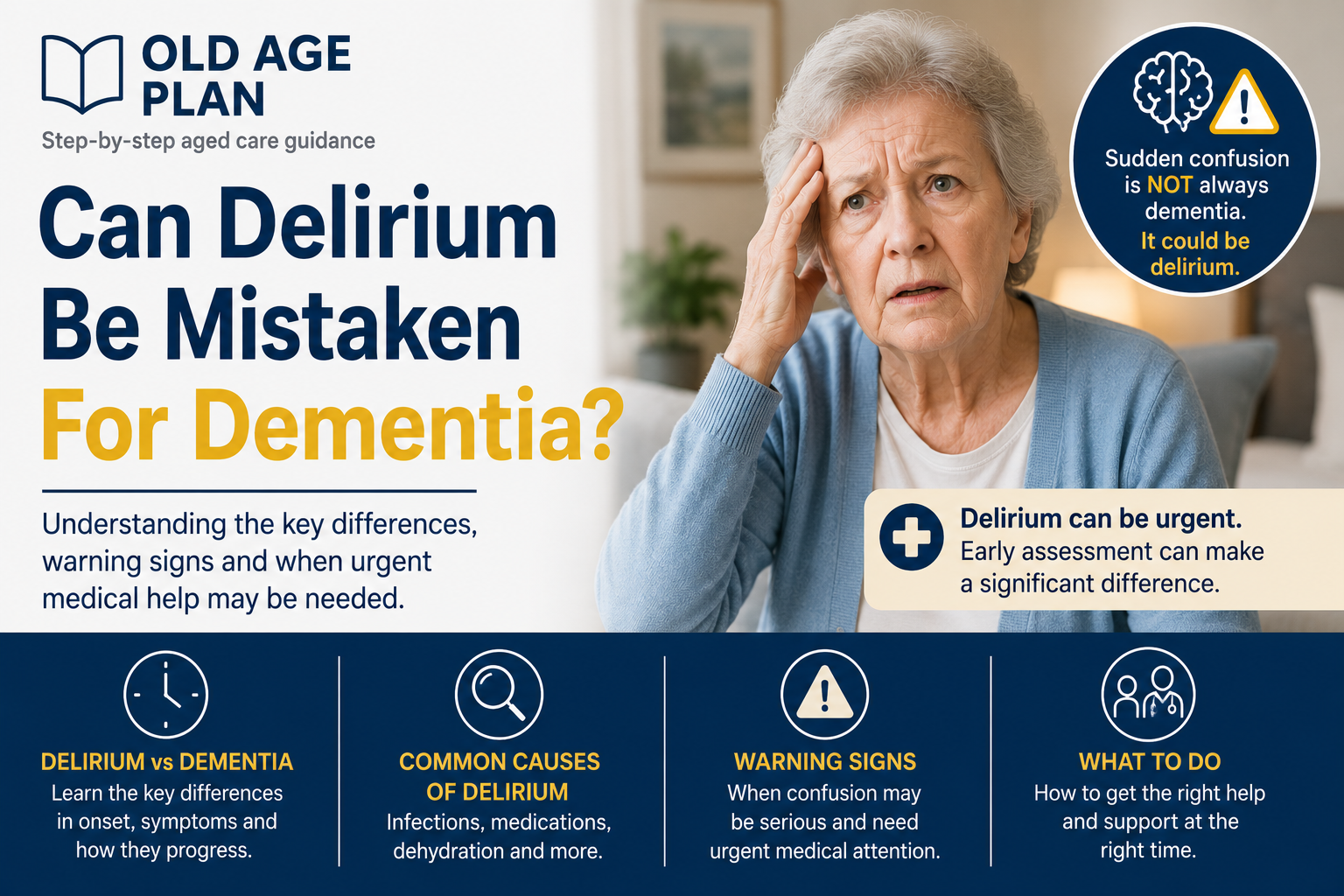

Can Delirium Be Mistaken For Dementia?
Sudden confusion in an older adult can be frightening, especially if family members wonder whether dementia has appeared or rapidly worsened.
Can delirium be mistaken for dementia?
Yes. Delirium can be mistaken for dementia because both can affect memory, thinking, attention, behaviour and communication.
However, delirium is usually more sudden and may be linked to illness, infection, medication changes, dehydration, surgery or hospitalisation. It should be treated as a medical concern, not simply as normal ageing.
Short Answer
Delirium can be mistaken for dementia, especially when an older person suddenly becomes confused, disoriented, sleepy, agitated or unable to follow conversations.
The major difference is timing. Dementia usually develops gradually, while delirium often appears quickly over hours or days and may fluctuate during the day.
Sudden confusion should be checked urgently because delirium can be caused by serious but sometimes treatable medical problems.
Key Takeaway
Key takeaway: Sudden confusion should not be assumed to be dementia. Delirium can look similar, but it often needs urgent medical assessment because the cause may be treatable or serious.
What Is Delirium?
Delirium is a sudden change in thinking, attention, awareness or behaviour.
It is more common in older adults, especially during illness, after surgery or during a hospital stay.
A person with delirium may seem confused, restless, unusually sleepy, frightened, withdrawn or unable to focus.
They may also seem better at one time of day and worse later.
This changing pattern is one reason delirium can be missed or mistaken for dementia.
Why Delirium And Dementia Are Often Confused
Delirium and dementia can both affect memory, communication and daily function.
From the outside, family members may notice:
- confusion
- forgetfulness
- repeating questions
- difficulty following conversations
- changes in behaviour
- poor attention
- unusual sleepiness or agitation
The confusion happens because the symptoms overlap.
The decision problem is that the next step may be very different.
Dementia usually needs assessment, planning and ongoing support.
Delirium may need urgent medical review to identify and treat the underlying cause.
Key Difference: Sudden Change Matters
The clearest warning sign is sudden change.
If an older person becomes confused over hours or days, delirium should be considered.
This is especially important if the person was thinking and communicating more clearly before the change.
Dementia usually develops gradually over time.
Delirium often develops quickly and may fluctuate.
That means the person may seem clear in the morning, confused in the afternoon and very unsettled overnight.
Common Causes Of Delirium
Delirium can have many possible causes.
These may include:
- infection
- dehydration
- pain
- constipation
- medication side effects
- medication changes
- alcohol withdrawal
- poor sleep
- surgery or anaesthetic
- hospital admission
- low oxygen levels
- changes in blood sugar or other body chemistry
Sometimes more than one factor is involved.
This is why medical review matters.
Can Someone Have Both Dementia And Delirium?
Yes. A person can have dementia and delirium at the same time.
In fact, people living with dementia may be more vulnerable to delirium during illness, hospitalisation, infection or medication changes.
This can make the situation harder to judge.
A sudden worsening should not simply be assumed to be “the dementia getting worse”.
The more useful question is:
Has there been a sudden change from this person’s usual level of thinking, alertness or behaviour?
If yes, delirium or another acute medical issue should be considered.
When To Seek Urgent Medical Help
Urgent medical help may be needed if confusion appears suddenly or worsens quickly.
This is especially important if confusion appears with:
- fever or signs of infection
- new weakness or speech problems
- falls or head injury
- severe sleepiness
- hallucinations or unusual beliefs
- severe agitation
- new incontinence
- poor fluid intake
- recent surgery or hospitalisation
- recent medication changes
If safety is at risk, seek urgent medical advice rather than waiting to see if it settles.
Why It Is Risky To Assume It Is Dementia
Assuming sudden confusion is dementia can delay treatment.
That delay may matter if the cause is infection, dehydration, medication reaction, stroke, injury or another acute problem.
At the same time, assuming delirium means “nothing long-term is happening” can also be risky.
Some people recover from delirium but still need follow-up if memory, thinking or function do not return to their previous level.
The balanced approach is to treat sudden confusion as something that needs checking now, then review what remains after the acute issue is managed.
What A Doctor May Need To Know
When seeking medical help, it can be useful to explain what has changed and when it started.
Important details may include:
- when the confusion began
- whether it came on suddenly
- whether symptoms fluctuate during the day
- recent infections, falls, surgery or hospital stays
- recent medication changes
- fluid intake and eating patterns
- sleep changes
- what the person’s usual thinking was like before
This information helps clinicians compare the current behaviour with the person’s normal baseline.
What You May Really Be Trying To Decide
Many families asking this question are trying to work out whether a sudden change means permanent decline.
The real questions may be:
- Is this dementia?
- Is this a medical emergency?
- Could this be temporary?
- Should we go to hospital?
- Has dementia suddenly worsened?
- What should we do if the person is unsafe?
The safest decision is not to guess from symptoms alone.
If confusion appears suddenly, seek medical advice quickly.
Decision Support Questions
Before deciding what to do next, ask:
- Did the confusion appear over hours or days?
- Is the person much different from their usual self?
- Does the confusion come and go during the day?
- Have they recently been unwell?
- Have medicines changed?
- Have they had a fall, surgery or hospital admission?
- Are they safe to be alone right now?
If the answer to several questions is yes, urgent medical review is usually the safer option.
Related Old Age Plan Articles
- Can Medication Cause Confusion In Older Adults?
- When Should Memory Loss Be Checked?
- When Should You See A Doctor About Memory Problems?
- Can Depression Cause Dementia-Like Symptoms?
- Can Anxiety Cause Memory Problems?
- How Is Dementia Diagnosed?
Sources
- healthdirect Australia — Delirium
- healthdirect Australia — Confusion
- Better Health Channel — Delirium
- Victorian Department of Health — Differential diagnosis: depression, delirium and dementia
- Dementia Australia — Early warning signs of dementia
Disclaimer
This article provides general information only. It is not medical, legal or financial advice. Delirium, dementia and confusion can have different causes, and individual circumstances vary. If confusion appears suddenly, worsens quickly or safety is at risk, seek urgent medical help.
Summary
Delirium can be mistaken for dementia because both can affect memory, thinking, behaviour and communication.
The major warning sign is sudden change. Dementia usually develops gradually, while delirium often appears quickly and may fluctuate during the day.
If an older person becomes suddenly confused, it is safest to seek medical advice quickly rather than assuming it is dementia or normal ageing.